









- bhavya gada
- No Comments
If you live in Maryland, the best way to plan a native garden is to use Maryland-based guides first, then match plants to your yard’s sun, soil, moisture, and deer pressure. That means starting with statewide plant lists, then moving to pollinator templates, rain garden guides, and county programs if your site needs more detail.
Here’s the short version:
- Use UMD Extension guides for plant shortlists, ecoregion filters, and bed ideas
- Use Maryland DNR lists to sort by bloom time, light, and moisture
- Use central Maryland pollinator templates for ready-to-plant layouts
- Use rain garden and Bay-Wise tools if runoff, soggy areas, or drainage are part of the job
- Check deer pressure, mature size, and bloom timing before you buy plants
A few numbers stand out:
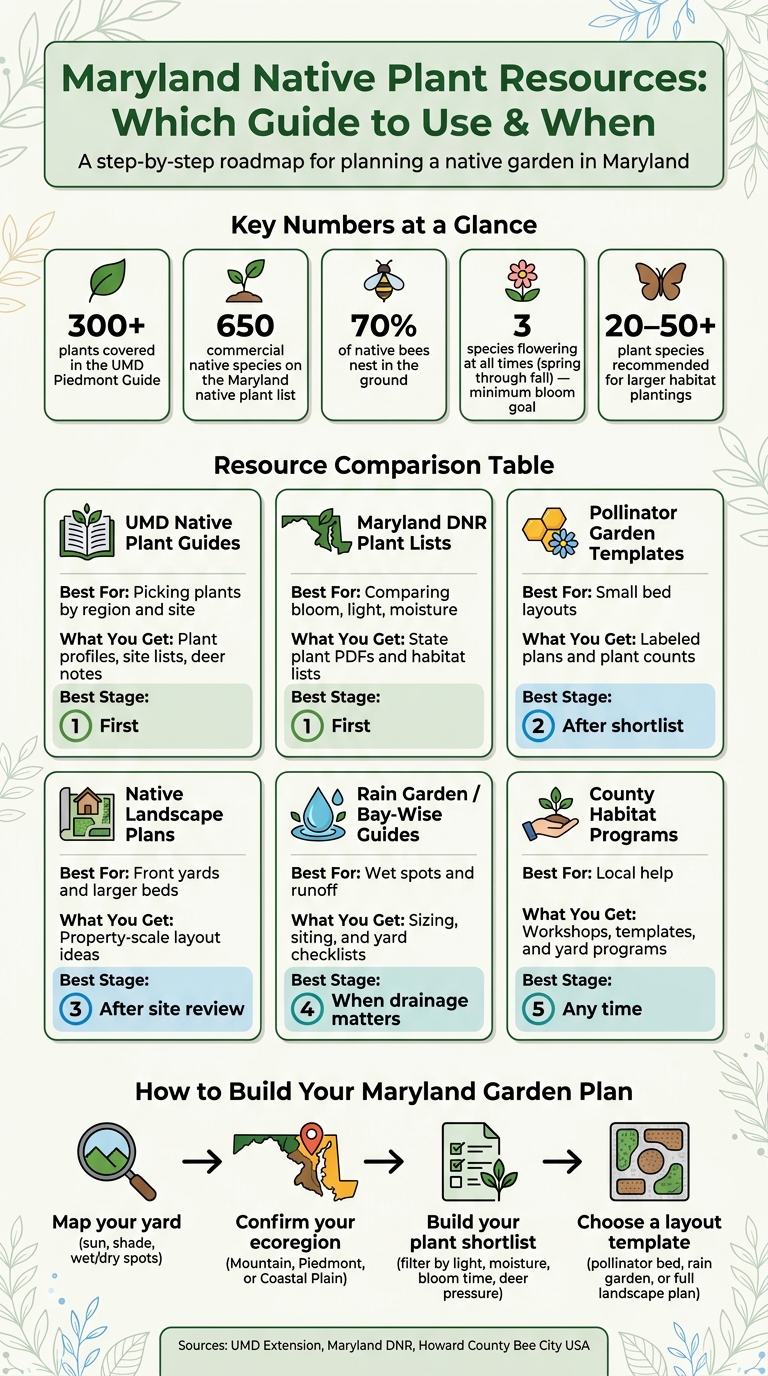
- The UMD Piedmont guide covers 300+ plants
- The Maryland native plant list includes about 650 commercial native species
- DNR pollinator plans suggest 20–50 species or more for larger habitat plantings
- A simple bloom goal is 3 species flowering at all times from spring through fall
- About 70% of native bees nest in the ground
Maryland Native Plant Resources: Which Guide to Use & When
Filling your garden with native Maryland plants could
sbb-itb-843f8be
Quick comparison
| Resource type | Best for | What you get | Best stage to use it |
|---|---|---|---|
| UMD native plant guides | Picking plants by region and site | Plant profiles, site lists, deer notes | First |
| Maryland DNR plant lists | Comparing bloom, light, moisture | State plant PDFs and habitat lists | First |
| Pollinator garden templates | Small bed layouts | Labeled plans and plant counts | After shortlist |
| Native landscape plans | Front yards and larger beds | Property-scale layout ideas | After site review |
| Rain garden / Bay-Wise guides | Wet spots and runoff | Sizing, siting, and yard checklists | When drainage matters |
| County habitat programs | Local help | Workshops, templates, and yard programs | Any time |
I’d use this article as a simple roadmap: start with the plant lists, narrow by ecoregion and site conditions, then move into layout plans only after you know what your yard can support.
Statewide Maryland Native Plant Lists and Reference Guides
Maryland’s statewide native plant guides do different things. Some are fast shortlists. Some give you deep plant profiles. Others are built around habitat goals. A simple way to work is this: start with the statewide guides, then narrow your options based on your yard’s light, soil moisture, and space before you map out a planting plan.
University of Maryland Extension Native Plant Guides

The best in-depth guide is the Maryland Native Plant Guide: Piedmont Region from the University of Maryland Extension’s Maryland Native Plants Program. This free PDF runs about 180 pages and covers more than 300 plants with photos, descriptions, and site-based plant lists for spots like dry slopes, moist low areas, and ponds or aquatic edges.[6][15]
It also includes articles on design choices, invasive species control, climate-change planting approaches, and deer issues.[6] The current volume covers Maryland’s Piedmont region, with Mountain and Coastal Plain volumes to follow.[15][5] If you live in central Maryland counties like Howard, Baltimore, or Montgomery, you’re in the Piedmont coverage area.[6][2]
UMD Extension also keeps a Recommended Native Plants for Maryland webpage. Think of it as the fast version: a short plant list grouped by type, including trees, shrubs, grasses, and perennials.[7][3] From there, you can move into ready-made pollinator layouts.
Maryland DNR Recommended Plant Lists
Maryland DNR has two statewide guides that help with bloom timing, site conditions, and habitat use. The Native Plants of Maryland PDF sorts species by bloom period, light, and moisture tolerance, which makes side-by-side comparison much easier.[10][16] Native Plants for Wildlife Habitat and Conservation Landscaping: Chesapeake Bay Watershed leans more toward buffers, slopes, and wetland edges.[11][9][13]
DNR also has shorter specialty lists. These include shade-loving perennials for birds, butterflies, and wildlife, along with a Create Your Own State Park Native Plant List for sun-loving perennials.[14][12] These are handy when you’re planting one bed or one zone instead of reworking the whole yard.
| Resource | Publisher | Format | Geographic Scope | Best Use |
|---|---|---|---|---|
| Maryland Native Plant Guide: Piedmont Region | University of Maryland Extension / Maryland Native Plants Program | Free PDF; hard copy available | Piedmont ecoregion | Detailed profiles and site matching |
| Recommended Native Plants for Maryland | University of Maryland Extension | Webpage | Statewide | Quick homeowner shortlist |
| Native Plants of Maryland | Maryland DNR | Statewide | Bloom, light, and moisture filtering | |
| Native Plants for Wildlife Habitat and Conservation Landscaping: Chesapeake Bay Watershed | Maryland DNR | Chesapeake Bay Watershed | Wildlife habitat and buffer planting | |
| DNR specialty native plant lists | Maryland DNR | PDF lists | Maryland | Sun/shade specialty lists |
Once you have a shortlist, the next move is to turn it into a bloom sequence and a site plan. Use these guides to narrow your plant options, then move on to garden templates and layout plans.
How to Pick the Right Statewide Guide
The best guide depends on the size of the job. For a small pollinator patch or a few shrub swaps, start with UMD’s Recommended Native Plants for Maryland webpage.[7][3] It’s fast, simple, and easy to scan.
If you’re reworking a bigger space – like several beds, a rain garden, or a sloped backyard – go straight to the full Piedmont guide. Its site-condition lists and design articles give you enough detail to sort plants by light, moisture, and bloom season, then combine species that fit the same space.[6]
It also helps to pair that guide with DNR’s Native Plants of Maryland PDF when you want to compare bloom timing or habitat role across a larger species list.[10][9]
Maryland Pollinator Garden Templates and Ready-Made Plans
Plant lists tell you what to grow. Templates help you figure out where it goes. That makes them most useful after you’ve narrowed down your species list, but before you get into a site-by-site layout.
UMD Extension Pollinator Garden Templates for Central Maryland
The University of Maryland Extension shares central Maryland pollinator garden templates grouped by sun and moisture conditions. The available PDF layouts cover Sunny and Dry, Sunny and Moist, Part Sun and Dry, Part Sun and Moist, Shade, and Wet.[17][20]
Each PDF comes with a labeled plan, plant labels, and plant counts, so you can use it as a buildable layout instead of just a rough sketch.[17][20] These templates were first developed by Howard County Bee City USA / Live Green Howard and later shared through UME.[30][17][24]
County Pollinator Plans from Howard and Baltimore County Programs
Howard County’s Native Plant Pollinator Garden Design Templates go a bit further. They include labeled diagrams, bloom-time notes, markers for deer-resistant/resilient plants, and guidance on how to scale the plans. The Shade Garden for Pollinators template, for example, shows how to scale the design down by cutting each species count.[19]
Howard County also offers a plants for pollinators spreadsheet with a broader set of flowers, shrubs, trees, vines, and grasses that help butterflies, bees, hummingbirds, and birds in the Maryland Piedmont.[22] That extra list makes it easier to shrink a plan without stripping out the layers that make the habitat work.
One small detail from the Howard County material matters a lot: leave some bare soil. About 70% of native bees nest in the ground.[25]
Baltimore County’s "How to Attract Pollinators" guide takes a different angle. Instead of giving you a bed diagram, it focuses on planting strategy: group each species in larger drifts so pollinators can find them more easily, lean on mostly perennials for lower upkeep, and skip invasives and nectar-poor hybrids.[8] In plain terms, it’s a good add-on when you’re using a Howard County or UME template and want help fine-tuning plant choices.
| Resource | Diagrams | Plant List | Site Conditions | Best Fit |
|---|---|---|---|---|
| UME Central MD Pollinator Templates | Yes | Yes | Sunny/Part Sun × Dry/Moist/Wet | Small beds and residential borders |
| Howard County Bee City / Live Green Howard | Yes | Yes (+ spreadsheet) | Shade and other residential site types | Residential beds and specialty layouts |
| Baltimore County "How to Attract Pollinators" | No | General recommendations | Broad residential guidance | Supplemental planting guidance |
| Maryland DNR Pollinator Habitat Plan | No | Diversity criteria | Habitat-level criteria | Meadow-style or habitat gardens |
Pollinator Habitat Plans for Season-Long Bloom
If you’re planning a larger habitat planting, Maryland DNR’s Pollinator Habitat Plan sets a broader target. It recommends 20–50 plant species or more, with at least 10 food plants that provide nectar or pollen, and a design where flowering periods cover at least 80% of the growing season.[26]
A simpler minimum target comes from the Maryland Pollinator Protection Plan: aim for at least three plant species in bloom at all times from early spring through late fall.[27][28]
The easiest way to reach that mark is to mix perennials, shrubs, and trees instead of leaning on just one plant group. Early bloomers, summer perennials, and fall flowers can overlap to keep nectar and pollen available through the season.[21][23] DNR also recommends using a range of flower colors – red, blue, purple, yellow, and orange – since different pollinators respond to different colors. A one-color planting tends to pull in a narrower mix of species.[26]
For spacing in larger plantings, Chesapeake Bay Trust guidance suggests about 1 foot between perennials, 5–7 feet between shrubs, and about 10 feet between mixed trees and shrubs.[29] Those spacing targets make the most sense when you pair them with a site-specific layout.
Use these templates after you have a plant shortlist and before you pick a front-yard, rain-garden, or Bay-Wise layout.
Native Landscape Plans for Front Yards, Rain Gardens, and Bay-Friendly Homes
For bigger projects, it helps to move past simple plant lists and use a full landscape plan that shows where each bed should go on the property. Plant lists and pollinator templates are a good starting point, but some yards need a clearer view of the whole setup, including beds, borders, drainage, and how the yard works day to day.
UMD Native Landscape Designs for Residential Beds and Borders
UMD Extension native landscape designs give homeowners a ready-made layout for foundation beds, front-yard curb appeal plantings, and beds and borders built mostly with Maryland natives.[4] UME recommends aiming for at least 70% native plants by species count to better support native beneficial insects and birds.[4]
The main idea is simple: keep the layered structure, scale the bed to fit your site, and swap in Maryland-native substitutes that have a similar height and bloom time.
Rain Garden Guides for Runoff and Wet Areas
For wet spots and runoff, it makes sense to switch from ornamental layouts to rain-garden plans built to handle water first. If your yard has a soggy low area, a downspout that sends water across the lawn, or a driveway that pushes water toward the house, a rain garden is often a smart fix.
UME’s Rain Gardens Across Maryland guide includes county-specific rainfall depth data tied to Maryland stormwater design criteria, which helps homeowners size a basin correctly for their area.[34] Most rain garden guides also include cross-section diagrams, soil infiltration tests, and sizing formulas tied to a roof or driveway area.
Howard County materials add setback, ponding-depth, and sizing guidance tied to impervious area.[32]
Bay-Wise and Chesapeake Bay Habitat Planning Resources
For whole-yard planning, Bay-Wise works best as a checklist instead of a bed-by-bed planting guide. The UMD Extension Bay-Wise Yardstick looks at the yard as a whole: native plant coverage, mulching practices, stormwater management, fertilizer use, and buffers near storm drains and water bodies. It connects those practices to water quality by promoting precipitation capture, native plants, a smaller lawn footprint, and protective buffers.[33][31]
Bay-focused guides also lean toward layered planting and less turf to support habitat and water quality.
| Plan Type | Best Property Use | Diagrams | Addresses |
|---|---|---|---|
| UME native landscape design | Front yards, foundation beds, backyard borders | Yes | Habitat (primary), secondary runoff benefits |
| UME rain garden guide | Downspout runoff, soggy lawn areas, stormwater capture | Yes | Both habitat and runoff control |
| Howard County rain garden guidance | County homeowners needing sizing and siting rules | Yes | Runoff control (primary), habitat support |
| Bay-Wise Yardstick | Whole-yard conservation landscaping | Checklist-based | Both habitat and runoff control |
| Chesapeake Bay habitat guides | Suburban yards, buffers, restoration-minded gardens | Yes | Habitat (primary), water-quality co-benefits |
When drainage or slope makes the plan harder to sort out, professional help can turn these guides into a layout you can actually build. For slope, drainage, or foundation issues, Pro Landscapes MD can pair native planting with drainage and hardscaping solutions across central Maryland.
How to Turn These Resources Into a Maryland Garden Plan
A Simple Order for Using Guides Before Planting
After you’ve gone through the plant lists and templates above, turn that research into a plan by starting with your site. Map the areas with full sun, part sun/part shade, and shade. Then note puddling, dry spots, and runoff from downspouts.[4] That step matters more than people think. A plant can be a good fit for Maryland and still fail if it lands in the wrong spot.
Once you know what your yard is doing, confirm your Maryland ecoregion – Mountain, Piedmont, or Coastal Plain – and open the matching UMD Native Plant Guide.[4] From there, use the guide filters to make a shortlist. Before you lock anything in, check mature size and deer pressure.[4] That helps you avoid a bed that looks good on paper but turns into a crowded mess or a deer buffet a few months later.
Build each bed with a small mix of layers that fit the space. Think in terms of structure: taller plants in back or center, mid-height plants around them, and lower plants along edges. Then cross-check bloom time so the bed still has color and interest through the season.
When Professional Landscape Help Makes Sense
Some projects are simple enough to handle with a template. Others need more than a plant list and a shovel.
If drainage, slope, or current hardscape makes the plan harder to sort out, get help before planting. That’s often the smart move when you’re converting a large front lawn into layered native beds, fixing a grading issue that sends water toward your foundation, or trying to fit a rain garden around a patio or walkway. In those cases, layout and grading can work against each other fast.
Pro Landscapes MD can handle design, grading, drainage, planting, and hardscaping together.[35]
Key Maryland Native Plant Resources to Start With
Bookmark these core resources first: the UMD ecoregion guides, Maryland DNR’s Native Plants of Maryland, UMD landscape designs, and Howard County pollinator templates.[1][2][4][18]
Use each one for a different job:
- Use plant lists to choose species
- Use templates to shape the layout
- Use rain-garden or Bay-Wise guides only when water management is part of the site[4][21]
That way, you’re not trying to force one guide to answer every part of the project.
FAQs
Which Maryland native plant guide should I start with?
Start with the University of Maryland Extension. Its Pollinator Gardens page is a strong first stop, with Maryland-specific plant lists, garden layout ideas, and seasonal care tips.
You can also use the Maryland Plant Atlas to check which species are native to your ecoregion. If you want help pulling the plan together, free site-specific garden templates can make the project a lot easier to map out.
How do I choose native plants for my yard conditions?
Start by looking at your yard’s soil, sunlight, and moisture. In Maryland, conditions can change a lot from one place to another. Some areas have rocky mountain soil, central parts often have heavy clay, and the Eastern Shore tends to have sandy soil. That’s why plant choice matters so much. The closer the match between the plant and the site, the better your results.
Pay attention to how much sun each part of the yard gets during the day, and notice where water tends to sit or drain off fast. It also helps to check your local ecoregion and USDA hardiness zone so you can pick native plants that are more likely to do well in your space.
When should I use a rain garden or Bay-Wise guide?
Use a rain garden guide if your yard has places where water tends to pool, like low spots or areas near downspouts.
Rain gardens are planted areas that soak up stormwater runoff from roofs and driveways. They can help cut polluted runoff and are a smart fit for soggy ground or spots that stay wet, especially when you use water-tolerant native plants.
Chat with Us