









- bhavya gada
- No Comments
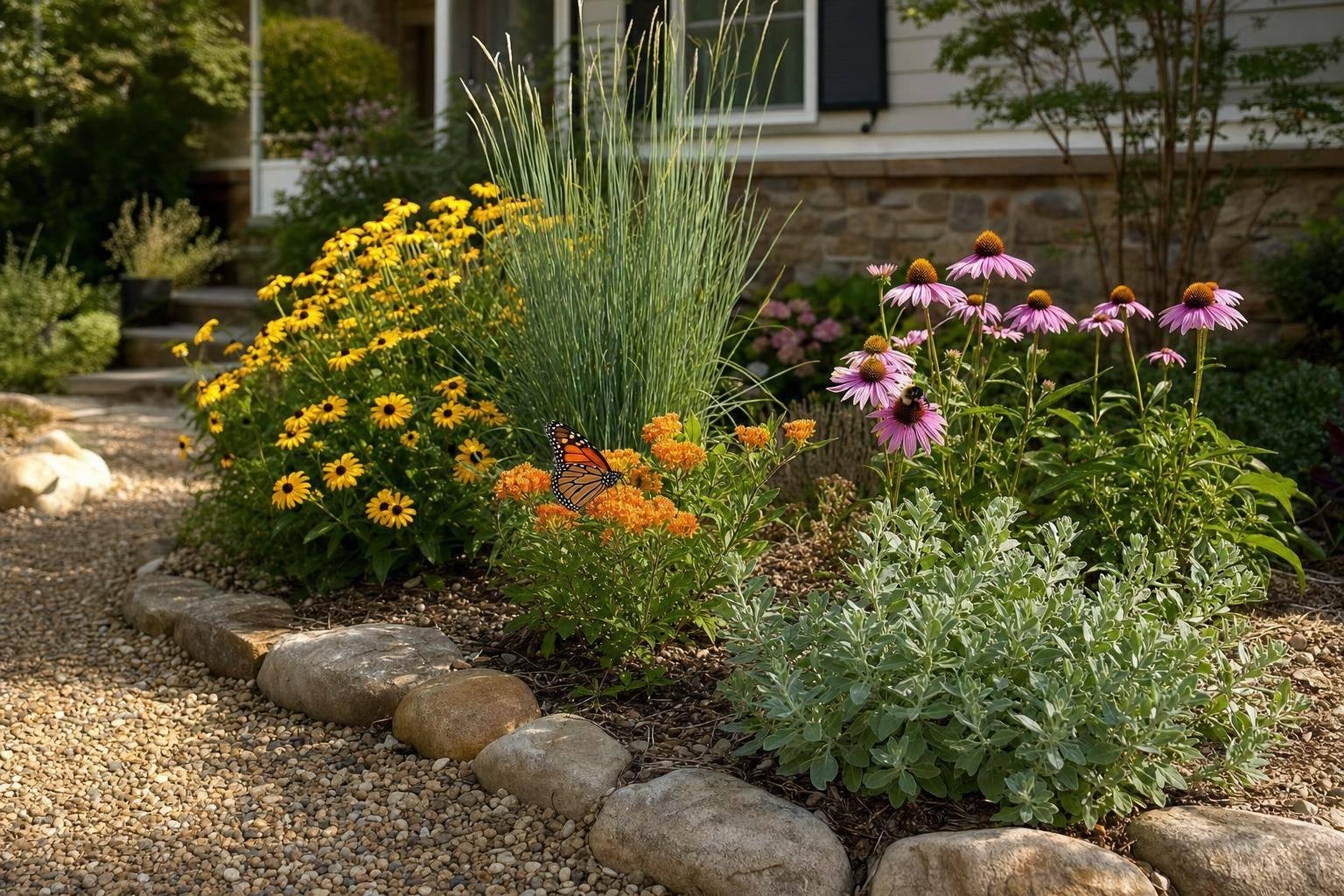
If your yard dries out fast, the fix is simple: plant natives that like heat, sun, and fast-draining soil. In this guide, I cover 10 Maryland native plants that fit dry slopes, curb strips, mailbox beds, and sunny borders: butterfly weed, purple coneflower, black-eyed Susan, little bluestem, blazing star, wild bergamot, narrowleaf mountain mint, New Jersey tea, Eastern red columbine, and threadleaf coreopsis.
Here’s the short version:
- Most of these plants want full sun, or at least 6+ hours of direct light.
- Many can handle dry soil after the first growing season.
- The first year matters most: plan on deep watering every 2 to 3 days at first, then every 3 to 7 days as roots grow in.
- Dry sites near pavement, south-facing slopes, and rocky ground often work well for plants like butterfly weed, little bluestem, and blazing star.
- Spots with part shade are a better match for Eastern red columbine.
- Plant size matters too: some stay near 18 to 24 inches, while others reach 3 to 5 feet.
Before I pick any plant, I’d check 4 things first:
- Sun: full sun vs. part shade
- Drainage: does water drain in about 2 to 4 hours, or sit too long?
- Heat: is the bed next to pavement, a wall, or a slope?
- Mature size: will the plant outgrow the space?
GardenDC Podcast Episode 205: Drought-Tolerant Native Plants
sbb-itb-843f8be
Quick Comparison
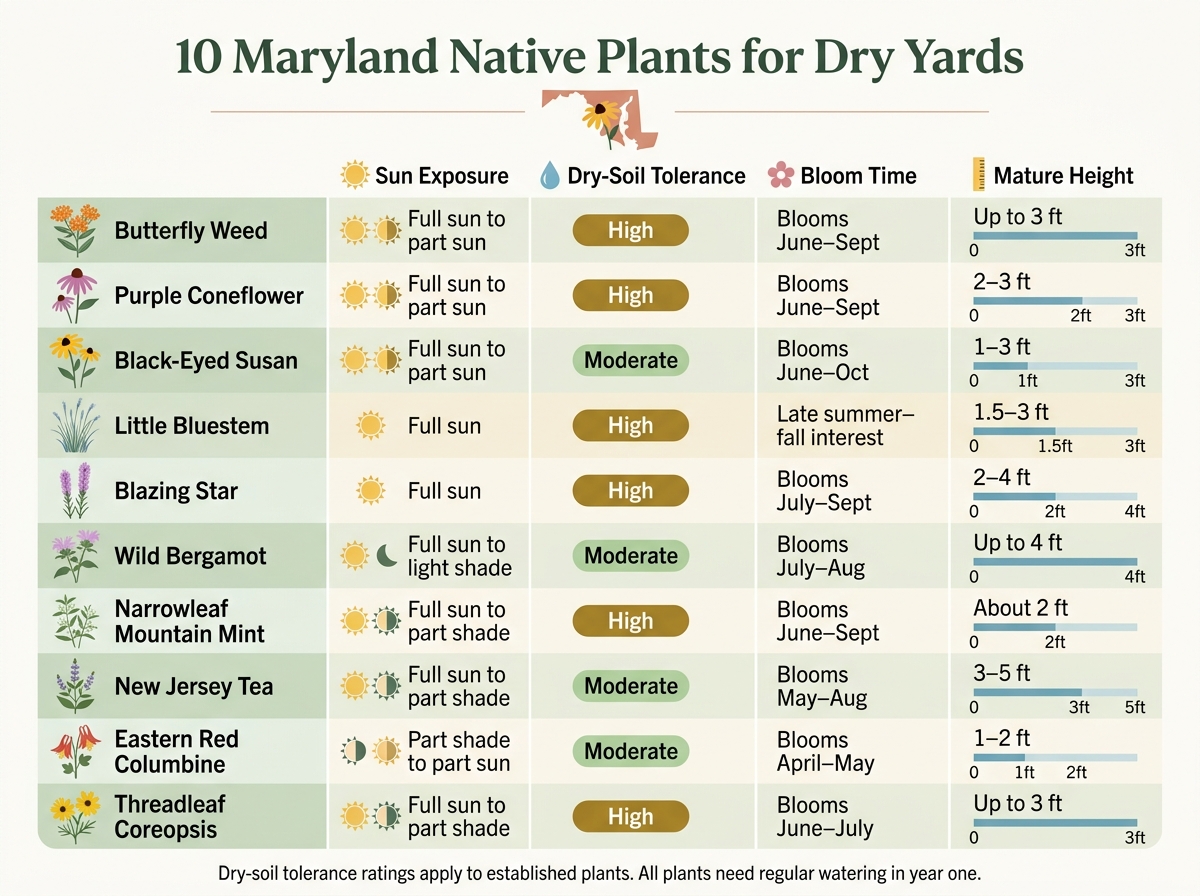
10 Maryland Native Plants for Dry Yards: Quick Comparison Guide
| Plant | Best Light | Dry Soil After Establishment | Bloom or Main Season | Mature Height |
|---|---|---|---|---|
| Butterfly Weed | Full sun to part sun | High | June–September | Up to 3 ft |
| Purple Coneflower | Full sun to part sun | High | June–September | 2–3 ft |
| Black-Eyed Susan | Full sun to part sun | Moderate | June–October | 1–3 ft |
| Little Bluestem | Full sun | High | Late summer to fall | 1.5–3 ft |
| Blazing Star | Full sun | High | July–September | 2–4 ft |
| Wild Bergamot | Full sun to light shade | Moderate | July–August | Up to 4 ft |
| Narrowleaf Mountain Mint | Full sun to part shade | High | June–September | About 2 ft |
| New Jersey Tea | Full sun to part shade | Moderate | May–August | 3–5 ft |
| Eastern Red Columbine | Part shade to part sun | Moderate | April–May | 1–2 ft |
| Threadleaf Coreopsis | Full sun to part shade | High | June–July | Up to 3 ft |
Bottom line: if you match the plant to the site, you can cut watering, keep upkeep low after year one, and still get flowers, grass texture, and pollinator value through much of the season.
How to Pick Native Plants for Dry Maryland Yards
Start with the site, not the plant tag. Sun, drainage, slope, and bed size will tell you which natives are likely to do well and which ones will struggle. A dry Maryland yard can still support a lot of good native plants, but the match has to be right.
Check Sun Exposure
In Maryland, full sun means at least 6 hours of direct sun. Most natives for dry sites need that much light to bloom well and keep a tidy, upright shape. Areas with 4–6 hours count as part sun or part shade. That works for some natives, but it takes many top dry-site picks off the table.
Check the same spot in the morning, at midday, and again in late afternoon. That gives you a clearer read on how many hours of direct sun the area gets. If plants like butterfly weed or little bluestem get less than 6 hours, they often turn leggy, flop, or produce fewer flowers.[1][4][6][7]
Check Drainage and Soil Texture
Soil changes the whole equation. Sandy or rocky soil drains fast. Clay hangs on to water longer, then can bake hard in summer.
A simple drainage test helps. Dig a 12-inch hole, fill it twice, and time how long the water from the second fill takes to drain. If it drains in 2–4 hours, that spot should work well for many dry-site natives. If water is still sitting there after more than 8 hours, drainage is too slow for most plants in this group.
Some Maryland natives can grow in dry clay once they’re settled in. The catch is location. If the area stays soggy after storms, especially in a low spot, many dry-site plants won’t like it.[2][3]
Account for Slopes, Heat, and Hard Surfaces
Some parts of the yard are just tougher than others. South- and west-facing slopes dry out faster than level ground because they get stronger afternoon sun and shed water before it can soak in.
Beds near pavement have another problem: heat bounce. Curbside strips, driveway edges, and spaces by patios or walkways often run hotter and drier than the rest of the yard because hard surfaces warm the soil and speed up moisture loss.
For spots like these, go with the toughest native plants you can find. Deep-rooted plants that handle heat and drought well tend to do best in these hard-use areas.[1][4][13]
Match Mature Size to the Planting Area
Small in a nursery pot does not mean small for long. A lot of native plants reach 2–4 feet tall and wide within a few growing seasons. Native grasses can also form clumps more than 2 feet across.
That matters in tight spaces. Near walkways and mailboxes, look for plants that stay around 12–24 inches tall and won’t lean into where people walk. In foundation beds, place taller grasses and shrubs at least half of their mature width away from walls.
A quick sketch helps more than most people think. Draw the bed to scale and mark each plant’s mature spread. It’s a simple step, but it can save you from a crowded mess later.[4][6][7]
Water During the First Growing Season
Even the right plant needs help getting started. Water deeply right after planting. Then water every 2–3 days for the first 1–2 weeks. After that, shift to every 3–7 days as roots move down into the soil.
Before watering again, check whether the top inch or two of soil is dry. That one habit can help you avoid both overwatering and underwatering.
Deep, slow watering works better than light daily sprinkles. A soaker hose or a hose set to a low trickle for 30–60 minutes is usually a better fit, especially on slopes or in clay soil. Once plants are established, most of them need much less water.[2][3][5][9][10][11][12][14]
Quick Comparison: 10 Native Plants for Dry Yards
Once you’ve matched your yard’s conditions, this table makes it easier to narrow down the best picks for hot slopes, curb strips, and other spots that dry out fast. Full sun means 6+ hours of direct sun. Part sun or part shade means 3–6 hours. The dry-soil ratings below apply to established plants, not first-year care. Even plants with high dry-soil tolerance still need regular watering during the first season.
| Plant | Sun Exposure | Dry-Soil Tolerance | Bloom Time | Mature Height |
|---|---|---|---|---|
| Butterfly Weed | Full sun to part sun | High | June–September | Up to 3 ft [18] |
| Purple Coneflower | Full sun to part sun | High | June–September | 2–3 ft [20][21] |
| Black-Eyed Susan | Full sun to part sun | Moderate | June–October | 1–3 ft [19] |
| Little Bluestem | Full sun | High | Late summer–fall interest | 1.5–3 ft [22] |
| Blazing Star | Full sun | High | July–September | 2–4 ft [23] |
| Wild Bergamot | Full sun to light shade | Moderate | July–August | Up to 4 ft [24] |
| Narrowleaf Mountain Mint | Full sun to part shade | High | June–September | About 2 ft [27] |
| New Jersey Tea | Full sun to part shade | Moderate | May–August | 3–5 ft [28][29] |
| Eastern Red Columbine | Part shade to part sun | Moderate | April–May | 1–2 ft [17] |
| Threadleaf Coreopsis | Full sun to part shade | High | June–July | Up to 3 ft [26] |
Use the table to line up plant size, sun needs, and soil dryness with the space you’re planting.
For hot curb strips or mailbox beds, shorter plants with high dry-soil tolerance usually make the most sense. Black-Eyed Susan, Butterfly Weed, and Threadleaf Coreopsis all work well there. On dry slopes, Little Bluestem brings shape and texture, while Blazing Star adds color in summer. If you’re planting near a lightly shaded foundation bed, Eastern Red Columbine is a better match.
Next, each plant profile shows where each one fits best.
1. Butterfly Weed
For the hottest, driest beds in Maryland, butterfly weed is one of the best native picks. Butterfly weed (Asclepias tuberosa) is a Maryland native perennial that does well in hot, dry, sunny spaces and serves as a top nectar source for pollinators.[18] It also acts as a host plant for monarch butterfly caterpillars.
Sun needs
It does best in full sun. Part sun can cut back flowering. Plant it along south- or west-facing edges, driveway strips, or other spots that take a lot of heat.
Soil fit
Butterfly weed likes lean, fast-draining soil and does well in sand, gravel, or rocky ground.[18][30][32][33] Stay away from wet, heavy soil. If drainage is iffy, plant it on a slight mound and avoid low areas where water sits.
Bloom time
It produces bright orange flowers from June through September, with the heaviest show in early to midsummer.[18][35]
Mature size
Most plants reach 18 to 24 inches tall and 12 to 18 inches wide. In richer or slightly moister soil, it can grow taller, sometimes up to 3 feet.[18][34]
Best landscape use
Its deep taproot helps it handle drought well once established, but that same root is why mature plants don’t like being moved.[30][31][32] That’s why it’s a smart fit for sunny borders, dry slopes, and curbside strips where heat and low water are part of the deal.[18][30][32]
2. Purple Coneflower
If butterfly weed takes the hottest, driest spots, purple coneflower is the next easy pick for sunny, well-drained beds. Purple coneflower (Echinacea purpurea) is a tough, long-blooming native that does well in dry areas with plenty of sun. It draws pollinators for months, and after the petals fade, the seed heads keep feeding birds.
Sun needs
Purple coneflower grows best in full sun, which means at least 6 hours of direct light each day[36][37]. It can handle part shade, but more shade often means floppier stems and fewer flowers. In south- or west-facing beds, it also holds up well against heat bouncing off driveways and sidewalks.
Soil fit
This plant handles clay, sand, rocky ground, and shallow soil as long as the drainage is good[21][36][37][39]. In fact, poorer soil often leads to sturdier plants and more blooms, so there’s no need to load the bed with compost or fertilizer. Avoid low areas or spots that stay soggy after rain, since too much moisture can lead to root and crown rot[37][39][41].
Bloom time
You can expect flowers from June through September, with the strongest show in July and August[38][42][40][43]. Once blooming wraps up, the seed heads still look good and feed goldfinches and other seed-eating birds through fall and winter[44][45].
Mature size
Most plants grow to 2 to 4 feet tall and 1 to 2 feet wide[42][40][43]. Space them about 18 inches apart, and set them 18 to 24 inches back from path edges[36][38][39].
Best landscape use
Purple coneflower fits right into sunny borders, meadow-style beds, dry slopes, and curbside strips. It works especially well with butterfly weed, which blooms earlier, so together they stretch flower color and nectar across more of the season[21][39][41]. Next up is black-eyed Susan, another dependable native for dry sites.
3. Black-Eyed Susan
After purple coneflower, Black-Eyed Susan gives you another tough pick for dry Maryland beds. Black-eyed Susan (Rudbeckia hirta) is a dependable native for sunny, well-drained spots in Maryland.
Sun needs
Black-eyed Susan needs full sun – at least 6 hours of direct sunlight each day. When it doesn’t get enough sun, plants get leggy, bloom less, and face a higher risk of mildew.
Soil fit
It grows well in clay, sand, and rocky or shallow soil, as long as the site drains well[19]. In many cases, poor to average soil makes for sturdier plants. Skip low areas that stay wet after rain.
Bloom time
Flowers bloom from June through October, which makes it one of the longer-blooming natives in this group[19]. After flowering, the seed heads can stay in place and feed birds through fall.
Mature size
Most plants grow to 1 to 3 feet tall and about 1 to 2 feet wide[19]. Space them 12 to 18 inches apart, and keep them a bit back from path edges so they don’t spill into walkways.
Best landscape use
Black-eyed Susan works well in sunny borders, meadow-style beds, dry slopes, and curbside strips. Its main appeal is simple: it performs well in hot, open beds where steady color matters more than rich soil. It also pairs nicely with butterfly weed and purple coneflower, helping stretch flower color across the season.
4. Little Bluestem
Little bluestem (Schizachyrium scoparium) is a native clumping grass made for hot, dry, sunny spots. Unlike the flowering perennials covered so far, it adds structure, texture, and year-round color to a dry yard without much fuss once it settles in.
Sun needs
Little bluestem needs full sun, with 6+ hours each day.[46][48] In part shade, the stems can flop and the color tends to fade.[46] It does especially well along south- or west-facing slopes and in open borders near driveways or sidewalks.
Soil fit
This grass does best in dry, lean, well-drained soil.[22][47][51] It can handle sandy, gravelly, clay, or rocky ground, as long as water doesn’t sit after rain. Low spots near downspouts are a bad fit, and so is any area that stays soggy. That strong drainage tolerance makes it a smart pick for slopes and other places where water runs off fast.
Mature size
Most plants grow 2 to 4 feet tall and 1.5 to 2 feet wide.[47][48][49][50] In borders or meadow-style beds, space plants 18 to 24 inches apart so air can move through and each clump has room to fill in on its own.[48][50]
Best landscape use
Use little bluestem in meadows, for erosion control, or as a specimen planting on dry slopes and hard edges. Its blue-green foliage shifts to copper in fall, and the seed stalks stay up through winter, adding texture and wildlife value.[47][50]
A Calvert County native grass guide notes that its root system can reach roughly 6 feet deep, which helps it stabilize dry slopes and hold soil during heavy rain.[52]
It also looks great with black-eyed Susan and purple coneflower in sunny borders. The upright form gives a nice contrast next to lower-growing perennials.
If you want a taller bloom companion for the same dry, sunny site, the next plant adds summer color and height.
5. Blazing Star
After low, clumping grasses, blazing star brings height and midseason color. Blazing star (Liatris spicata) sends up tall purple flower spikes in dry, sunny beds and does best where water drains out fast. It’s a strong pick for sunny borders and meadow-style plantings.
Sun needs
Blazing star needs full sun, which means at least 6 hours of direct sunlight per day.[53][54][57] Give it the kind of spot that gets sun most of the day. In partial shade, stems tend to get weaker and flowering drops off.
Soil fit
This plant grows best in fast-draining soil, but once it’s settled in, it can deal with poor, dry, and even rocky ground.[54][56][57][58][59] Sandy soil, loam, and some clay can all work if they don’t stay soggy.
The main thing to avoid is wet soil that lingers after rain. Heavy clay and low spots can lead to corm rot. In heavier Maryland soils, planting on a slight mound or in a raised bed helps keep the crowns dry.
Bloom time
Blazing star blooms from July through September.[55][23][57] One detail gardeners tend to love: the flower spikes open from the top down. When planted in groups, blazing star can give you 3 to 6 weeks of color.[54][56][57] That stretch helps carry a garden through the hottest part of summer.
Mature size
Most blazing star plants grow 2 to 4 feet tall and about 12 to 18 inches wide.[54][57][58][59][60] Each clump stays fairly narrow, so a single plant can look a bit thin on its own.
For a fuller look, plant them in small groups:
- Use 3 to 7 plants
- Space them about 12 to 18 inches apart
That setup gives the planting more presence without taking up much ground space.
Best landscape use
Blazing star shines as a vertical accent in pollinator beds. Its narrow, upright shape pairs well with black-eyed Susan, purple coneflower, and coreopsis. It’s especially useful when you want to break up a planting of shorter natives with something taller and more upright.
It also works well in tight spots where width is limited but height still matters.
6. Wild Bergamot
Wild bergamot (Monarda fistulosa) is a fragrant native perennial that fits dry Maryland yards well. It brings rounded lavender-pink flower heads, plus strong pollinator appeal. In a planting bed, it works best as a mid-height layer in a dry, sunny spot.
Sun needs
Wild bergamot grows best in full sun to part shade, but full sun is the better pick for dry sites. With 6+ hours of sun, plants stay more compact and bloom more heavily.[62][64] In shadier areas, stems can stretch and flop. Plants under stress are also more likely to deal with powdery mildew.[62][67][68]
Soil fit
This is one of those perennials that doesn’t need pampering. It does well in poor soil, and University of Maryland Extension notes that it is adapted to poor, dry soils. Rich, moist soil can make stems tall and floppy.[70][69]
It also handles clay and rocky ground well. The big thing is drainage. Plant it where water moves through the soil and doesn’t sit after rain.[24][63][64][67][68]
Bloom time
You can expect flowers from mid-July through September, often for 4 to 8 weeks.[64][65][66] The blooms range from lavender to pink-purple and draw bees, butterflies, and hummingbirds through the season.[61][64][66][67][68]
Mature size
Wild bergamot grows 2 to 4 feet tall and 2 to 3 feet wide. Space plants 18 to 24 inches apart so air can move between them.[61][64][65][66][68]
Best landscape use
Place wild bergamot in the middle of a sunny border, where its height and rounded flowers can fill that in-between layer nicely. It pairs well with little bluestem, purple coneflower, and black-eyed Susan. It also works well on dry slopes, along curbside edges, and in naturalized areas.
7. Narrowleaf Mountain Mint
Narrowleaf mountain mint (Pycnanthemum tenuifolium) is another tough midsummer bloomer worth a spot in Maryland gardens. It’s easy to care for, keeps feeding pollinators during dry stretches, and holds up well when the heat settles in. Once it’s established, it doesn’t ask for much.
Sun needs
It does best in full sun, though it can handle light afternoon shade in hotter spots.[27][25][74][75]
Soil fit
This plant grows well in average to dry, well-drained soil. That includes clay, sand, rocky ground, and loam. Once established, it handles poor, dry soil well. Wet or poorly drained soil is where it tends to struggle.[71][25][72][73][74][75]
Bloom time
Look for small white to pale pink flower clusters from June through September, with the heaviest bloom in July and August. That late-summer window helps fill a gap after many spring native flowers are done.[77][78][79][80][81]
Mature size
Narrowleaf mountain mint usually reaches 2 to 3 feet tall and 2 to 3 feet wide. It can spread by rhizomes if you don’t use edging to keep it in check.[77][78][80][81][76]
Best landscape use
It works well in pollinator gardens, sunny native borders, dry slopes, and curbside edges. Near pavement, hardscaping and edging help keep its spread under control.
8. New Jersey Tea
New Jersey tea (Ceanothus americanus) is a small native shrub that handles dry Maryland yards with very little fuss. Once it settles in, its deep taproot helps it deal with drought. That same root system also makes it a solid pick for slopes and other spots where water drains out fast.
Sun needs
Plant it in full sun to part sun for the best flowering and a neat shape.[91] It can handle a bit of light shade, but you’ll usually get fewer blooms there.
Soil fit
This shrub grows best in dry, well-drained soil, especially sandy or rocky sites.[83][85] Skip wet areas or places where water tends to sit. It also handles road salt, which makes it a good fit near driveways and along street edges.[83][84]
Bloom time
Fragrant white flower clusters appear from May through July.[84][90] Those blooms help draw native bees and butterflies.[86][29]
Mature size
New Jersey tea usually grows to 2–3 feet tall and 2–3 feet wide.[86][87][88][29] One thing to plan for: once it’s established, it can be hard to move because of its very deep root system.[88][29]
Best landscape use
It’s a strong choice for dry slopes and rocky banks, where the roots can help hold soil in place.[89][86] It also works well in sunny shrub borders, meadow beds, mailbox plantings, and roadside edges.[89][83][82] Skip fertilizer and heavy soil amendments.
Next: a smaller perennial for dry, sunny beds.
9. Eastern Red Columbine
For dry Maryland yards with morning sun or dappled shade, Eastern red columbine fills a spot that can be hard to plant well. Eastern red columbine (Aquilegia canadensis) is a light, airy native that handles dry soil once established. In Maryland, it grows on rocky slopes, limestone bluffs, and thin soils over bedrock[93][98]. That makes it a smart match for dry, sloped yards where many other plants tend to struggle.
Sun needs
Eastern red columbine does best in part shade to part sun, with morning sun preferred[92][96]. A good setup is morning sun with afternoon shade, especially in east- or north-facing beds, under open trees, or in dappled light.
Soil fit
This plant needs well-drained, sandy, or rocky soil. It tends to struggle in heavy clay or anywhere water sits after rain[92][94][95][96][97].
Bloom time
Its red-and-yellow flowers bloom from April to June across most of Maryland[93][96]. That bloom window lines up with the return of ruby-throated hummingbirds, and the plant also hosts Columbine Duskywing butterflies[92][96].
Mature size
Plants usually grow 1 to 3 feet tall and spread about 1 to 1.5 feet at maturity[96][93][97]. Space them 12 to 18 inches apart so air can move through the planting and so seedlings have room to pop up over time[96][97].
Best landscape use
Eastern red columbine fits well in part-shade foundation beds, dry slopes, and understory plantings beneath open-canopy trees[92][94][99]. It also works nicely in shady rock gardens and along woodland path edges where you want a softer, looser look[94][97]. It does best in spots where dry soil and light shade come together.
10. Threadleaf Coreopsis
If you need one more plant for a dry, sunny part of the yard, threadleaf coreopsis is a smart pick. It brings long-lasting color and a light, feathery texture to lean beds. In hot spots with thin or sandy soil – places where many perennials struggle – threadleaf coreopsis (Coreopsis verticillata) tends to keep going. It’s a drought-tolerant perennial that needs very little water once established.[26][100][101][103][106]
Even when it’s not in flower, the fine, ferny foliage adds a soft, airy look that helps a bed feel less harsh.
Sun needs
Threadleaf coreopsis wants full sun, which means at least 6 hours of direct light each day.[101] It flowers best and keeps a better shape in full sun. South- or west-facing beds are often the right fit.[26][101][103]
Soil fit
This plant does best in dry, poor, well-drained soil, especially if that soil is sandy, rocky, or gravelly.[103][26][107] Wet feet are a problem here. It does not handle waterlogged ground or heavy clay well, and poor drainage can lead to crown rot.[103][105]
A few planting tips help a lot:
- Skip low spots where water sits after rain.
- If your yard has heavy clay, plant it on a slight berm.[103][105]
Bloom time
Bright yellow flowers show up from June through September.[101][102][104]
Mature size
Most plants grow to about 18 to 24 inches tall and wide.[100][102][104]
Best landscape use
Threadleaf coreopsis works well in sunny borders, dry slopes, and along driveway or patio edges.[100][101][103]
Where to Plant Dry-Site Natives in Your Yard
Plant choice matters, but placement is what cuts water use. The goal is simple: match each plant to the spot where sun, heat, and drainage already fit.
Sunny Borders and Meadow-Style Beds
Start with the sunniest, best-drained beds. That’s where most of these plants are happiest.
Butterfly weed, blazing star, purple coneflower, wild bergamot, and threadleaf coreopsis all do well in full-sun borders with lean, well-drained soil.[16][15][109] If you want that loose, meadow-like look, mix grasses and flowers for texture and better weed control. Planting in drifts of 3–5 plants per species also helps the bed look more natural and settled.[111][112]
Dry Slopes and Erosion-Prone Areas
Dry, sunny slopes can be tough, but they’re a good fit for plants like little bluestem and black-eyed Susan. A simple rule helps here: put the plants that like the driest conditions near the top of the slope, and set the more flexible ones farther down.
After planting, spread about 3 inches of shredded hardwood mulch to help hold soil in place while roots get established.[113] On steeper grades, erosion-control blankets can give added support until the plants fill in.[113]
The same setup works for narrow, heat-baked curb strips too.
Mailbox Beds, Narrow Curb Strips, and Curbside Edges
These strips are some of the roughest planting spots in a yard. You’ve got hot pavement on both sides, packed soil, and little to no shade.
A few natives from this list are well suited for those conditions: butterfly weed, black-eyed Susan, blazing star, wild bergamot, and purple coneflower.[110][8] Before planting, loosen compacted soil so roots have a better shot. Near sightlines, keep mature plant height under 3 feet. It also helps to leave space between plant crowns and the curb edge so foot traffic or snow plows don’t beat them up.
Foundation Beds Near Patios and Walkways
South- and west-facing foundation beds near masonry, pavers, and concrete often turn into heat traps. Many plants struggle there, but a few dry-site natives fit right in.
Threadleaf coreopsis works well along walkway and patio edges because it handles dry, sunny conditions well.[108][16] Butterfly weed stays fairly compact, which makes it a smart front-of-border pick near paver edges or foundation shrubs.[16][15] For the middle of the bed, especially against a warm wall, wild bergamot and purple coneflower bring more height and pollinator activity. Keep taller plants a few feet back from busy paths, and place shorter ones closer to the hardscape edge.
When to Get Help With Design, Grading, or Drainage
Some yards need more than the right plant list. If grading or drainage is the main issue, deal with that first before adding plants. For sites with drainage, grading, or planting issues near hardscape, Pro Landscapes MD can help with design and installation across central Maryland.
Conclusion
These plants do well because they fit conditions that already show up in many Maryland yards: full sun, fast-draining soil, and dry periods with little rain. That fit is what makes them low-maintenance. In plain English, they tend to do best in the parts of a yard that are already hot, sunny, and dry, like sunny borders, dry slopes, curb strips, and foundation beds.
The key is simple: match each plant to the site. Sun, drainage, slope, and nearby root competition all matter. Even drought-tolerant natives can struggle when they’re planted in the wrong spot. When the fit is right, a water-efficient native planting can cut outdoor watering and reduce upkeep after the first season.
There’s also more to the payoff than lower water use. These plants bring seasonal color and give pollinators and birds more to work with in low-water spaces.[114]
Water them on a steady schedule through the first growing season, then scale back as the roots get established.[115] If your yard has steep slopes, erosion, or drainage problems near patios, walkways, or foundations, Pro Landscapes MD can help with grading, drainage, planting, and design.
FAQs
Which plants are best for clay soil?
For Maryland gardens with heavy clay soil, Swamp Milkweed and Cardinal Flower are strong native picks when you put them in the right spot.
Clay soil can be tough to work with. It holds water for a long time and can add extra pressure around landscape structures. The upside? With the right native plants, your garden can still look lively and hold up well through the season.
Can I mix these plants in one bed?
Yes – as long as you group plants with similar sun and moisture needs so they grow well together.
For drought-prone yards, mix drought-tolerant native plants with deep root systems. If needed, improve drainage so the bed can support every plant in the mix.
How do I know when my plants are established?
Plants are considered established once their roots move beyond the original planting hole and into the native soil around them. At that point, they usually need less extra watering.
You can spot an established plant by looking for a few simple signs: steady new growth, healthy leaf color, and a plant that stays firm in the ground when you give it a gentle tug. The timeline depends on the species.
Chat with Us