









- bhavya gada
- No Comments
Maryland yards support far more than bees alone: the state has 430+ bee species and 150+ butterfly species, plus hummingbirds, moths, flies, beetles, and wasps. If I want more flowers, fruit, and seed set in a Maryland landscape, I need to give pollinators food, host plants, and places to nest.
Here’s the short version:
- Bees are major pollinators because they collect pollen to feed their young.
- Most native bees are solitary, and about 70% nest in the ground.
- Butterflies need two things: nectar for adults and host plants for caterpillars.
- Other pollinators matter too, including hoverflies, beetles, moths, wasps, and the Ruby-throated Hummingbird.
- Native plants with bloom times from spring through fall help support more species.
- Simple yard choices help a lot: leave some stems standing, keep some bare soil, add water, and cut back on pesticide use.
A few plant examples from the article:
- Milkweed for monarch caterpillars
- Dill, fennel, and parsley for black swallowtail caterpillars
- Violets for great spangled fritillary caterpillars
- Goldenrod, asters, and ironweed for late-season nectar
- Blueberries, wild geranium, and native azaleas for early spring pollinators
The main point is simple: if I plant for different pollinators instead of just one, my Maryland yard can support bees, butterflies, birds, and many other flower visitors across more of the year.
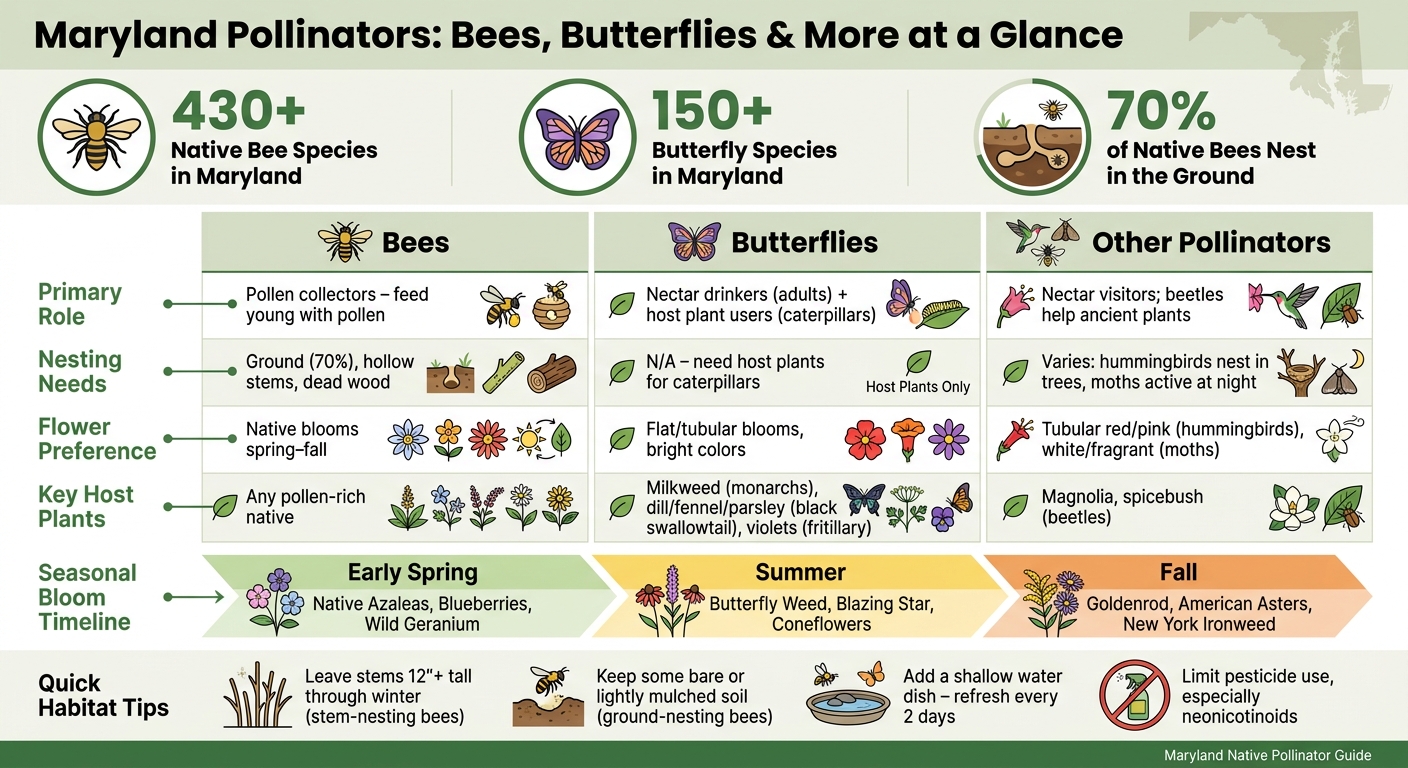
Maryland Pollinators: Bees, Butterflies & More at a Glance
Gardening for Pollinators
sbb-itb-843f8be
Bees in Maryland: The Most Important Pollinators
Among Maryland’s many pollinators, bees do a lot of the heavy lifting in landscape projects in Maryland. The state has a broad mix of native bees, from sweat bees to bumble bees and carpenter bees. They’re such strong pollinators for one simple reason: bees gather pollen to feed themselves and their young.
Native Bees vs. Honey Bees
When people think of pollinators, they often picture honey bees first. But honey bees are a non-native, managed species [1]. They live in colonies with a queen and workers, which makes them different from most of Maryland’s native bees.
Most native bees are solitary. They nest in bare soil, hollow stems, dead wood, brush piles, or logs [2]. Maryland’s native bee groups include bumble bees, mason bees, leafcutter bees, mining bees, cellophane bees, carpenter bees, and sweat bees [1]. Each female solitary bee lays her own eggs and builds and stocks her own nest. No queen. No colony.
Where Bees Nest and What They Need
About 70% of native bee species nest in the ground, so they need bare or lightly mulched soil [5]. The rest nest in cavities and depend on hollow stems, dead wood, brush piles, and logs. Leaving stalks standing at least 1 foot tall through winter can help give stem-nesting bees, such as mason and leafcutter bees, a place to overwinter [2][4].
Why Native Bees Are Effective Pollinators
Bees collect pollen as food for themselves and their young [1], and that’s a big part of why they’re such dependable pollinators. To support native bees, plant native flowers that bloom from spring through fall and limit pesticide use, especially neonicotinoids [2].
Bees are only one part of the story. Butterflies and other pollinators need different plants and nesting or shelter spaces.
Butterflies and Other Pollinators in Maryland
Butterflies use plants in a different way than bees do. The big reason is simple: bees mostly need flowers for food, but butterflies need two things. Adults need nectar, and caterpillars need the right host plants. Maryland is home to more than 150 butterfly species [2].
Butterflies Need Nectar Plants and Caterpillar Host Plants
Adult butterflies drink nectar. Caterpillars, on the other hand, often rely on one plant or a small group of plants to survive. If you want butterflies in your yard, you need to support both life stages.
A few examples make this clear:
- Monarch caterpillars feed on milkweed (Asclepias spp.) [3][1]
- Black Swallowtail caterpillars need plants in the carrot family, such as dill, fennel, and parsley [2][4]
- Great Spangled Fritillary caterpillars depend on violets [1]
For adult butterflies, flower shape and color matter too. They tend to like flat or tubular blooms in bright colors. It also helps to plant at least three of each species and stagger bloom times from spring through fall [2][4][5]. That way, food is available for more of the season.
Skip butterfly bush (Buddleja), which is invasive in Maryland. A better pick is native nectar plants like blazing star, New York ironweed, and butterfly weed [4].
Hummingbirds, Moths, Flies, Beetles, and Wasps
Butterflies aren’t the only visitors that matter. Other pollinators use flowers in different ways, and some are active at totally different times of day. That’s why mixed plantings tend to support more species.
Hummingbirds go for tubular red, orange, and pink flowers [2][4]. Moths are active at night and often head to white or pale flowers with strong fragrance [2][3]. The hummingbird moth breaks that pattern a bit, since it hovers and feeds during the day [2][3].
Some pollinators don’t get much attention, but they still do a lot of work. Syrphid, or hover, flies visit many kinds of flowers. Beetles are rougher on blooms, but they matter for magnolias, spicebush, and other ancient plant types [1][2]. Wasps also visit flowers for nectar, and they can help control garden pests. They don’t pollinate as well as bees, though, because their bodies hold less pollen [1][2].
Flower shape, bloom style, and plant height all play a part here. A yard with more variety can support butterflies, birds, moths, flies, beetles, and wasps across Maryland landscapes.
How to Support Pollinators in Maryland Landscapes
The next step is turning species knowledge into a planting plan. The goal is pretty simple: give pollinators food, places to nest, and flowers in bloom from spring through fall.
Choose Native Plants and Plan Bloom Times From Spring Through Fall
Plant native species that flower at different points in the year so pollinators have something to eat across the season. In early spring, native azaleas (Rhododendron), blueberries (Vaccinium), and wild geranium (Geranium maculatum) work as early food sources for mining bees (Andrena), which come out before most flowers open [6].
Summer is a good time for butterfly weed (Asclepias tuberosa), blazing star (Liatris spicata), and coneflowers (Rudbeckia) [4][6]. Then, as fall gets closer, goldenrod (Solidago), American asters (Symphyotrichum), and New York ironweed (Vernonia noveboracensis) supply late-season energy for bees, butterflies, and other pollinators [4][6].
Once bloom timing is in place, the next piece is nesting and shelter.
Add Nesting and Shelter Features Without Making the Yard Look Neglected
Leave flower stalks standing at least 12 inches tall through winter to help stem-nesting bees such as mason and leafcutter bees [2]. If you want the yard to look tidy, shift brush piles and cut stems to a side yard or back corner [4]. That way, you still keep habitat without making the whole space look messy.
A shallow water dish or damp patch also helps butterflies get water. Refresh it every two days to help prevent mosquito breeding [5][4].
After food and habitat, it helps to fit plants to the site itself.
Match Pollinator Plants to Sun, Soil, Moisture, and Small Lots and Containers
Maryland’s mountains, Piedmont, and coastal plain each have different soil and moisture conditions [4]. Before you plant, check how much sun the area gets and how fast the soil drains after rain. Then pick plants that fit those conditions.
Smaller spaces can still do a lot. Patios, balconies, and compact urban lots can support native plants in containers, and even a few pots can act as a small habitat patch [4]. If drainage, shade, or soil compaction is getting in the way, Pro Landscapes MD can help match plants to tough site conditions.
Conclusion: Building a Maryland Landscape That Supports Bees, Butterflies, and More
Put it all together, and the picture is pretty clear: Maryland pollinators need both food and habitat. Maryland is home to more than 430 bee species, and bees are often the most important pollinators because they deliberately collect pollen to feed their young [1]. Butterflies play a different but equally important part. To support them, you have to think about two needs at once: nectar plants for adults and specific host plants for caterpillars [4][1]. Mixed plantings with different heights, shapes, and bloom colors help support other pollinators too [4][3].
A good planting plan keeps things simple and smart: use native plants with staggered bloom times, match them to your site’s sun, soil, and moisture, limit pesticide use, and add nesting and overwintering habitat [4][5].
Going native helps bees, butterflies, birds, and the food web they rely on.
Those choices support pollinators and the food web all year long.
FAQs
Which pollinators are most common in Maryland yards?
Bees are the most common and important pollinators in Maryland. More than 430 bee species live across the state.
Maryland yards can also support 150+ butterfly species, along with moths, wasps, beetles, flies, and the Ruby-throated Hummingbird.
How can I support pollinators year-round in Maryland?
Support pollinators by giving them what they need all year: food, shelter, water, and places to nest. A simple way to start is to plant native species that bloom from spring through fall, so nectar and pollen are available across the seasons.
Just as important, let parts of the garden stay a little wild. Leave fallen leaves, garden debris, and dead stalks in place through winter. Add brush piles, dead wood, or patches of bare sandy soil for nesting and cover. Set out water sources like birdbaths or small mud-puddling areas. And skip pesticides, which can harm the very insects you’re trying to help.
What plants help both bees and butterflies?
Plant native species that supply nectar and pollen across the growing season. Good options include asters, purple coneflowers, goldenrod, yarrow, dill, fennel, milkweed, bee balm, blazing star, ironweed, and columbine.
Pro Landscapes MD offers expert garden services and planting to help create outdoor spaces with native, pollinator-friendly plants.
Chat with Us