









- bhavya gada
- No Comments
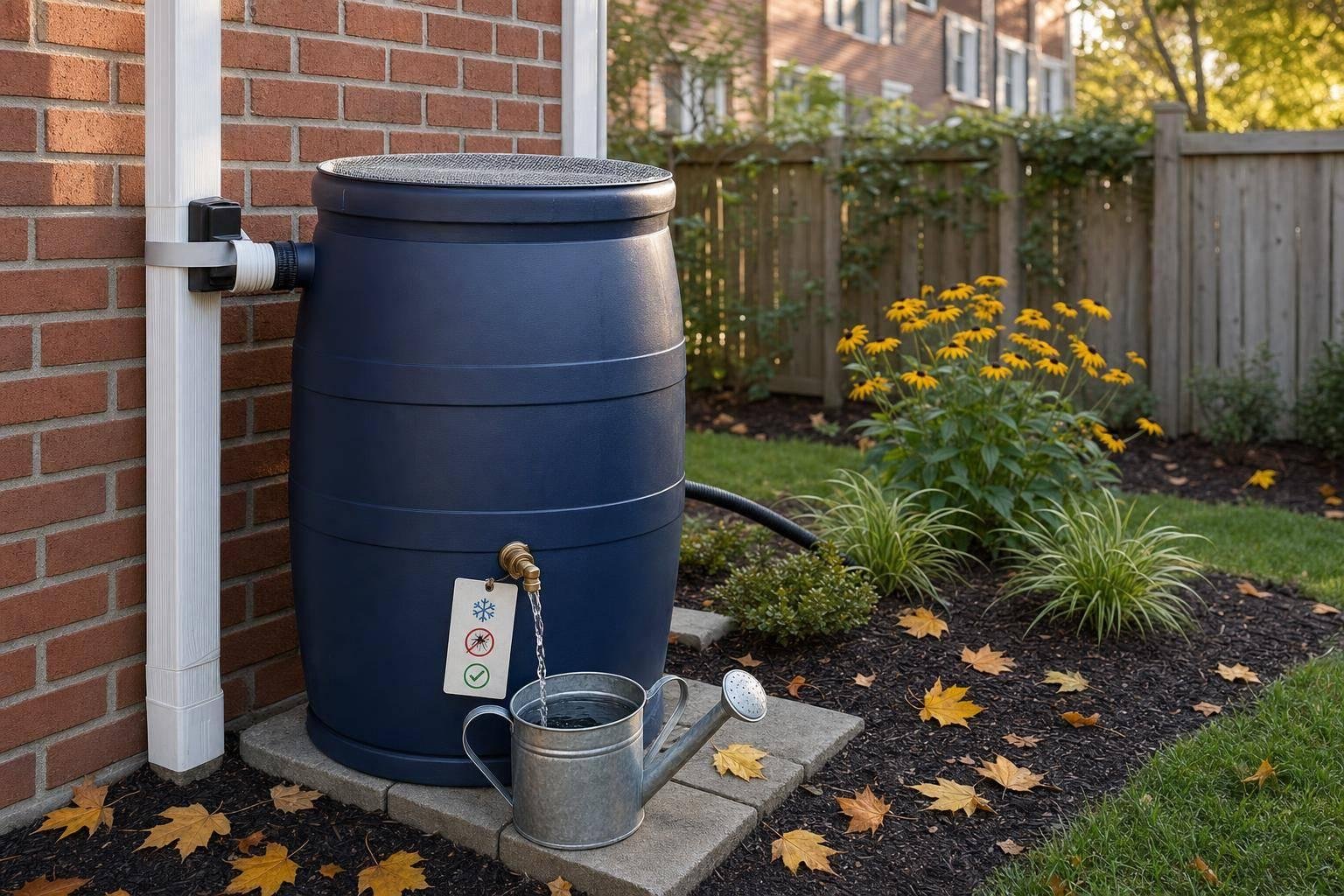
If I own a rain barrel in Maryland, I need to do three things: empty it often, shut it down before freezing weather, and check county and HOA rules before I install or change anything.
Here’s the short version:
- Drain stored water every 5 to 7 days during the warmer months.
- Empty the barrel before big storms so it can hold new roof runoff.
- Disconnect and drain it before the first hard freeze to help prevent cracks.
- Keep the lid tight and screens intact to cut down on mosquitoes and debris.
- Send overflow away from the house, often at least 4 feet from the foundation.
- Do not use barrel water for drinking, cooking, dishwashing, or washing food.
- Check HOA rules first, because Maryland law does not give rain barrels the same HOA protection that some low-impact landscaping gets.
A few numbers stand out. A full barrel can weigh about 450 lb. Some Maryland guidance says to drain it after each heavy rain and not let water sit for more than a few days. That’s why simple upkeep matters more than most homeowners think.
If I had to boil the full article down to one point, it’s this: a rain barrel works best when it stays empty enough for the next storm, clean enough to avoid algae and odor, and set up in a way that won’t send overflow toward the house or upset local rules.
How to Get Your Rain Barrel Ready for Winter
sbb-itb-843f8be
What Maryland Guidance Says About Routine Rain Barrel Maintenance
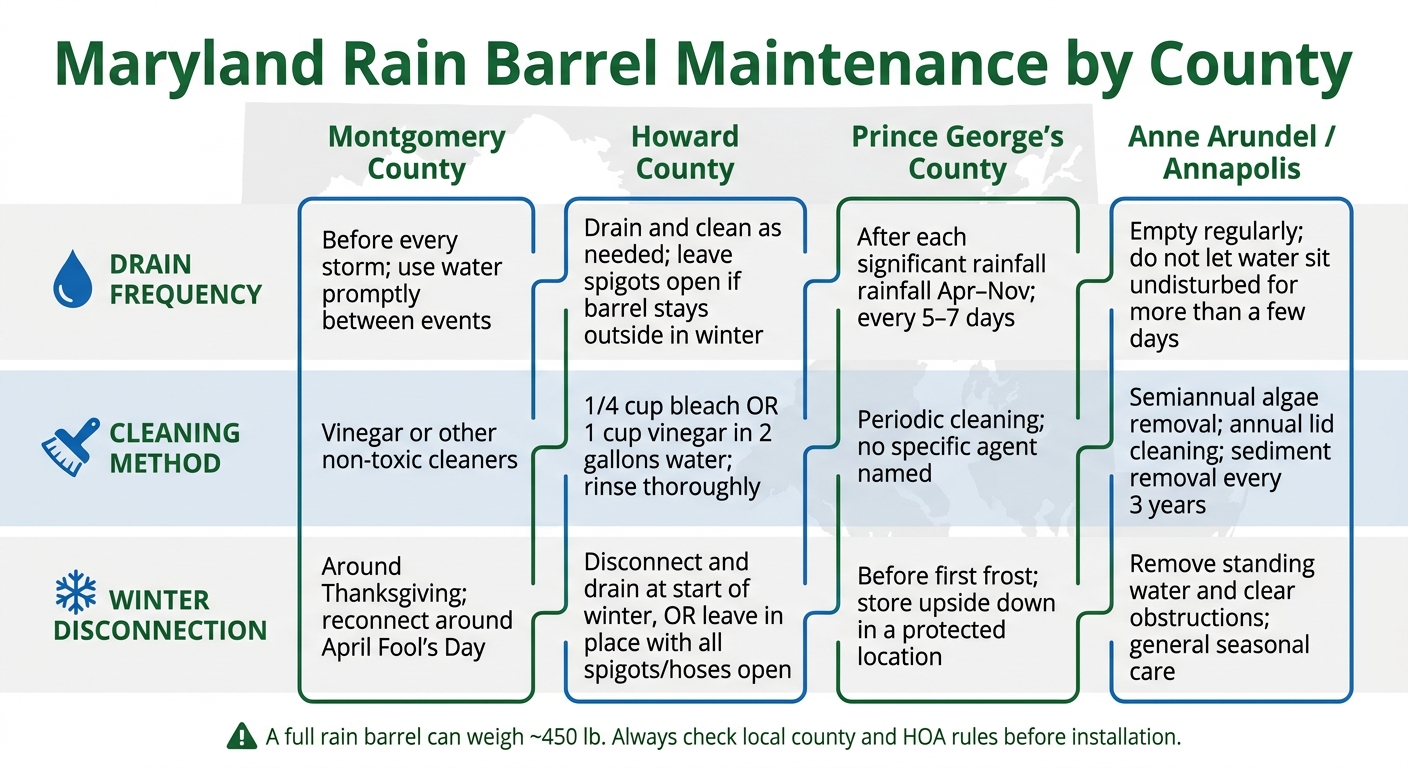
Maryland Rain Barrel Maintenance by County: Quick Reference Guide
Maryland guidance is pretty consistent on rain barrel care: empty stored water between storms, keep screens and gutters clear, check where overflow goes, and inspect fittings on a regular basis. Those basic checks matter even more when you’re heading into winter shutdown, spring restart, or storm prep.
Prince George’s County gives one of the plainest schedules out there. It states: "Drain [rain barrels] after each significant rainfall from April to November. As a general rule, empty the rain barrel every five to seven days."[11] Prince George’s County says to drain barrels after each significant rainfall from April to November, or about every 5 to 7 days. Montgomery County takes a similar approach, telling residents to use stored water promptly so the barrel is ready for the next storm.
Cleaning advice changes a bit by county. Howard County gives a specific mix – 1/4 cup bleach or 1 cup vinegar in 2 gallons of water – and says to rinse the barrel thoroughly afterward. Montgomery County points people toward non-toxic cleaners such as vinegar.[2][4][9] Annapolis and Anne Arundel put more focus on timing: remove algae twice a year, clean the lid once a year, and remove sediment from the barrel every three years.[6][13]
How Maintenance Guidance Differs by County
| County / Area | Drain Frequency | Cleaning Method | Winter Disconnection |
|---|---|---|---|
| Montgomery County | Before every storm; use water promptly between events | Vinegar or other non-toxic cleaners | Around Thanksgiving; reconnect around April Fool’s Day |
| Howard County | Drain and clean as needed; leave spigots and hoses open if the barrel stays outside for winter | Dilute bleach or vinegar solution; rinse thoroughly | Disconnect and drain at the start of winter, or leave in place with all spigots/hoses open |
| Prince George’s County | After each significant rainfall from April to November; about every 5–7 days | Periodic cleaning; no specific agent named | Before the first frost; store upside down in a protected location |
| Anne Arundel / Annapolis | Empty regularly so water does not sit undisturbed for more than a few days | Semiannual algae removal; annual lid cleaning; sediment removal every three years | Seasonal care is more general, with an emphasis on removing standing water and clearing obstructions |
Parts of the System That Need Regular Inspection
A rain barrel is only as good as its weakest fitting. Gutters and downspouts come first. Howard County specifically warns that debris buildup in gutters can lead to bacterial growth, not just clogs.[4] So this isn’t only about keeping water moving. It’s also about keeping the system cleaner from the start.
Past the gutters, the parts that need regular checks are the inlet screen, lid, overflow hose, spigot, and drain plug. If the screen is torn or loose, mosquitoes can get in and debris can pass through. If the overflow hose is blocked, water can end up where you don’t want it – like near your foundation.
It’s also smart to check the stand or platform under the barrel for levelness and stability. Then look at the ground around the base after overflow events. Erosion or standing water there can be a sign that runoff isn’t draining the way it should.[2][6][12] In plain terms, a rain barrel works best when it stays clear, sealed, and able to send overflow away safely. These checks matter most before winter shutdown and before storm season.
Once the main parts are clean and working, the next step is adjusting care by season.
Seasonal Rain Barrel Care in Maryland: Winter, Spring, and Storm Prep
After the inspection, seasonal care is the next job if you want the barrel to stay safe and keep doing its job. In Maryland, that usually comes down to three key moments: late fall shutdown, spring restart, and prep before big storms. Skip any one of them, and you can end up with cracks, leaks, or a mosquito problem.
Late Fall and Winter Shutdown Steps
Before the first hard freeze, disconnect the barrel, drain it all the way, and store it dry. Wash the inside to remove sediment, disconnect the downspout diverter, and reattach a full-length downspout extension so water flows away from the foundation.[2][15]
Store the empty barrel upside down in a garage or shed. If it has to stay outside, leave spigots and hoses open so any leftover water can drain.[4] The goal is simple: no standing water anywhere in the system once temperatures start to drop.
Spring Restart and Growing-Season Upkeep
For most of Maryland, early April is the usual time to reconnect the barrel.[2] Before you hook anything back up, check the stand. A full barrel can weigh 450 lb, so a platform that shifted or softened over winter is a safety risk.[7] Make sure it’s level and solid before adding weight.
Then go through the rest of the setup:
- Check the barrel body, fittings, hoses, and mesh screens for cracks, leaks, holes, or loose edges.[2][3][10][14]
- Clear gutters and downspouts, flush spigots and hoses to remove sediment, and make sure the overflow outlet still sends water several feet away from the foundation.[2][3][10][14]
Once the system is running, use the stored water within 5 to 7 days and empty the barrel after each heavy rainfall.[16][17] That same routine also matters when a storm is on the way.
Preparing Barrels Before Major Storms or Extended Time Away
Before a forecasted heavy rain event, the barrel should be as empty as possible.[17] If it’s already full, it can’t take in new runoff, which defeats the point. Use the stored water on garden beds or lawns in the days before the storm, and check that the overflow hose is clear and pointed away from the house.
Before a major storm or a trip, drain the barrel or leave it in bypass so it can’t hold stagnant water.
Mosquito Control, Water Quality, and Safe Use of Stored Rainwater
After seasonal upkeep, the next issues are mosquitoes, odors, and how to use stored rainwater safely. A barrel that’s kept in good shape is less likely to draw mosquitoes. Still, standing water, torn screens, or a loose lid can create problems fast.
How to Reduce Mosquito Breeding and Stagnant Water
Maryland guidance is pretty simple: keep the lid tight, keep screens in good shape, and keep water from sitting too long.[20][21][23][27] Howard County recommends emptying the barrel every 2–3 days if mosquitoes are already active. Prince George’s County says to drain it after each heavy rainfall and every 5–7 days during the season.[26][27]
If you can’t use or drain the water in time, a Bti larvicide like Mosquito Dunks can serve as a backup. Just follow the label.[20][21][24] That said, larvicides don’t replace screens or routine draining.
Overflow matters too. So does any standing water nearby. Shallow puddles, buckets, trays, and other containers can turn into mosquito spots.[23][25] Before a storm, lower the water level so overflow doesn’t collect around the barrel. Route overflow to a place where water can soak into the ground, like:
Cleaning Practices That Protect Plants and the Barrel
Algae and bad smells usually mean leaves, pollen, sediment, or other organic debris have been sitting in the system too long. Clean gutters and inlet screens on a regular basis, and avoid placing the barrel in full sun if you can. All-day sun speeds up algae growth and odors.[20][2][22][16]
For periodic cleaning, drain the barrel and scrub it with a soft brush. Use vinegar for light buildup. For heavier biofilm, use dilute bleach, then rinse the barrel well before using it again.[2][10][16]
Do not drink rain barrel water or use it for cooking, washing food, or doing dishes.[18][19] It’s best used on lawns, ornamentals, shrubs, and trees. If you use it on edible crops, apply it at the soil line and wash produce with potable water.
The main trouble spots are mosquitoes, algae, odors, and overflow pooling. Those same checks also help if local rules or HOA limits come into play.
Local Rules, HOA Limits, and When to Get Professional Drainage Help
State, County, and HOA Rules That Can Affect a Home Rain Barrel
Maintenance keeps a barrel working. Local rules decide whether it can stay where you put it.
Maryland does not have a statewide ban on rainwater harvesting, but homeowners still need to follow county rules and any HOA requirements.[5] State guidance for home rain barrels calls for secured, screened inlets and lids. County programs may set standards for overflow routing and minimum distance from the foundation. On top of that, HOAs may add their own rules for placement, screening, and prior approval.[14][8][1][28][29]
Here’s how those rules usually break down:
| Level | Key Requirements |
|---|---|
| State guidance | Secured, screened lids and inlets; overflow must not pond or saturate soil near the foundation; overflow routed onto pervious surfaces or into a downspout bypass[14][8] |
| County programs | Safe overflow routing to a pervious surface or into a downspout bypass; outlet at least 4 feet from the foundation; periodic inspections in some counties[1][28] |
| HOA restrictions | Prior architectural review, screening and visibility rules, placement limits, and drainage rules that avoid conflicts with neighboring properties[29] |
One detail matters more than many homeowners expect: Maryland’s low-impact landscaping law protects rain gardens and similar plantings from unreasonable HOA restrictions, but that protection does not apply to rain barrels.[29] So even if your county supports rainwater harvesting, your HOA can still require approval, limit where the barrel goes, and set screening rules. Check with your HOA’s architectural review board before you buy or install one.
When a Barrel Is Not Enough
A rain barrel helps with roof runoff. It does not fix a drainage problem caused by the land itself.
If your yard has poor grading, wet spots that keep coming back, or a large roof area, one barrel will not solve the root issue.[1][14] In those cases, Maryland guidance often points homeowners to options like rain gardens, dry riverbeds, French drains, or permeable paving so water can soak in instead of sitting on the surface.[1][14]
When the issue is grading or site drainage, it may be time to bring in a pro. For drainage problems a barrel cannot solve, Pro Landscapes MD (https://prolandscapesmd.com) handles grading, French drains, dry riverbeds, and stormwater management across central Maryland.[1][14]
Key Care and Rule Takeaways for Maryland Rain Barrel Owners
Before installing or changing a barrel setup, confirm county and HOA rules on screening, placement, and overflow routing.[1][29][30][31]
FAQs
How do I know if my overflow is draining safely?
Make sure excess water flows away from your home’s foundation and into a safe discharge area, like a rain garden or an existing drainage system.
Check the overflow valve and its connections on a regular basis for leaks. Also clear out leaves, twigs, and other debris from the drainage path. If you notice standing water or soil erosion near the outlet, the overflow likely needs an adjustment.
Can I leave my rain barrel outside all winter?
No. To help prevent ice damage, get your rain barrel ready before the first frost by draining it all the way and disconnecting it from your downspouts.
That winter prep helps protect the barrel’s structure when temperatures drop below freezing.
Do I need HOA approval for a rain barrel in Maryland?
Yes – check your HOA rules before you install a rain barrel. Most home setups in Maryland don’t need major permits, but an HOA may still have its own rules, design standards, or approval steps for outdoor changes.
It’s also smart to check with your local county building department so the installation lines up with area stormwater management rules.
Chat with Us