









- bhavya gada
- No Comments
If I own waterfront property in Maryland, I should start with the cause of erosion, not the fix. In most cases, the state prefers living shorelines, but that only works when wave energy, bank height, water depth, and drainage all line up. If my site has stronger wave action, deep water near shore, or a failing bank, I may need stone sills, riprap, or, in tight spaces, a bulkhead.
Here’s the short version:
- Low-energy shorelines may work with marsh grasses and sand
- Moderate-energy shorelines often need a mix of plants plus coir logs or stone sills
- High-energy shorelines may need riprap or other hard structures
- Upland runoff matters just as much as waves because water from roofs, lawns, and driveways can weaken the bank from behind
- Maryland permits all tidal shoreline work through the Joint Permit Application
- Living shoreline permits may take about 90 days, while larger wetlands licenses may take 240 to 325 days
- Fee waivers and 0% loans may help lower project cost for some owners
A few details can change the right choice fast: fetch, storm surge, boat wakes, nearshore depth, and signs like undercut banks or exposed roots. That’s why I’d use the Maryland Shoreline Stabilization Mapper first, then match the site to the least structural option that can still hold the shoreline.
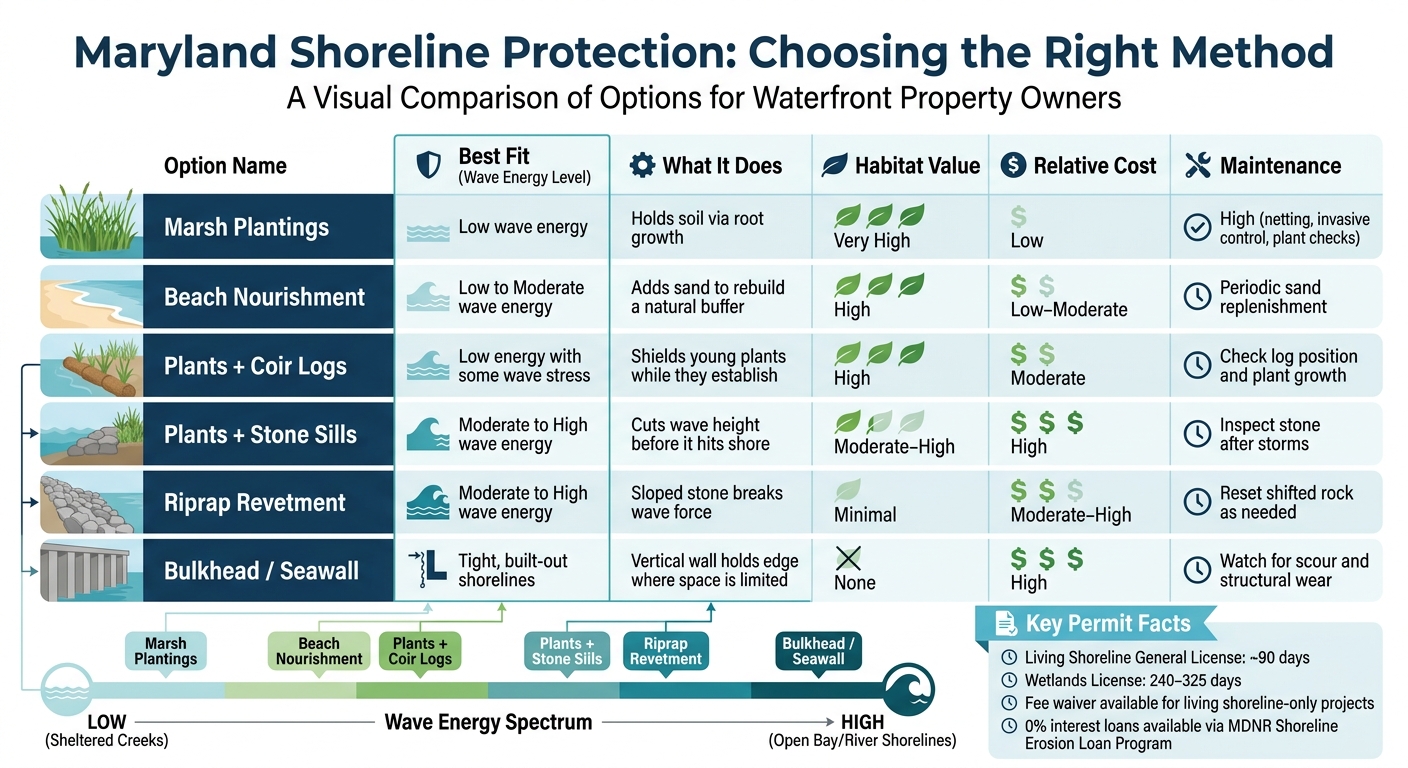
Maryland Shoreline Protection Options: Choosing the Right Method
Implementing Climate Resilient Living Shorelines in Maryland with Wesley Gould
sbb-itb-843f8be
Quick Comparison
| Option | Best Fit | What It Does | Upkeep |
|---|---|---|---|
| Marsh plantings | Low wave energy | Helps hold soil with root growth | Netting, plant checks, weed control |
| Beach nourishment | Low to moderate wave energy | Adds sand to rebuild a buffer | Sand may need to be added again |
| Plants + coir logs | Low wave energy with some wave stress | Shields young plants while they establish | Check log position and plant growth |
| Plants + stone sills | Moderate to high wave energy | Cuts wave height before it hits shore | Inspect stone after storms |
| Riprap revetment | Moderate to high wave energy | Uses sloped stone to break wave force | Reset shifted rock if needed |
| Bulkhead / seawall | Tight, built-out shorelines | Holds the edge where space is limited | Watch for scour and structural wear |
So before I spend money on shoreline work, I’d look at wave energy, bank condition, habitat limits, drainage, and permit rules as one decision, not five separate ones.
How to Assess Your Shoreline and Choose the Right Protection Level
Before you pick a shoreline treatment, take a hard look at four things: wave energy, bank condition, habitat, and upland drainage. That early review sets the direction. Some sites can handle wave energy with living features. Others need stronger structural support.
Site Conditions That Shape Shoreline Design
Start with the Maryland Shoreline Stabilization Mapper. It gives you a first pass at exposure, fetch, bank height, nearshore depth, and existing shoreline practices [2]. In Maryland, living shorelines are generally preferred unless the site is mapped for structural stabilization [2].
Then get out on the shoreline and inspect it up close. Bank height matters because it helps show how the shoreline should be stabilized. Shallow nearshore water can support marsh plantings and other living shoreline features [2].
Don’t treat upland runoff as a separate issue. Roof, driveway, and lawn drainage can weaken the bank from behind, even if the water-side edge looks like the main problem [3]. It also helps to note nearby marshes, beaches, SAV, roads, and structures, since any of them can narrow your options [2][3].
Once you have a clear picture of the site, sort the shoreline by energy level.
Low-, Moderate-, and High-Energy Shorelines in Maryland
In Maryland, shoreline energy is usually low in sheltered creeks, moderate in semi-exposed tributaries, and high along open Bay or river shorelines. That energy level shapes the kind of protection that makes sense. A low-energy site may rely on plants. A moderate site may need a hybrid setup. A high-energy site may call for hard armoring.
As you assess the bank, look for warning signs such as:
- undercut banks
- exposed roots
- slumping soil
- beach loss
- post-storm sediment plumes [2]
If you’re seeing several of those at once, marsh plantings alone may not do the job.
After you pin down the energy level, check what Maryland will allow before moving into design or construction.
Permitting and Early Planning Before Construction
Tidal shoreline work in Maryland requires a Joint Permit Application (JPA) through the Maryland Department of the Environment (MDE). If the project is solely a living shoreline, MDE waives the application fee [2].
Timing matters here. Living Shoreline General Licenses usually take about 90 days. Larger Living Shoreline Wetlands Licenses can take 240 to 325 days [2].
Before filing, document the shoreline well. That usually means photos, sketches, and erosion notes. Then request a pre-application meeting with MDE and the Maryland Department of Natural Resources (DNR). That meeting gives you a chance to confirm the right approach before you lock in the design [2].
With the permit route mapped out, the next move is picking the protection method that fits the site.
Living Shorelines and Wave Energy Reduction Methods
Once you know the shoreline’s energy level, the next step is simple in theory: pick the least structural option that can still hold the bank. In Maryland, living shorelines are the preferred stabilization method. But there’s no one-size-fits-all setup. The design needs to fit the site.
Living shorelines cut erosion by using vegetation, sand, and small structural elements to take the force out of waves. What works best depends on things like exposure, bank height, nearshore depth, and maintenance.
Marsh Plantings, Beach Nourishment, and Combined Systems
Marsh plantings are the core of most Maryland living shorelines. Spartina alterniflora and Spartina patens are commonly used to form a dense edge that helps protect the shoreline. New plantings should be protected with mesh netting until they establish [2].
Beach nourishment adds sand to rebuild a natural buffer. This usually makes sense in places that historically had a beach. It’s often paired with breakwaters or sills so the sand stays put instead of washing away.
Combined systems mix plantings with nourishment and, when needed, structural elements. They work well on sites with changing fetch, bank heights, or nearshore depths.
| Method | Suitable Wave Energy | Habitat Value | Maintenance Needs |
|---|---|---|---|
| Marsh Plantings | Low | Very High | High (initial netting, invasive control) |
| Beach Nourishment | Low to Moderate | High | Periodic sand replenishment |
| Combined Systems | Moderate | High | Moderate |
Living Shorelines with Coir Logs and Low Stone Sills
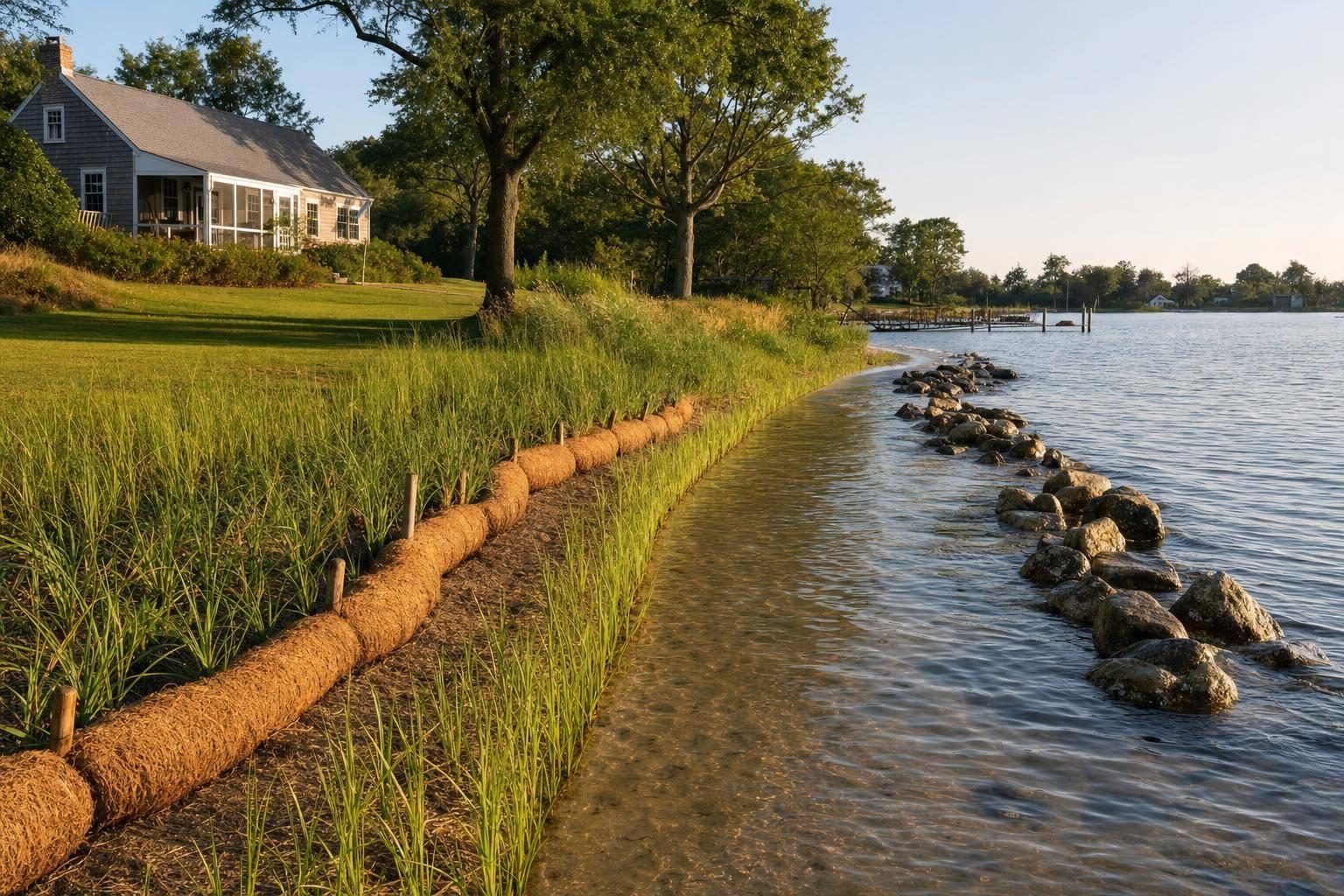
If wave energy is strong enough to wipe out new marsh plantings before they take root, coir logs can help. These are compressed coconut-fiber rolls placed at the waterline. Their job is to soften wave action while marsh grasses get established behind them. Over time, they biodegrade.
Low stone sills do a similar job in a tougher setting. These low-profile rock structures sit just offshore and cut wave height before it reaches the marsh. They tend to fit moderate to high-energy shorelines better than coir logs. They also last longer, though the price tag is higher.
| System Type | Relative Cost Band | Durability | Ecological Value | Site Suitability |
|---|---|---|---|---|
| Vegetation Only | Low | Low–Moderate | Highest | Very low energy; minimal fetch |
| Veg + Coir Logs | Moderate | Moderate (temporary) | High | Low energy; biodegradable support |
| Veg + Stone Sills | High | High | Moderate–High | Moderate to high energy; protects marsh from waves |
Oyster Reefs and Upland Drainage Improvements
Some properties need help from both sides: wave control at the shoreline and runoff control from upland areas. In some Maryland waters, oyster reefs can reduce wave energy, improve water quality, and add habitat [3].
It’s also smart to look beyond the shoreline edge. Water from roofs, driveways, and lawns can soak the bank from the landward side and weaken it, even when the waterfront edge looks fine. That’s why grading, French drains, dry riverbeds, and stable outfalls matter. These features help redirect stormwater before it reaches the bank [3]. Pro Landscapes MD handles drainage and grading that redirect stormwater before it reaches the bank.
When Structural Shoreline Protection Is Necessary
If low- and moderate-energy shoreline methods can’t hold the bank, the next step is structural stabilization. At that point, wave energy is simply too strong for a living shoreline to do the job on its own, so structural protection becomes the fallback.
Use the Maryland Shoreline Stabilization Mapper to check whether structural stabilization fits your site. If the mapper does not mark your property for structural stabilization, talk with MDE before moving ahead with a hardened design.
Riprap Revetments for Moderate to High Wave Energy
A riprap revetment is a sloped layer of large stone placed along the bank face to break up wave energy and cut erosion. Riprap works in moderate to high wave energy settings, but it offers little habitat value [1].
| Feature | Living Shoreline (with Stone Sills) | Riprap Revetment |
|---|---|---|
| Wave Energy Handled | Low to Moderate | Moderate to High |
| Wave Attenuation Method | Dissipation via vegetation and stone | Dissipation via sloped stone face |
| Habitat Impact | Enhances habitat, filters water | Minimal to no habitat support |
| Permitting | Preferred approach | Requires justification or waiver |
If you’re replacing a non-functional structure with riprap, Maryland policy leans toward keeping the new revetment from extending into a much larger footprint [3].
Bulkheads and Seawalls on Constrained Shorelines
When space is very tight, vertical walls become the last structural option. Bulkheads and seawalls are usually used on heavily developed shorelines where there’s little or no room for a buffer [3]. In Maryland, replacement bulkheads are generally allowed only when a functional bulkhead is already in place. A stone toe is also often suggested at the base to help cut scour [3].
That tradeoff matters. Vertical walls bounce wave energy back instead of absorbing it, which can increase scour at the base and make nearby erosion worse. They also don’t provide the habitat or stormwater management benefits that living shorelines can offer [1].
Planning, Maintenance, and Next Steps for Maryland Property Owners
How to Build a Shoreline Protection Plan
Once you’ve settled on the shoreline type, the next step is permits, funding, and upkeep. Use the Maryland Shoreline Stabilization Mapper, along with field photos and erosion notes, to lock in the plan.
Before you file anything, ask for a pre-application site visit with MDE and MDNR staff. That early visit can save a lot of back-and-forth if drawings are incomplete or site details aren’t clear [2]. All tidal projects require a Joint Permit Application (JPA) [2].
Permit timing varies quite a bit:
- General Licenses usually take about 90 days [2]
- Larger Wetlands Licenses can take 240 to 325 days [2]
There’s also a cost break worth noting. MDE now waives application fees for projects built ONLY as living shorelines [2].
Maryland also has a few funding options that can make these projects easier to handle. The MDNR Shoreline Erosion Loan Program offers 0% interest loans with repayment terms from 5 to 20 years [2]. On the tax side, Anne Arundel County gives a 10% property tax credit on materials and installation costs, capped at $10,000 over five years, while Dorchester County offers a 30% credit against real property taxes over 15 years for eligible erosion control structures [2].
Maintenance Tasks That Protect Long-Term Performance
After installation, the first growing season is a big one. It often decides whether the shoreline gets established the way it should.
Install 3- to 4-foot-tall mesh netting right after planting marsh grasses, and leave it in place through the full first year to stop waterfowl from grazing the plants [2]. Once the plants are established, remove the netting so it doesn’t trap debris or create problems for wildlife.
You’ll also want to check the structural parts of the system after major storms. That includes coir logs, stone sills, and riprap. If stone or logs shift, reset them. Remove large debris like logs and algae mats before they smother vegetation. On a seasonal basis, watch for invasive species such as Phragmites or English ivy, and replace them with native wetland plants [2]. Those small maintenance jobs help the marsh edge, stone sill, and bank keep doing their job as wave buffers over time.
Maryland also requires an annual maintenance report to MDE for each of the first five years after installation [2].
Don’t stop at the shoreline itself. Upland drainage matters too. Runoff from your property can weaken even a well-built shoreline from behind, so keep an eye on drainage paths and fix grading issues on the landward side as needed [3].
Conclusion: The Most Effective Maryland Shoreline Protection Strategy
The best long-term results come from caring for both the shoreline edge and the upland area behind it. Start with a plainspoken site review, use living shorelines where the site allows, and turn to structural measures only when the mapped conditions call for them. Drainage and grading on the upland part of the property play a direct role in how well any shoreline treatment holds up over time.
For landward drainage and grading support, Pro Landscapes MD serves central Maryland and Washington, DC.
FAQs
How do I know my shoreline energy level?
Use the Maryland Shoreline Stabilization Mapper to get recommendations for your site. If your site shows up as undetermined, check the physical conditions yourself. One of the big ones is fetch – the open-water distance that wind-driven waves travel before they hit your shoreline.
As a rule of thumb, low-energy sites have less than 1.0 mile of fetch. Medium-energy sites fall between 1.0 and 4.0 miles. High-energy sites have more than 4.0 miles of fetch.
You should also look at water depth, erosion trends, and prevailing winds.
When is a living shoreline not enough?
Living shorelines are usually the first choice for erosion control. But they don’t work everywhere.
At some sites, bulkheads or revetments make more sense, especially where wave energy is high, boat traffic is heavy, exposure is strong, or erosion is severe.
Geology matters too. In some areas, the shoreline itself calls for a structural fix instead of a planted one. That’s why property owners should check the Maryland Shoreline Stabilization Mapper to see whether a living shoreline or a structural approach is the better fit.
What should I do before applying for a permit?
Before you apply, take time to evaluate your site so you know what your shoreline is dealing with. That means looking at conditions like erosion rates and wave energy.
Use the Maryland Shoreline Stabilization Mapper to check the measures suggested for your property. If your site is marked undetermined, you’ll need to gather more information or use a site evaluation guide.
It’s also a good idea to contact MDNR and MDE to set up a pre-application site visit.
Chat with Us