









- bhavya gada
- No Comments
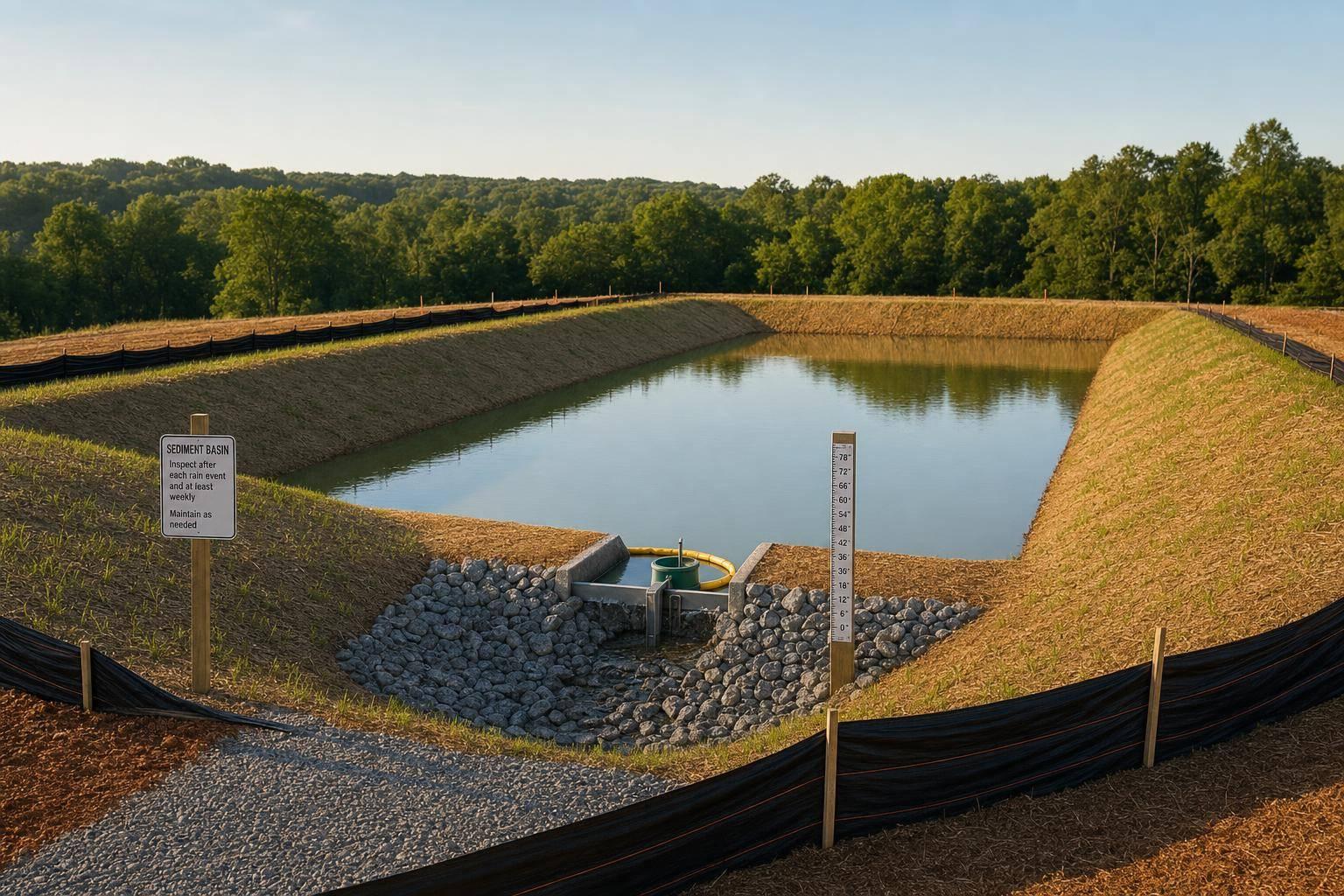
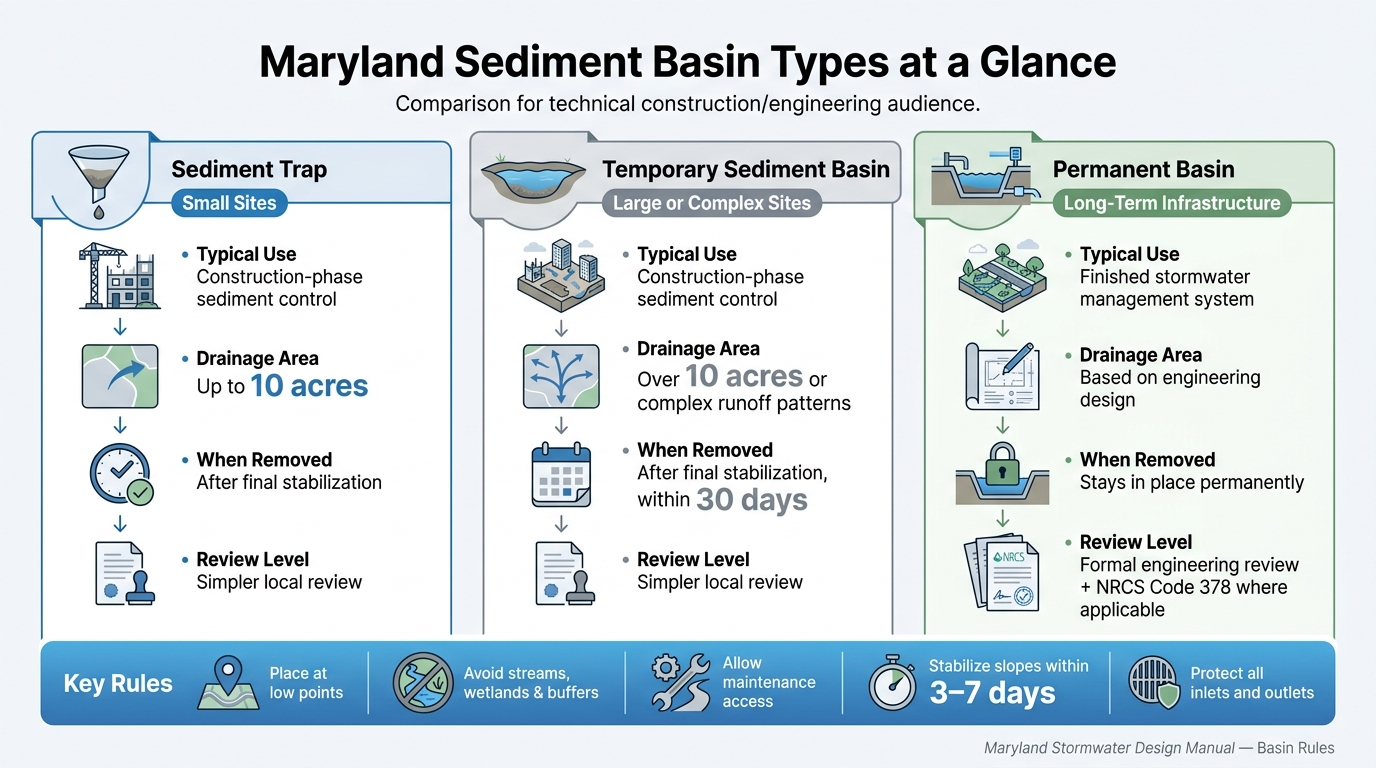
If you’re dealing with grading or drainage work in Maryland, basin rules come down to 5 things: location, size, site limits, upkeep, and removal. For construction sites, a sediment trap is generally used for drainage areas up to 10 acres, while a temporary sediment basin is used for larger or more complex runoff areas. Temporary controls must stay in place until final stabilization, then are often removed within 30 days.
Here’s the short version I’d want to know first:
- Put basins at low points so runoff drains into them.
- Keep them out of streams, wetlands, buffers, and tree-save areas.
- Leave access for cleanout and repairs.
- Stabilize disturbed slopes and channels within 3–7 days.
- Protect inlets and outlets with measures like riprap and stable outlet structures.
- Remove sediment when it reaches the plan’s cleanout level.
- Use fencing or restricted access if standing water or side slopes create a hazard.
- Permanent basins need engineered review, and in some cases NRCS Code 378 review too.
What matters most is simple: pick the right location, build from the approved plan, keep erosion controls working, and don’t remove temporary basins too early.
Quick comparison
| Basin type | Typical use | Drainage area | When removed | Review level |
|---|---|---|---|---|
| Sediment trap | Construction-phase sediment control | Up to 10 acres | After final stabilization | Simpler local review |
| Temporary sediment basin | Construction-phase sediment control | Over 10 acres or more complex runoff | After final stabilization, often within 30 days | Simpler local review |
| Permanent basin | Finished stormwater system | Based on design | Stays in place | Formal engineering review |
If I were checking a Maryland site plan, I’d focus first on basin placement, cleanout access, slope stabilization, and whether the outlet and spillway match the drainage area.
Maryland Sediment Basin Types: Trap vs. Temporary vs. Permanent
MDE Stormwater Regulations and Design Manual Updates Listening Session – January 20 (2026)
sbb-itb-843f8be
Site Selection and Placement Rules
Basin placement comes down to three things: collecting runoff, staying out of protected areas, and leaving enough room for maintenance access. This step comes before construction controls for a simple reason: if you pick the wrong spot, you can create erosion issues and access headaches that were easy to avoid.
Place Basins at Low Points with Stable Inflow Paths
Put basins at natural low points so runoff flows to them as intended. Just as important, make sure the inflow paths stay stable and non-erosive.
Avoid Streams, Wetlands, Buffers, and Protected Areas
Keep basins out of streams, wetlands, their buffers, tree-save areas, and other protected zones. Check local setback rules too. In some Maryland jurisdictions, sediment traps or basins are not allowed within 20 feet of a building.
Allow Room for Maintenance Access
Leave clear access for inspection, sediment removal, repairs, and final cleanout. It’s much easier to plan for that during layout than to deal with compliance problems later.
Once the basin location is set, temporary sediment control rules govern construction.
Temporary Sediment Control During Construction
Once the site location is set, construction-phase controls take over. In Maryland, that usually means using sediment traps or temporary sediment basins, based on the size of the site and how runoff moves across it.
Trap or Basin: Which One Does Your Site Need
Use a sediment trap for drainage areas of up to 10 acres. Use a temporary sediment basin for larger sites or for sites with more complicated runoff patterns.
Cleanout Triggers
When sediment reaches the cleanout level shown on the approved plan, it must be removed, and the storage capacity must be restored.
Removing Temporary Controls After Final Stabilization
Keep temporary controls in place until final stabilization is complete. Then remove them within 30 days, as required by local rules, and regrade and stabilize the area.
Stabilization, Safety, and Erosion Protection
Once the basin is in place, the job isn’t done. Grading alone is not enough. Any disturbed area needs to be stabilized right away, and every flow point needs protection from erosion.
Stabilize Embankments, Dikes, and Swales Quickly
Stabilize disturbed embankments, dikes, channels, and swales within 3–7 calendar days, based on site conditions. Common options include:
- Seeding
- Anchored straw mulch
- Sod
- Erosion control matting
The main goal is simple: get exposed soil covered before runoff starts wearing it away.
Protect Inflow and Outfall Points from Erosion
Provide inlet and outlet protection at all flow points. Required measures include riprap, level spreaders, and stable outlet structures.
These controls help stop runoff from cutting channels at inlets and outlets. They also reduce scour, undercutting, and sediment release at both locations.
Safety Fencing and Standing Water Considerations
Standing water in temporary basins can create a safety hazard. Use safety fencing and restricted access when standing-water depth, side slopes, or public access create a hazard.
This isn’t an add-on. These protections are part of basin compliance, not optional extras.
Design Review Checkpoints and Key Takeaways
After site placement and stabilization, the last step is plan review.
What Reviewers Check Before and During Construction
Before approval and during construction, reviewers make sure the basin can be built the way it was drawn. Before any work starts, they check that the basin is sized for the contributing drainage area and that the outlet and spillway design make sense. They also confirm there is cleanout access.
During construction, the focus shifts to field conditions. Reviewers check whether soil was stripped beneath embankments before fill was placed and whether the core trench was excavated where needed. They also verify riser installation, emergency spillway construction, and outlet protection.
When Engineering and NRCS Review Apply
Permanent sediment basins need formal engineering design. They also need formal engineering review and, where it applies, NRCS Code 378 approval before construction begins. Temporary sediment controls go through a simpler approval process.
Main Points for Maryland Drainage and Grading Work
For Maryland drainage and grading work, reviewers pay close attention to basin sizing, drainage area, outlet design, cleanout access, and embankment preparation. Permanent sediment basins need formal design review before work starts, while temporary sediment controls follow a simpler approval path.
FAQs
How do I choose between a sediment trap and a temporary basin?
It mostly comes down to project size and soil conditions.
Temporary sediment basins are usually the better fit for larger sites and longer-term dewatering. Sediment traps tend to work better for smaller sites or disturbed areas that are more limited in scope.
Basins can handle larger flows, but there’s a trade-off: they often take more setup and more upkeep, including monthly dredging. Soil type also plays a part. If the site has coarser soils, a basin may do a better job of filtration.
What counts as final stabilization before a basin can be removed?
Before a sediment basin can be removed, all disturbed soil areas on the site must be fully stabilized.
In most cases, that means the site has reached at least 70% vegetation density compared to nearby undisturbed ground. If vegetation isn’t the method used, an approved option like mulch can also meet the requirement.
You also need to document the site condition. That includes:
- Dated, multi-angle photos that show the coverage
- A record of the stabilization methods used
Once that documentation is in place, you can file a Notice of Termination (NOT).
When does a basin need formal engineering or NRCS review?
In Maryland, larger residential projects over 30,000 square feet usually need plans that are signed and sealed by a licensed design professional. Those plans also generally need approval from the local Soil Conservation District.
Smaller lots may be able to use standard plans. That said, a project can still trigger a formal engineering review if it changes drainage in a major way, disturbs a large area, or includes more complex elements like large retaining walls.
It’s smart to check with your local jurisdiction or permitting authority early, before plans are too far along.
Chat with Us