









- bhavya gada
- No Comments
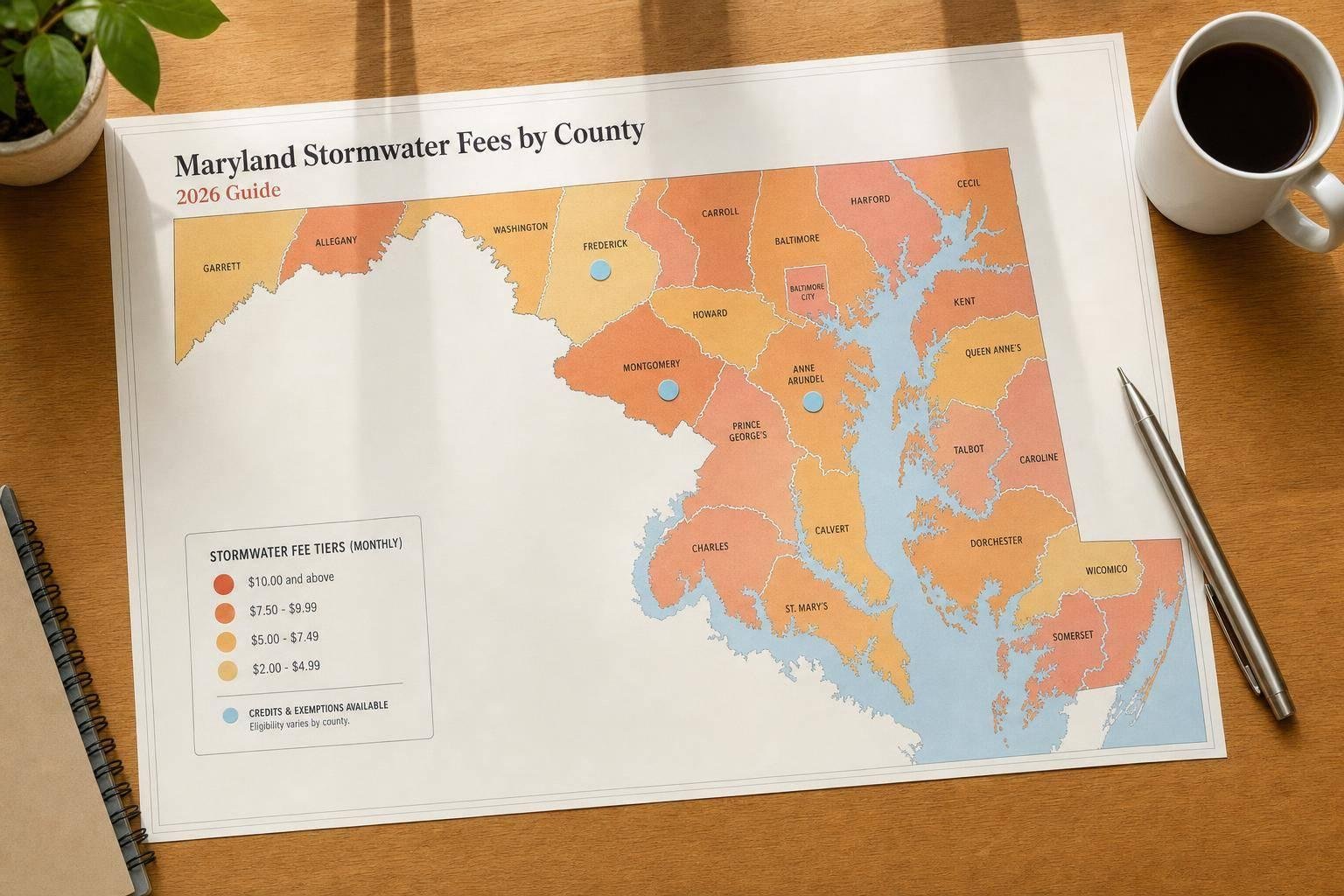
Maryland does not have one statewide stormwater fee._ In 2026, the charge depends on your county, your property type, and often your impervious area like roofs, driveways, and other hard surfaces. On many tax bills, you’ll see it as stormwater, water quality, watershed protection, or remediation.
If I wanted the short answer, here’s what I’d keep in mind:
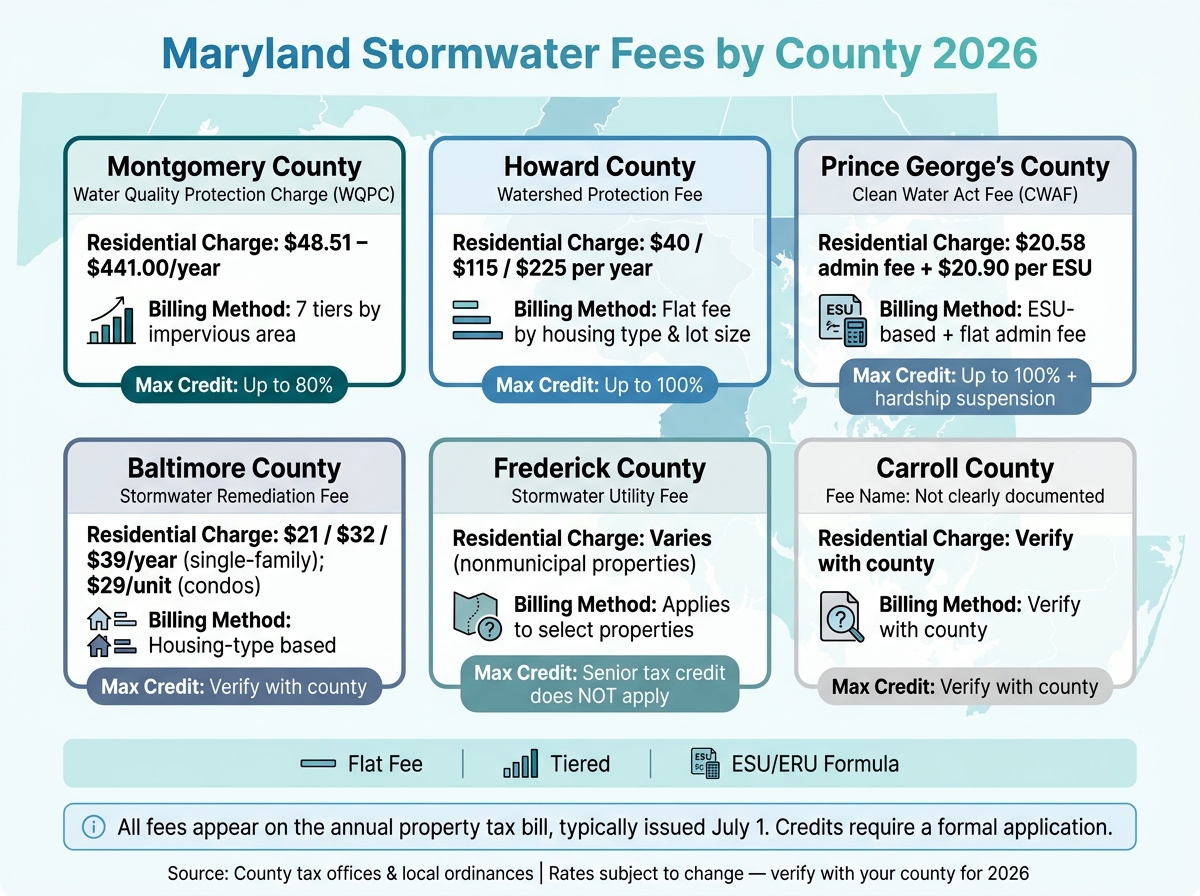
- Montgomery County: $48.51 to $441.00 per year for many single-family homes, using 7 tiers
- Howard County: $40, $115, or $225 per year for most residential properties
- Prince George’s County: $20.58 admin fee plus $20.90 per ESU
- Baltimore County: residential fees listed at $21, $32, or $39, with $29 per condo unit
- Frederick County: fee applies to some nonmunicipal properties
- Carroll County: fee details should be checked with the county
A few patterns show up across counties:
- The fee usually appears on the annual property tax bill
- Counties use flat fees, tiers, or ERU/ESU formulas
- Credits can cut charges by up to 80% or even 100% in some programs
- Some counties offer exemptions or hardship relief, but the rules change by county
If you own property in Maryland, the main job is simple: find the line item, check how your county calculates it, and see whether your property may qualify for a credit or exemption.
Maryland Stormwater Fees by County 2026: Side-by-Side Comparison
Where does revenue from Maryland’s ‘rain tax’ go?
sbb-itb-843f8be
Quick Comparison
| County | Fee Name | Main Residential Charge | Billing Method | Credit / Relief Note |
|---|---|---|---|---|
| Montgomery | Water Quality Protection Charge | $48.51 to $441.00 | 7 tiers by impervious area | Up to 80% credit |
| Howard | Watershed Protection Fee | $40, $115, or $225 | Flat residential categories | Up to 100% credit |
| Prince George’s | Clean Water Act Fee | $20.58 + $20.90 per ESU | ESU-based + admin fee | Up to 100% impervious-area reduction; hardship help |
| Baltimore | Stormwater Remediation Fee | $21, $32, $39; condos $29/unit | Housing-type based | Check county for current rules |
| Frederick | Stormwater Utility Fee | Varies | Applies to some nonmunicipal properties | Senior tax credit does not apply |
| Carroll | Not clearly listed | Check county | Check county | Check county |
Below, I break down how these county fees work, where they show up, and what may lower the amount.
How Counties Calculate and Bill Stormwater Charges
Once you know the basic terms, county stormwater bills start to make a lot more sense. In Maryland, counties don’t all use the same formula. Each one sets up its own billing method based on local property data and how its tax system works. That’s why the charge can look one way in one county and quite different in the next.
Flat Fees, Tiers, and Impervious-Area Formulas
The three most common methods are flat per-parcel fees, residential tiers, and ERU/ESU formulas.
A flat fee means every eligible parcel in a group pays the same amount, no matter the lot size. It’s simple. But it also means a small townhouse can get the same charge as a much larger home with a broad driveway.
A tiered system sorts properties into bands based on lot size or estimated impervious area. Howard County uses flat residential tiers based on housing type and lot size.[15][16][6]
An ERU/ESU formula links the charge to impervious area. The county sets a standard unit size, then divides a property’s impervious area by that unit to find the number of billable units. This method shows up often for larger non-residential or multi-family parcels, where runoff can vary a lot more from one site to another.
Montgomery County uses seven residential tiers based on impervious area.[1][14] Prince George’s County uses an ESU-based fee.[10][12]
Where the Fee Appears on Bills and Online Accounts
In central Maryland, the stormwater charge usually shows up as a separate line item on the annual property tax bill, which is generally issued around July 1.
The wording changes by county. You might see Water Quality Protection Charge (WQPC) in Montgomery County, Clean Water Act Fee or Impervious Area Fee in Prince George’s County, and Watershed Protection Fee in Howard County.[1][10][15][16][6] Some counties split the charge into two parts: an administrative fee and an impervious-area fee.[10][12] On online tax portals, it may also sit under water quality or environmental headings.
Credits, Reductions, and Documentation Requirements
Most Maryland county programs let property owners cut the impervious-based part of the fee by installing approved stormwater practices.[3][8][9][12] In some programs, credits can reach 80% of the impervious-based charge. In certain Clean Water Act fee setups, owners may get up to 100% of the impact fee portion, while still paying the smaller administrative part.[3][8][10][12]
That said, credits don’t just appear on their own. Counties usually ask for a formal application, a site plan or sketch, dimensions or storage capacity for the installed practice, photos of the completed work, and a signed maintenance agreement.[3][8][9][12] Many counties also require maintenance logs to keep the credit in place. If the practice is removed or allowed to fall into poor condition, the credit can be reduced or taken away.[3][8][9]
Some counties also offer hardship reductions for low-income homeowners, seniors, disabled owner-occupants, and qualifying nonprofits.[4][11][2]
County Billing Methods at a Glance
The table below shows the main billing patterns used in central Maryland.
| County | Calculation Method | Residential Example | Typical Bill Label | Where It Appears |
|---|---|---|---|---|
| Montgomery | Seven residential tiers by impervious area; non-residential billed by ERU[1][14] | Tier 1: ≤1,000 sq ft = $48.51; Tier 7: >6,215 sq ft = $441.00[1][14] | Water Quality Protection Charge (WQPC) | Annual property tax bill |
| Prince George’s | ESU-based fee with a small administrative fee[10][12] | Tier 1: 0.6 ESU; Tier 2: 1.0 ESU; Tier 3: 2.0 ESU at $20.90 per ESU[10][12] | Clean Water Act Fee / Impervious Area Fee | Annual property tax bill |
| Howard | Flat residential fee by housing type/lot size; non-residential billed by impervious area[15][16][6] | Condominiums and townhouses: $40; single-family detached ≤0.25 acre: $115; single-family detached >0.25 acre: $225[15][16][6] | Watershed Protection Fee | Annual property tax bill |
These billing methods are the reason county stormwater charges don’t all look the same on paper. The formula, the label, and even the way the fee is split can change depending on where the property sits.
County-by-County Overview for Central Maryland
Montgomery County, Howard County, and Prince George’s County
These counties all use the billing approaches noted above, but the actual charges and credit rules can look very different from one place to the next.
Montgomery County uses the Water Quality Protection Charge (WQPC). It applies to all property owners, including homeowners, businesses, HOAs, and nonprofits.[5] The charge is based on impervious area, and 1 ERU equals 2,406 square feet. The current rate is $147.00 per ERU.[17] For single-family homes, Montgomery County uses a seven-tier schedule, with annual charges ranging from $48.51 to $441.00, based on impervious area. Townhomes and condos often land in lower tiers because they usually have less impervious surface.[17][18] Homeowners who install approved stormwater practices may qualify for credits of up to 80% of the charge.[8]
Howard County uses a Watershed Protection Fee, billed once a year on the July 1 property tax bill.[7] Its residential setup is pretty simple:
- $40 per year for townhouses, apartments, and condominiums
- $115 per year for single-family detached homes on lots of one-quarter acre or less
- $225 per year for single-family detached homes on lots larger than one-quarter acre
Commercial and other non-residential improved properties pay $40 for every 500 square feet of impervious surface.[7] Credits can go as high as 100% for qualifying residential and commercial properties.[6]
Prince George’s County uses the Clean Water Act Fee (CWAF). This fee has two parts: a flat $20.58 administrative fee per tax account each year, plus an impervious area fee of $20.90 per Equivalent Service Unit (ESU) for properties with impervious area.[12] In this county, 1 ESU equals 2,465 square feet of impervious area.[12] The fee is charged annually through the property tax bill. Exemptions apply to properties inside the municipal limits of the City of Bowie, along with property owned by the state, county, municipalities, or volunteer fire departments when used for public purposes.[12] Approved stormwater practices can cut the impervious-area fee by up to 100%, and eligible hardship homeowners may receive a full annual suspension.[10]
Baltimore County, Frederick County, and Carroll County
Baltimore County shows a stormwater remediation fee on the county property tax bill. For residential properties, the fee depends on housing type: $21, $32, or $39 per year for single-family homes, and $29 per dwelling unit for condominiums.[20][13] The fee is generally due July 1, though semiannual payment options may also be available.[20] Because county sources can change, homeowners should check the current rate with the county.
Frederick County charges a stormwater utility fee for nonmunicipal properties, not including government parcels and volunteer fire company parcels.[19] For properties that owe it, the fee appears on the county property tax bill. The senior tax credit does not apply to this charge.[19]
In places where public county records are less clear, it makes sense to confirm the current amount directly with the local office.
Carroll County: Verify the fee directly with the county tax or public works office.
Central Maryland County Fee Details Compared
The table below gives a side-by-side look at the main differences.
| County | Official Fee Name | Basic Residential Charge | Key Credit/Exemption Note |
|---|---|---|---|
| Montgomery | Water Quality Protection Charge (WQPC) | Seven-tier charge; $48.51–$441.00/year; 1 ERU = 2,406 sq. ft. at $147.00 per ERU[17] | Up to 80% credit for qualifying stormwater practices[8] |
| Howard | Watershed Protection Fee | $40, $115, or $225/year depending on housing type and lot size[7] | Credits up to 100% for qualifying properties[6] |
| Prince George’s | Clean Water Act Fee (CWAF) | $20.58 administrative fee plus $20.90 per ESU; 1 ESU = 2,465 sq. ft.[12] | Up to 100% reduction; hardship suspension available[10] |
| Baltimore | Stormwater Remediation Fee | $21, $32, or $39/year for single-family; $29 per dwelling unit for condos[20][13] | Not clearly documented in current sources; verify with county |
| Frederick | Stormwater Utility Fee | County fee for nonmunicipal properties[19] | Senior tax credit does not apply[19] |
| Carroll | Not clearly documented | Verify with county | Verify with county |
How Homeowners Can Find, Review, and Possibly Lower Their Fee
How to Look Up Your Property’s Current Charge
Once you know your county’s fee name and how it shows up on your bill, the next step is simple: check your own property.
Start with your most recent county property tax bill or your county’s online property or account portal. Look for the charge under stormwater, drainage, environmental, or utility headings.
If you don’t have the bill in front of you, search the county portal using your:
- Street address
- Tax account number
- Parcel ID
Still not seeing it? Contact the county office that handles the fee and ask if it applies to your property and how the county bills it.
What Affects Your Fee Amount
For most homeowners, the biggest driver is the amount of impervious surface on the property. That’s the hard stuff that doesn’t soak up water, like roofs, driveways, patios, sidewalks, and similar surfaces.
In plain English, more hard surface usually means a higher fee.
Depending on how your county sets up billing, your housing type and lot size may also affect the amount.
On-Site Improvements That May Support Fee Credits
If the bill looks too high, first check the county’s parcel data. Fee amounts usually follow the impervious-area data the county has on file, so compare this year’s bill with last year’s and review the parcel record if something seems off. Then call or email the county to ask for a parcel review.
If the data looks right, shift your attention to approved property improvements that may cut the bill. Some counties give credits for things like rain gardens, permeable paving, French drains, and dry riverbeds. But there’s a catch: credits usually aren’t automatic.
Counties often ask for:
- An application
- Photos
- A site sketch or plan
- A maintenance agreement
Planning drainage work or a hardscaping project that might qualify? Check the county’s rules before work starts. That small step can save a lot of back-and-forth later.
Conclusion: What Maryland Property Owners Should Keep in Mind for 2026
Maryland stormwater fees are local charges, not one statewide rule. Each county sets its own fee name, rate, and way of figuring the bill. So if you own property in more than one county, or you’re comparing one county to the next, don’t assume the billing method is the same.
Once you know how your county handles it, the next step is simple: find the charge on your bill. In most cases, it shows up as a separate line item on the property tax bill. Check for terms like stormwater, water quality, watershed protection, or remediation when you review your bill or log into the county’s online portal.
If the charge looks higher than expected, it’s worth taking a second look at your property upgrades. Added drainage work may qualify for a fee credit. In many counties, that means filing an application and sending in supporting documents.
Rates, credit percentages, and exemption rules come from local ordinances and yearly budget decisions, which means they can shift from one year to the next. Before you budget for 2026 or start any landscape work, confirm the current rate, exemption status, and credit rules with your county.
FAQs
How do I find my stormwater fee?
Start with your annual property tax bill. Many counties, including Howard County, show recurring charges there, such as the Watershed Protection Fee.
If your area doesn’t use a tax bill for this, or if you’re looking into construction-related costs, contact your county’s permitting or environmental agency. You can also check your county’s official website or the Maryland OneStop portal for property-specific fee or permit details.
Why is my county fee different?
Stormwater fees vary by county because local governments in Maryland decide how to fund stormwater systems on their own. That leads to different rules and pricing from one county to the next.
Some counties charge an annual fee tied to the amount of impervious surface on a property. Others charge fees only when construction or land disturbance takes place and a permit is needed. In some cities or towns, separate local utility fees can also affect what you pay on top of county-level charges.
Can I lower my stormwater charge?
Yes. In many Maryland counties, homeowners can cut their annual stormwater fee – and in some cases wipe it out entirely – by installing approved on-site stormwater controls.
Here’s what that looks like in practice:
- Howard County offers up to 100% credit through the CleanScapes Program.
- Montgomery County allows fee cuts of up to 60% through approved Environmental Site Design or other Best Management Practices.
There’s usually a catch, of course: you need to install a county-approved system and submit the required paperwork to get the credit.
Chat with Us