









- bhavya gada
- No Comments
If a small yard swale in central Maryland is failing, I’d first check grade, soil, lining, and outlet. Most problems come from a flat spot, compacted clay soil, washout in fast flow, or no safe place for water to exit. On lots as small as 5,000 to 9,500 sq. ft., with about 41–45 inches of rain each year, even a short swale has to move water away from the house and keep it off nearby property.
Here’s the short version:
- I’d look for a steady downhill slope, with at least 2% grade
- I’d check whether water sits longer than 24–48 hours
- I’d test if the swale bottom is compacted or slow-draining
- I’d use grass for slow flow, stone for erosion-prone spots, or a dry creek bed where drainage and looks both matter
- I’d make sure the swale has a safe outlet and an overflow route
- I’d get county review before layout changes if the swale ties into a public drain, lot line, or formal drainage setup
A few design numbers matter most: keep side slopes around 3:1 or flatter, many small swales work best with a 2–8 foot bottom width, and outlet routing should keep flow away from the home. If ponding keeps coming back, a French drain or rain garden tie-in may be the next step.
DIY Backyard Drainage Swale SUCCESS!!
sbb-itb-843f8be
Quick Comparison
| Fix | Best for | Main issue it solves | Typical fit on small lots |
|---|---|---|---|
| Regrading | Flat or uneven swales | Standing water, reverse flow | Good if there’s room to reshape |
| Grass lining | Mild slopes and slow runoff | Light erosion | Best on open lawn areas |
| Stone lining | Fast flow, shade, scour | Washout and bare soil | Good in tight side yards |
| Dry creek bed | Visible drainage paths | Erosion plus appearance concerns | Good near patios, fences, and side yards |
| French drain tie-in | Compacted soil or repeat ponding | Water that won’t soak in or drain out | Useful where open flow alone fails |
| Rain garden tie-in | Swales that need added soak-in area | Extra runoff volume | Works if yard space allows |
That’s the core of it: diagnose the cause first, then match the fix to the flow, the soil, and the outlet.
Diagnose the Problem Before You Change the Swale
Walk the swale after a moderate rain and match what you see to the cause.
Check Slope, Low Spots, and Drainage Area
The most common troublemakers are flat sections and reverse grades. You don’t need fancy gear here. A string line and a 4-foot level are enough to spot them. If any part of the swale sends water back toward the house or holds water between storms, that’s a red flag. And if water sits for more than 24–48 hours after rain, that’s a solid sign the slope, outlet, or soil isn’t doing its job.[9]
As you follow the channel, track every inflow point. That includes:
- Roof downspouts
- Driveway edges
- Sump pump outlets
- Runoff coming from a neighboring yard
This part matters. A narrow, shallow swale that takes water from multiple roofs plus a driveway may just be too small for the amount of runoff it’s getting. Bare soil and scour on the steepest section usually mean too much flow. Thin grass without rills points more to soil or vegetation failure.
Test Soil Infiltration and Compaction
After you check the slope, test the soil. Dig a hole about 12 inches deep in the swale bottom. Pre-wet the hole, fill it again, and time how fast the water drops. If the rate is below 0.5 inches per hour after the soil is already saturated, poor percolation is likely the issue. That usually means clay-heavy or compacted subsoil that can’t take in runoff fast enough.[10][11]
Then do one more simple check. Push a long screwdriver or soil probe into the swale bottom and compare that to the lawn nearby. If it goes in with little effort on the lawn but hits a hard stop in the swale, traffic or equipment has likely compacted the soil and cut off infiltration.
Taken together, these two tests tell you what kind of fix makes sense. Poor infiltration plus a hard layer usually means regrading alone won’t solve it. In that case, you may need deep tilling, soil amendment, or an underdrain before anything else.[2] Once you know whether the problem is the grade, the soil, or outlet capacity, you can pair it with the right regrading or lining fix.
When Layout Changes Need a Professional Review
If the issue points to layout changes instead of basic upkeep, check the property limits and permit rules first. If the swale connects to a public drain, sits on a lot line, or belongs to a permitted stormwater facility, get county review before changing the layout.
Prince George’s County requires the centerline of a drainage swale or storm drain to be at least 15 ft from a residential structure. Moving a swale closer than that may trigger formal review.[5] Montgomery County design criteria also set minimum separation distances and require swales to handle the 10-year storm with freeboard. That’s beyond what most homeowners can confirm with a string line.[6]
If you’re dealing with repeat drainage trouble, runoff crossing a lot line, or a swale tied to a formal stormwater facility, contact your county’s stormwater or environmental services office before making layout changes. A drainage contractor who knows central Maryland county standards can also help you check whether a permit or engineered plan is needed before work starts.
Regrading and Lining Fixes for Small Residential Swales
Match the fix to the problem: regrade for slope, line for erosion, or use both when the swale needs shape and surface help.
Regrade for a Steady, Erosion-Resistant Flow Path
Regrade the swale so water moves downhill in a smooth, steady way without ponding or cutting into the soil. A good target is a 2% to 4% slope.[1][14] If the bottom has low spots, fill them with soil in thin, compacted lifts until the channel follows one clean downhill line. If there are humps, cut them down and blend them into the nearby grade so water stays on course instead of getting shoved sideways toward a fence or foundation.
Shape matters here. Widen narrow sections to a 2–8 ft bottom width and keep side slopes at 3:1 or flatter.[14][7][8] That gives water more room and lowers the chance of washouts.
On tight suburban lots, this may mean small grade changes near patios or fence lines. The goal is simple: keep the flow path broad and continuous instead of squeezing runoff through a skinny choke point.
Choose Grass, Stone Lining, or a Dry Creek Bed Based on Flow
Pick the lightest fix that can handle the flow. Grass works for slow sheet flow. Stone works better when water moves faster or gets forced into a tighter path.[14][7][8][1][17][15]
| Swale Type | Erosion Resistance | Appearance | Upkeep | Fit for Tight Lots |
|---|---|---|---|---|
| Grass / vegetated | Moderate; works well at slopes ≤ 4% with low velocity | Green, natural; blends with lawn | Mowing, reseeding, aeration; sensitive to shade and compaction | Very good where 2–8 ft bottom width and 3:1 slopes are possible |
| Stone-lined swale | High; resists scour where grass fails on steep or shaded runs | Plain; functional | Periodic debris removal and weed control; stones may need resetting after extreme storms | Good for narrow, high-flow paths and under downspout discharges |
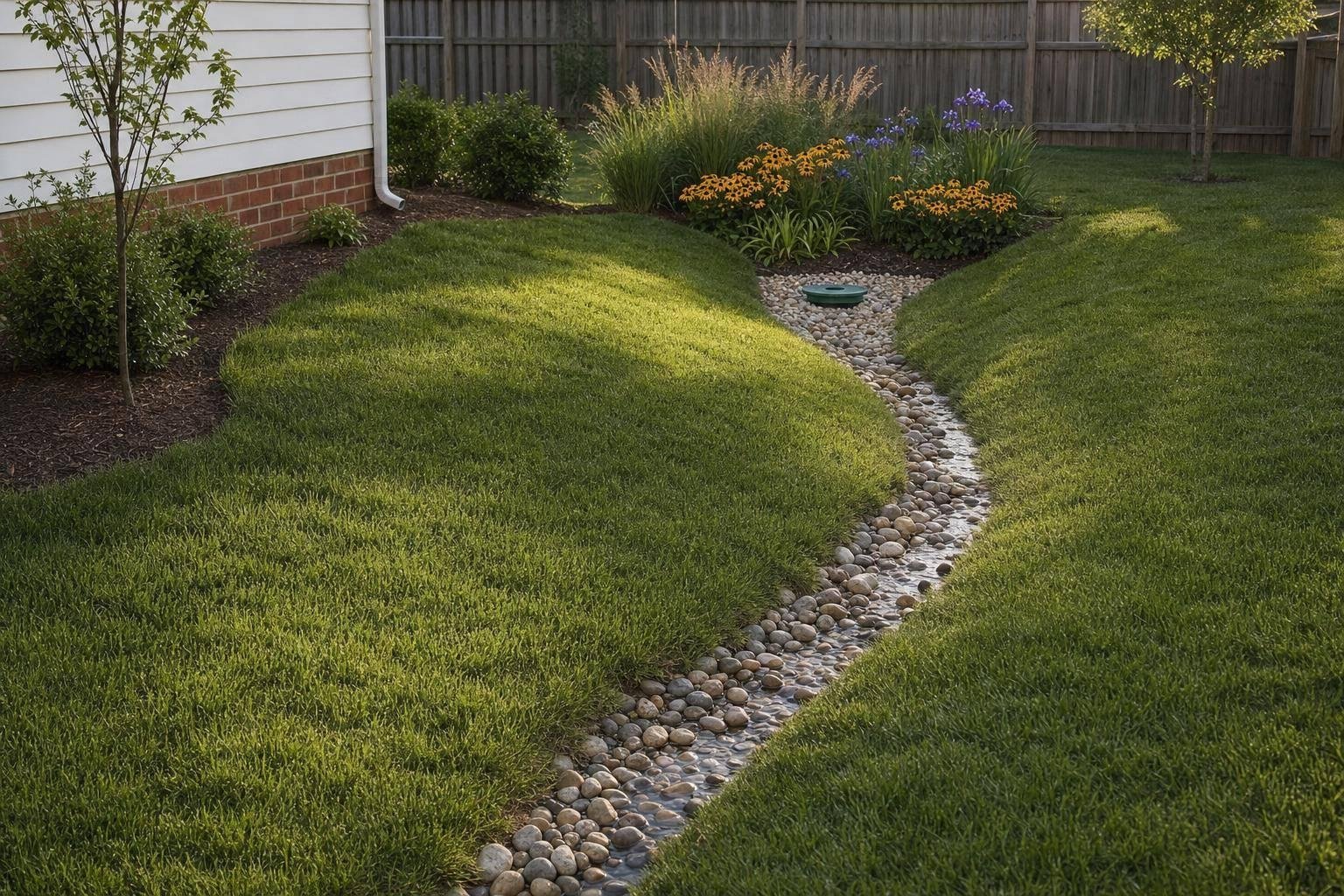
| Dry creek bed | High; decorative stone-lined channel built for drainage and stability | Attractive; works as a landscape feature | Low mowing; similar debris and weed management | Excellent where the route is visible or needs to double as a landscape feature |
A grass swale is usually the best place to start when the slope stays at 4% or less, turf can get established before the main storm season, and runoff enters as sheet flow instead of a concentrated jet.[14][7]
When the slope gets steeper, shade keeps turf thin, or the soil already shows scour marks, stone lining is the more practical fix. And if the swale runs through a visible side yard or between a patio and fence, a dry creek bed can do the same drainage job while looking planned rather than patched in.[17][15]
In many central Maryland yards, the answer lands somewhere in the middle: grass through the flatter middle stretch, then stone or dry creek treatment at steeper drops or tight turns.
Use Check Stones, Fabric, and Grade Breaks Only Where They Help
These add-ons are for steep or erosion-prone spots, not for the whole swale. If erosion isn’t the main issue, they can be overkill.
Landscape fabric (geotextile) goes under stone linings on steep or high-flow sections. It separates rock from soil and helps stop fine particles from working up into the stone over time.[17][18] On newly graded bare soil that will be seeded, an erosion control blanket protects the surface while grass fills in.[17][18]
Small rock check dams slow water down and help sediment settle before runoff reaches the outlet. They work best in swales draining about 10 acres or less. Use angular stone that is usually 3–7 inches in size, and set the center crest about 6 inches lower than the edges so water spills over the middle instead of cutting around the sides.[19][20][21][22][23]
Grade breaks do a similar job on longer swales with more drop, splitting one long run into shorter, gentler sections.[7][16]
Use these tools sparingly. Too many can make the swale act more like a fast conveyance channel than an area that soaks water in. They also collect debris fast. If check dams aren’t cleaned out, they can back water up or leave standing pools.
If the swale still backs up after these fixes, the next step is outlet control and overflow routing.
Drain Tie-Ins, Outlet Control, Plant Layout, and Overflow Routes
Connect Swales to Drains, French Drains, or Rain Gardens Correctly
If grading and lining still leave water sitting in place, the next step is to fix how the swale connects at the inlet and outlet. A pipe, French drain, or rain garden should come into play only when an open swale can’t move water out safely. An open swale works when vegetated flow stays non-erosive and the drainage area is small enough for the channel to handle.[28][3][13]
A subsurface drain is often the better fit when low spots hold water for more than a day, soils are too compacted to drain well, or the flow path gets squeezed near a structure or building restriction line.[29][27][6][24]
Set the inlet or berm above the low-flow line so day-to-day runoff stays inside the swale. Then, during larger storms, the basin or garden can turn on without sending water back toward the house.[25][27] Where water enters as concentrated flow, add a gravel pad or rock apron to keep the inlet from washing out.[12][31]
| System Type | Best Use Case | Complexity | Typical Scope on a Tight Lot |
|---|---|---|---|
| Swale only | Gentle slopes, non-erosive velocities, and adequate soil drainage | Low | Regrade, plant, and stabilize the outlet. |
| Swale + French drain | Compacted soils, recurring ponding, high velocities, or water that must be intercepted before crossing a lot line | Moderate | Perforated pipe in stone with a stable outlet. |
| Swale + rain garden | Lots needing both conveyance and infiltration, with room for a planted basin | Moderate | Shallow basin with amended soil and overflow. |
One mistake to avoid: don’t pipe a sump pump discharge straight into a swale or rain garden. That flow can overload small drainage features and erode the inlet area.[4]
Build a Controlled Outlet and a Clear Emergency Overflow Path
Every swale needs two things at the downstream end: a controlled outlet for normal storms and a clear overflow route for bigger events. Size the outlet for the 10-year, 24-hour storm and keep at least 6 inches of freeboard. Montgomery County uses 0.5 feet of freeboard and 6 inches of ponding depth before overflow begins.[12][6] Send outflow to a stable vegetated area, rock outlet, stream, or storm drain.[31]
Keep the swale and its outlet at least 15 feet from any residential structure. Also send concentrated flow away from septic components and other sensitive areas.[5][6]
If the outlet can’t carry normal storms, the overflow path becomes the next safe route. Grade it, vegetate it, and keep it clear of sheds, fences, or landscape features that could block flow. In Prince George’s and Montgomery Counties, these overflow routes may need to stay inside drainage easements so they don’t affect neighboring properties.[24][6]
Place Maryland-Friendly Plants Where Moisture Levels Change
Once the flow path is set, plants should hold the swale in place without squeezing it narrower. This isn’t just about looks. It’s about matching plants to moisture levels across the channel and keeping the low-flow line open.
University of Maryland Extension rain garden guidance breaks planting into three moisture zones that also work well for swales:[30] the wet bottom, the mid-slope, and the drier upper edge.
- At the bottom, use deep-rooted grasses and sedges that can handle periodic inundation and dry periods between storms.[26][3]
- On the mid-slope and berm, grasses, perennials, and smaller woody plants help hold the channel sides and slow sheet flow without creeping into the main channel.[27][26]
- At the upper edge, more drought-tolerant perennials and shrubs can frame the swale, intercept shallow overland flow, and add screening, as long as they stay out of the flow path.[26][27]
Keep the center open for water movement and put stabilizing plants along the sides. After planting, routine cleanup helps keep the low-flow line clear.
Maintenance, Costs, and Final Takeaways
Maryland Swale Fix Comparison: Cost, Use Case & Complexity
How to Maintain a Swale So It Keeps Draining
Once the swale is built, upkeep is what keeps it doing its job. After major storms, walk the swale and look for spots where water stalls, spills over, or hangs around. If water is still sitting there after 24–48 hours, compaction, poor grading, or a blocked outlet is often the cause.[32][34]
A simple seasonal routine helps stop small issues from turning into bigger repairs:
- Spring: Clear debris, remove 1–2 inches of sediment, and reseed bare spots.
- Fall: Remove leaf buildup and trim turf that has crept into the channel.
- Winter: Keep inlets and grates clear, and don’t pile snow in the swale.
If erosion keeps showing up in the same place, add a check stone or flow dissipator there.[33]
What Drives Project Cost and Scope on Small Lots
Project scope, not just the repair itself, shapes the budget. On small lots, cost usually comes down to grading volume, site access, stone quantity, drain length and depth, and the work needed to restore the area afterward.
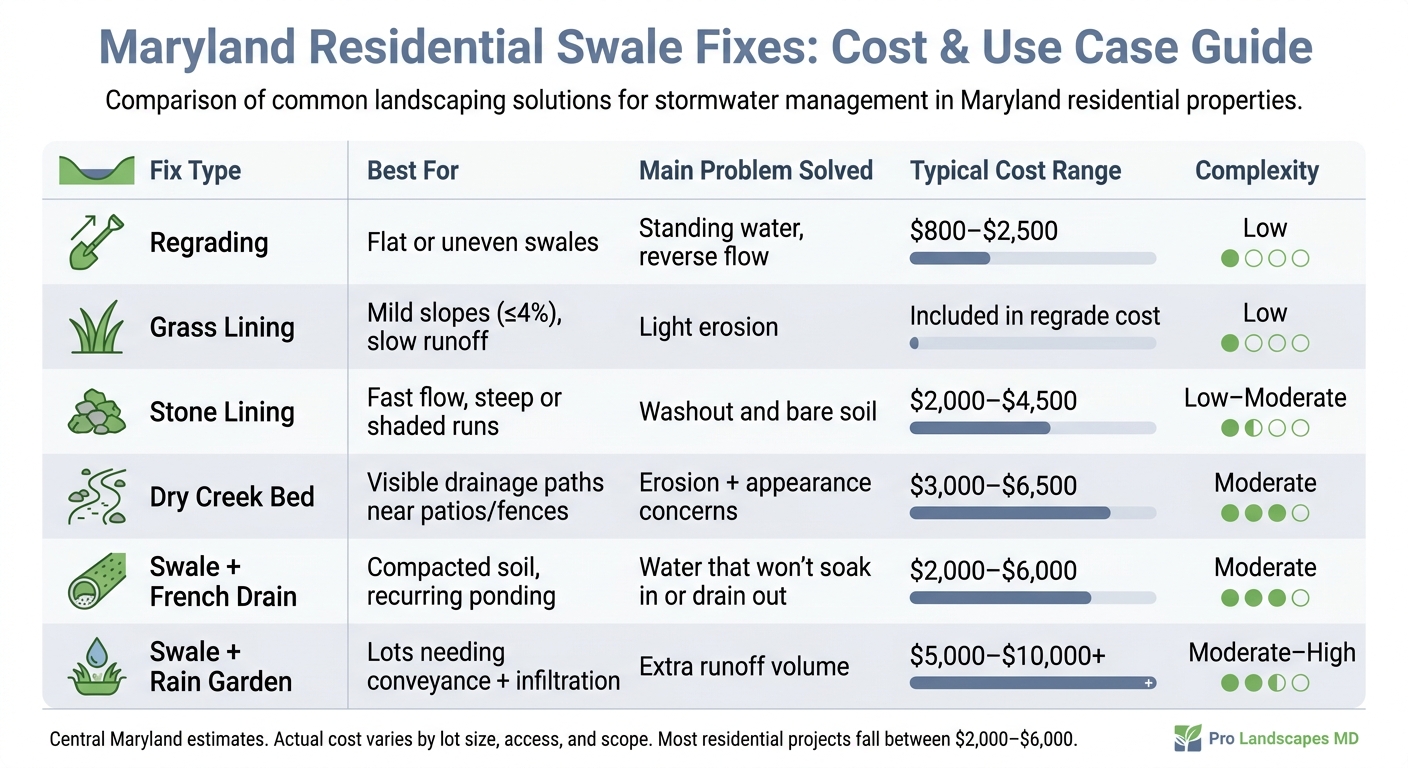
Simple landscape swales often cost $800–$2,500. Gravel-lined swales usually fall around $2,000–$4,500. Dry creek bed styles tend to run $3,000–$6,500, while engineered stormwater swales can land in the $5,000–$10,000+ range.[35]
In central Maryland, most residential swale projects tend to fall between $2,000 and $6,000 when grading, stone, and outlet work are all part of the job.[35]
Conclusion: The Key Fixes That Make a Small Swale Work
After cost, the main point is pretty simple: a swale works when the steps happen in the right order. First, check slope and soil. Then regrade for steady flow, stabilize spots that keep eroding, connect the swale to a safe outlet, and keep up with maintenance so sediment doesn’t slowly undo the work.
Pro Landscapes MD provides grading, drainage, French drains, dry riverbeds, stormwater management, and landscape restoration across central Maryland.
FAQs
How do I know if my swale needs regrading or a drain?
If you keep seeing water pooling or signs of water damage around your property, your swale may need regrading or a drain.
A swale is supposed to move water away from the area. When it doesn’t, the slope may be off, or you may need a proper drainage system. Pro Landscapes MD provides grading, land leveling, and drain pipe placement across central Maryland.
What is the best lining for a small swale in Maryland?
For a small swale in central Maryland, stone lining is a smart way to manage stormwater and help stop erosion.
It’s often installed as a dry riverbed, which gives the swale a tough surface that can handle moving water without washing out. Natural stone or gravel also helps the area hold its shape over time, which matters a lot on tight suburban lots where every foot counts.
When do swale changes require county approval?
In central Maryland, you’ll usually need county approval when swale changes involve structures that set off local permit rules.
For example, a retaining wall may need a permit if it:
- exceeds 3 feet (36 inches)
- supports a surcharge load
- crosses a property line
- involves problem soils
- is part of a tiered system
Pro Landscapes MD recommends checking with your local Department of Permitting Services before work begins.
Chat with Us