









- bhavya gada
- No Comments
If your Maryland yard project disturbs 5,000 square feet or more, you’ll likely need a formal stormwater plan. That is the main state trigger, and counties may still ask for more even when your job seems small.
Here’s the short version: I’d check total disturbed area across the whole site, confirm whether the county wants drainage or grading review, and make sure the design follows ESD to the MEP under current Maryland rules. That means trying to keep runoff on-site and slow it down near where it falls.
Before work starts, I’d focus on these points:
- 5,000 sq. ft. is the main state review trigger
- Maryland counts all disturbed areas together, not just one feature
- A project can include patios, walkways, driveways, grading, drainage work, rain gardens, and retaining walls
- Counties handle much of the permit review and enforcement
- Local rules can be stricter than the state baseline
- Some maintenance work may avoid formal review, but grading and drainage changes can still trigger county attention
- Current rules come from Environment Article Title 4 and COMAR 26.17.02
- Late-2026 guidance changes may happen, so I’d verify what is in force before final design or permit filing
A fast way to think about it: state rules set the floor, county review often shapes the job. So if I were planning a residential project in Maryland on 07/26/2026, I’d confirm the permit path, drawings, drainage notes, and site conditions first.
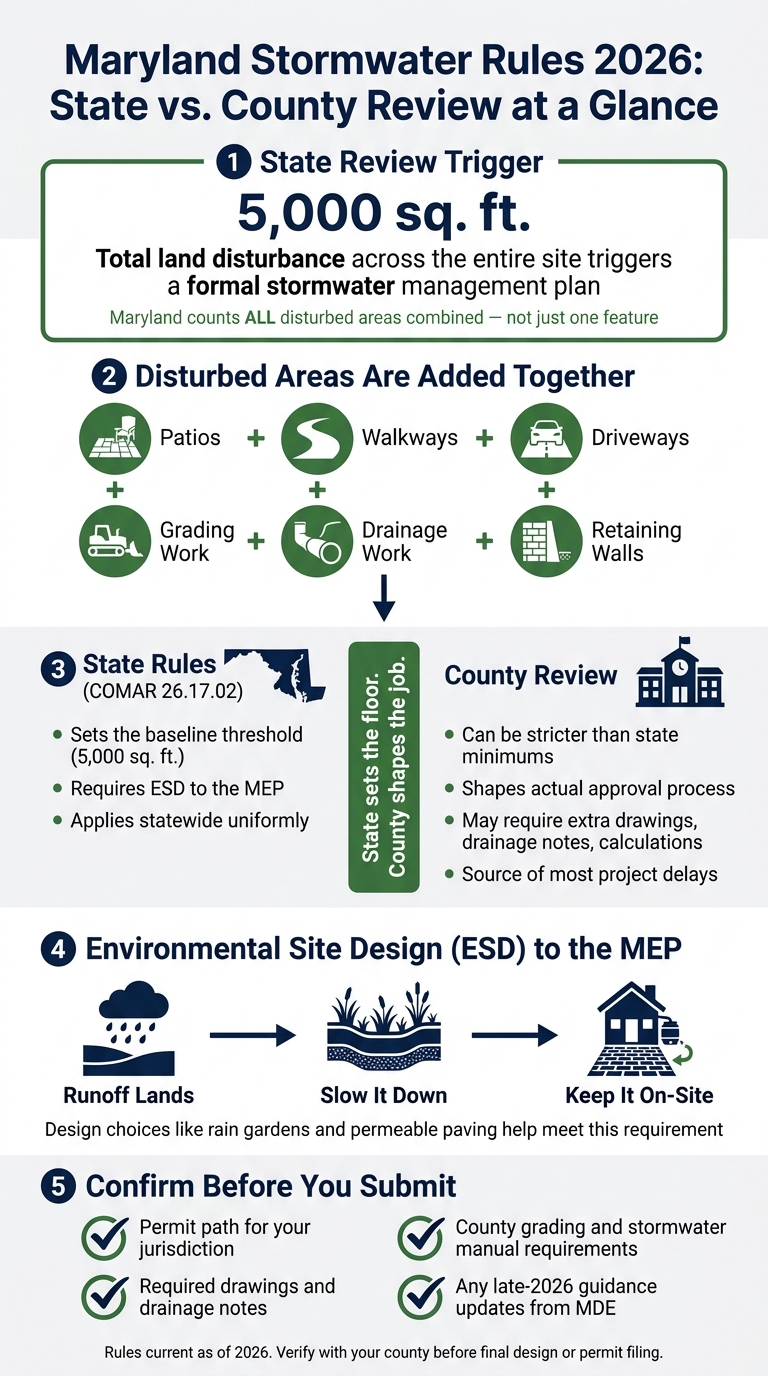
Maryland Stormwater Rules 2026: State vs. County Review at a Glance
Statewide Rule Triggers for Residential Landscape Projects
The 5,000 sq. ft. land-disturbance threshold
The main statewide trigger is 5,000 square feet or more of land disturbance. Once a project hits that mark, it needs a formal stormwater management plan.
This is where many homeowners get tripped up. Maryland looks at total disturbed area across the entire site, not just one part of the job. So if your project includes grading, a patio, a driveway, drainage work, and retaining walls, those areas are added together. That combined number can end up being much larger than any one feature on its own.
That total is what decides whether a project stays fairly simple or moves into formal review.
Some small maintenance jobs and like-for-like replacement work may sit outside formal review. But even then, grading changes and drainage work can still bring county oversight into the picture.
Environmental Site Design to the maximum extent practicable
Maryland also requires Environmental Site Design (ESD) to the maximum extent practicable, often shortened to ESD to the MEP.
The idea is pretty simple: keep runoff on-site and slow it down close to where it lands. For residential projects, that usually means choosing layouts and features that cut runoff before water leaves the property.
The next section looks at the design guidance that shapes those choices.
sbb-itb-843f8be
2026 Reference Materials and Design Standards to Review
2026 Maryland References to Review
Once you identify the project trigger, the next step is to review the current Maryland and county documents that govern design and permit review.
The main references are COMAR 26.17.02, current MDE stormwater guidance, county grading and stormwater manuals, and permit application checklists.
These documents shape what counties will want to see next, including drawings, drainage details, and supporting calculations.
What homeowners should verify before design
Before design starts, homeowners should verify current county runoff, grading, and permit requirements for rain gardens, permeable paving, drainage, and regrading.
MDE Stormwater Regulations and Design Manual Updates Listening Session – January 20 (2026)
County Review Trends Across Central Maryland in 2026
Local review rules can add extra steps, even when a project already meets state stormwater thresholds. That said, verified county-specific 2026 review trends are not available in the source material.
How county stormwater and grading reviews differ from state minimums
State rules set the baseline. But county review is what often shapes the actual approval process for residential work.
In plain terms, a project can meet COMAR 26.17.02 and still run into more county-level requirements. Those added county steps are often where delays show up. That’s especially true when reviewers ask for extra drainage details, grading notes, or supporting documents that go beyond the state minimum.
County review patterns for driveways, patios, retaining walls, and regrading
County review is usually where details for driveways, patios, grading, and drainage get checked against local standards. This is the point where small design choices can turn into back-and-forth revisions.
Before locking in a design, homeowners should check county manuals and permit checklists to confirm what each jurisdiction wants. That can include:
- Documentation
- Drawings
- Calculations
A simple plan on paper may not be enough if the county expects drainage data or grading support.
Why local project experience matters in central Maryland
Knowing how each county handles residential stormwater and grading review can mean the difference between a smooth submittal and a long revision cycle.
That’s why local project experience matters. It helps teams spot county-specific asks early, before plans are submitted and time starts slipping. The pre-construction checklist in the next section covers the key points to confirm before design and permit submission.
Pre-Construction Checklist and Key Points for 2026
What to confirm before design and permit submission
Once you’ve identified the state triggers and the county’s review pattern, the next step is simple: confirm the exact items the jurisdiction wants before you submit plans.
That usually means checking:
- the permit path
- the required drawings
- any site-specific drainage or grading conditions
This step can save a lot of back-and-forth. A rain garden, permeable paving area, or grading change may look straightforward on paper, but the county may still want very specific notes, plan details, or drainage information.
Comparison table: Common residential ESD practices and review considerations
| ESD Practice | What homeowners should verify |
|---|---|
| Rain garden | Sizing and drainage details required by the county |
| Permeable paving | Permit type and site plan requirements for the jurisdiction |
| Drainage and grading work | County checklist items, drawings, and drainage notes |
Conclusion: Maryland stormwater points homeowners should remember
Use the current county checklist, then finalize the design, drawings, and permit package before work starts.
FAQs
How is disturbed area calculated?
Calculate disturbed area by counting all land affected by construction activity. That means the total square footage of any area where soil is exposed, cleared, or graded, along with any dedicated borrow or fill sites.
You should also document these limits in your sediment control plan, including areas with exposed or stockpiled soil. Getting the measurement right matters. In Maryland, projects that disturb 5,000 square feet or more will usually trigger state and local permit requirements.
Does a small patio need stormwater review?
It depends on your county’s rules, how much land the project disturbs, and whether the patio changes drainage on the site. In many cases, projects under 5,000 square feet may not need a formal grading permit. But that cutoff can change based on the jurisdiction and the conditions on your lot.
You may still need review if the property is in the Chesapeake Bay Critical Area, a historic district, or if the patio adds impervious surface or shifts how water drains. Check with your county before design and construction.
What county approvals should I check first?
First, check whether your property is in a sensitive area, such as the Chesapeake Bay Critical Area or a local Historic District. In these areas, you need a grading permit no matter how small the project is.
Then verify the rules with your county Department of Inspections, Licenses, and Permits or Planning and Zoning office. If the work will disturb a large amount of land, also check with your local Soil Conservation District and any town-level permit office.
Chat with Us