









- bhavya gada
- No Comments
If I want more soil carbon in a Maryland landscape, I should keep roots in the ground, keep soil covered, and disturb the soil less.
That is the main point. The article shows that perennials, shrubs, and trees often help soil hold more carbon over time than short-term plantings, mostly because they keep living roots in place and send more root mass deeper into the ground. It also shows that small lawn conversions can help, especially in slopes, edges, tree rings, and other low-use spots.
Here’s the article in plain English:
- Soil organic matter stores carbon, even though it is often only 1%–5% of soil by weight.
- Maryland guidance often points to 4 basic soil rules: disturb less, keep soil covered, use more plant variety, and keep living roots in the soil.
- Perennials usually root deeper than annuals, and deeper roots can help move carbon into soil layers that are less likely to be disturbed.
- Research cited in the article links perennial systems with more soil carbon over about 20 years, including 20% more in the top 0–12 inches and 11% more in the top 0–39 inches.
- Native grass mixes in one study stored about 1.52 tons of carbon per hectare per year in the top 8 inches, about 30% more than several turfgrass types.
- For Maryland lots, compaction, drainage, slope, mulch, compost, and mowing habits all shape results.
- The article’s practical advice is simple: test soil every 3 years, top-dress beds with about 1 inch of compost each year, leave grass clippings on lawns, and avoid routine digging or bed resets.
A quick way I’d think about it: keep turf where people use it, and switch problem areas to perennial beds, shrubs, or trees where it makes sense. That cuts work in many spots and gives the soil more time to build organic matter.
| Area type | Best fit in the article | Main carbon idea | Main care note |
|---|---|---|---|
| Active lawn | Turfgrass | Moderate soil carbon when kept healthy | Mow, feed as needed, leave clippings |
| Low-use edges and slopes | Mixed perennial beds | More roots, less disturbance | Mulch, compost, avoid digging |
| Large open areas or erosion spots | Trees and shrubs | Deep roots and woody growth store carbon for longer | Low care after plants are established |
If I had to sum up the whole piece in one line, it would be this: Maryland research and extension guidance support low-disturbance planting with deep, long-lived roots as a smart way to help soil hold carbon.
Science in Motion: Stashing Carbon for the Long Haul with Healthy Soils
sbb-itb-843f8be
Soil Carbon in Maryland Landscapes
In Maryland landscapes, soil does a lot of quiet work. It stores carbon, cycles nutrients, and helps a site deal with rain and heat. Perennials play a big part because their roots keep feeding soil carbon year after year. That makes them a key part of any planting plan built around soil health.
Soil Organic Matter, Carbon, and Sequestration in Plain Language
Soil organic matter is the mix of living and decaying plant and animal material, along with microorganisms, in the soil. Soil carbon is the carbon stored in that material.
Here’s the basic idea: plants pull carbon dioxide from the air as they grow. Some of that carbon ends up in roots, stems, and leaves. When roots and leaves break down, part of that carbon stays in the ground. That’s carbon sequestration.
University of Maryland Extension (UME) notes that soil organic matter usually makes up just 1%–5% of soil by weight, but it still plays a big role in the soil food web, nutrient cycling, and water movement.[10] UME also says most garden and landscape plants in Maryland do best when soil organic matter is at least 2%.[6][9] So even though organic matter is only a small share of the soil by weight, it has a strong effect on water, nutrients, and root growth. And that helps build more soil carbon over time.
Why Maryland Guidance Recommends Covered, Low-Disturbance Soil
Maryland’s Healthy Soils Program and UME guidance point to four core principles: minimize disturbance, maximize soil cover, maximize biodiversity, and keep living roots in the soil.[1][2][3] That matters a lot in Maryland, where exposed or often disturbed urban and suburban soils can degrade fast from runoff, compaction, and hard rain.
Bare soil loses carbon faster through erosion, oxidation, and temperature swings. In Maryland, heavy rain can wash away exposed topsoil in a hurry. UME recommends keeping soil covered with mulch, groundcovers, or dense plantings to slow that loss and add organic material back as plant residue breaks down.[4] Organic mulches such as leaves and wood chips also help suppress weeds, hold moisture, and add organic matter as they decay.[13]
Digging or regrading when it isn’t needed can break apart soil aggregates and speed up carbon loss. On Maryland lots with disturbed or thin topsoil, UME recommends adding 2–4 inches of compost for a few years, then 1 inch per year to maintain and build organic matter over time.[6][7][13] How much soil carbon builds from there depends a lot on how much carbon roots send belowground, which the next section explains.
What Research Shows About Root Mass and Long-Term Carbon Storage
Once you have soil cover and low disturbance in place, the next carbon issue is root depth. Most carbon in a landscape sits below the surface – in roots, root debris, and soil organic matter. About 30% of global root mass and 50% of soil organic carbon are found below 8 inches, where carbon is less exposed to disturbance. On Maryland lots, deeper perennial roots often lead to more stable carbon in beds, borders, and areas converted from turf.
Why Belowground Carbon Is Often Overlooked in Landscape Planning
A lot of landscape choices are based on what people can see: plant height, flower color, and how dense a bed looks in July. But a planting system’s carbon value mostly comes from what’s happening underground, and that part is easy to ignore[16][17].
Roots send carbon-rich sugars and other compounds into the soil to feed microbes. That process is called rhizodeposition. When roots die, they break down and add organic matter. Both live roots and dead roots also help form and hold soil aggregates, which improve drainage and reduce compaction[14][16].
University of Maryland Extension guidance points out that sugars released by roots feed microbes, and dead microbes make up a large share of soil organic matter. That helps soil recycle and store carbon[4]. Fine roots also turn over fast, which creates a steady flow of organic matter and helps build soil carbon over time.
Perennials vs. Annual Plantings: Root Depth and Soil Persistence
The gap between annual and perennial root systems is large. Annual plants usually keep most of their roots in the top 1 m of soil. Perennial plants – especially trees, shrubs, and deep-rooted forbs – often extend more than 2 m down[12][21]. That added depth means carbon enters soil layers that are rarely disturbed, where root-derived carbon can stay in place for years[18][20].
One global analysis found that shifting annual fields to perennial vegetation led to 20% more soil carbon in the top 0–30 cm and 11% more soil carbon from 0–100 cm over about 20 years[15][12]. In side-by-side comparisons of annual crops and perennial grasses, perennial systems had 11 to 16 times more total belowground biomass, with more root mass at every depth down to about 120 cm – roughly 4 feet[19].
| Factor | Annual Plantings | Perennial Beds & Woody Plants |
|---|---|---|
| Typical root depth | Up to ~1 m (about 3 ft) | Often more than 2 m (6+ ft) |
| Root biomass | Lower; concentrated near the surface | Higher; distributed across depths |
| Soil disturbance frequency | High (seasonal replanting) | Low (established systems) |
| Long-term carbon benefit | Modest; surface-concentrated | Greater; deeper, more stable pools |
These differences matter when you’re deciding how much lawn to keep and where to switch to perennials. They also help explain why even partial lawn conversion can improve long-term soil carbon on Maryland properties.
Lawn Conversion and Maryland Land-Care Practices That Support Soil Carbon
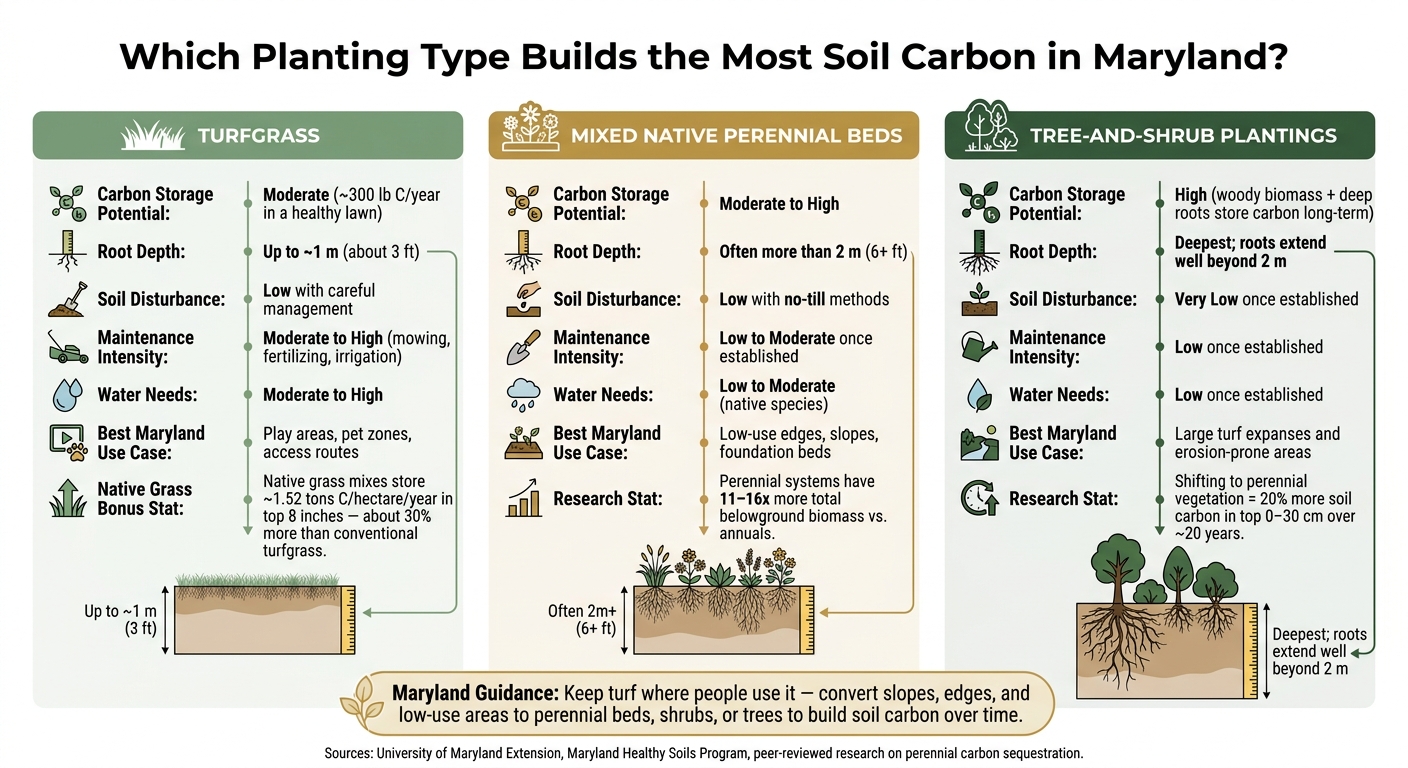
Turfgrass vs. Perennial Beds vs. Trees & Shrubs: Soil Carbon Comparison for Maryland Landscapes
When Replacing Some Lawn Can Reduce Inputs and Build Carbon
You do not need to replace your entire lawn to make a dent. Maryland extension guidance suggests starting with the spots where turf already struggles: steep slopes, foundation edges, tree rings, narrow side yards, and low-use corners that are a pain to mow.[22][24]
Swapping those areas for native perennials, shrubs, groundcovers, or small trees can mean less mowing and more deep roots in the soil. That matters. Research on native grass mixes found about 1.52 tons of carbon per hectare per year in the top 8 inches of soil, which is about 30% more than several conventional turfgrass species.[26] Even a small conversion can start to shift a property’s carbon balance, because deeper roots and less soil disturbance help the ground keep carbon for longer.
For the turf you keep, small care choices still add up. University of Maryland Extension says that leaving grass clippings on the lawn can cut nitrogen needs by up to 50%, while sending organic matter back into the soil at no added cost or extra work.[22]
Site Conditions That Shape the Right Planting Strategy
Carbon gains depend on whether new plants get established well. Drainage, compaction, and slope should guide the plan from the start, since these conditions often need attention before – or at the same time as – new planting if you want it to last and add soil carbon over time.
On sloped or compacted ground, lower-disturbance conversion methods make more sense. UMD Extension recommends smothering turf with cardboard or newspaper, adding 2–4 inches of compost, and planting right into that layer.[8] This lets existing turf roots and organic matter break down in place, which can limit soil loss while new plants get settled.[5][8] In wet or eroding spots, it helps to steady the soil first with mulch, dry riverbed features, or other drainage fixes before planting.[22]
Sun exposure and upkeep goals matter too. Some areas work better as native perennial beds. Others can handle meadow-style planting. Not every lawn alternative works well in every Maryland setting, and Maryland extension guidance notes that some choices, such as microclover, are not backed across Maryland conditions.[23][24] In many cases, a mixed approach works best: keep turf where people use it, convert the trouble spots, and care for perennial beds with compost and mulch.[22][24]
How Pro Landscapes MD Supports Maryland Property Upgrades
These site fixes often come before planting design. Pro Landscapes MD serves central Maryland, including Howard County, Montgomery County, Frederick County, and Baltimore County, with landscaping, planting, drainage, and hardscaping services that support lower-disturbance, perennial-based property upgrades. That includes landscape restoration, planting design, drainage installation, grading, dry riverbeds, and lawn care. When slope or drainage issues come first, handling those problems before planting gives perennial beds a better shot at getting established and holding soil in place.
Practical Takeaways for Homeowners and Property Managers
Next Steps for Residential Lots, HOA Spaces, and Small Commercial Properties
Most of the carbon in a landscape sits below the surface. So the day-to-day job is pretty straightforward: protect the soil while you manage the plants.
For Maryland properties, that means keeping soil covered, limiting disturbance, and keeping living roots in the ground all year.[11][32]
Test soil every three years before adding amendments.[11][32] For established beds, top-dress with 1 inch of compost per year and leave it on the surface – don’t till it in.[5][27] For lawns and most landscape beds, aim for 2%–4% soil organic matter.[30]
If you manage HOA spaces or small commercial sites, it helps to update maintenance contracts so crews care for beds without routine digging or seasonal resets. In plain English: use compost top-dressing and mulch replacement, not seasonal bed resets.[25][35] If a full site change feels like too much at once, phase it in over one to three years, starting with the spots that take the most work.[25][35]
Comparison Table: Turf, Perennial Beds, and Tree-and-Shrub Plantings
The table below turns the research into a simple planning guide.
| Feature | Turfgrass | Mixed Native Perennial Beds | Tree-and-Shrub Plantings |
|---|---|---|---|
| Carbon storage potential | Moderate; up to ~300 lb C/year in a healthy lawn[31] | Moderate to high[24][29] | High; woody biomass and deep roots store carbon long term[5][24] |
| Soil disturbance | Low with careful management | Low with no-till methods; higher if beds are reset annually[4][28] | Very low once established |
| Maintenance intensity | Moderate to high (mowing, fertilizing, irrigation) | Low to moderate once established[24][29] | Low once established |
| Water needs | Moderate to high | Low to moderate (native species)[24] | Low once established |
| Best Maryland use case | Play areas, pet areas, access routes[27][4] | Low-use edges, slopes, foundation beds[24][29] | Large turf expanses and erosion-prone areas[5][24] |
Turf still has a clear role where people need open, level space – like play areas, pet zones, and access routes.[27][4] But when a lawn sits there mostly unused, or keeps turning into a maintenance headache, native perennial beds and tree-and-shrub plantings tend to give better long-term results for soil carbon and resource use.[33][34]
FAQs
Which parts of my lawn should I convert first?
Start with the parts of your yard that already struggle. Areas with poor drainage or weak plant growth are often the best places to begin.
Pay close attention to spots where water pools. Those areas can be a good fit for moisture-loving native plants or drainage features like dry riverbeds.
It also helps to target places with drought stress or constant shade. In those problem areas, swapping high-maintenance grass for resilient native groundcovers and deep-rooted perennials can improve soil health and cut down on upkeep.
How long does it take soil carbon to increase?
The available sources do not give a specific timeframe for soil carbon to increase.
They only point to longer-term gains from healthier soils. For example, native plants can improve soil health and fertility over time, but the sources don’t say how long that process takes.
Do I need trees and shrubs, or are perennials enough?
Perennials do a lot of good. They add color and help pollinators. But on their own, they usually don’t make a resilient, low-maintenance landscape.
That’s where native trees and shrubs come in. They give the yard structure, add interest through every season, and provide food and shelter for birds. Their deeper roots also help hold soil in place and improve water infiltration.
When you combine all three layers – perennials, shrubs, and trees – you get a healthier Maryland landscape that’s easier to maintain and better able to handle changing conditions.
Chat with Us