









- bhavya gada
- No Comments
If I use a yard pesticide in Maryland, I have to follow three rule sets: the product label, Maryland guidance, and any local law that is stricter. In practice, that means a product sold at a store can still be illegal to use on my lawn in some places, especially in Montgomery County.
Here’s the short version:
- The label is law. If I apply a product at the wrong rate, on the wrong site, or in the wrong weather, I can be in violation.
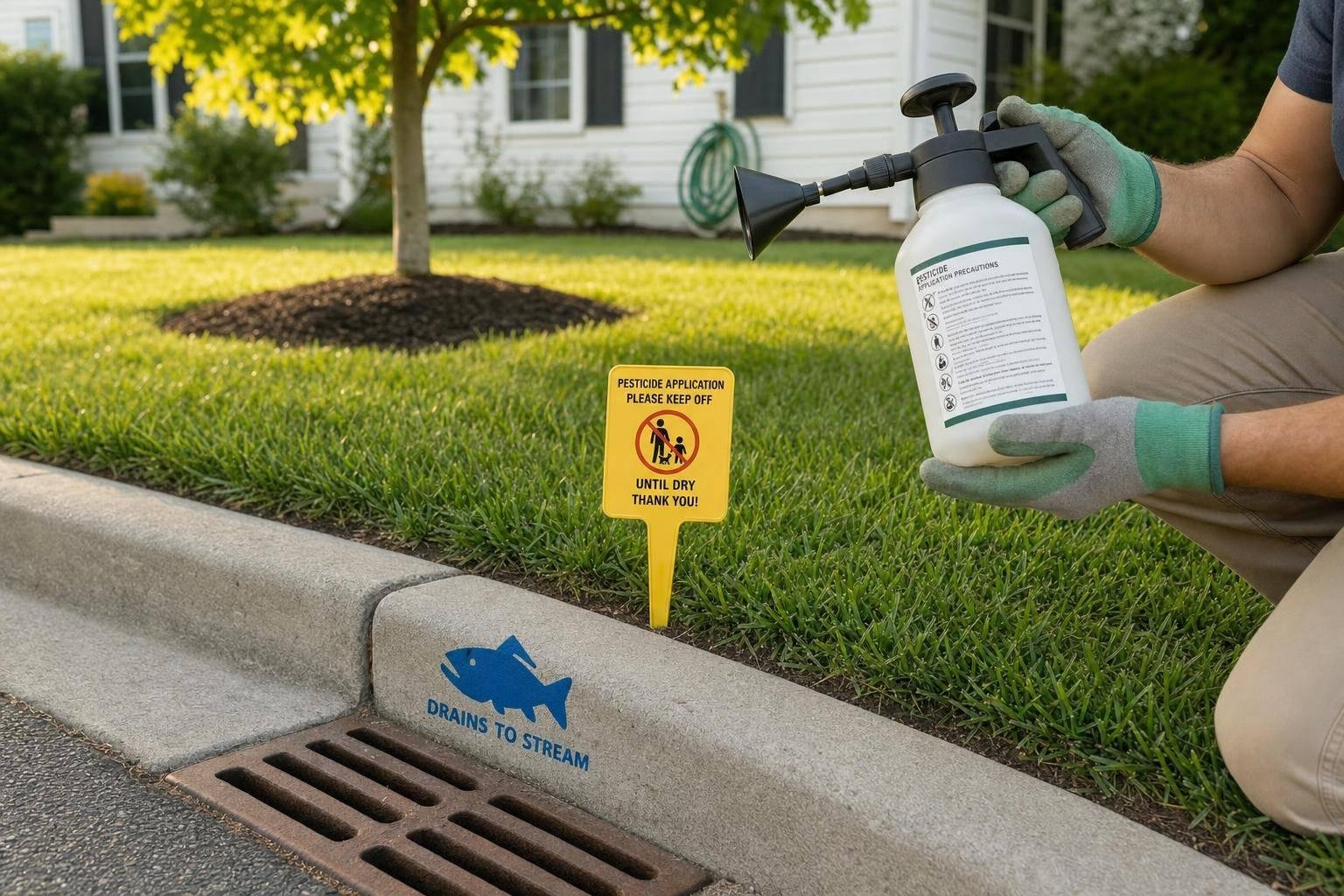
- Runoff and drift are common trouble spots. Pavement, gutters, storm drains, slopes, and shared property lines can turn a simple yard treatment into a problem fast.
- Montgomery County is stricter than the state baseline. Many synthetic lawn pesticides used for cosmetic lawn care are restricted there, even if the product is sold in stores.
- Storage and disposal matter too. I should keep products in original containers, never pour leftovers into drains, and use household hazardous waste drop-off when needed.
- Spot treatment beats blanket treatment. It lowers the chance that product moves off the yard and into nearby water or a neighbor’s property.
A few plain facts stand out:
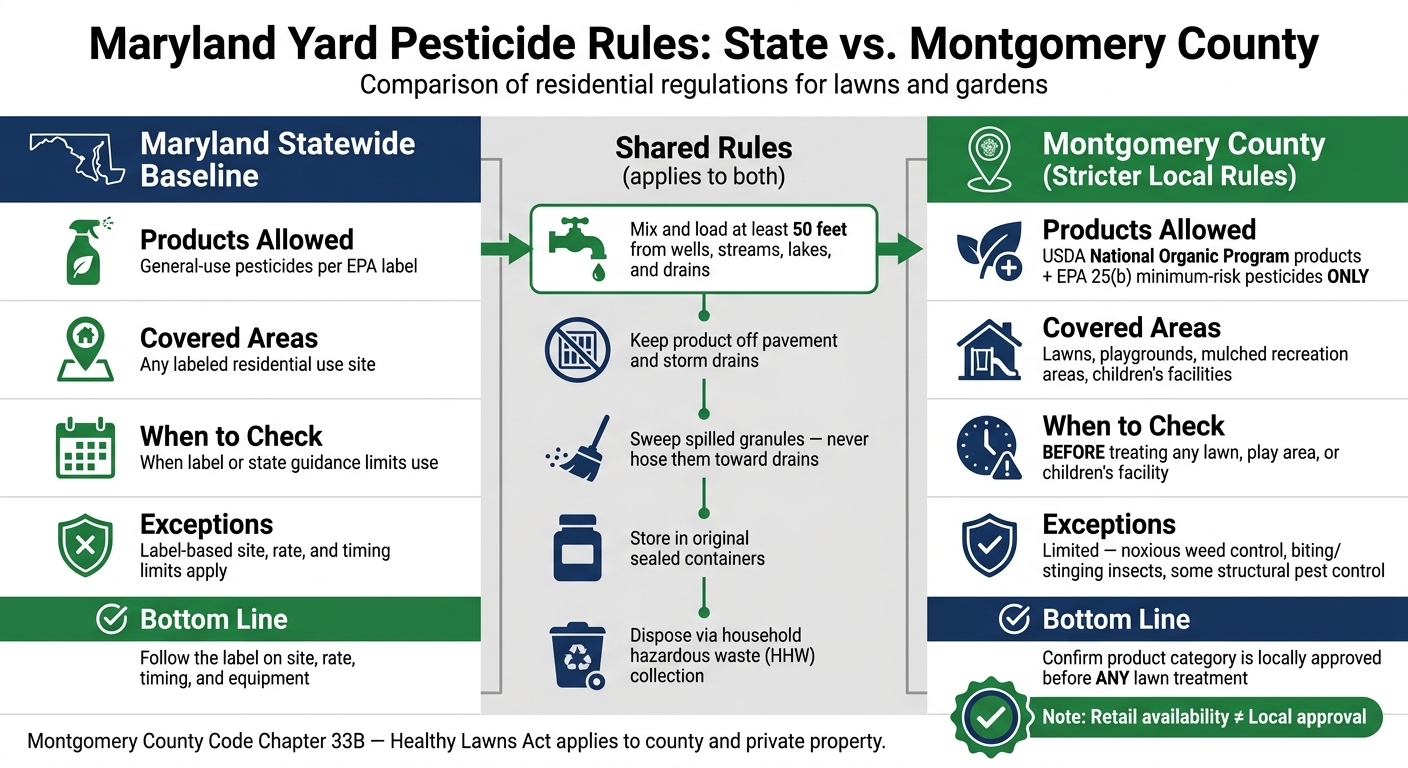
- Maryland guidance says to mix and load at least 50 feet from wells, streams, lakes, and drains.
- Montgomery County rules apply to lawns, playgrounds, mulched recreation areas, and children’s facilities.
- Spilled granules on pavement should be swept up, not hosed down.
| Rule area | What I need to do |
|---|---|
| Federal label law | Follow the label exactly: site, rate, timing, and safety steps |
| Maryland guidance | Keep product out of storm drains, pavement runoff, wells, and wet areas |
| Local county law | Check if my county blocks or limits certain lawn pesticides |
So if I want to stay within Maryland rules, the safe path is simple: check the label, check the county, and keep the product on the target area only.
Common homeowner mistakes that Maryland rules are meant to prevent
Once the rules are clear, the main trouble spots are pretty simple: misuse, runoff, and drift.
Using store-bought products without reading the label
The most common mistake is skipping the label. Under FIFRA, the label is law, so using a pesticide in a way the label does not allow is a violation. [9][12]
That usually leads to the same set of problems: applying too much, applying again too soon, or using the wrong product in the wrong place. Labels also limit use when conditions make it more likely that chemicals will move beyond the yard. In Maryland’s suburban areas, that matters a lot because storm drains often feed directly into nearby waterways. [9][12][11]
Applying near storm drains, paved surfaces, and runoff zones
Pesticides that land on pavement, gutters, or driveway cracks can wash straight into storm drains. [11][13]
Keep the application on plants and lawn areas, not hard surfaces. If granules spill onto pavement, sweep them up. And don’t treat when the soil is already saturated or rain is in the forecast. [14][15][16]
Problems at shared property lines and during storage or disposal
On small lots and along shared property lines, drift and overspray can easily move into the next yard. A liquid spray used on a breezy day might land in a neighbor’s vegetable bed or play area. In some cases, visible pesticide use can also lead to complaints to an HOA or county environmental office. [5][7]
The risk doesn’t stop once the spraying is done. Leftover product can still end up in stormwater if it’s handled the wrong way. Never pour leftover spray or rinse water into a sink, driveway drain, or catch basin. [9][12][11] Storage matters too. Products kept in unlabeled containers, or in places that freeze or get too hot, are more likely to leak. For products you don’t want to keep, use a local household hazardous waste collection site.
sbb-itb-843f8be
What the rules require: label law, Maryland guidance, and local restrictions
Maryland Yard Pesticide Rules: State vs. Montgomery County
Federal label law and Maryland homeowner use rules
Those mistakes turn into violations when someone uses a product in a way the label does not allow, or when a local rule blocks that use.
Under FIFRA, the label is legally binding. Homeowners have to follow the product’s directions for site, rate, timing, weather, and protective equipment. [3] Put simply, the label is the legal instruction sheet. It tells you where the product can be used, how much to apply, how often you can reapply it, what weather conditions are allowed, and what protective gear you need.
In Maryland, homeowners may use general-use pesticides on their own property only within label limits and local rules. If a turf herbicide is used on a site that is not listed on the label, that use is illegal. [3]
How Montgomery County rules go further than statewide rules
Statewide rules set the baseline. Montgomery County goes further for many lawn products.
Montgomery County’s Healthy Lawns Act (Montgomery County Code Chapter 33B) restricts many synthetic lawn pesticides on lawns, playgrounds, mulched recreation areas, and children’s facilities on county and private property. [8][10][6] On covered lawns, only approved pesticide categories are generally allowed. That includes USDA National Organic Program products and EPA 25(b) minimum-risk pesticides. [18][19][20][1]
For homeowners on small, closely spaced lots, this matters a lot. Runoff and drift can cross a shared property line pretty easily. So the local rule can change which products a homeowner may legally use, even if those products are sold in stores. Retail availability does not mean local approval. The product type and the local rule both matter. [1]
Here’s what that looks like in practice for homeowners.
Table: Statewide homeowner use compared with stricter local lawn rules
| Factor | Statewide (Maryland baseline) | Montgomery County (local rules) |
|---|---|---|
| Products allowed | General-use pesticides used according to the EPA label | USDA National Organic Program products and EPA 25(b) minimum-risk pesticides |
| Covered areas | Labeled residential use sites | Lawns, playgrounds, mulched recreation areas, and children’s facilities |
| When to check local rules | When the label or state guidance limits use | Before treating any lawn, play area, or children’s facility |
| Exceptions | Label-based site, rate, and timing limits still apply | Limited exceptions for noxious weed control, biting/stinging insects, and some structural pest control |
| Bottom line for homeowners | Follow the label on site, rate, timing, and equipment | Confirm the product category is locally approved before any lawn treatment |
Check county and municipal rules before treating any lawn or play area.
Safe use, storage, and disposal around Maryland homes
How to apply pesticides without sending them into storm drains
Once you understand the label, the next issue is simple: where the product ends up after it leaves the sprayer or spreader.
Rain or irrigation can wash pesticides off lawns and pavement into storm drains and nearby waterways.[4][22]
That’s why pesticides should stay on the treatment area, not on hard surfaces. Do not apply them to sidewalks, driveways, patios, or other paved spots. If granules spill onto pavement, sweep them back onto the lawn. And don’t treat when rain is in the forecast, the ground is saturated, or turf is frozen.[24][25][27][28][32]
Spot treatment is usually the better move than treating the whole yard. Avoid applying pesticides in drainage paths, swales, or other stormwater drainage areas. Keep products away from gutters, ditches, storm drain inlets, ponds, streams, and wells.[30][4][26] On Maryland properties with curb drains and short setbacks, staying on target matters just as much as picking the right product.
If you have product left after treatment, what happens next matters just as much as the application itself.
How to store and dispose of products legally
Keep each product in its original, sealed container with the label still attached. Never move pesticides into food or drink containers. Store them in a locked, dry, ventilated place away from living areas, food, pet feed, fertilizer, and seed. Avoid basements with floor drains, sump pumps, or any place that floods, since a spill can reach the sewer or stormwater system.[4][17][29][26][11]
When a product can’t be used anymore, disposal has to be handled the right way.
Never pour unused pesticide or rinse water into sinks, toilets, floor drains, gutters, storm drains, or onto bare ground. If the product is still usable, apply it to a labeled target site at the labeled rate. If it’s unused or expired, keep it sealed in the original container with the label intact and bring it to a county household hazardous waste collection event or permanent drop-off site. Triple-rinse empty containers, apply the rinse water to the labeled site, and dispose of the container under local rules.[21][31][22][23][33]
Table: Allowed versus prohibited practices for residential yards
| Category | Allowed | Prohibited | Basis |
|---|---|---|---|
| Application – surface | Apply to lawns and garden beds at labeled rates | Apply to sidewalks, driveways, patios, or curbs | Label law and state stormwater guidance |
| Application – timing | Apply when no rain is forecast and soil is not saturated | Apply before rain or on frozen, waterlogged turf | EPA and Maryland stormwater guidance |
| Application – method | Use spot treatments for visible pest problems | Blanket applications without a pest problem | Maryland stormwater outreach |
| Application – granules | Sweep granules that land on pavement back onto the lawn | Hose granules or residues toward drains or streets | Label law and EPA guidance |
| Application – setbacks | Keep away from gutters, ditches, inlets, ponds, streams, and wells | Apply directly into drainage paths or stormwater drainage areas | Maryland stormwater guidance |
| Storage – containers | Keep products in original sealed containers with intact labels | Store leaking, unlabeled, or transferred containers | Maryland pesticide guidance |
| Storage – location | Use a locked, dry, ventilated area; store away from wells and flood-prone areas | Store near floor drains, sump pumps, or flood-prone areas | Maryland pesticide guidance |
| Disposal – unused product | Use on labeled sites at labeled rates; take unusable product to HHW collection | Pour leftovers into sinks, toilets, gutters, storm drains, or onto bare ground | Label law and MDE HHW guidance |
| Disposal – containers | Triple-rinse; apply rinsate to the labeled area; then trash or HHW program | Dump rinse water into streets, drains, or waterways | Label law and MDE guidance |
| Equipment cleaning | Rinse equipment on a vegetated area within the treated site | Hose equipment over driveways or near storm drain inlets | Maryland core manual |
Conclusion: A site-aware approach for Maryland yards
Key takeaways for homeowners and property managers
For homeowners, the rule is pretty simple: use only products that the label allows and that local law permits. In Montgomery County, most synthetic cosmetic lawn pesticides are restricted, so it’s smart to check local approval before you treat a yard [2][10]. Some municipalities, including Rockville, have also opted into that law [34].
But even if a product is allowed, that doesn’t mean the site is low-risk. A yard can still move pesticide off-site. Keeping applications on vegetated areas, away from pavement and storm drain inlets, and out of wet conditions or before rain can help protect nearby waterways [4][11].
And if runoff keeps showing up, the fix usually isn’t more pesticide. It’s the landscape itself. Grading changes, drainage repairs, and native or stress-tolerant plantings can cut runoff and reduce the need for repeat pesticide use.
FAQs
Can a store-bought lawn pesticide still be illegal where I live?
Yes. In Maryland, a lawn pesticide you buy in a store can still be illegal or restricted based on where you apply it and how you use it.
The product label matters. So do state application rules, including 10- to 15-foot buffer zones near waterways. If misuse leads to runoff into storm drains or protected waterways, you may be violating local rules.
What areas around my yard are riskiest for runoff or drift?
The riskiest spots are hard surfaces like driveways and sidewalks. Why? They can send pesticides straight into storm drains.
Use extra care near waterways such as streams, ponds, and wetlands. In those areas, keep a 10- to 15-foot buffer of native plants or unfertilized grass.
You’ll also want to watch shaded, low-lying, or damp areas where water tends to collect. If any product lands on hard surfaces, sweep it back onto the lawn right away.
What should I do with leftover pesticide or empty containers?
Never pour leftover pesticide or rinse water into storm drains, sinks, or onto the ground.
Check the product label for disposal steps. If the container is empty, dispose of it as directed – often by wrapping it in plastic or putting it in the trash. If there’s still product left, contact your local municipal waste facility to ask about hazardous waste collection or disposal sites.
Chat with Us