









- bhavya gada
- No Comments
Your soil life changes with how you manage your yard. In Maryland, research shows that pH is the biggest driver of soil bacteria, roadside soils near I-95 had lower diversity with a Shannon Index of 4.237, and old land use can shape soil microbes for 10 to 130 years.
If I had to boil the article down, it would be this:
- Soil microbes run key soil jobs like breaking down organic matter and cycling nitrogen and carbon.
- Bacteria lead the picture in many Maryland soils, with groups like Pseudomonadota (42.59%) and Actinomycetota (41.04%) showing up in one Maryland sampling area.
- pH, moisture, and land-use history decide which microbes stick around.
- Road traffic and heavy metals can lower microbial richness and evenness.
- Compost, plant cover, less disturbance, and good drainage help keep soil biology in better shape.
In plain English: if you compact soil, strip topsoil, or leave drainage problems in place, the microbial community shifts. If you add compost, keep roots in the ground, and manage water well, you give that soil life a better shot at doing its job.
That’s the core message of the article below.
The Power of Soil Microbiomes | Dr. Mallory Choudoir | NC State Extension
sbb-itb-843f8be
Major Microbial Groups Found in Maryland Soils
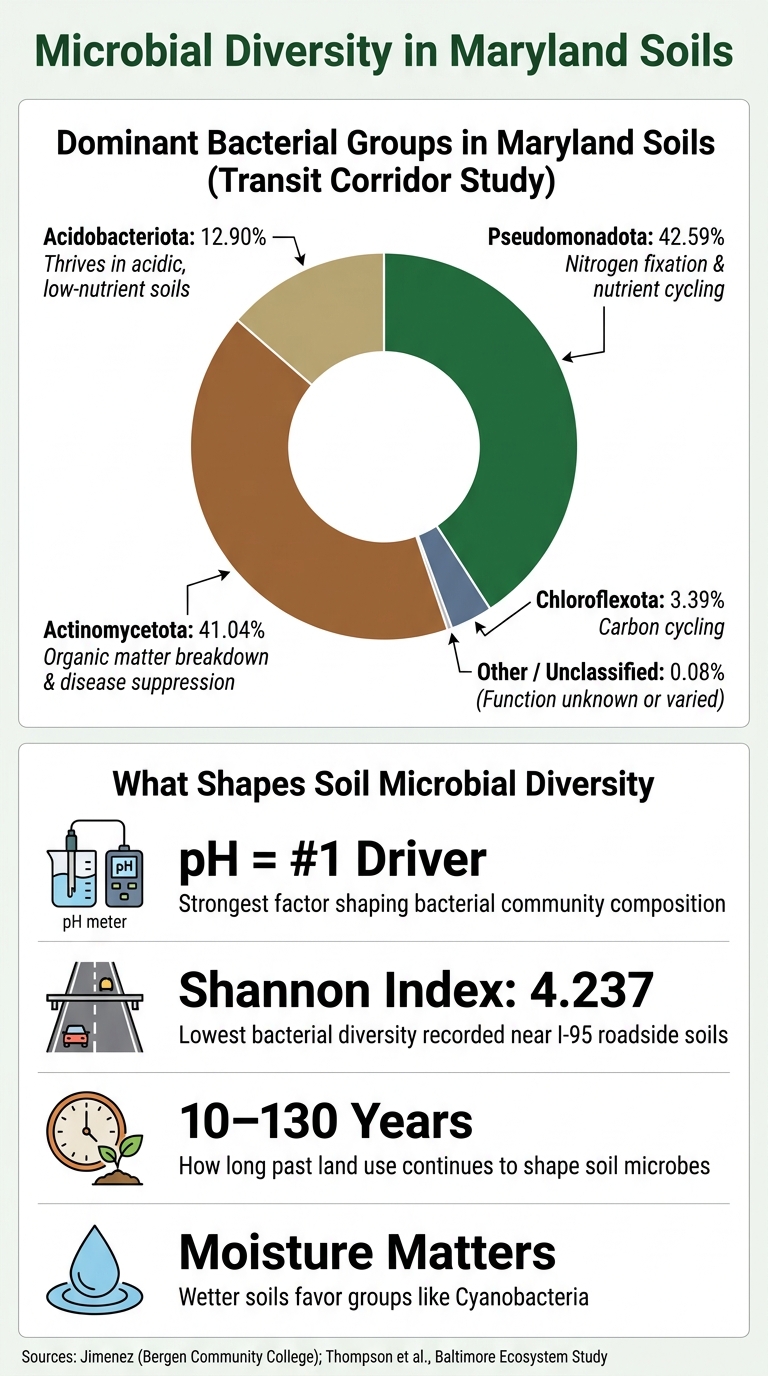
Microbial Diversity in Maryland Soils: Key Data at a Glance
Those big soil jobs come from different microbial groups, and studies from Maryland show which ones show up the most.
Bacteria, fungi, archaea, and actinomycete bacteria
Maryland soils are dominated by bacterial phyla such as Pseudomonadota, Actinomycetota, Acidobacteriota, Chloroflexota, and Bacteroidota [2]. For homeowners, that matters in plain terms: these groups shape decomposition, nutrient supply, and how well lawns and planting beds bounce back after digging, compaction, or other disturbance.
"The core microbiome between all seven soil samples [including Maryland] comprised Pseudomonadota, Actinomycetota, Bacteroidota, Acidobacteriota, and Chloroflexota." – Luis Jimenez, Biology and Horticulture Department, Bergen Community College [2]
One Maryland study near transit corridors found that Pseudomonadota made up 42.59% of the bacterial community, while Actinomycetota accounted for 41.04%. Acidobacteriota came in at 12.90%, and Chloroflexota at 3.39% [2]. Regional soils also commonly include Bradyrhizobium, Rhodoplanes, Sphingomonas, Acidobacteria, and Chloroflexi [1][2].
There’s another piece here that stands out. In Maryland lawns converted from forest, bacterial communities can slowly shift back toward a more forest-like composition over decades. Fungal communities, though, stay different from forest soils [3]. Archaea are part of the picture too, including Crenarchaeota, but they appear at lower abundance than the main bacterial groups [2].
How These Groups Affect Soil and Plants
Each group plays a different role in the yard. Actinomycetota help break down complex organic matter and also contribute natural antibiotics that may suppress soil-borne disease [2]. Bradyrhizobium helps with nitrogen fixation, while Sphingomonas is tied to bioremediation and biodegradation [1]. Nitrospira handles nitrification, converting ammonia into forms plants can use, and its abundance can increase in soils that are fertilized on a regular basis [2].
| Microbial Group | Key Maryland Taxa | Primary Landscape Function |
|---|---|---|
| Pseudomonadota | Bradyrhizobium, Rhodoplanes | Nitrogen fixation and nutrient cycling [2] |
| Actinomycetota | Streptomyces | Organic matter breakdown and disease suppression [2] |
| Acidobacteriota | – | Adapted to acidic, low-nutrient soils [2] |
| Representative genus | Sphingomonas | Bioremediation and biodegradation [1] |
| Representative genus | Nitrospira | Nitrification [2] |
| Archaea | Crenarchaeota | Element cycling [2] |
In managed yards, the main issue isn’t just which microbes are present. What matters is whether the whole community still supports healthy soil function. Many sequences are still unclassified, which shows how much Maryland soil diversity has not yet been documented [2].
These patterns change with soil chemistry, moisture, and land use, which the next section explains.
What Shapes Microbial Diversity Across Maryland
Across Maryland, pH, moisture, and land-use history act like the main filters for soil microbes. They help decide which groups stick around, which ones fade out, and why two nearby places can look similar above ground but host very different life below it.
Soil Type, Moisture, and pH
Of all the factors that shape soil microbes, pH is the strongest driver of bacterial community composition and diversity. When pH moves to either extreme, too acidic or too alkaline, diversity drops and a smaller number of dominant groups take over [2].
Moisture matters too. Wetter soils tend to favor some groups more than others. For example, Cyanobacteria show up more often in wetter surface soils [2].
Urbanization, Past Land Use, and Pollution
Past land use can leave a long mark on managed yards. A 2023 study led by Grant L. Thompson and colleagues at the Baltimore Ecosystem Study looked at a chronosequence of urban lawns in Baltimore County. These lawns had been converted from either agricultural or forested land between 10 and 130 years earlier. The pattern was clear: lawns with an agricultural past stayed microbially similar to agricultural reference sites, while lawns converted from forest slowly shifted over decades toward a forest-like bacterial community [3].
"Land-use legacy, depending on the prior use, is an important factor to consider when examining urban ecological homogenization." – Thompson et al., Researchers, Baltimore Ecosystem Study [3]
Pollution near roads adds another layer. A 2025 study found that Maryland surface soil sampled near I-95 had the lowest bacterial diversity among the tested sites, with a Shannon Index of 4.237 [2]. Heavy metals and vehicle emissions lower microbial richness and evenness [2]. That helps explain why nearby landscapes can end up with very different microbial communities.
Landscape Practices That Support Healthier Soil Microbiomes
Because pH, moisture, and land history shape microbial communities, the next step is simple: manage landscapes in ways that help those microbes stick around and do their job.
Compost, Plant Cover, and Reduced Soil Disturbance
Cutting back on soil disturbance and adding organic matter are two of the best ways to support healthier microbial communities in Maryland soils. Heavy land use can lead to major losses of soil organic carbon in as little as two years [5].
Compost pushes things in the other direction. Adding organic amendments supports higher microbial biomass and improves carbon and nitrogen pools over time [4]. Keeping plant cover in place instead of leaving soil bare between seasons also helps bacterial communities settle and recover toward more natural compositions [3].
Rain Gardens, Drainage Design, and Bioretention Soils
The same ideas apply in drainage areas, where water and oxygen can change fast. Bioretention areas and rain gardens help support healthier soil life by balancing moisture, oxygen, and organic inputs.
Engineered drainage areas with small grade changes can host distinct microbial communities [4]. That matters because those communities help with nitrogen cycling and pollutant filtration, while also improving how water moves through the landscape.
Applying This Research to Maryland Landscape Projects
For Maryland properties, the goal is practical: protect soil biology while dealing with water and compaction. The main priorities are straightforward:
- Limit compaction
- Preserve topsoil
- Manage drainage
- Avoid unnecessary soil disruption
Poor grading and drainage can shift soil moisture patterns, which then affects which microbial communities are able to thrive [4].
Pro Landscapes MD applies these practices through drainage installation, grading, rain garden design, and landscape restoration across central Maryland.
Conclusion: Why Microbial Diversity Matters for Maryland Landscapes
The Maryland studies point to a simple pattern: how a property is managed changes the soil’s microbial community, and that change affects soil fertility, resilience, and plant performance.
Roadside soils near I-95, for example, have lower bacterial diversity, likely because of heavy metal buildup and vehicle emissions [2]. That matters for more than plant health. In stormwater settings, the soil’s ability to filter pollutants also relies on a healthy, balanced microbial community.
On the ground, that means practices like compost use, less soil disturbance, and stormwater-friendly design help support the same microbial jobs.
Pro Landscapes MD puts these ideas into practice through drainage installation, grading, rain garden design, and landscape restoration across central Maryland. For Maryland property owners, the takeaway is straightforward: protect soil biology with compost, minimal disturbance, and stormwater-friendly design. That’s the most practical way to build healthier, more resilient soils across Maryland.
FAQs
How can I improve soil microbes in my yard?
Support soil microbial diversity by managing the conditions that shape it most. Soil pH matters a lot, especially for bacterial communities, so it’s one of the main things to watch. Organic inputs like compost can also change microbial activity in the soil.
Stick with properly composted materials to help avoid bringing in unwanted pathogens. Pro Landscapes MD offers landscaping and soil management services in central Maryland and can help support healthy, sustainable soil.
Why does soil pH affect microbial diversity so much?
Soil pH is widely seen as the main force shaping bacterial communities in soil. When soil is very acidic or very alkaline, conditions get tough for many microbes. That pressure filters out a lot of species, so the community becomes more clustered and overall diversity drops.
At or near neutral pH (around pH 7), that pressure is weaker. As a result, chance has more room to shape which bacteria are present, leading to a more diverse and less clustered community.
Can old land use still affect my soil today?
Yes. Previous land use can leave a long-lasting mark on soil. This is known as land-use legacy. Research in Baltimore County found that land once used for agriculture versus forest still shapes today’s soil microbial communities.
Lawns converted from agricultural land often keep microbial traits that look a lot like those in farmed sites. And lawns that came from former forest land can still hold onto certain fungal traits, even decades later.
Chat with Us