









- bhavya gada
- No Comments
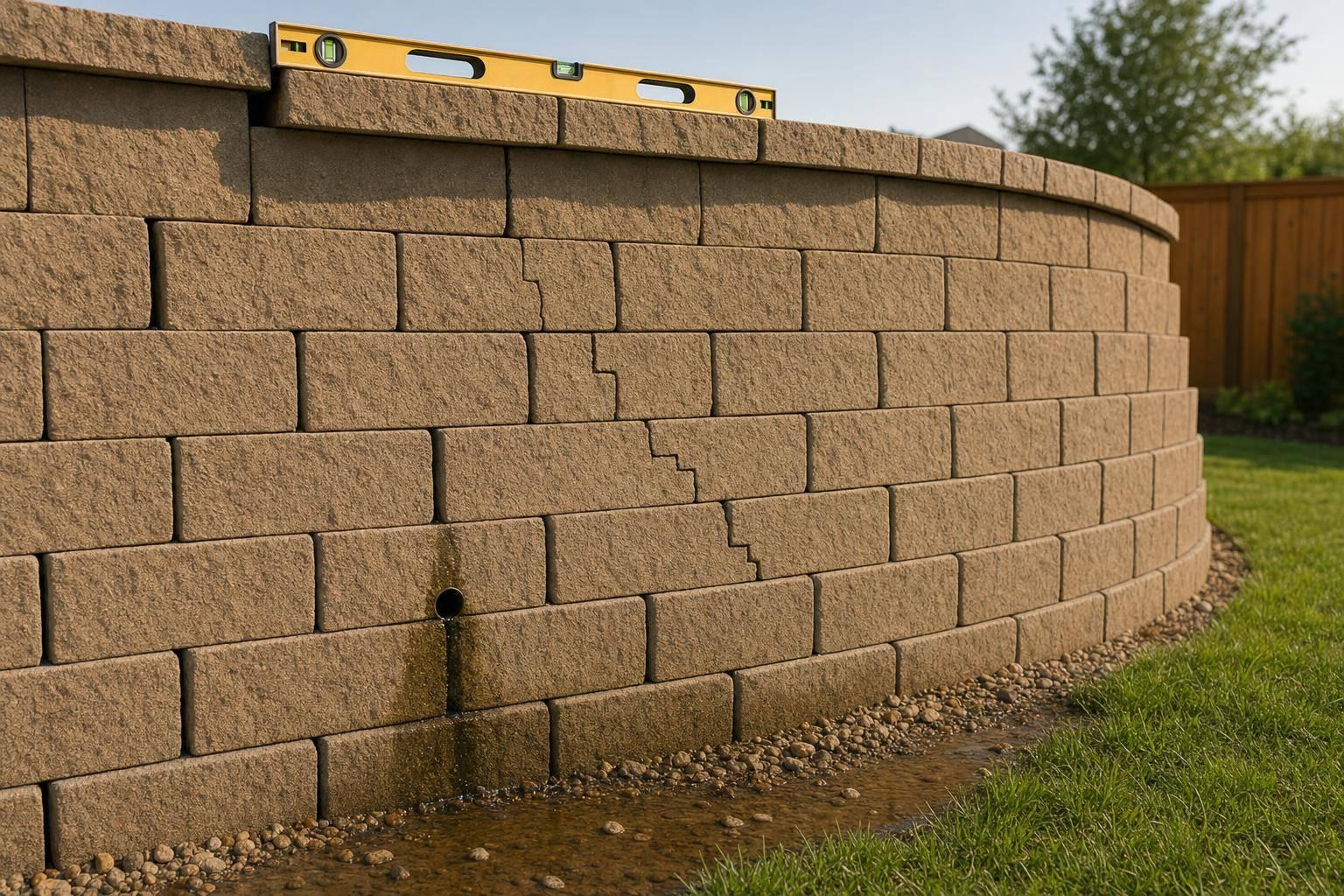
If your retaining wall is leaning, bowing, cracking, or leaking water, don’t wait. In many cases, wall failure starts with small movement, blocked drainage, or soil washout long before a collapse happens.
Here’s the short version: water behind the wall and too much soil pressure are the two main problems. If I saw any of the signs below – especially after heavy rain or a freeze-thaw season – I’d treat the wall as a safety issue, not just a looks issue.
You should watch for all 7 signs:
- Leaning or tilting at the top or face
- Bulging or bowing in the middle
- Horizontal, diagonal, or vertical cracks
- Water pooling, seepage, or clogged drainage
- Soil erosion, sinkholes, or settling nearby
- Loose, shifted, or separating blocks and caps
- Surface damage like white staining, flaking, or spalling
A few numbers matter here:
- A crack over 1/4 inch is a warning sign
- Leaning more than 2 inches can mean emergency-level movement
- Walls over 4 feet in Maryland often need permits and engineering review
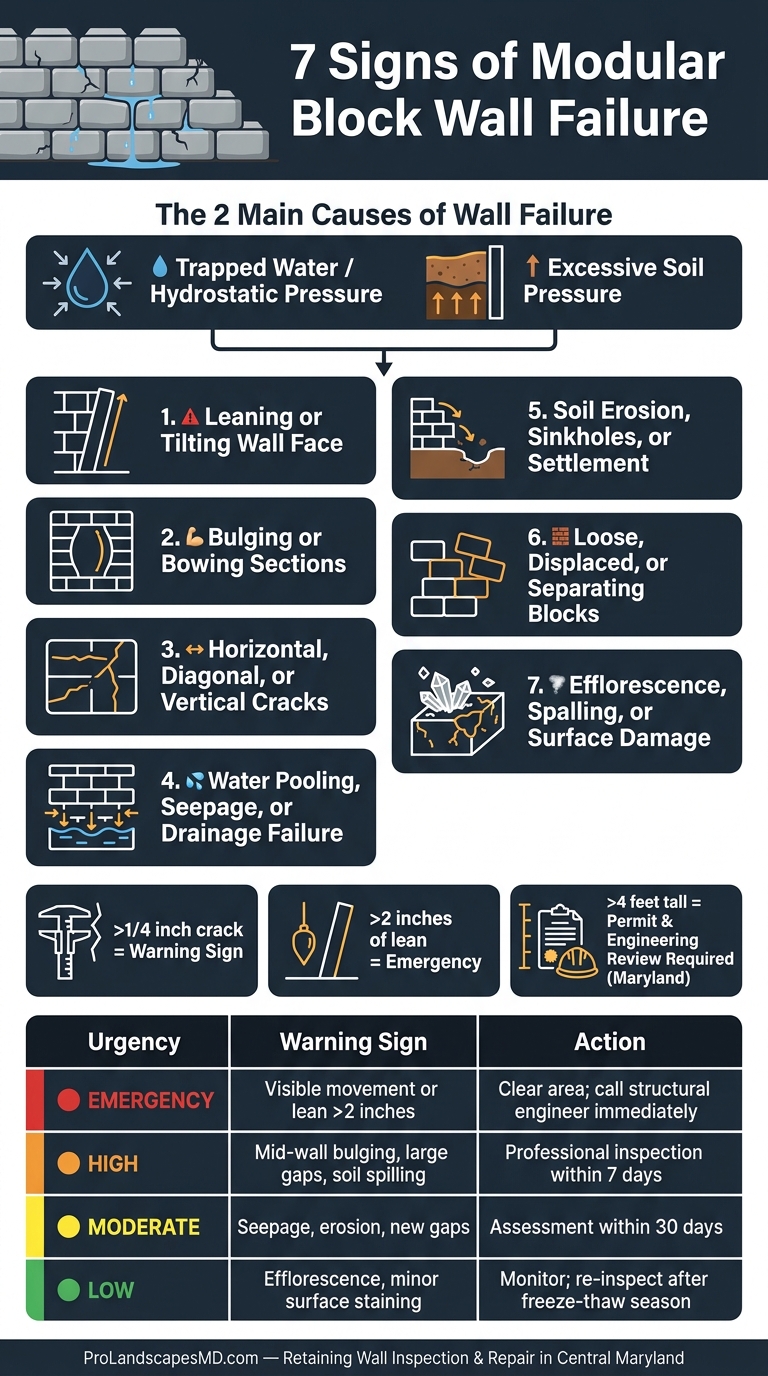
7 Signs of Retaining Wall Failure: Warning Signs & Urgency Guide
Retaining Wall Failures | IT WILL FALL!
sbb-itb-843f8be
Quick Comparison
| Warning sign | What it often points to | How fast I’d act |
|---|---|---|
| Leaning face | Wall movement and soil pressure | Fast |
| Bulging section | Pressure building behind wall | Fast |
| Horizontal crack | Water pressure behind wall | Fast |
| Stair-step or vertical crack | Base settlement or shifting | Soon |
| Seepage or pooling | Drainage trouble | Soon |
| Sinkholes or erosion | Soil washout and lost support | Fast |
| Loose blocks or caps | Active movement | Fast |
| Efflorescence or spalling | Moisture moving through the wall | Watch closely |
In plain English: if the wall is moving, separating, or letting water through, I’d get it checked before a small repair turns into a $1,000s-to-$10,000s rebuild.
Why Modular Block Walls Start to Fail
Before you spot failure, it helps to know what’s driving it. Most modular block wall problems come from two main forces: trapped water and too much soil pressure. Catching those early can help you avoid expensive repairs.
Water is the biggest threat. If weep holes clog or gravel backfill fills with fine soil, water gets stuck behind the wall. That creates hydrostatic pressure, which is the outward force from trapped water. Wet soil also weighs more, so it pushes harder against the wall.
"Water is a retaining wall’s biggest enemy." [2]
Poor base prep and weak compaction can also start the slide toward failure. When the base isn’t set right, the wall can settle unevenly. That’s when blocks begin to tilt or pull apart. Water can also wash fine soil out from behind the wall, leaving empty pockets that reduce support.
Heavy additions near the top of the wall can make things worse fast. A patio, parking pad, shed, hot tub, or a similar feature adds extra load and can push the face of the wall outward.
Age wears the wall down over time. Drainage fabric can clog with roots and sediment. Freeze-thaw cycles can weaken the base and loosen block connections season after season.
These forces usually show up next as the warning signs you can see on the wall itself.
1. Leaning or Tilting Wall Face
A leaning wall is often one of the first warning signs you’ll spot before bulging, cracking, or block separation shows up. Instead of standing straight or following its planned curve, the wall face starts to tip forward. And even a small forward tilt at the top is a red flag. The top row of blocks may look uneven or start sliding outward, while caps that used to sit flush can begin to separate from the courses below.
A slight backward tilt is normal. A forward shift is not. Once that happens, the wall usually keeps moving as it loses its ability to resist pressure.
This isn’t just a cosmetic issue. A lean points to structural movement. When a wall starts tipping, it takes on more lateral pressure, which can push it faster toward collapse. If you notice a lean, keep people and vehicles away and book a professional inspection within a week. If the movement looks active, treat it as urgent. Don’t patch it or try to brace it yourself – those quick fixes won’t solve the drainage or foundation trouble underneath.
2. Bulging or Bowing Sections
If the wall isn’t leaning, check for an outward bulge. A bulging wall looks like it has a belly pushing out from the face, instead of tilting as one piece.
One of the clearest warning signs is a horizontal crack across the middle of the wall. That often points to bowing caused by pressure from the soil behind it. As Keith Eneix, Co-Owner of New Life Rockeries, explains:
"Horizontal cracking typically means the wall faces excessive lateral pressure from the soil behind it. This is one of the earliest signs of a bowing wall." [2]
As the wall starts to bow, cracks usually show up soon after.
The biggest cause is trapped water behind the wall due to failed or missing drainage. In Maryland, clay soil and freeze-thaw cycles can make that pressure worse [2][4][5][7]. Missing geogrid reinforcement can also weaken the wall, since the blocks lose support from the backfill [5][6].
If you spot bowing, keep people and vehicles away. Don’t try to reset blocks or patch cracks. Those fixes only cover up the surface issue and won’t solve the structural or drainage problem underneath. Contact a structural engineer or retaining wall specialist within the week [2][4]. If bowing is visible, cracking usually isn’t far behind.
3. Horizontal, Diagonal, or Vertical Cracking
When a wall starts to lean or bulge, cracks often show up next. And the direction of those cracks tells you a lot about what’s going wrong.
Horizontal cracks are the biggest warning sign. In most cases, they mean strong pressure is building behind the wall. These cracks form when water pressure behind the wall starts to overpower the structure [2]. In Maryland, heavy clay soils and freeze-thaw cycles can make this more likely after long periods of rain or during a spring thaw [5][3].
Diagonal or stair-step cracks move in a zig-zag pattern through the joints between blocks. That usually points to uneven settlement, where one part of the wall is shifting or sinking faster than the rest.
Vertical cracks usually point to base settlement or movement.
Here’s the quick read:
- Horizontal: Water pressure behind the wall; high urgency
- Stair-step: Uneven settlement; moderate to high urgency
- Vertical: Base movement; moderate to high urgency
Hairline cracks are often cosmetic and can come from normal settling. It’s smart to take a photo and check them once a year to make sure they aren’t getting bigger. But if a crack is wider than 1/4 inch, is actively spreading, or shows up along with a lean or bulge, schedule a professional inspection within 30 days [2][9].
Don’t pack a widening crack with masonry filler. That can cover up the real issue, which is often poor drainage or soil pressure behind the wall.
If cracks show up at the same time as wet soil or seepage, that points even more strongly to a drainage failure.
4. Water Pooling, Seepage, or Drainage Failure
Poor drainage is one of the most common reasons retaining walls fail [10]. So the first job is simple: watch for moisture that hints at water getting stuck behind the wall.
Look for water seeping through cracks, running down the face after rain, pooling at the base, or muddy water pushing soil through the joints between blocks. That last sign is serious. It can mean soil is washing out from behind the wall [8].
Wet clay adds even more pressure. In Maryland, clay-heavy soils can hold water for a long time, which means drainage trouble can turn bad fast.
| Sign | What It Means | Urgency |
|---|---|---|
| Persistent seepage or staining | Water is trapped; pressure is building | Moderate – address soon |
| Muddy water or soil through joints | Drainage has failed; soil is washing out from behind the wall | High – act quickly |
| Pooling at the base + mid-wall bulge | Active failure; the wall is under active pressure and may be failing | Emergency |
If you notice seepage, start by checking the drainage outlets. See if weep holes are blocked. Then check whether downspouts, patios, and driveways are sending water away from the wall. If soil is washing out too, this has likely gone past simple seepage.
5. Soil Erosion, Sinkholes, or Settlement Around the Wall
When water starts moving soil, the ground around the wall often changes before the wall itself does. That’s why the area around the wall can tell you a lot. Once water slips through or under the wall, the soil can settle, sink, or wash out. If you spot sunken areas behind the wall or gaps forming under the base, treat them as warning signs [2][4].
Sinkholes are one of the clearest signs that something is wrong. They happen when water carries fine soil particles out from behind or beneath the wall, leaving empty spaces that weaken the base.
Erosion at the bottom of the wall strips away the support holding everything in place. And once that support starts disappearing, parts of the wall can sink, lean, or move out of line.
Don’t just dump more soil into a sinkhole and move on. If the same area keeps settling, the wall is still losing support.
The signs that matter most are:
- Sunken spots or depressions behind the wall – soil is moving through or under the wall, so check the drainage instead of only filling the area back in
- Gaps beneath the wall base – the wall’s support is being washed out, so this needs attention fast
After heavy rain, these low spots are often the first thing to show up.
6. Loose, Displaced, or Separating Blocks and Caps
If leaning, bulging, and cracking keep getting worse, the wall often starts to lose the block-to-block lock that holds it together.
That’s when blocks and caps begin to shift. The wall is no longer staying tight under pressure, and the interlock starts to give way. Some blocks may rock when touched. Others may sit unevenly or slip a bit out of line. From the street, the wall can still look fine. Up close, though, the movement is hard to miss.
Don’t stop at the caps. Check for gaps opening between courses too. Freeze-thaw cycles and wet soil can push blocks apart and weaken the locking system the wall depends on.
Once blocks separate, water can move into the wall much faster. That speeds up internal erosion and increases the chance of a sudden collapse. In plain terms, those gaps let in more water and push the wall toward failure faster.
"Small gaps (under ½ inch) may get a temporary fix with hydraulic cement or masonry filler. But the root cause – drainage, soil pressure, or material failure – still needs attention." – Keith Eneix, Co-Owner, New Life Rockeries [2]
Here’s what each type of movement usually points to:
- Loose caps: early movement
- Gaps between blocks: active structural shift
- Fallen blocks or sections: urgent failure
If new gaps show up after winter, that’s a strong sign the wall has moved and needs attention.
Once separation starts, surface wear and moisture damage usually come next.
7. Surface Deterioration, Efflorescence, or Freeze-Thaw Damage
Once blocks start to pull apart, moisture damage often starts showing up on the face of the wall.
Efflorescence is a white mineral residue that shows water is moving through the wall. In many cases, light efflorescence is mostly cosmetic. Even so, it still points to moisture passing through the block.
Spalling means the concrete is flaking, chipping, or crumbling. It often happens when moisture gets into the material and freeze-thaw cycles wear it down. Clay-heavy soils can make the problem worse by holding water against the wall for longer [5][7].
"White mineral deposits on the wall surface may indicate water migrating through the wall material. Concrete surfaces that are flaking, chipping, or crumbling… may signal progressive deterioration." – Rimkus Built Environment Solutions [1]
The pattern of damage helps you judge how urgent the problem is. Small areas of efflorescence or hairline cracks often just need monitoring. But deep spalling, gaps that keep getting wider, or exposed internal reinforcement call for an immediate inspection.
If these signs show up along with leaning, bulging, or cracking, treat the issue as structural.
After heavy rain, stains and surface damage like this often appear at the same time as seepage or pooling.
Drainage Clues to Watch After Heavy Rain
After heavy rain, look for signs that water is still stuck behind the wall. A quick check right after a storm is one of the easiest ways to spot trouble early.
Start with the weep holes. In a healthy wall, they should show active outflow after heavy rainfall. If they stay completely dry while the ground around the wall is soaked, the drainage system may be clogged, and hydrostatic pressure may be building behind the wall [4].
Then look at the soil just behind the wall. If you see depressions, sinkholes, or slumping soil, that can point to washout behind the wall [4][2].
Here’s a simple way to tell normal drainage from a warning sign:
| Feature | Proper Drainage Condition | Drainage Failure Clue |
|---|---|---|
| Weep Holes | Active outflow after rain | Completely dry or clogged with sediment or roots |
| Soil Behind Wall | Level; mulch stays in place | Sinkholes, depressions, or slumping soil |
| Water Flow | Water exits through pipes or weep holes | Water seeps through block joints or pools at the base |
If you notice more than one of these signs at the same time, the wall is likely under active pressure.
Pay attention to small gaps opening between blocks too. That often shows up before any clear bulging, and it can mean internal pressure is already starting to shift the units out of place [8].
In Maryland, heavy clay soils tend to hold water for longer, which keeps pressure behind a wall high after a storm [5]. In winter, trapped moisture can freeze and expand. That can push blocks farther out of line and slowly widen small cracks over several seasons [6][3]. Drainage trouble is often the first sign behind leaning, bulging, and settlement.
What to Do When You Notice These Warning Signs
Act fast. If the wall is visibly moving, bowing, or tilting, keep people away from the area above and below it until a professional checks it [2][1][4]. If you see lean, bulging, cracking, or seepage, treat that as structural movement. Once movement shows up, stop adding load and document what changed before you repair anything.
Start with photos. Take dated pictures from several angles, then compare them with any older photos you have. Hold a 4-foot level against the face of the wall to check for lean, and use a fixed reference point to track side-to-side movement. If a crack is wider than 1/8 inch (3 mm), treat it as active movement and monitor it from season to season.
If water is part of the problem, clear any weep holes you can safely reach and redirect runoff away from the wall. When weep holes are blocked, water builds up behind the wall. That’s often what sets off leaning, bulging, and settlement.
Don’t patch cracks or gaps with masonry filler or hydraulic cement until you fix the cause. And don’t add heavy loads near a stressed wall, including vehicles, stored materials, or new structures.
Use this urgency guide:
| Warning Sign | Urgency | Action |
|---|---|---|
| Visible movement, partial collapse, or leaning more than 2 inches | Emergency | Clear the area; call a structural engineer immediately [2][10] |
| Mid-wall bulging, large gaps, or soil spilling over the top | High | Schedule a professional inspection within 7 days |
| Water seeping through the face, soil erosion, or new gaps | Moderate | Have the wall assessed within 30 days |
| Efflorescence or minor surface staining | Low | Keep monitoring and inspect again after the freeze-thaw season |
If the wall is moving or draining poorly, the next step is a professional assessment.
Getting Professional Help for Retaining Wall and Drainage Problems in Maryland
When the warning signs in the previous sections show up, the next move is a professional inspection. If you notice leaning, bulging, cracking, seepage, or settlement, don’t treat the wall like a surface-level issue. In central Maryland, clay-heavy soils and freeze-thaw cycles can turn small shifts into structural damage [5][3].
Early inspection is the best way to stop minor movement from turning into wall failure.
Pro Landscapes MD handles retaining wall inspection, drainage correction, and wall replacement across central Maryland and Washington, DC. That includes French drains, grading, stormwater management, and drain pipe placement. The key point is simple: a lasting repair has to deal with both the wall and the drainage behind it.
Before repair work starts, Maryland permit and engineering rules may come into play. In Maryland, walls taller than 4 feet – measured from the bottom of the footing – usually need engineering review and permits [1]. If the wall supports a surcharge load, such as a driveway, patio, or structure near the top, that rule can apply even to shorter walls [1][2].
If your wall is moving or not draining the way it should, book an on-site assessment before any repair work begins.
Conclusion
A modular block wall almost never fails out of the blue. Leaning, cracking, seepage, soil loss, and surface damage usually signal problems below the surface. And in most cases, those problems get worse if you wait.
The main thing is simple: act before minor movement turns into structural failure. Early repair is almost always far less expensive than rebuilding a wall that has already failed.
Here’s how to think about the warning signs:
- Leaning or bulging needs immediate action.
- Cracking and erosion call for a fast inspection.
- Seepage and drainage issues should be fixed promptly.
- Minor surface wear should be watched closely.
If any of these signs are active or getting worse, schedule an inspection right away.
If you notice these issues in central Maryland, Pro Landscapes MD can inspect the wall and fix the drainage behind it.
FAQs
Can a leaning retaining wall be repaired, or does it need to be replaced?
It depends on how bad the structural damage is. The sooner you act, the better the odds that a pro can stabilize the wall before it gives out.
Repairs may include wall anchors, tiebacks, or carbon fiber straps. But if the base has rotated, the footing is inadequate, or the wall is badly compromised, partial or full reconstruction is usually the best path for long-term stability and proper drainage.
How can I tell if wall cracks are structural or cosmetic?
Small, thin hairline cracks that stay the same over time are often cosmetic. In many homes, they can simply reflect normal settling.
Cracks are more likely structural when they’re horizontal, stair-step, widening, or affect more than 5% of the blocks. You should also get a professional assessment if the cracks come with displacement, bowing, leaning, water seepage, or if they show up after heavy rain.
Who should inspect a failing retaining wall?
If you notice leaning, bowing, bulging, or major cracking, contact a structural engineer or a qualified retaining wall specialist right away.
They can figure out what’s causing the damage and whether you need emergency shoring or a full rebuild. Pro Landscapes MD offers professional hardscaping and drainage services across central Maryland and the Washington, DC, area.
Chat with Us