










- bhavya gada
- No Comments
Modular wetlands are compact stormwater treatment systems designed to clean polluted urban runoff before it reaches waterways. By combining pretreatment chambers and horizontal biofiltration, these systems effectively remove pollutants like suspended solids, phosphorus, heavy metals, and motor oil. They are space-efficient and can be installed in various urban settings, such as curb inlets, underground vaults, or downspout systems. Key benefits include:
- 89% removal of Total Suspended Solids (TSS)
- 61% removal of Total Phosphorus (TP)
- 79% removal of motor oil
- Effective heavy metal filtration: 66% Zinc, 50% Copper
Case studies highlight their success in cities, with examples like the Bio Clean® system achieving high pollutant removal efficiencies and the Towerside Innovation District project treating 90% of runoff while supporting urban development. Modular wetlands not only improve water quality but also help manage runoff volume and reduce flooding risks, making them a practical solution for urban stormwater challenges.
How the Modular Wetlands Linear Bioretention System Works – Contech Engineered Solutions

sbb-itb-843f8be
Case Studies of Modular Wetlands Systems in Urban Areas
Real-world examples show how modular wetlands excel at removing pollutants, saving space, and maintaining performance over time. Their compact, adaptable designs allow them to handle urban runoff challenges effectively, even in space-constrained areas. Each example below highlights unique design features and results.
Bio Clean® Modular Wetland System
The Bio Clean® system stands out for its performance, as demonstrated in the 2012/2013 TAPE Field Study. It achieved 89% removal of Total Suspended Solids (TSS), 61% removal of Total Phosphorus (TP), and 79% removal of motor oil [1][2]. These results earned it the General Use Level Designation (GULD) from the Washington Department of Ecology for Basic, Enhanced, and Phosphorus treatment. Additionally, it received approvals from the New Jersey Department of Environmental Protection (NJDEP), the California Water Resources Control Board (Full Capture Certification), and the Virginia Department of Environmental Quality (VA DEQ) [1].
The system’s design includes a pretreatment chamber that captures solids and debris. Water then moves horizontally through specialized biofiltration media, which uses multiple processes to remove pollutants. This patented horizontal flow design offers a larger filter surface area and higher treatment capacity compared to traditional vertical systems, making it ideal for tight urban spaces [1][2].
Upper Villa Park Underground Infiltration Project
In this project, engineers paired a modular wetland with an underground infiltration system and cistern to treat stormwater runoff and collect water for irrigation [1]. This setup highlights how modular wetlands can work alongside underground storage systems to improve water treatment and manage volume.
Advanced Subsurface Flow Wetland System
The Towerside Innovation District in Minneapolis provides an example of district-scale stormwater management using modular wetlands. Between 2013 and 2020, the Mississippi Watershed Management Organization partnered with private developers to manage runoff from an 8-acre area. The project, led by Dan Kalmon, included two large biofiltration basins and a 207,000-gallon underground cistern. This system treats 90% of all runoff, achieving 90% TSS removal and 60% TP removal [5].
The total construction cost was approximately $1,300,000, with $430,000 allocated for reuse treatment and pumping components. The remaining $860,000 covered the district system’s construction costs (excluding reuse) [5]. This centralized system reduced capital costs by more than 15% compared to site-by-site treatment. It also spurred $250 million in economic investment, provided 1,000 housing units, and created a public park that reuses 4.5 million gallons of water annually for a community garden and "bee lawn" [5].
Modular Wetlands Linear Biofiltration System
The Linear system is highly versatile, making it suitable for both basin and linear applications, such as along roadways and parking lots. In curb inlet configurations like "sump" or "flow-by", it captures sheet flow from impervious surfaces. The system has been shown to remove 66% of Total Zinc and 50% of Total Copper, which is especially important in high-traffic areas [1][2].
Maintenance is simple, thanks to its self-contained treatment train. Cleaning involves sediment removal and periodic media replacement, which can be done using a vacuum truck or by hand [1].
Performance Comparison of Modular Wetlands Systems
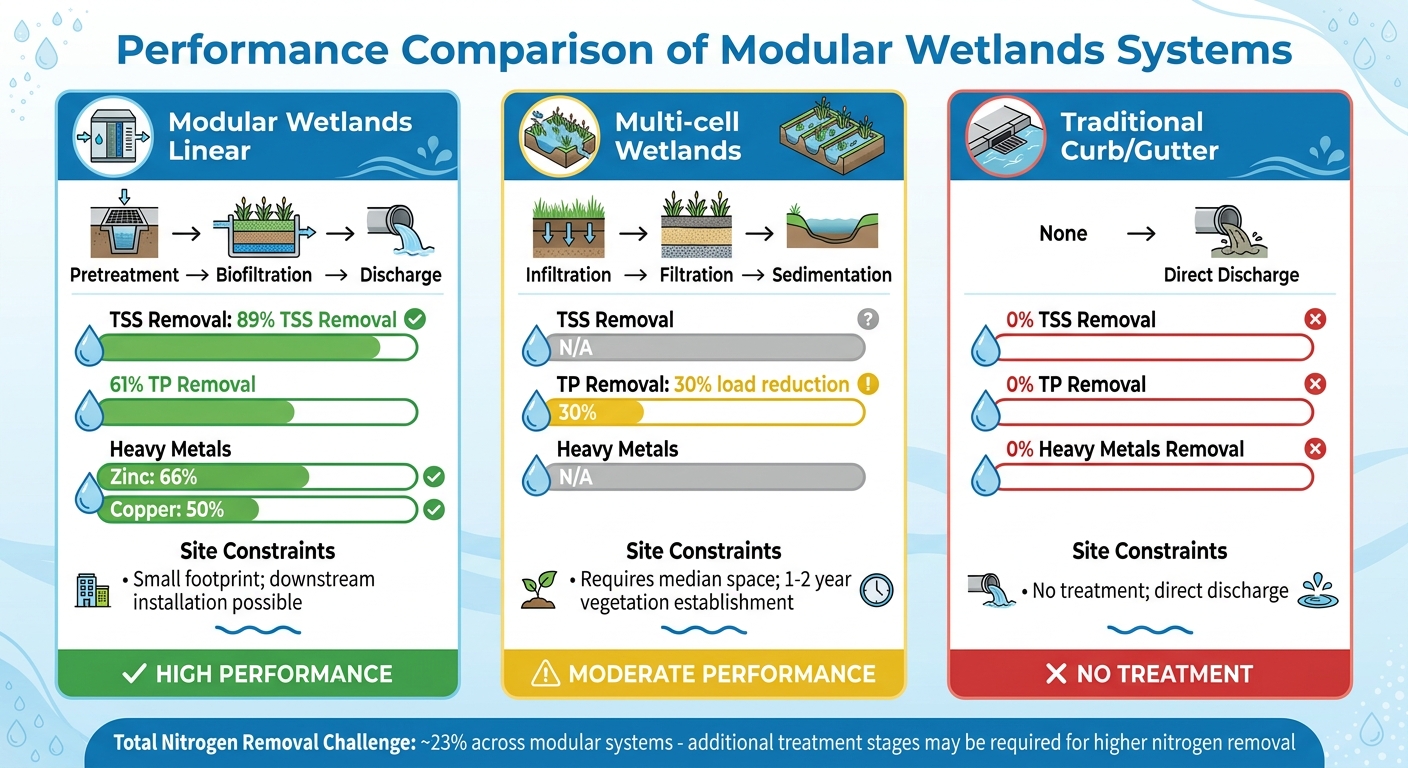
Modular Wetlands Performance Comparison: Pollutant Removal Rates by System Type
Looking at performance comparisons, we can see how specific design features in modular wetlands translate into measurable treatment efficiencies, particularly in urban areas.
When comparing modular wetlands designs, it’s clear that design choices directly influence pollutant removal capabilities and the ability to adapt to site constraints. Systems using horizontal flow, for instance, optimize the filter’s surface area within a compact footprint. This is especially valuable in urban environments where available space is at a premium, and treatment efficiency cannot be compromised.
One important metric for urban applications is the treatment-to-footprint ratio. Systems with a dedicated pretreatment chamber, which removes sediment and debris before the biofiltration process, demonstrate higher pollutant removal efficiency compared to single-stage designs.
Performance Metrics Comparison Table
| System Type | Treatment Stages | TSS Removal | TP Removal | Heavy Metals | Site Constraints |
|---|---|---|---|---|---|
| Modular Wetlands Linear | Pretreatment, Horizontal Biofiltration, Discharge | 89% | 61% | 66% (Zinc), 50% (Copper) | Small footprint; downstream installation possible [2] |
| Multi-cell Wetlands | Infiltration, Filtration, Sedimentation | N/A | 30% load reduction | N/A | Requires median space; 1–2 year vegetation establishment [3] |
| Traditional Curb/Gutter | None | 0% | 0% | 0% | No treatment; direct discharge [3] |
While these systems excel at removing particulates and heavy metals, nutrient removal – particularly nitrogen – remains a challenge. Across modular systems, total nitrogen removal typically hovers around 23% [2]. This highlights the difficulty of treating dissolved nutrients in compact urban setups. For projects where higher nitrogen removal is critical, additional treatment stages or expanded surface areas may be required to support more effective biological processes.
Modular Wetlands in Urban Landscaping
As cities grow, urban landscapes are under increasing pressure to manage stormwater and reduce the environmental impact of impervious surfaces. With more paved areas and rising populations, challenges like polluted runoff and flooding are becoming harder to ignore [7]. Modular wetlands offer a practical solution, acting as infrastructure that improves water quality, replenishes aquifers, reduces flooding, and helps conserve soil [7].
Between 2015 and 2018, MIT’s J-WAFS team developed modular wetland designs in Los Angeles and Houston to tackle these issues. Researchers Alan Berger and Heidi Nepf created guidelines to help urban planners incorporate "wetland parks" into city designs. These parks not only manage stormwater but also reduce the urban heat island effect and increase biodiversity [7]. According to the J-WAFS team:
"Constructed wetlands have been shown to effectively clean water at a lower cost than conventional water treatment plants." [7]
This research highlights how modular wetlands combine efficient water management with improved urban aesthetics.
What makes these systems stand out is their flexibility. They can be integrated into streetscapes, parking lots, and even residential areas [2]. Despite their compact size, these wetlands are highly effective at treating stormwater, making them ideal for sites where space is limited [2]. Beyond functionality, they transform the harsh look of urban infrastructure into greener spaces that support local ecosystems [7][8].
In places like Maryland and the Washington, DC area, these systems are tailored to meet specific urban needs. For example, they can be configured as Curb Inlets for roadways, Vaults for end-of-line installations, or Downspout units to handle building runoff [2]. Companies like Pro Landscapes MD use these modular wetlands to design urban landscapes that are both sustainable and functional.
Conclusion
The case studies and performance data discussed earlier highlight the practical benefits of modular wetlands in tackling urban water management challenges.
Research shows that modular wetlands are highly effective in improving urban water quality. With stormwater now recognized as the only growing source of water pollution in the United States – and nearly 13% of the nation’s rivers impacted by it – these systems offer a proven method to address this pressing issue [4]. Performance metrics further validate their reliability and efficiency [2].
Their adaptable designs make them suitable for a wide range of environments. From managing 20 million gallons of stormwater annually at MedStar Harbor Hospital in Baltimore to enhancing the Audubon Naturalist Society‘s rain garden in Chevy Chase, these systems have been successfully implemented in parking lots, historic areas, hospital grounds, and residential neighborhoods throughout Maryland and beyond [6].
In addition to their cost-effective treatment capabilities – highlighted by J-WAFS – modular wetlands help reduce flooding, combat urban heat, and support biodiversity. These benefits address critical challenges that collectively cost the U.S. billions of dollars each year [4][7].
For property owners and municipalities in Maryland, Pro Landscapes MD provides expert installation services, turning runoff issues into sustainable, functional landscapes.
As urban populations are expected to grow by 2.5 billion by 2050 [7], modular wetlands stand out as a scalable, space-efficient solution to stormwater management, seamlessly integrating into diverse urban settings.
FAQs
Where can modular wetlands be installed on an urban site?
Modular wetlands are a practical solution for managing stormwater in urban areas. They’re commonly installed in places like residential neighborhoods, streets, and community green spaces that often deal with runoff and flooding. These systems are particularly effective near impervious surfaces, such as parking lots or rooftops, where they can capture and treat runoff directly. What’s more, they can be seamlessly incorporated into both existing landscapes and new developments, offering a mix of functionality and visual appeal in urban settings.
How often do modular wetlands need maintenance?
Modular wetlands need consistent upkeep to perform as intended. Although exact maintenance timelines aren’t outlined, ensuring proper and routine operation and maintenance (O&M) is essential. This is especially true for stormwater systems like wetlands, which rely on sustained care to provide long-lasting advantages.
Can modular wetlands help reduce flooding, not just pollution?
Modular wetlands can play a role in reducing flooding by temporarily holding excess floodwaters and slowing their return to streams. This process helps control downstream flooding and erosion while also improving stormwater management.
Chat with Us