









- bhavya gada
- No Comments
If you want the short answer: mycelium pavers are not a good pick for most Maryland yards. I’d only look at them for small, sheltered, low-traffic spots like bed borders or a few stepping stones.
Here’s why:
- They soak up a lot of water – some tests show 100% to 700% weight gain after water exposure.
- They are weak compared with concrete or stone – published compressive strength is often around 0.05 to 0.18 MPa.
- Maryland weather is hard on them – humid summers, about 40 to 46 inches of rain a year, and 15+ freeze-thaw cycles each winter.
- Outdoor tests have shown early failure – including cracking, decay, pests, and mass loss in about 4 months in damp conditions.
- They make more sense as accents than as a full patio or main walkway.
If you’re thinking about using them, I’d keep the plan simple:
- put them in a covered or partly covered area
- use a drained gravel base
- keep them out of direct soil contact
- expect more upkeep and earlier replacement
- test a small area first before spending more
| Material | Best Use in Maryland Yards | Water Handling | Cold Weather Performance | Overall Fit |
|---|---|---|---|---|
| Mycelium pavers | Borders, light stepping spots, small accents | Poor without coating | Not proven for yard exposure | Narrow use |
| Concrete pavers | Patios, walks, seating areas | Good | Built for freeze-thaw conditions | Strong fit |
| Natural stone | Patios, walks, borders | Good to very good | Good when installed right | Strong fit |
So my takeaway is simple: if you want looks and low-carbon appeal, use mycelium pavers in small protected spots only. If you want a surface that lasts through Maryland weather, concrete or stone is still the safer choice.
What Mycelium-Infused Concrete Pavers Are and How They Differ From Standard Concrete and Stone
Mycelium-Based Composites vs. Cement-Based Pavers
Mycelium composites are grown, not poured. The mycelium acts like a natural binder, tying organic fibers together into a solid block. Then heat or drying stops the growth and sets the final shape.[6][1]
That process creates a lightweight, porous material. Its density is usually around 212–282 kg/m³ (about 13–18 lbs/ft³), which is far lower than standard concrete at about 2,400 kg/m³ (around 150 lbs/ft³).[1][3][2] Put simply, mycelium composites are more like a grown fiber block, while cement-based concrete becomes hard when water starts hydration and forms a dense mineral bond.[2][8] Mycelium depends on biology. Concrete depends on chemistry. That’s the main split between the two.
How Mycelium Pavers Compare With Standard Concrete and Natural Stone
The biggest gap for yard use shows up in compressive strength. Mycelium composites usually land around 0.05–0.18 MPa, although published numbers change based on the substrate, fungal species, and treatment method.[1][12] Standard concrete pavers are made for pedestrian and vehicle loads, and dense natural stone like granite is stronger still.[2][7] For central Maryland, though, the bigger concern isn’t just load. It’s what happens when the material faces wet weather and winter cold over and over again.
Water absorption is the other major issue. Some mycelium mixes can absorb more than 200% of their weight in water.[12] That’s a red flag outdoors. Concrete pavers usually have much lower water absorption, and sealers can help even more. Natural stone, if it’s the right type and installed well, also does well with repeated wetting.[2][7]
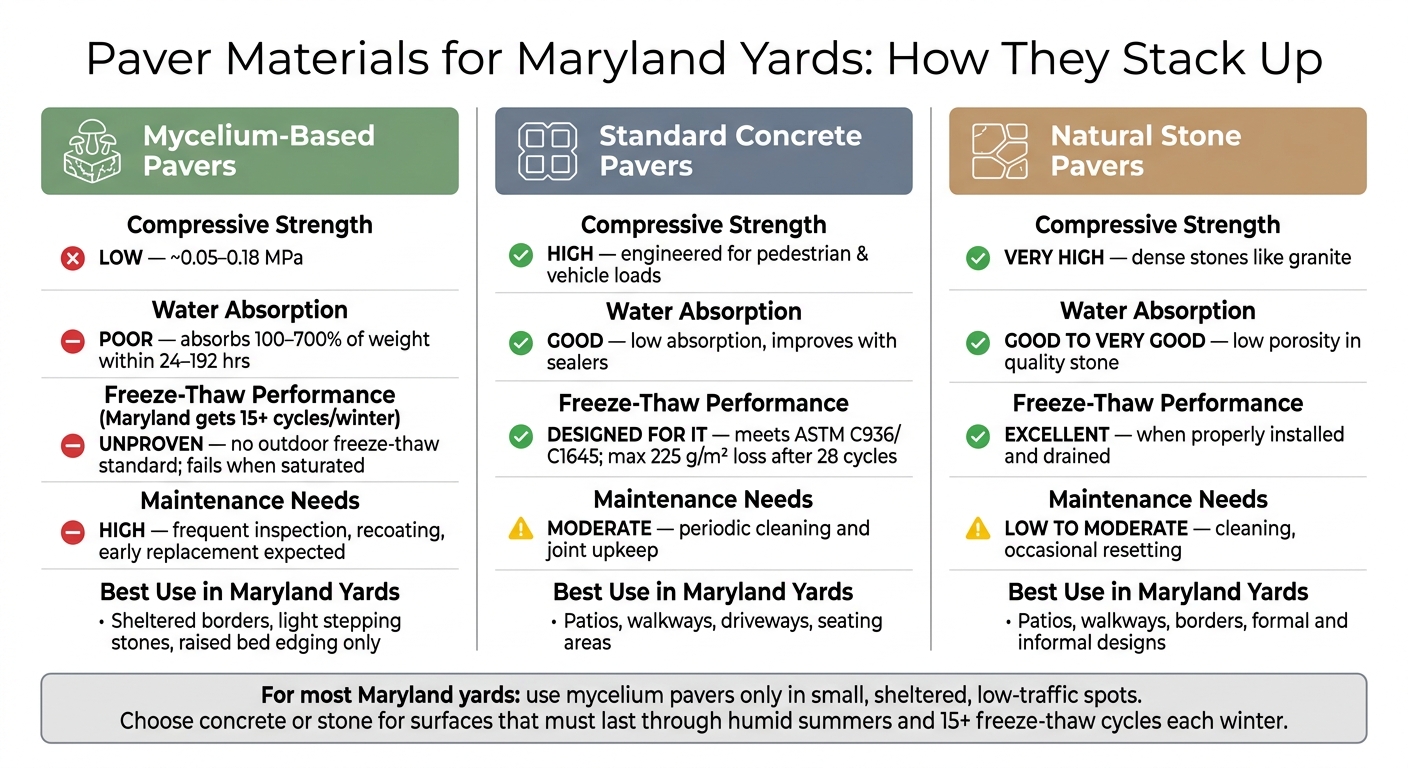
Here’s how the three materials stack up for the factors that matter most in central Maryland hardscape work:
| Material | Strength | Moisture Resistance | Freeze-Thaw Performance | Maintenance Needs |
|---|---|---|---|---|
| Mycelium-based paver | Low; ~0.05–0.18 MPa typical[1][12] | Poor without treatment; very high water uptake[1][11] | Unproven outdoors; weak when saturated[6][2][1] | High; inspect often, recoat, expect replacement[6][2][1] |
| Standard concrete paver | High; engineered for pedestrian and vehicle loads[2][8] | Good; low absorption, improves with sealers[2][8] | Designed for freeze-thaw climates[2][7] | Moderate; periodic cleaning and joint upkeep |
| Natural stone paver | Very high for dense stones[2][7] | Strong; low porosity in quality stone[2][7] | Excellent when properly installed and drained | Low to moderate; cleaning, occasional resetting |
One more point matters here. Some products sold as mycelium concrete pavers are hybrids. In those systems, the concrete handles the load, while the mycelium is used to cut embodied carbon. Even then, outdoor performance in central Maryland still comes down to the same thing: how well the full system deals with long-term moisture and repeated freeze-thaw cycles. In this climate, those two factors tend to make or break the material.
sbb-itb-843f8be
This Fungus Grows Solid Bricks From Waste. No Cement Required. Why Do Engineers Refuse to Use It?
How Mycelium Pavers Hold Up in Maryland Moisture and Freeze-Thaw Conditions
Mycelium vs. Concrete vs. Natural Stone Pavers: Maryland Yard Performance
Moisture Exposure, Soil Contact, and Surface Drainage
Mycelium-based composites and water don’t get along very well. When left untreated, they can absorb 100–700% of their weight in water within 24 to 192 hours of contact.[3][21][19] That’s a big deal in Maryland, where outdoor use depends heavily on the exact spot you choose.
In Central Maryland, clay-heavy soils tend to drain slowly, so water often sits after a storm instead of moving through the ground.[17] If a paver stays wet day after day, problems can pile up fast. In humid soil-contact tests, mycelium composites cracked, decayed, and attracted pests after about four months. Some samples lost up to 43% of their mass after just 16 weeks.[20][6]
The riskiest spots are the ones that stay damp the longest, like:
- Low areas near downspouts
- Shaded side yards
- Compacted subgrades with poor drainage
Those conditions can turn a paver into a sponge, and that’s not a good setup for long-term outdoor use.
Freeze-Thaw Limits for Outdoor Use in Central Maryland
Winter adds another problem. Central Maryland gets 15+ freeze-thaw cycles each winter, and any water trapped inside a paver can expand as it freezes and start breaking the material apart.[15]
Concrete pavers are built for this and tested for it. ASTM C936/C1645 requires an average mass loss of no more than 225 g/m² after 28 freeze-thaw cycles and no more than 500 g/m² after 49 cycles when tested in tap water or 3% saline.[13][14][16]
Mycelium composites don’t have a matching exterior freeze-thaw standard. That gap matters. Published research says outdoor durability is questionable unless you add protective coatings or use careful site design.[1][10][2][18] So while the idea may sound appealing, the margin for error is pretty small in a Maryland yard.
Where Site Design Can Help
Site design can do some of the heavy lifting. Mycelium units should stay raised, sit on a drained aggregate base, and avoid direct soil contact.[17] That setup helps move water away instead of letting it linger underneath and around the paver.
Hydrophobic coatings can slow water uptake, but they only go so far and may need to be reapplied over time.[2][1][9][5] In plain terms, a coating helps, but it’s not a magic shield.
The most dependable move is placement. A covered patio, pergola area, or sheltered garden nook cuts down on direct rain, snow buildup, and repeated freeze-thaw exposure better than any coating by itself. That leaves mycelium pavers best suited to sheltered, low-load areas where moisture stays more under control.
Where Mycelium Concrete Pavers May Fit in Maryland Yards
Those limits put mycelium pavers in a pretty narrow lane for central Maryland yards. They make the most sense in sheltered, low-load areas. In other words, placement is everything.
Patios and Seating Areas: Low-Traffic and Sheltered Uses Only
Main patios usually get too much foot traffic and too much moisture for mycelium pavers. If you use them here, keep them to small accent sections under a pergola or roof overhang, where rain and snow stay off the surface. The main patio should still be a standard material. The mycelium section is there for texture and looks, not for heavy-duty use.[23][3][1]
Garden Paths and Stepping Routes: Better for Light Use Than Main Walkways
A garden path that gets used a few times a week during the growing season is nothing like a front walk or a main route to the driveway. That lighter use is where mycelium pavers may make sense. They’re light, and swapping out a damaged piece is fairly simple.[3][22]
Installation still matters. Set them on a drained gravel or sand base, and keep them a bit above nearby planting beds. Another smart option is to use them as spaced stepping stones inside a mulched or gravel path. That way, if one unit starts to break down, the path still works while you replace it.
Main walkways are a different story. Stick with concrete, brick, or natural stone there. Those areas need materials with a longer track record for durability and low upkeep, and mycelium composites just don’t meet that bar yet.[23][11][1]
Even in these lighter-use spots, drainage and base prep do a lot of the heavy lifting when it comes to service life.
Garden Edges and Raised Bed Borders: The Most Realistic Near-Term Use
This is the clearest near-term fit for mycelium pavers. Garden edging and raised bed borders deal with much lighter loads than any walking surface. They’re mostly holding back soil, not taking repeated foot traffic or the weight of chairs and tables.[4][3]
They’re also easier to place in forgiving spots. You can set them on gravel and keep them a little above turf grade. That makes edging strips, tree rings, and bed accents a better match for the material.[3][1]
The fit is limited, but it’s easy to map out:
| Use Case | Mycelium-Infused Units | Standard Concrete Pavers |
|---|---|---|
| Primary patio surface | Experimental only; protection required[1][6] | Proven with proper base and drainage |
| Stepping path | Plausible for light traffic; easy to replace[1][4] | Reliable for frequent use |
| Edging / raised-bed borders | Best near-term fit[1][4] | Common and durable |
Design Fit, Installation Priorities, and Final Thoughts for Central Maryland Homes
Drainage, Base Construction, and Winter Care Come Before Material Choice
With mycelium pavers, installation details matter even more than they do with standard concrete because the material is sensitive to moisture. In Central Maryland, that matters fast. The region gets repeat freeze-thaw cycles, and water expands by about 9% when it freezes. If the base traps water, that pressure can work its way up and damage the surface.
A typical patio build calls for 10–12 inches of excavation, 6–8 inches of compacted angular stone, and about 1 inch of bedding sand. Clay-heavy soils need deeper bases.[24][25][26][27] The finished surface should slope 1/8 to 1/4 inch per foot away from the house so water drains off instead of sitting in place.[25][26] For a moisture-sensitive paver like a mycelium-infused unit, this part isn’t just a box to check. It’s the part that decides whether the material has a fair shot at all.
Base prep lowers risk, but it doesn’t make the risk go away. That’s the key point. Before you think about color, shape, or layout, the first question is simple: Can this site stay dry enough through a Maryland winter?
A few habits help:
- Keep snowmelt moving away from the surface
- Stop roof runoff from pooling near the pavers
- Use de-icers sparingly
Pro Landscapes MD works on grading, drainage, patios, walkways, and environmental pavers across central Maryland. If a yard already has grading or drainage trouble, that kind of site review should happen before any purchase decision.
How the Look Fits Central Maryland Homes
If the site conditions work, then it makes sense to think about appearance. Mycelium-infused pavers have an earthy, organic look. They tend to work best alongside native plantings, mulch paths, irregular flagstone, and woodland-style beds. That lines up with the lower-risk places where they make the most sense anyway: edging, stepping stones, and sheltered accent areas.
In a formal front yard, though, they usually feel more like a niche detail than the main event. Think of them as a small design note, not the whole patio.
Conclusion: Best Uses, Main Limits, and Next Steps
Mycelium-infused pavers are still a niche option in Maryland because moisture and freeze-thaw exposure limit how well they hold up outdoors.[7][1][6] The most realistic near-term uses are garden edging, raised bed borders, and light stepping paths in sheltered spots with good drainage.
Start small. A short border strip or a few stepping stones in a lower-risk part of the yard is a smart way to test them. Then let them go through a full Maryland winter before doing more. Sustainability matters, but only if the installation lasts long enough to be worth the money and effort. For now, the safest move is to treat mycelium-based pavers as a protected, low-exposure test rather than a full hardscape solution.
FAQs
Are mycelium pavers worth trying in Maryland?
It comes down to one thing: can they stand up to Maryland’s moisture and freeze-thaw cycles? If a material isn’t made for those conditions, it can crack, wear down, or start breaking apart over time.
Mycelium-infused pavers are an interesting option, but they should still deliver the same durability you’d expect from high-quality concrete or natural stone. Pro Landscapes MD recommends materials with a solid track record in local conditions and can also help evaluate structural support and drainage needs.
How long might mycelium pavers last outdoors?
Mycelium-infused concrete pavers are still an emerging option, so their outdoor lifespan in Maryland’s up-and-down climate is still being studied.
Because they contain organic fungal structures, they may react differently than standard masonry when exposed to freeze-thaw cycles and humidity. That’s why they’re usually a better fit for lighter-duty uses, such as garden paths.
What is the safest way to test mycelium pavers at home?
Start small with non-structural uses, especially in spots that don’t deal with much moisture or weight. A good place to begin is in dry, shaded garden borders or as decorative edging, rather than anywhere that collects standing water.
Skip patios and walkways. In Maryland, freeze-thaw cycles can make these installations fail sooner than you’d expect. A level base and good drainage matter a lot here, and Pro Landscapes MD can help you figure out the right setup.
Chat with Us