









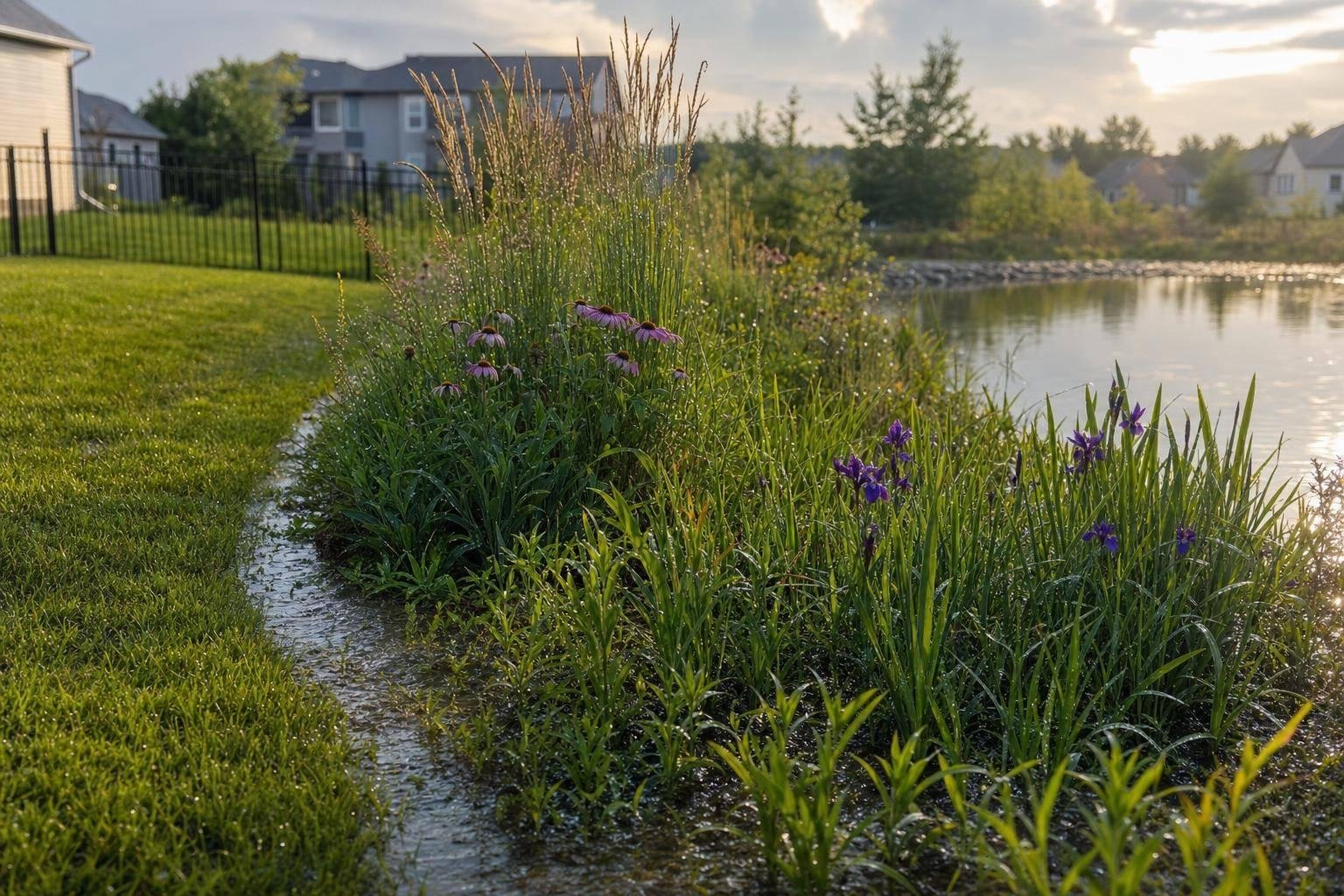
- bhavya gada
- No Comments
If water is cutting through your yard, a native buffer zone can slow it, hold soil in place, and keep sediment from washing away. I’d use it where runoff already moves: below downspouts, along swales, near low fence lines, and at backyard low spots.
Here’s the short version:
- Buffers work by slowing water down
- Deep, dense roots help hold soil
- Sediment can drop out before runoff leaves the yard
- Some buffers can cut runoff by 35% to 90%
- Sediment removal can reach 75% to 90% in the right setup
- Even a 3- to 6-foot strip can help with small erosion spots
- Keep infiltration-focused buffers at least 10 feet from your house
- Keep them at least 25 feet from wells and septic drainfields, and 50 feet downhill from a drainfield
If I were setting one up, I’d keep the plan simple:
- Map where water flows during rain
- Place the buffer in that path
- Spread out downspout discharge before it hits plants
- Match plants to wet, medium, and dry spots
- Check the area after storms and fix washouts early
The main point: native buffers help most when water enters them as shallow sheet flow, not as a hard stream. That means plant choice matters, but placement matters first.
This article shows how I’d spot the best locations, where buffers fit around a yard, and how to set them up so they help control runoff instead of getting washed out.
What is a Riparian Buffer
sbb-itb-843f8be
How Native Buffer Zones Slow Water, Hold Soil, and Filter Runoff
Dense native vegetation slows runoff, holds soil, and filters what water carries. This works best in the spots where water already gathers and moves with force.
Slowing Surface Flow Before It Causes Erosion
Runoff from roofs, patios, and driveways can hit fence lines and lawn edges fast enough to carve channels and strip away topsoil. A native buffer helps stop that by adding surface resistance. Stems, leaves, mulch, and root-shaped soil texture create friction that slows the water down.[1][4]
Once that friction kicks in, runoff spreads into slower, thinner sheets instead of rushing through the same path. That gives water more time to soak into the ground. Even a 3- to 6-foot-wide strip of dense native grasses and perennials can cut down on rills and bare patches.[4][6]
That’s why placement matters just as much as plant choice.
Root Systems That Stabilize Slopes and Yard Edges
Many Maryland native grasses and perennials used in buffer zones have deep, fibrous roots that spread down and out, helping hold soil in place.[3][5] Along swale banks, low yard edges, and fence-line strips that collect water from more than one direction, those roots help keep mulch and topsoil from washing away after one storm and then the next.
Deep roots also improve soil structure and help more water soak in.[4][5][10]
How Buffers Filter Sediment and Yard Pollutants from Water
As runoff slows inside the buffer, sediment drops out near the upslope edge and stays on your property instead of moving into a storm drain or swale.[1][4] Dense native buffers can remove 75% or more of sediment, and NRCS reports removal rates of up to 90% when conditions line up well.[5][11]
Buffers also catch dissolved nutrients, pesticides, and organic debris. Some of that happens when particles settle out. Some happens as water moves into the soil. And some happens through direct plant uptake.[4][5][9] Well-kept buffers can cut dissolved nutrients and pesticides by about 50%.[7][8] For Maryland homeowners, that can mean clearer runoff and less fertilizer leaving the yard after a hard rain.
Next, map where runoff already concentrates on your property.
Assess Your Property and Find the Best Buffer Locations
Track Water from Roofs, Pavement, and Lawn Areas
To see how water moves through your yard, walk the property during a light to moderate rain – ideally 0.5 inch or more – and then again soon after the rain stops.[12] That’s when the flow is easiest to spot. Once the ground dries, those clues can vanish fast.
Bring your phone and take a few photos or short videos as you go. A quick visual record makes it much easier to spot patterns later.
As you walk, look for two kinds of flow:
- Sheet flow: a thin, even layer of water moving across turf or mulch
- Concentrated flow: water moving through small rills, channels, or a downspout outlet
Concentrated flow has more force behind it, so it can erode soil faster. Those spots usually need attention first.
Check the usual trouble areas: roof downspouts, sloped driveways, patio and walkway edges, and compacted turf where foot traffic has packed the soil down. In many yards, worn paths shed water almost like pavement. When you spot those routes, mark them as possible buffer locations.
Where to Place Buffers Around Your Yard
Once you know where water begins and where it travels, sketch a simple map of your lot. Mark the house, paved areas, downspouts, and any visible low spots or swales. Then draw arrows to show how water moves from each source to the point where it leaves the property.[12]
That rough sketch usually makes the best planting zones stand out. On many residential lots, these four areas matter most:
- Below downspouts: Send water to a vegetated strip or shallow depression where it can spread out and soak into the soil.
- Along swales and low side yards: Thick native grasses and shrubs in these areas can slow concentrated flow and catch sediment before it leaves the site.
- Beside fence lines: A linear buffer on the low side of a fence can work like a last filter where water gathers or exits the yard.
- At low backyard edges: A wider mix of plants here can function like a shallow planted basin, holding water at the lowest part of the yard.
The main rule is simple: put buffers where water already goes, not where you wish it would go. Before you settle on a layout, check distances from the foundation and any septic parts.
Setback Rules Near Foundations and Septic Areas
After mapping your buffer locations, confirm setback limits before planting. Keep buffers built to soak in water at least 10 feet from the foundation. If they’re too close, water can move toward basement walls and add moisture pressure over time.
Septic systems need more space. Keep buffers at least 25 feet from drainfields and well heads, and at least 50 feet downhill from a drainfield.[13][15][16][17]
If your yard has a tricky slope, a past basement moisture problem, or a septic layout you’re not fully sure about, it’s smart to have a drainage professional check the grades, drainage features, and setback limits before you plant.
How to Place Buffer Zones Near Downspouts, Swales, Fence Lines, and Low Yard Edges
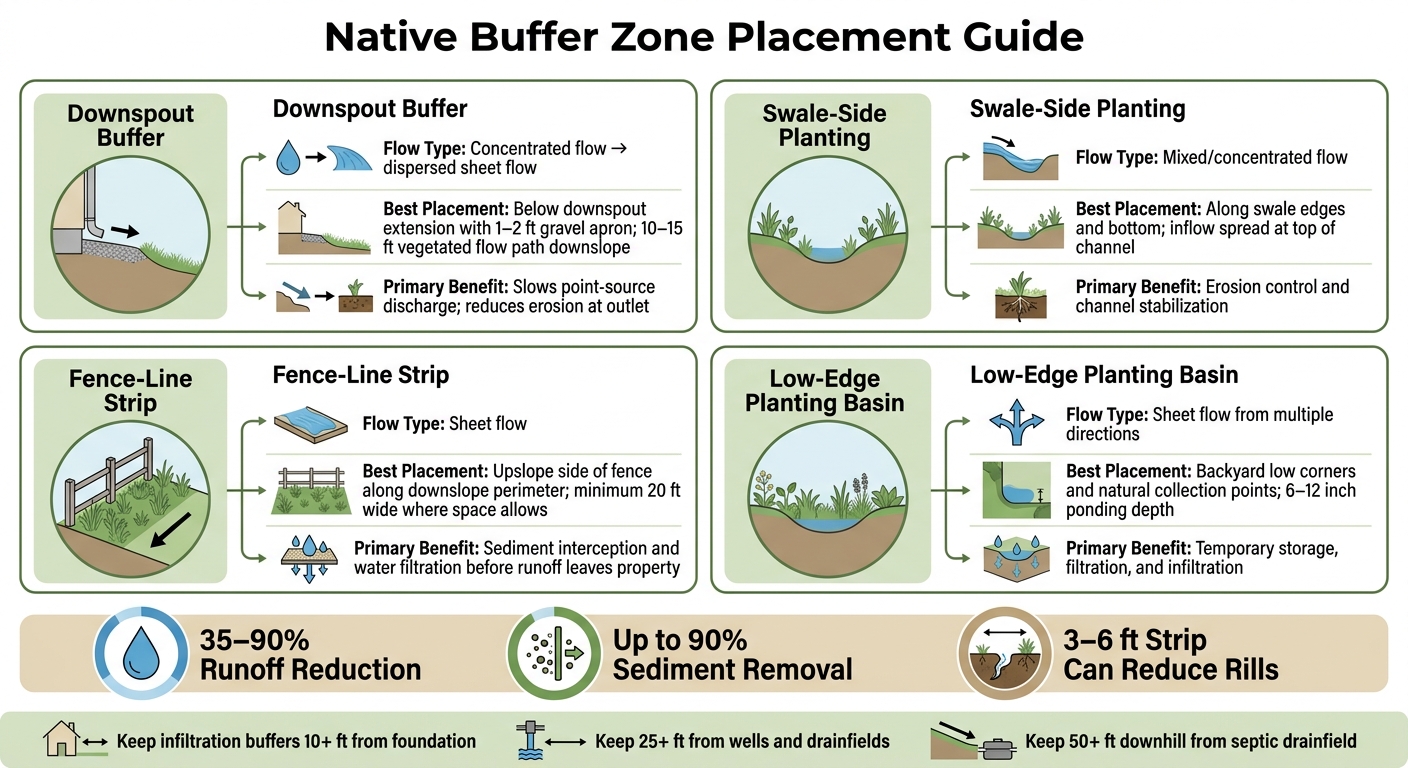
Native Buffer Zones: Placement Locations & Runoff Control Benefits
The main rule is simple: water should reach the buffer as slow, shallow flow, not a concentrated jet. If water rushes in like a hose, it can cut around the plants instead of soaking into the root zone. That’s why your mapped runoff paths matter. They help you match each buffer to the way water moves across the yard.
Downspouts and Swales: Spread Water Before It Reaches Plants
A downspout dumps roof runoff into one tight spot. Left alone, that flow can carve a small channel through a planting bed in no time. Start by pushing water away from the foundation with a downspout extension, splash pad, or short drain line. After that, let it enter a shallow vegetated area where the flow can fan out before it reaches the buffer. A splash pad or a 1–2-foot No. 57 stone gravel apron can turn concentrated discharge into slower sheet flow.[20][23]
From there, the buffer should take in water as sheet flow across mulch or a level-spreading edge, not as direct discharge into the root zone. A good target is 10–15 feet of vegetated flow path downslope of the discharge point to help with filtration and infiltration.[21][22]
Swales follow the same basic idea. Keep inflow spread out at the top of the channel, then plant the sides and bottom with dense native grasses or other low-growing vegetation. Dense native grasses help hold the swale in place and cut down on scouring.[24]
Once the flow is spread out, the job stays the same in both cases: slow the water before it reaches the planting strip.
Fence Lines and Low Edges: Build Linear Filters at the Property Perimeter
A fence-line buffer makes the most sense along a downslope edge where runoff already heads toward a property line, alley, or ditch. Put the planting strip on the upslope side of the fence so water passes through the root zone before leaving the lot. The strip should be dense enough to slow sheet flow and catch sediment along the way. Maryland guidance recommends buffer strips of at least 20 feet where space allows so sediment has room to settle before runoff reaches a receiving area.[2][19]
Low backyard corners and edges need a different setup. If a spot already ponds after storms or collects runoff from more than one direction, a narrow strip usually won’t hold enough water. In that case, a shallow planted basin is a better fit. A ponding depth of about 6–12 inches, sized to the drainage area, can hold runoff for a short time, let sediment settle, and help water soak into a place where it already wants to collect.[18]
If the grade or drainage pattern is messy, bring in a drainage professional to size the basin and check setbacks before planting.
When water ponds, use a wider planted basin. When water moves in a line, use a strip. That keeps the buffer matched to the way water behaves.
Buffer Location Comparison Table
These locations differ most by flow pattern and storage need.
| Buffer Location | Flow Type Received | Best Placement | Primary Runoff-Control Benefit |
|---|---|---|---|
| Downspout buffer | Concentrated flow, then sheet flow after dispersal | Below a downspout extension in a set-back vegetated area | Slows runoff and reduces point-source discharge |
| Swale-side planting | Mixed flow | Along swale edges and bottom, with inflow spread at the top | Erosion control and channel stabilization |
| Fence-line strip | Sheet flow | Downslope perimeter, on the upslope side of the fence | Water filtration and sediment interception |
| Low-edge planting basin | Sheet flow from multiple directions | Backyard low corners and other natural collection points | Temporary storage, filtration, and infiltration |
Choose Maryland Native Plants and Set Up the Buffer Correctly
Match Plant Types to Wet, Medium, and Dry Parts of the Buffer
Once you know where water tends to sit, you can line up each part of the buffer with plants that can handle those conditions.
The key is simple: match plants to how long each zone stays wet after a storm.
Wet zone: swale bottoms, low spots, and downspout outlets. These areas need plants that can handle saturated soil and short periods of standing water, up to 24–48 hours after a storm.[26][27] Good fits include switchgrass (Panicum virgatum), common rush (Juncus effusus), cardinal flower (Lobelia cardinalis), and swamp milkweed (Asclepias incarnata).
Middle zone: buffer slopes and sides that stay damp but drain within a day or two. This area works well for black-eyed Susan (Rudbeckia hirta), joe-pye weed (Eutrochium purpureum), New England aster (Symphyotrichum novae-angliae), and sea oats (Chasmanthium latifolium). They handle that back-and-forth between wet and drying soil.
Dry rim: fence lines and upper edges that drain fast between storms. Little bluestem (Schizachyrium scoparium), butterfly weed (Asclepias tuberosa), and coneflower (Echinacea purpurea) fit well here. Shrubs and small trees also help hold the outer edge together and steady soil along drainage paths. Good options include red twig dogwood (Cornus stolonifera), Virginia sweetspire (Itea virginica), and winterberry holly (Ilex verticillata).
Prepare Soil, Plant Densely, and Maintain After Storms
Start by removing turf and loosening compacted soil before planting. Then add a 3-inch layer of organic mulch to protect the soil surface, hold moisture, and cut down early weed pressure.[28]
Space perennials and low groundcovers 18–24 inches apart so the plants knit together over bare soil before weeds take hold.[28] That matters because bare gaps are often where erosion begins.
Water the area on a steady schedule through the first growing season. After heavy rain, walk the buffer and look for exposed roots, mulch moved by runoff, or small channels forming through the planting area. Fix those spots right away. In years one and two, the buffer is still getting established.[25]
Once the planting fills in, dense cover helps keep runoff slower and more filtered after the first year. By year three, upkeep should mostly come down to storm cleanup and watering during dry spells.[25]
If runoff is too concentrated for plants to handle on their own, do the drainage work first and then plant the buffer.
Native Plant Selection Table for Maryland Buffer Layers
Use this layering to build a buffer that stays covered from the wettest edge to the driest rim.
| Plant Category | Function in Buffer | Moisture Zone | Sun Needs | Example Maryland Natives |
|---|---|---|---|---|
| Grasses & sedges | Dense filtering cover; slows flow and traps sediment | Wet to medium | Full sun to part shade | Switchgrass, common rush, sea oats |
| Perennials | Surface protection; fills gaps and reduces splash erosion | Medium to wet | Full sun to part shade | Bee balm, black-eyed Susan, joe-pye weed, New England aster |
| Shrubs | Edge stabilization; anchors soil along drainage paths and fence lines | Wet to medium | Full sun to part shade | Red twig dogwood, Virginia sweetspire, winterberry holly, buttonbush |
| Small trees | Structure and deep root anchoring along swales and low yard edges | Wet | Full sun to part shade | River birch, sweetbay magnolia |
Conclusion: Build a Buffer That Fits How Water Moves Through Your Yard
After you map runoff and pick buffer spots, the last step is simple: fit the plants and layout to the way water moves through your yard.
A native buffer does its job when the planting sits right in the runoff path. Thick vegetation slows water, holds soil in place, and filters sediment before that runoff leaves your property. When vegetated buffers are placed where water actually concentrates, they can cut runoff volume by 35–90% and filter up to 90% of incoming sediment [14][5].
That’s why placement matters so much. A strip near a downspout outlet, a planted swale edge, or a narrow band along a low fence line can work well because water already travels through those areas. Put the buffer in the wrong spot, and even good plants won’t do much.
Plant choice comes next. Match each area to its moisture level:
- Use water-tolerant natives in wet zones near outlets
- Put plants for in-between moisture on middle slopes
- Use drought-tolerant natives along dry edges
After that, establishment is what helps the buffer stay in place during storms. Loosen compacted soil, plant densely, and check the area after major storms so small washouts don’t turn into bigger problems.
Keep the wettest parts of the buffer a few feet away from basement walls. Also avoid planting deep-rooted shrubs or trees over septic drainfields or tanks. When all of this lines up, the buffer slows runoff, protects soil, and keeps sediment on-site instead of letting it wash away.
FAQs
How wide should a buffer zone be?
There’s no single buffer width that fits every yard. Slope, soil, and overall site conditions all play a part.
For runoff control and water-quality protection, a common minimum for riparian buffers is about 35 to 100 feet. For residential planting strips meant to slow and filter runoff, Pro Landscapes MD recommends roughly 10 to 15 feet.
What if runoff reaches the buffer too fast?
If runoff hits the buffer zone too fast, slow it down first and spread that concentrated flow into a more even sheet.
You can do that with retaining walls, boulders, timbers, or a dry riverbed. Inside the buffer, native grasses with dense, stiff stems – like switchgrass – tend to stay upright, trap sediment, and help water soak into the ground.
Can I plant a buffer near my house or septic system?
Avoid planting buffer zones, trees, or other deep-rooted plants over or too close to your septic system and drain field.
Roots naturally chase water and nutrients. That means they can work their way into pipes, clog lines, and damage other parts of the system. It’s one of those problems that starts underground and stays out of sight until it turns into an expensive mess.
Heavy plant growth and frequent watering can cause trouble too. If the soil gets too wet, the drain field can’t filter and spread wastewater the way it should.
A septic pro can help you figure out how far landscaping should stay from your system and keep those buried parts out of harm’s way.
Chat with Us