









- bhavya gada
- No Comments
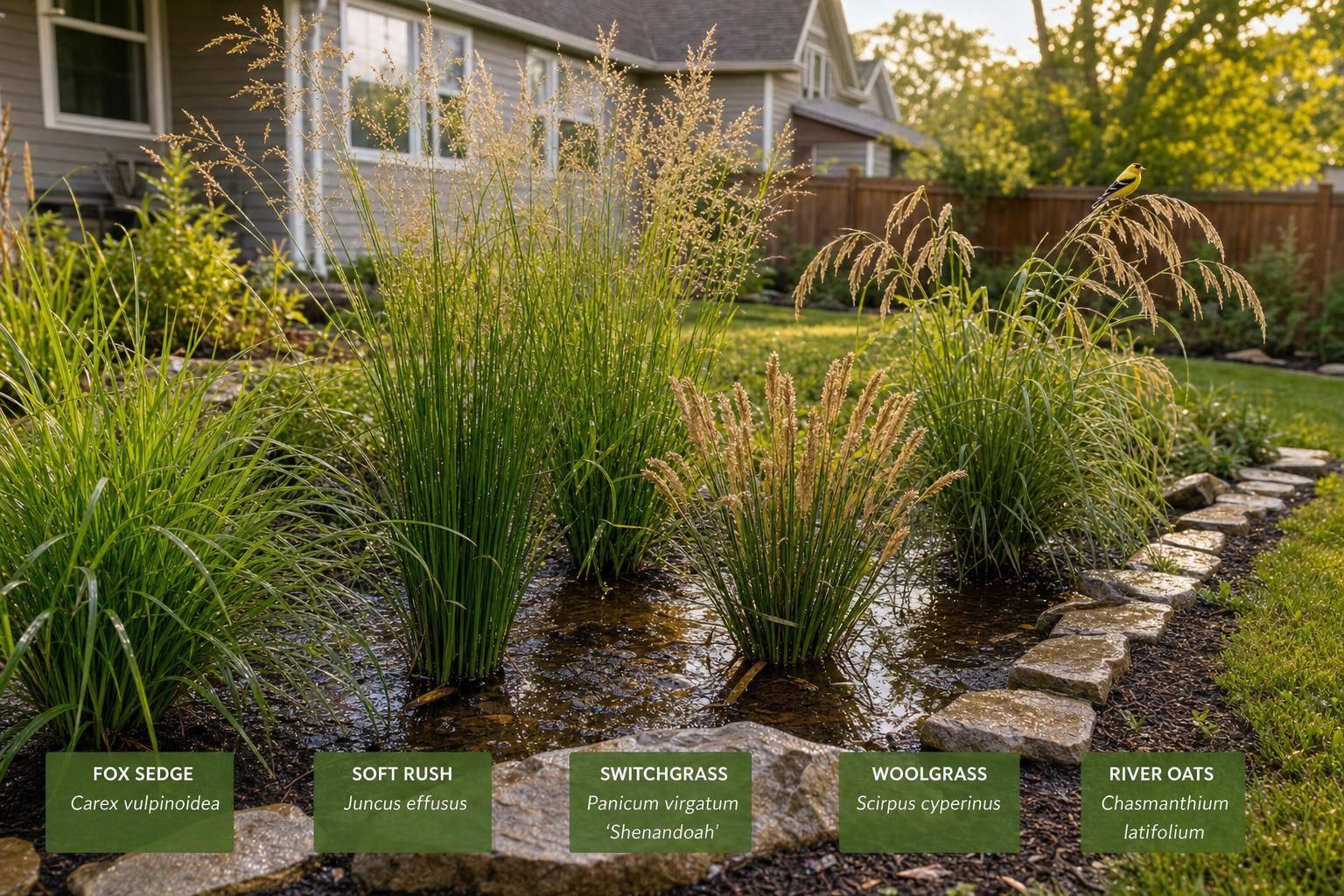
If your Maryland yard stays wet after rain, the fix starts with the right native plants. I’d focus on tussock sedge, fox sedge, switchgrass, soft rush, and woolgrass because they handle soggy soil, help slow runoff, and hold soil with deep or dense roots.
Here’s the short version:
- Tussock sedge fits the wettest low spots and forms clumps about 2 to 3 feet tall.
- Fox sedge works well in rain gardens and damp basins that dry out slowly.
- Switchgrass is best for larger sunny spots and can root 5 to 6 feet deep.
- Soft rush handles saturated soil and fits pond edges or swales.
- Woolgrass suits marshy ground, pond edges, and places with standing water.
These plants do three main jobs:
- Hold wet soil in place
- Slow stormwater
- Support birds, bees, and butterflies
If I were picking by site, I’d keep it simple: use switchgrass for height in sunny wet areas, sedges for lower rain garden zones, and soft rush or woolgrass where the ground stays wet for days.
Quick Comparison
| Plant | Best for | Moisture | Sun | Height |
|---|---|---|---|---|
| Tussock Sedge | Wet low spots, edges | Saturated soil, seasonal flooding | Full sun to part shade | 2–3 ft. |
| Fox Sedge | Rain gardens, swales, damp basins | Moist to seasonally wet soil | Full sun to part shade | 1–3 ft. |
| Switchgrass | Large sunny wet areas | Moist soil, periodic flooding | Full sun | 3–7 ft. |
| Soft Rush | Soggy ground, pond edges | Saturated soil, some flooding | Full sun | 2–4 ft. |
| Woolgrass | Marshy spots, standing water | Saturated soil, standing water | Full sun | 3–5 ft. |
One detail stands out: when roots go deep and clumps grow thick, wet areas become easier to plant and easier to keep in place over time.
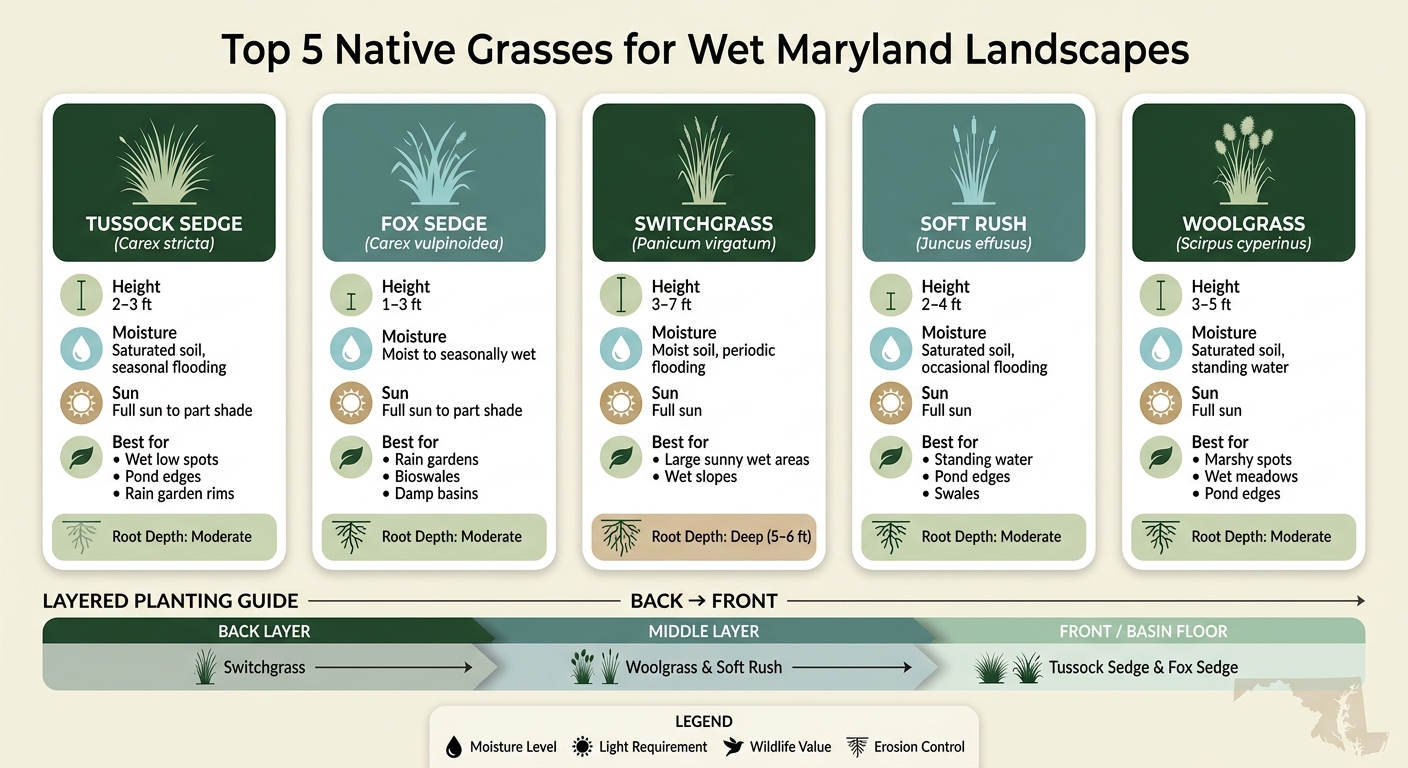
Top 5 Native Grasses for Wet Maryland Landscapes: Quick Comparison Guide
Best Bets: Native Plants for Wet Conditions
Why Native Wet-Site Plants Work Well in Maryland Yards
Native wet-site plants are a good match for Maryland yards because they’re built for the job. They’re used to clay soils and the wet-to-dry swings that show up in rain gardens and drainage swales. That matters for two big reasons: better soil stability and better stormwater control.
Since these plants evolved under local conditions, they tend to handle Maryland’s moisture patterns with more consistency. Many grow deep, wide root systems that help hold soil in place and keep banks from washing out. Switchgrass (Panicum virgatum) can root 5 to 6 feet deep [1], which helps anchor soil in spots where erosion is a problem.
Thick plantings do more than fill space. They slow runoff, trap sediment, and help filter pollutants before that water reaches the Chesapeake Bay [3]. In plain terms, they act like a living buffer.
Those same dense stands also help wildlife. They provide seed heads for birds, plus shelter for native bees and other helpful insects.
This list includes grasses, sedges, and rushes. They’re different plant groups, but they play a similar role in wet parts of Maryland landscapes. The five plants below are the best fit for those soggy Maryland spots.
1. Tussock Sedge (Carex stricta)
Tussock sedge is one of the best picks for the wettest spots in a Maryland yard. It grows in dense clumps, or tussocks, that reach about 2 to 3 feet tall, which gives soggy areas some shape and presence.
Maryland Native Status
Tussock sedge is native across all three of Maryland’s main ecoregions: the Mountain, Piedmont, and Coastal Plain [4].
Wet-Soil Tolerance
This plant does well in saturated soil and seasonal flooding. It can also handle short dry periods [1].
Stormwater, Erosion, and Habitat Value
Its deep roots help keep soil in place along rain gardens, swales, and drainage channels [1][2]. That matters in spots where water moves hard after a storm. The raised tussocks also give wildlife a drier place above wet ground, while the seed heads feed birds. Dense stands can shelter insects and bees through winter [2][3].
It works especially well in areas where soil stays saturated after heavy rain.
2. Fox Sedge (Carex vulpinoidea)
For wet areas that stay damp but don’t sit under water for long, fox sedge is a solid next pick. This native sedge does well in Maryland landscapes, especially in rain gardens, bioswales, and low-lying yards that hold moisture.
Maryland Native Status
Fox sedge is native to Maryland and the broader Mid-Atlantic ecoregion [4].
Wet-Soil Tolerance
Fox sedge handles moist to seasonally saturated soil well, which makes it a good match for the shifting water levels common in Maryland rain gardens and low spots [1]. It also grows best in full sun to partial shade. In plain terms, if you have a spot that stays damp after storms and dries out slowly, this plant can fit right in [1].
Stormwater Value
It helps hold damp soil in place in rain gardens, bioswales, and other low areas where runoff tends to collect.
Wildlife and Habitat Benefits
Its dense clumps give small wildlife a place to shelter. That thick growth also supports local biodiversity without spreading aggressively [1][3].
3. Switchgrass (Panicum virgatum)
For bigger, sunny wet areas, switchgrass brings height and deeper roots. It’s a good match for moist sites in Maryland, including rain gardens and drainage swales.
Maryland Native Status
Switchgrass is native across Maryland. It works well when you need a tall, upright native grass.
Wet-Soil Tolerance
This grass grows in sandy, loamy, and heavy clay soils, and it can handle periodic flooding [4][2]. It does best in full sun. In shade or very rich soil, the clumps can flop [1][3]. Skip fertilizer, since high nutrient levels can weaken the plant’s structure [3]. That toughness makes it a solid pick for Maryland rain gardens and swales.
Stormwater and Erosion Value
Its deep roots help hold wet soil in place, cut erosion, and slow runoff [1][2][3]. With roots that reach 5 to 6 feet deep, switchgrass stays anchored through wet stretches and summer dry spells [1].
Wildlife and Habitat Benefits
It hosts native butterflies, feeds songbirds, and gives wildlife cover in winter [1][3]. Wait until early spring to cut back the stalks so the stems can keep sheltering wildlife and stem-nesting bees through winter [1][2].
Compact forms fit smaller swales. Upright forms make better taller accents.
For areas that stay wetter for longer, the next plant can handle even more saturated ground.
sbb-itb-843f8be
4. Soft Rush (Juncus effusus)
Soft rush is a smart pick for the wettest parts of a yard. If you have a spot that stays soggy long after rain, this plant is right at home there. It handles saturated soil better than most of the plants listed above, including switchgrass, and fits especially well in the wettest corners of a Maryland yard.
Maryland Native Status
Soft rush is native to Maryland and fits local wetland plantings well.
Wet-Soil Tolerance
Soft rush does well in soil that stays saturated and can also take occasional flooding [5]. That makes it a solid option for rain garden edges, drainage swales, and other low areas where the ground stays moist on a steady basis.
Stormwater and Erosion Value
That ability to handle wet ground also makes soft rush useful in places where runoff collects and banks tend to wash out. Its dense clumps and root system help hold wet banks in place and cut down on erosion [1].
Wildlife and Habitat Benefits
Soft rush provides shelter for wildlife [2]. Its clumping form gives insects and native bees a place for winter shelter and nesting habitat [3]. It also serves as a host plant for butterfly and moth larvae.
5. Woolgrass (Scirpus cyperinus)
For the wettest, slowest-draining parts of a yard, woolgrass (Scirpus cyperinus) is a smart last pick. It grows in marshes, wet meadows, and along pond edges, so it fits the most waterlogged spots in a Maryland landscape.
Maryland Native Status
Woolgrass is native to Maryland and well suited to local growing conditions.
Wet-Soil Tolerance
Woolgrass needs saturated soil and can handle seasonal flooding or standing water. That makes it a solid option for places where runoff collects after storms.
Stormwater and Erosion Value
Its dense clumps help slow runoff, while its roots hold wet soil in place and cut down on erosion. It also gives birds and other wetland wildlife a place to shelter.
Wildlife and Habitat Benefits
Woolgrass also helps support wetland habitat in Maryland yards.
How to Use These Plants in a Wet Maryland Yard
These five plants work well as a layered planting plan for wet Maryland yards. Put the tallest plants in the back, mid-height plants in the middle, and sedges along the wet edges and at the basin floor.
Switchgrass fits best at the back of a rain garden, as the main focal plant in a bioswale, or along a wet slope [1]. In front of it, woolgrass and soft rush help build the middle layer. Woolgrass grows 3–5 feet tall and works well in wet meadow areas. Soft rush reaches 2–4 feet and does best in standing water or along pond edges. Up front, tussock sedge and fox sedge fill in the lower layer. Tussock sedge works well as hummock-forming groundcover, while fox sedge is a good fit for the bottoms of bioswales and rain garden basins.
| Plant | Height | Light | Best Placement |
|---|---|---|---|
| Switchgrass | 3–7′ | Full sun to part shade | Back of rain gardens, wet slopes, stream edges |
| Woolgrass | 3–5′ | Full sun | Wet meadow areas, late-season texture |
| Soft Rush | 2–4′ | Full sun | Standing water, pond edges, vertical accent |
| Tussock Sedge | 1–3′ | Full sun to part shade | Pond margins, hummock-forming groundcover |
| Fox Sedge | 1–3′ | Full sun to part shade | Bottoms of bioswales, rain garden basins |
Sun exposure matters more than many people think. Switchgrass and soft rush do best in full sun. If switchgrass gets too much shade, the clumps can flop and may need staking [1]. If your wet area sits under trees or near a woodland edge, tussock sedge and fox sedge are often the better pick because they handle part shade more comfortably.
If you’re working with a smaller home rain garden, the switchgrass cultivar ‘Shenandoah’ gives you a smaller option for residential rain gardens [1]. A simple combo is to use fox sedge in the basin and tussock sedge around the outer rim. That setup helps cover both the soggiest spots and the slightly drier edges in the same bed.
When a low spot stays saturated for days, plants alone may not be enough. In that case, drainage support can help. Pro Landscapes MD provides drainage installation, stormwater management, and grading across central Maryland.
Planting and Care Tips
Once you’ve matched each plant to the right wet spot, the next job is helping it settle in well. Plant in spring, especially switchgrass, since it begins active growth in April [1]. In most cases, nursery plants are easier to find than seed [5].
Give each plant room based on its mature width. Switchgrass reaches 2–3 feet wide at maturity [1], so that’s a good spacing guide for clumps.
From there, the main focus is first-season establishment and simple seasonal cleanup. Leave stalks standing through winter, then cut them back in early spring before new growth begins [1] [3].
A few things to keep in mind:
- Skip fertilizer and soil amendments, since both can lead to flopping [3].
- Keep an eye on switchgrass if you want to limit self-seeding in moist soil where it has space to spread [1] [4].
Conclusion
A wet yard doesn’t have to stay a problem. With native plants, that soggy patch can become a working part of your landscape. The key is simple: pick the plant that fits the wet spot.
Match plant size, sun, and moisture to the site. Switchgrass works well in larger, sunnier wet areas, while sedges make more sense for smaller, lower-profile swales. In Maryland, the best pick comes down to two things: how wet the area stays and how much sun it gets. That match matters because each plant helps wildlife in its own way.
There’s more going on here than moisture control. These grasses help build local habitat and support pollinators and birds with cover, seed, and host habitat. Start with the basics: sun, soil moisture, and site size.
For larger drainage issues in central Maryland, Pro Landscapes MD offers drainage, grading, and native planting services.
FAQs
How do I choose the right plant for my wet yard?
Start by checking your site’s sun exposure and soil moisture. That gives you a much clearer sense of what will grow well and what won’t.
For sunny, wet areas, switchgrass is a solid pick. If the space is damp or gets more shade, sedges tend to do better. Deertongue and sugarcane plumegrass are also good fits for moist, low-lying spots.
It also helps to focus on species with deep root systems. Those roots help with drainage and keep the soil in place, which matters a lot in wet areas.
If you want a second set of eyes, Pro Landscapes MD can assess your property’s drainage needs and help choose native plantings that fit the site.
Which native grass is best for part shade?
For Maryland landscapes with part shade, tufted hair grass is one of the best picks. In many cases, it even does better in part shade than in full sun.
Other strong options include bottlebrush grass, river oats, and sedges. These plants tend to do well in shady spots and can also handle damp areas.
When should I plant wet-site natives in Maryland?
Most native grasses for wet sites in Maryland are warm-season grasses. That means they start putting on active growth in spring as the weather warms up.
They also tend to take more time to get established than standard cool-season grasses. So don’t expect instant results. Early on, growth can look slow, and that’s normal.
Chat with Us