









- bhavya gada
- No Comments
If you’re deciding between native grasses and conventional lawns for your Maryland yard, here’s what you need to know:
- Native grasses like switchgrass and little bluestem are low-maintenance, drought-resistant, and environmentally friendly. They require minimal watering, mowing just once or twice a year, and no chemical treatments after establishment.
- Conventional lawns (e.g., tall fescue) offer a lush, uniform look and are great for high-traffic areas but need constant care: weekly mowing, regular watering during summer, and seasonal fertilization.
- Maryland’s climate makes it tough for typical turf grasses to thrive without significant upkeep, while native options are naturally suited to local conditions.
Key takeaway: Native grasses save time, money, and resources over the long term, but conventional lawns are better for areas with frequent outdoor activities. A mix of both can balance aesthetics, functionality, and maintenance.
Quick Comparison
| Feature | Native Grasses | Conventional Lawns (Tall Fescue) |
|---|---|---|
| Water Needs | Minimal after 1–3 years | Regular watering in summer |
| Maintenance | Mow 1–2 times annually | Weekly mowing, seasonal care |
| Cost (Annual) | $300–$700 after year 3 | $800–$1,500 |
| Wildlife Support | High, supports pollinators | Limited |
| Chemical Use | Rarely needed | Fertilizers, pesticides required |
| Durability | Best for low-traffic areas | Ideal for high-traffic zones |
For a balanced yard, use native grasses in low-use areas and keep conventional turf for spaces where durability is essential.
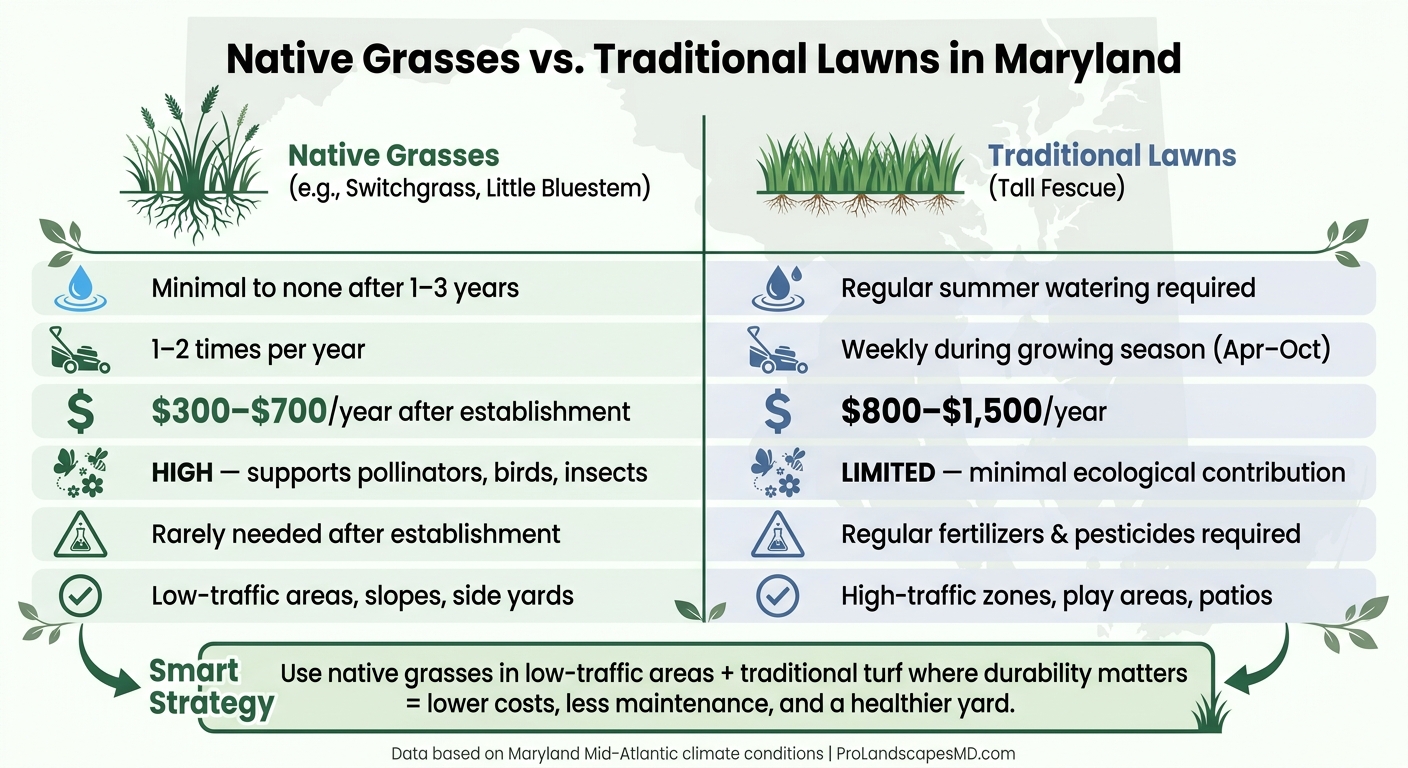
Native Grasses vs. Traditional Lawns in Maryland: Full Comparison
Native Grasses for Use in Home Gardens and Native Meadows with Sara Tangren
sbb-itb-843f8be
Native Grasses and Traditional Lawns: A General Overview
Understanding the characteristics of native grasses and traditional lawns – and how Maryland’s unique conditions influence their performance – sets the stage for comparing their water use, costs, and environmental impact.
Native Grasses for Maryland
Native grasses have adapted over time to thrive in Maryland’s Mid-Atlantic climate, which includes fluctuating temperatures, varied rainfall, and diverse soil conditions. These grasses are naturally suited to the challenges of the region’s climate transition zone.
"Native plants have been present here long before humans and are well-adapted to the local climate. They are naturally suited to the temperature, rain, and ‘pests’ of the area." – City of Bowie [8]
Here are some native grass options that work well in Maryland:
- Switchgrass (Panicum virgatum): This sun-loving grass tolerates drought and grows in a variety of soil types, requiring little to no fertilizer [7].
- Little bluestem (Schizachyrium scoparium): A compact, clumping grass that thrives on dry, rocky slopes. It also supports birds and pollinators [7].
- Pennsylvania sedge (Carex pensylvanica): Ideal for shaded yards, this low-growing grass tolerates dry conditions under trees and can be left unmown for a natural look [7][10].
Once established – usually after one to two growing seasons – native grasses require minimal maintenance. They need little water or fertilizer and only require a single cutback in spring [7].
On the other hand, traditional turf lawns present a different set of considerations.
Traditional Turf Lawns in Maryland
While native grasses are largely self-sufficient, traditional turf lawns demand consistent care to maintain their appearance and health throughout the year. In Maryland, turf-type tall fescue is the most commonly recommended lawn grass due to its durability and thick, uniform look [7][9].
"For lawn grasses, tall fescue (also called turf-type tall fescue) is the recommended cool-season lawn type, not Kentucky bluegrass." – Miri Talabac, University of Maryland Extension [9]
As a cool-season grass, tall fescue thrives during Maryland’s spring and fall seasons. However, it struggles during the hot, dry summers, often going dormant or showing signs of stress. Maintaining a healthy tall fescue lawn requires regular care, such as:
This grass is a practical choice for households with kids, pets, or frequent outdoor activities, thanks to its durability. However, its upkeep comes with a commitment of time, money, and resources to ensure it stays in good condition year-round.
Water Usage and Drought Performance
Understanding water needs is key to seeing how different ground covers handle Maryland’s climate. Native grasses and traditional lawns differ sharply in how much water they require and how they perform during dry spells.
How Much Water Native Grasses Need
Native grasses like switchgrass and little bluestem are built to thrive with minimal water. Their deep root systems tap into moisture far below the surface, making them highly self-sufficient. After an initial establishment period of 1–3 years, these grasses need little to no irrigation, even during dry spells [8]. Planting in the fall gives them the best shot at success, as Maryland’s cooler temperatures and naturally moist soil help reduce stress and encourage strong root growth [5].
How Much Water Traditional Lawns Need
Tall fescue, one of Maryland’s go-to turf grasses, faces challenges in summer heat. As a cool-season grass, it requires consistent watering during the hotter months to stay green and healthy [2]. Without regular irrigation, traditional lawns can quickly lose their resilience. Many homeowners turn to automated or smart irrigation systems to keep their lawns in shape with less manual effort [3].
Water Usage Comparison Table
| Feature | Native Grasses | Traditional Turf Lawns |
|---|---|---|
| Water Requirements | Minimal to none once established [8] | Regular summer watering required [2] |
| Drought Performance | High; resilient to local dry spells [8] | Moderate to low; prone to dormancy and stress [7] |
| Irrigation Needs | Supplemental only during establishment [1] | Often requires automated or smart irrigation [3] |
| Establishment Period | 1–3 years for full establishment [7] | Fast, but demands constant upkeep afterward [7] |
| Summer Maintenance | Minimal; one annual cutback [7] | Frequent mowing and irrigation throughout summer [2] |
For Maryland homeowners, native grasses offer a low-maintenance, drought-tolerant alternative once established. In contrast, traditional lawns require frequent watering and care to maintain their appearance during dry summer months. This side-by-side comparison helps homeowners weigh their options based on water usage and the effort they’re willing to invest.
Maintenance and Long-Term Costs
Water usage is just one piece of the puzzle. Maryland homeowners also need to think about the time, money, and effort required to keep their lawns looking good year after year.
Maintaining Native Grasses
Once native grasses are established, they’re incredibly low-maintenance. They typically only need to be cut 1–2 times a year to remove dead growth and encourage new shoots. Unlike traditional lawns, they don’t demand constant mowing. Fertilizers? Rarely necessary – and in fact, using them might encourage weeds to grow. The most labor-intensive task is spot-weeding during the first couple of years. But once the grasses take hold, they naturally suppress weeds. Adding organic mulch, like wood chips or shredded leaves, can help during the early stages by keeping moisture in and weeds out, all without needing chemical treatments [5].
Maintaining a Traditional Lawn
Traditional lawns, on the other hand, are much more demanding. Tall fescue lawns, for example, require weekly mowing at a height of 3–4 inches, 2–3 nitrogen applications each year, overseeding every fall, aerating the soil periodically, and constant weed management [2].
The costs reflect this difference in effort. Maintaining a traditional lawn can cost anywhere from $800 to $1,500 annually, while native grasses, once established, cost only $300 to $700 per year. Over time, the savings and reduced workload of native grasses become clear.
Cost and Effort Comparison Table
Here’s a side-by-side look at how native grasses and traditional turf compare when it comes to maintenance and expenses:
| Category | Native Grasses | Traditional Turf (Tall Fescue) |
|---|---|---|
| Mowing Frequency | 1–3 times per year [3] | Weekly during growing season [2] |
| Fertilization | Minimal to none after establishment | 2–3 lbs N/1,000 sq ft per year, 2–3 applications [2] |
| Overseeding | Occasional spot reseeding only | Annually in late summer/early fall |
| Weed Control | Initial spot-weeding only; minimal thereafter | Ongoing; herbicide applications often needed |
| Annual Pro Service Cost | ~$300–$700 after establishment | ~$800–$1,500 per year |
| Long-Term Cost Trend | Decreases after years 2–3 | Remains steady or increases over time |
Switching to native grasses does come with upfront costs. Professional installation, including site prep and seeding, can range from $2–$5 per square foot, compared to $0.10–$0.50 per square foot for basic turf seeding. But over a 5–10 year span, native grasses can reduce cumulative maintenance costs by 30–60% compared to traditional turf.
For Maryland homeowners, a smart approach might be to keep a smaller turf area where durability is needed – like near a patio or in a play area – while converting less-trafficked spots, such as slopes or side yards, to native grasses. This way, you get the best of both worlds: the toughness of turf where it’s most useful and the ease of native grasses elsewhere. A professional team like Pro Landscapes MD can evaluate your property and provide tailored recommendations, including estimates for annual maintenance costs.
Ecological Impact and Sustainability
Native grasses and traditional lawns have vastly different effects on the environment, which is a critical consideration for Maryland’s Chesapeake Bay watershed. Let’s break down how these differences impact wildlife, soil health, and the use of chemicals.
Wildlife Habitat and Biodiversity
Traditional turf lawns are not ideal for supporting local wildlife. These lawns, often made up of uniform, non-native grass species, provide little to no benefit for insects, birds, or pollinators. On the other hand, native grasses have coexisted with local ecosystems for centuries, making them a much better fit for fostering biodiversity.
For instance, Little bluestem (Schizachyrium scoparium) is a popular choice for its ability to provide food and shelter for birds and insects while resisting deer. Similarly, Big bluestem (Andropogon gerardii) and Indiangrass (Sorghastrum nutans) create excellent meadow-style habitats, with seed heads that attract birds, even during the winter months. In shaded areas where traditional lawns struggle, grasses like Bottlebrush grass (Elymus hystrix) and Tufted hair grass (Deschampsia cespitosa) thrive, offering dense cover for wildlife. According to the Maryland Native Plant Society, selecting true native species is crucial for effective conservation landscaping in the Chesapeake Bay watershed [11][12].
These benefits extend beyond wildlife, contributing to better stormwater management and healthier soil.
Stormwater Management and Soil Health
Native grasses bring an advantage that lies beneath the surface: their deep root systems. These roots improve the soil’s structure, allowing better water absorption and reducing surface runoff. In contrast, traditional lawns often lead to compacted soil over time, which causes water to run off instead of soaking in, increasing the risks of erosion and flooding [6].
A standout species like Switchgrass can adapt to various soil conditions and is particularly effective at controlling erosion, making it a valuable choice for coastal areas and rain gardens [12]. When used in features like swales or berms, native grasses naturally slow water flow and promote absorption – something traditional turf lawns rarely achieve [6]. Healthier soil not only supports the longevity of plants but also strengthens the ecosystem as a whole.
Chemical Use and Mowing Emissions
Traditional lawns require frequent use of fertilizers and pesticides, which often wash into storm drains and nearby waterways [2]. They also demand regular mowing, typically on a weekly basis during Maryland’s growing season (April through October), which consumes fuel and releases emissions [1][2][3].
In comparison, native grass landscapes are far less resource-intensive. They need only one to two cuts per year and minimal chemical treatments after establishment, significantly reducing both emissions and environmental harm [1][2][3].
Ecological Impact Summary Table
| Category | Native Grasses | Traditional Turf Lawns |
|---|---|---|
| Habitat Value | High; supports birds, insects, and pollinators [1][3] | Limited; minimal ecological contribution [1] |
| Stormwater Performance | High; deep roots reduce runoff and erosion [3][6] | Lower; compacted soil increases runoff risk [6] |
| Soil Health | Improves naturally; enriched by organic mulch [2][4] | Requires aeration to reduce compaction [5] |
| Chemical Use | Minimal to none after establishment [1][3] | High; regular fertilizers and pesticides required [1][2] |
| Mowing Emissions | Low; 1–2 cuts per year [3] | High; weekly mowing during growing season [2] |
| Invasive Species Risk | Low when true natives are selected [12] | Higher if non-native ornamentals are used [12] |
Choosing the Right Option for Your Maryland Property
Deciding between native grasses and traditional turf for your yard isn’t a one-size-fits-all decision. The best choice depends on how you use your outdoor space, the specific conditions of your property, and any neighborhood or community guidelines. Often, a mix of traditional turf and native plantings strikes the perfect balance.
How You Use Your Yard
The way you use your yard should play a big role in your decision. Your yard’s purpose shapes not only its appearance but also its environmental impact. Traditional turf, such as tall fescue, is ideal for high-traffic areas, as it can handle frequent use.
For parts of your yard that see less activity – like side yards, steep slopes, or narrow strips along fences – native grasses can be a better option. They offer ecological benefits and require less upkeep. A practical approach might be to keep traditional turf close to the house for activities like playing or entertaining, while transforming lower-use areas into native or meadow-style plantings.
Site Conditions to Consider
Your yard’s physical conditions are another key factor. Traditional turf thrives in areas with consistent sun exposure, but native grasses are often more drought-tolerant and adaptable to various soil types. For example, warm-season grasses like little bluestem and switchgrass do well in full sun and dry or average soils. However, they may not perform as well in shaded or persistently wet areas.
If your yard has poor drainage, traditional turf may struggle, leading to thinning grass or problems like moss and disease. Native plantings, on the other hand, can handle occasional wetness, especially when used in features like rain gardens or swales. Maryland’s Lawn Fertilizer Law, which limits the use of nitrogen and phosphorus, further encourages sustainable lawn care practices.
It’s also important to check your HOA guidelines. While many Maryland communities are becoming more open to native plantings, some still have specific requirements, such as maintaining a mowed edge or a minimum percentage of traditional turf in front yards. Defining native planting areas with clear borders can help meet these standards while embracing a more sustainable landscape design.
Working with Pro Landscapes MD

To bring these ideas to life, partnering with a local landscaping professional can make all the difference. Pro Landscapes MD serves central Maryland areas like Howard, Montgomery, Carroll, Frederick, Prince George’s, and Baltimore counties. They offer a full range of landscaping services to help you create a yard that fits your lifestyle and local regulations.
"Professional landscapers will assess your property and work with you to design a landscape that suits your preferences, lifestyle, and budget." – Pro Landscapes MD [2]
Pro Landscapes MD takes the time to evaluate your yard’s sun exposure, soil type, and traffic patterns to create a balanced design tailored to your needs. For example, they transformed a front yard in Columbia in June 2020 and installed a rain garden in Silver Spring in August 2024, showcasing their ability to deliver sustainable and functional designs. They can also integrate hardscaping features like patios, walkways, and retaining walls to help direct foot traffic and create a polished look that aligns with HOA requirements.
Conclusion
The comparisons above highlight distinct differences in performance and upkeep between native grasses and traditional turf. Your choice will depend on factors like water usage, maintenance requirements, and the overall environmental impact.
Native warm-season grasses, such as little bluestem and switchgrass, require less watering and mowing while benefiting pollinators, improving soil health, and reducing stormwater runoff. On the other hand, traditional cool-season turf like tall fescue is ideal for high-traffic areas or achieving a uniform, manicured appearance but typically demands more water, fertilizer, and ongoing care.
For many Maryland homeowners, a mixed approach could strike the right balance. Keep traditional turf in areas of frequent use and convert slopes, side yards, or less-trafficked spots to native grasses. This gradual transition allows you to reduce maintenance and resource use without needing to rework your entire yard all at once.
If you’re unsure, consider your yard’s water needs, usage patterns, and specific conditions – as outlined earlier – to guide your decision. Consulting with an expert can make the process easier.
Pro Landscapes MD supports homeowners in central Maryland, including areas like Columbia, Ellicott City, Silver Spring, Bethesda, and nearby counties. Their team of professional horticulturists can evaluate your property, suggest the right mix of native plants and turf, and address drainage or grading issues to ensure both thrive. Call 410-940-9664 to book a consultation today.
FAQs
Will native grasses look messy in my yard?
Native grasses don’t have to look untidy. With thoughtful planning, they can transform your yard into a stunning and lively space. Pro Landscapes MD specializes in keeping your landscape polished by carefully selecting plants and creating designs that suit your property’s unique features – like its size, sunlight, and soil conditions. These grasses not only amplify the natural charm of your yard but also cut down on upkeep, offering an appealing and low-maintenance solution.
How long does it take native grass to fill in?
Native grasses in Maryland usually need about 2–3 years to reach full maturity. Seeds tend to germinate during the spring months, from March to May, and their growth progresses steadily throughout this time. While the process requires patience, the wait is worthwhile. These grasses develop deep root systems, which help them become more drought-resistant and better suited for long-term environmental benefits.
Can I replace part of my lawn with natives without violating HOA rules?
HOA rules frequently govern how your yard should look, so it’s important to check your community’s bylaws or architectural review standards before making any updates. Opting for native plants is a smart way to support the local ecosystem and cut down on upkeep, but keep in mind that HOAs often have specific rules about ground cover and plant choices. Experts at Pro Landscapes MD recommend working with professional horticulturists to design a landscape that not only incorporates native plants but also aligns with your HOA’s requirements and your personal vision.
Chat with Us