









- bhavya gada
- No Comments
If I had to boil this study down to one point, it’s this: when I plant more Maryland-native species, cut back turf, and build my yard in layers, I make more room for insects, birds, and other wildlife. The study also points to a simple chain: native plants support more insects, and birds depend on those insects, especially during nesting season.
Here’s the short version:
- Native plants support more local wildlife than many non-native ornamentals.
- More plant variety in a yard supports a broader mix of insects and birds.
- Layered planting matters: trees, shrubs, and groundcovers give wildlife food, cover, and paths to move through.
- Less lawn often means more space for habitat.
- Site conditions still matter: drainage, grading, and soil can affect whether native plantings last.
A few facts the article keeps pointing back to:
- Birds need insects, and caterpillars are a main food source for many nesting birds.
- Single-species beds support less life than yards with many native species.
- Even one yard at a time can help connect broken habitat across suburban Maryland.
My takeaway: if I want a Maryland yard that does more than look nice, I should focus on native plants, more layers, and less turf. That gives me a simple way to judge progress: more native cover, more insect activity, and more bird use usually mean the yard is doing more work as habitat.
Filling your garden with native Maryland plants could
What the Research Found About Wildlife Support
The study then looks at which wildlife groups get the most from native plantings. Research on residential landscapes in Maryland shows that native plants do more than simply occupy space. They act as habitat, supporting insects, birds, and other wildlife through direct ecological ties.
In Maryland yards, that role depends a lot on fit. Plants need to match the needs of local species if the yard is going to support wildlife in a meaningful way.
How Native Plants Support the Insects Birds Depend On
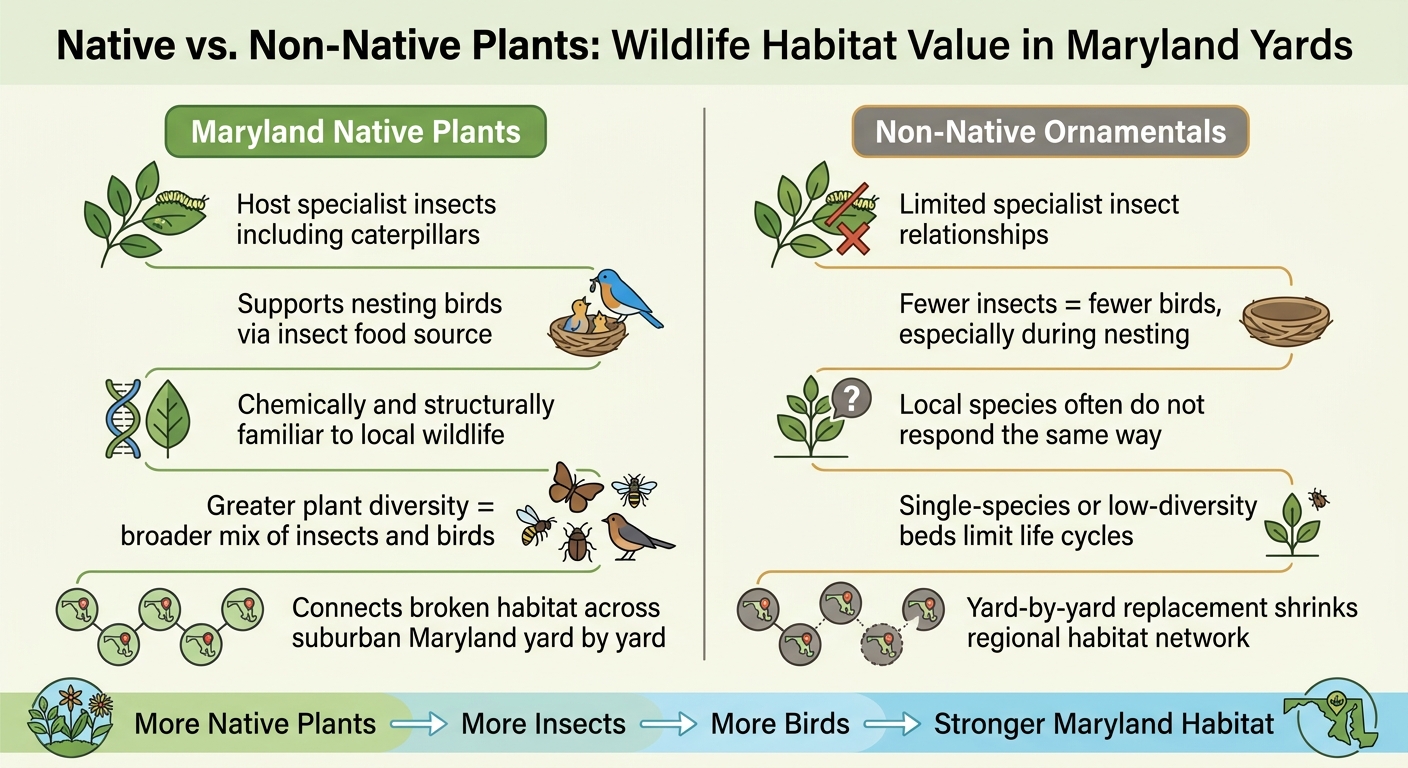
Native plants help support the insect populations that birds need for food, especially during nesting season. Many native trees, shrubs, and perennials host specialist insects, with caterpillars being a major example. Non-native ornamentals often don’t provide that same support.
When a yard is missing those host plants, the insect base gets smaller. Then the birds that rely on those insects tend to drop off too.
How Greater Native Plant Diversity Improves Residential Biodiversity
A yard with more kinds of native species can support a broader mix of insects and, as a result, a greater mix of birds and other wildlife. Single-species plantings or low-diversity beds put limits on which insects can complete their life cycles on-site.
Adding more native plant diversity across a residential landscape expands that capacity. It also strengthens the yard’s role in the local habitat network. As native plant diversity increases across the yard, its wildlife value grows too.
Why Native Plants Outperform Many Non-Native Ornamentals
Native vs. Non-Native Plants: Wildlife Habitat Value in Maryland Yards
Wildlife gets the most out of a landscape when plants fit local conditions. In Maryland, native plants have developed alongside local insects, soils, and seasonal patterns over a long stretch of time. Because of that, they play roles in the ecosystem that many non-native ornamentals just don’t.
A non-native plant can still fill space in a yard and look nice doing it. But looks aren’t the whole story. If that plant doesn’t support the specialist relationships local wildlife relies on, the yard offers less habitat than it seems to on the surface.
Local Adaptation Improves Habitat Value
Maryland native plants are familiar to local insects at a chemical and structural level. That’s what makes specialist relationships possible. An ornamental from somewhere else may seem similar to us, but local species often don’t respond to it in the same way.
That gap matters. If a plant lacks the traits local insects need for feeding, shelter, or reproduction, its role in the landscape shrinks. So even when a non-native ornamental blends in visually, it may do far less for the yard’s ecological function.
Habitat Loss and Non-Native Plant Pressure Reduce Biodiversity
When non-native ornamentals replace native species across home landscapes, the effect adds up. One yard may not seem like a big deal. But yard by yard, the habitat network available to insects and birds gets smaller.
Across a neighborhood or a region, that pressure stacks up. Fewer native plants means fewer usable resources for local wildlife, and that can chip away at biodiversity over time. That’s why plant choices in a single yard can matter more than they first appear.
sbb-itb-843f8be
How Maryland Homeowners Can Apply the Study’s Findings
Put the findings to work with more native plants, more layers, and better habitat structure. A good place to start is layered planting.
Use Layered Native Planting Instead of Single-Purpose Beds
Build your yard in layers instead of treating it like a set of separate beds. Mix canopy trees, shrubs, and groundcovers so wildlife has places to feed, travel, and take cover. Native host plants matter most here because they support the insects and animals that already live in Maryland.
A single-purpose bed may look neat, but it doesn’t do much for habitat. Layered planting gives your yard more depth and makes it far more useful for wildlife.
Add Habitat-Supportive Features and Reduce Common Stressors
Plants are a big part of the picture, but yard structure matters too. Water sources and shelter features can make a yard much more usable for wildlife. At the same time, cutting back lawn area frees up space for native planting beds and other habitat features.
In plain terms, less turf often means more room for a yard that actually supports life.
How Professional Installation Can Support Long-Term Success
Native plants do best when the site is set up the right way from the start. If drainage, grading, or soil conditions are off, even good plant choices can struggle.
Pro Landscapes MD helps homeowners fix drainage, grading, and soil problems that can weaken native plantings.
Measuring Results and Key Takeaways
The study doesn’t offer a formal, play-by-play scoring system. But the message is pretty clear: native plants, layered planting, and less turf lead to better habitat. In plain English, that gives homeowners a simple way to judge progress: yards with more native plants usually attract more wildlife.
What to Track in a Home Landscape
Watch for the return of native insects, more bird activity, plant survival, and the share of your yard planted with native species. Those signs help show whether your landscape is working as habitat, not just looking nice.
Conclusion: Native Planting Is a Practical Biodiversity Strategy
For Maryland homeowners, native planting is a practical way to support Maryland wildlife without giving up good landscape design. Insects, birds, and layered planting all tie back to one main point: the plants you choose shape how much life your Maryland yard can support.
FAQs
Which Maryland native plants help wildlife most?
Choose native plants that offer nectar, pollen, berries, and places to nest across the seasons. Good picks include wild geranium, mountain mints, butterfly weed, New England aster, Eastern columbine, cardinal flower, and coral honeysuckle.
For songbirds, plant American holly, inkberry holly, gray dogwood, and black cherry. Native trees like oaks matter a lot because they support many insect and bird species.
How much lawn should I replace first?
Start small with a manageable area, like a 4-foot by 4-foot patch, to make a garden island or border. That keeps the project from feeling too big, and you can build on it later by adding new plants or dividing the ones you already have.
You don’t need to redo your whole yard to make a difference. Even converting one-fifth to one-quarter of your yard to native plants can support local pollinators. A smart place to begin is anywhere turfgrass already has a hard time, such as shady spots or steep slopes.
How long does it take to see more birds and insects?
The research does not give a set timeline. Still, experts say native plants are the foundation of healthy ecosystems. So even swapping out part of a lawn for native plants can help support birds, insects, and pollinators.
When your yard offers food, water, shelter, and nesting sites, it starts to work more like habitat than decoration. In Maryland, that means your landscape can begin supporting local biodiversity right where you live.
Chat with Us