









- bhavya gada
- No Comments
If I want more birds in a Maryland yard, I need native plants that provide food, cover, and nesting space across the whole year. This list does that with 12 Maryland natives that fit different layers of a yard, from trees and shrubs to perennials and vines.
Here’s the short version: native plants support far more insect life than plants from other regions, and that matters because most land birds feed their young insects. The article points to a few big numbers: native woody plants in the Mid-Atlantic support about 13 times more caterpillar species, native oaks host about 557 caterpillar species, and a chickadee nest may need 6,000 to 10,000 caterpillars. It also gives a clear yard goal: aim for about 70% native plant mass.
If I were boiling the whole article down, I’d focus on this:
- For spring fruit: Serviceberry
- For winter berries: Winterberry holly and northern bayberry
- For compact shrubs: Black chokeberry and red chokeberry
- For dense middle-layer cover: Arrowwood viburnum
- For wet spots: Sweetbay magnolia and winterberry holly
- For evergreen shelter: Eastern red cedar
- For seedheads in fall and winter: Black-eyed Susan and purple coneflower
- For vertical cover and berries: Virginia creeper
- For hummingbirds plus songbirds: Coral honeysuckle
The plant list also works as a simple yard plan:
- Top layer: serviceberry, sweetbay magnolia, eastern red cedar
- Middle layer: winterberry, chokeberries, arrowwood viburnum, bayberry
- Ground layer: black-eyed Susan, purple coneflower
- Climbing layer: Virginia creeper, coral honeysuckle
The main idea is simple: don’t plant single “bird plants” here and there. Group natives in layers, match them to sun and soil, and leave seedheads, berries, and leaf litter in place when you can.
Transforming a Maryland Landscape with AMAZING Native Plants!
sbb-itb-843f8be
Quick Comparison
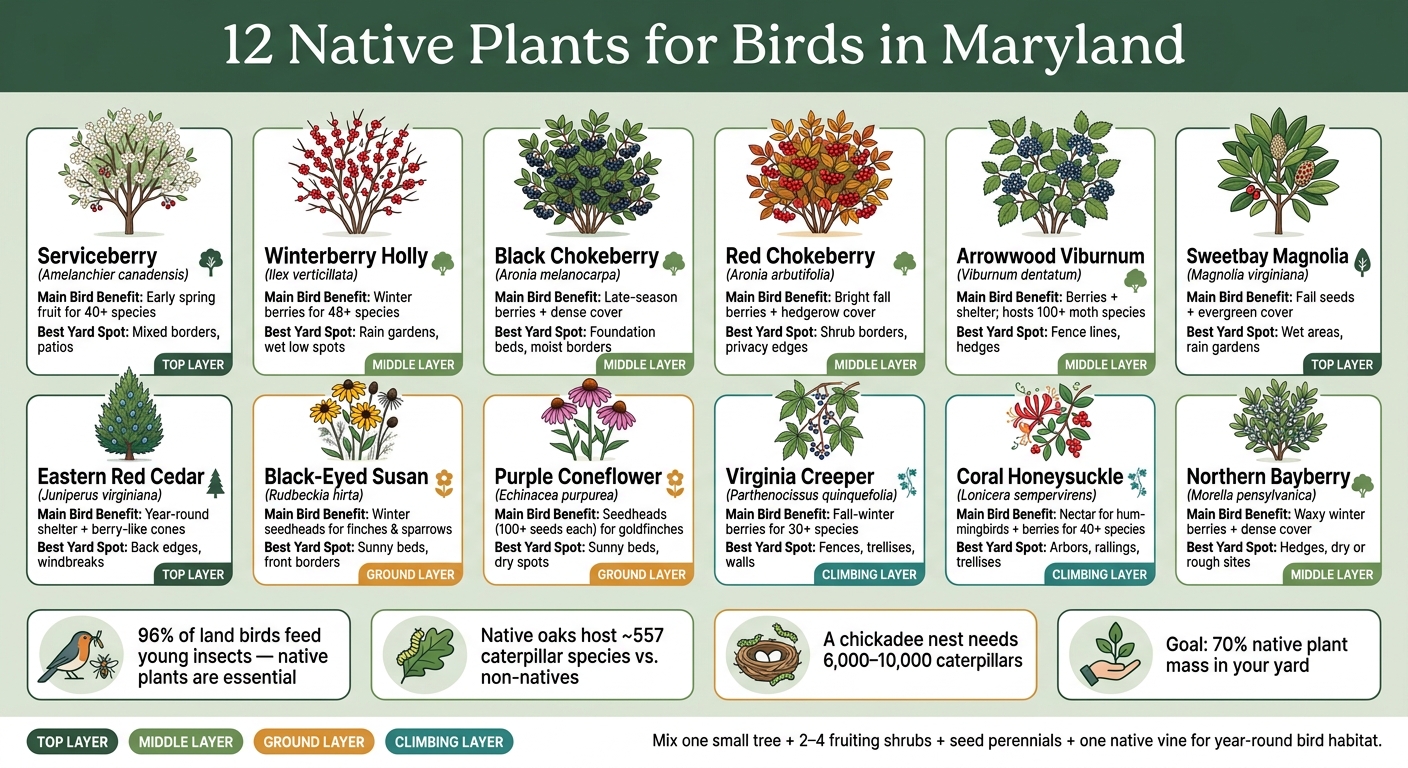
12 Native Plants for Birds in Maryland: At-a-Glance Guide
| Plant | Main bird use | Best yard spot |
|---|---|---|
| Serviceberry | Early fruit, nesting cover | Mixed borders, patios, small-tree layer |
| Winterberry holly | Late winter fruit | Rain gardens, wet low spots |
| Black chokeberry | Late fruit, low cover | Foundation beds, moist borders |
| Red chokeberry | Late fruit, taller shrub cover | Shrub borders, privacy edges |
| Arrowwood viburnum | Fruit plus thick shelter | Fence lines, hedges, property edges |
| Sweetbay magnolia | Fall seed, cover, nest material | Wet areas, rain gardens |
| Eastern red cedar | Evergreen shelter, cone crop | Back edges, screens, windbreaks |
| Black-eyed Susan | Winter seedheads | Sunny beds, front borders |
| Purple coneflower | Seedheads for finches | Sunny beds, dry spots |
| Virginia creeper | Fall-winter berries, vine cover | Fences, trellises, walls |
| Coral honeysuckle | Nectar plus berries | Arbors, railings, trellises |
| Northern bayberry | Winter fruit, dense cover | Hedges, dry or rough sites |
If I’m starting from scratch, I’d mix one small tree, 2 to 4 fruiting shrubs, a drift of seed-producing perennials, and one native vine. That setup gives birds something to use in nearly every season.
What Makes a Native Plant Good for Birds in Maryland
These 12 plants made the list for Maryland songbirds, woodpeckers, and finches for a simple reason: they do more than just look nice. They provide food, cover, nesting material, and a size that works in local yards. The best picks check all four boxes.
Food matters most. About 96% of terrestrial bird species feed their young insects, mostly caterpillars.[7][1][8] That’s a big deal. It means native plants pull more weight during breeding season because they support the insects birds need, not just berries or seeds. Fruit and seed still matter, though. Plants that produce in summer, fall, and winter help keep birds fed across more of the year.
Shelter and nesting go hand in hand. Dense branching, thorns, and evergreen foliage give birds places to hide from predators and rough weather. Those same plants can also offer nesting spots. And birds don’t just nest in them – they use twigs, bark fibers, and leaf strips from them to build nests.[2][3]
For Maryland yards, size and placement matter too. The strongest choices fit into places people already have: foundation beds, fence lines, side yards, rain gardens, and property edges. In other words, these are plants that can help birds without swallowing the whole yard.
There’s also a useful benchmark from University of Maryland Extension: aim for at least 70% of your yard’s plant mass to be native if you want to support healthy insect populations and the birds that depend on them.[5][9] Think of that as a practical target as you add more natives over time.
The plants below meet these needs in different parts of a Maryland yard.
1. Serviceberry (Amelanchier canadensis)
Serviceberry is one of the best early-season bird plants for Maryland yards. Its June fruit feeds at least 40 bird species, including robins, orioles, cedar waxwings, and catbirds. In many yards, birds strip the berries before they fully ripen. That early rush for fruit is exactly why people also call it Juneberry.
Bird Food Value
Serviceberry does more than feed birds. Its spring flowers support pollinators, and its leaves host 114 butterfly and moth caterpillar species [10], including luna moths, eastern tiger swallowtails, and viceroys.
That means this plant helps wildlife at more than one stage of the season. First come the flowers, then the caterpillars, then the berries. It pulls a lot of weight for a small tree or large shrub.
Shelter and Nesting Cover
Serviceberry also gives birds a good place to hide and nest. Its fine branching creates thick cover and small nesting pockets. Cardinals and robins sometimes nest in it [14][16].
A little light pruning can help keep that dense form in place. Think of it less like shaping a showpiece and more like keeping a living shelter in good condition.
Seasonal Interest and Wildlife Timing
White flowers open in late March or April [11][12][20][21]. Fruit follows in June. In fall, the leaves turn orange-red, and the branches keep giving cover through the rest of the year.
That timing matters. When birds are coming out of winter and food is still limited, serviceberry starts showing up right on cue.
Best Fit for Urban and Suburban Yards
Serviceberry grows 6 to 25 feet tall, depending on form and site [17][20]. In a small lot, a multi-stem plant works well along a fence or near a patio. In a suburban yard, it fits nicely at the edge of a mixed native border.
It grows in sun or part shade and handles clay soils, moist spots, and rain garden edges [17][18][19][20].
For longer-season bird support, pair serviceberry with a shrub that holds fruit into fall and winter.
2. Winterberry Holly (Ilex verticillata)
Where serviceberry helps birds in spring, winterberry steps in during winter. After the leaves drop, the shrub still holds its bright red berries, and that timing matters.
Bird Food Value
More than 48 bird species eat winterberry fruit, including bluebirds, waxwings, robins, catbirds, thrashers, cardinals, and turkeys.[23][32] The berries usually aren’t a first choice right when they ripen, so many birds hold off until mid- to late winter.[25][30] As freeze-thaw cycles repeat, the fruit softens and becomes easier to eat.[24][26] That’s a big part of why winterberry can keep berries on display for months instead of losing them all at once.
Shelter and Nesting Cover
Winterberry grows as a multi-stemmed shrub and often forms dense thickets, especially when planted in groups.[22][28] For small birds, that dense form is useful in a very simple way: it gives them places to duck out of sight, get out of the wind, and nest. Cedar Waxwings and Red-winged Blackbirds have been documented nesting within winterberry thickets.[27][29] Even after the leaves are gone, the branching still offers perches and a bit of cover.
Seasonal Interest and Wildlife Timing
Berries start forming at the end of August and stay on the shrub through much of winter.[24] In a Maryland yard, that makes winterberry a steady late-season food bridge. It helps fill the stretch between the food of fall and the return of early spring insects.
Best Fit for Urban and Suburban Yards
Winterberry does best in full sun to part shade and moist, acidic soil (pH 4.5–6.5).[33][34] In the wild, it grows in swamps and along forested wetland edges, so it fits well in rain gardens, low spots, or places where roof runoff collects.[22][26]
There is one planting detail you can’t skip: winterberry is dioecious, which means you need both a female and a male plant to get berries. One male can pollinate up to five female plants, and they should be planted within about 20 to 50 feet of each other.[35]
For smaller yards, compact cultivars like ‘Red Sprite’ and ‘Berry Poppins’ work well in foundation beds and mixed borders. In a more typical suburban yard, larger types like ‘Winter Red’ (6–9 ft) can anchor a mixed native shrub border along a fence or property line.[31]
For a shrub with earlier fruit and a lighter shape, black chokeberry is the next strong choice.
3. Black Chokeberry (Aronia melanocarpa)
Black chokeberry is a compact native shrub that helps feed birds from late summer into winter. Because it stays fairly low, holds its fruit well, and handles wet soil, it fits nicely into the low shrub layer of a Maryland bird garden.
Bird Food Value
The berries ripen in late summer and early fall, right when birds need extra fuel for migration and the cold months ahead. Cedar waxwings, American robins, gray catbirds, eastern bluebirds, tufted titmice, northern cardinals, and woodpeckers all eat the fruit.[43]
The berries are tart, so they often hang on into late fall and winter instead of disappearing all at once. That gives birds another food source when other shrubs have already been picked clean. The dense branching also gives birds a place to duck in, rest, and nest.
Shelter and Nesting Cover
Black chokeberry grows about 3–6 feet tall and wide.[36][39] When you plant several together, they form low thickets that give songbirds solid cover and nesting space. That thick growth keeps the shrub useful even after the flowers are gone.
Seasonal Interest and Wildlife Timing
White flowers show up in April and May, then berries follow and may stay into winter. In fall, the foliage turns crimson-red, burgundy, or orange.[37][38]
Best Fit for Urban and Suburban Yards
This shrub works well in rain gardens, foundation beds, and low areas with moist to wet soil.[40][41][42] In a standard suburban yard, it fits nicely into a mixed native shrub border with winterberry and arrowwood viburnum.
Its compact size and late-holding fruit make it a good bridge plant before the next shrub in the list. If you want a similar shrub with brighter fall color, the next plant is a good fit.
4. Red Chokeberry (Aronia arbutifolia)
If black chokeberry stays on the shorter side, red chokeberry brings much of the same bird value in a taller package. This upright native shrub fits the middle layer of Maryland bird plantings, usually growing 6–8 feet tall and reaching as much as 13 feet in good conditions.[49][55]
Bird Food Value
Red chokeberry produces red berries that ripen in late summer and often hang on into winter. That fruit feeds thrushes, robins, cedar waxwings, and mockingbirds.[44][46][49][51][52] A nice bonus: birds often leave the berries alone until after frost, so the fruit tends to stay put longer and serve as a steady food source late in the season.[47][54] Its thick branching also gives birds a place to pause, tuck in, and nest.
Shelter and Nesting Cover
The shrub’s dense stems give small birds cover for roosting, hiding, and nesting.[53][54]
Seasonal Interest and Wildlife Timing
White spring flowers are followed by bright red berries and red fall foliage.[48][49][50][53] Then winter comes along, and the fruit often remains on the branches, which keeps the shrub useful for birds and attractive in the yard.[54]
Best Fit for Urban and Suburban Yards
Red chokeberry does well in city settings and can handle wet, low-lying areas.[45][46][47][56] It works well when you need a taller shrub between lower chokeberries and larger viburnums. In a mixed shrub border, pair it with serviceberry, winterberry holly, and arrowwood viburnum to stretch fruit availability from spring into late winter.[57]
5. Arrowwood Viburnum (Viburnum dentatum)
Arrowwood viburnum adds height to the shrub layer and keeps fruit and cover available later in the year. In a Maryland bird yard, it fills that middle zone well, usually growing 6–10 feet tall with about the same spread. In the right spot, it can reach 12–15 feet.[58][59]
Bird Food Value
In late spring to early summer, arrowwood viburnum puts out flat-topped clusters of creamy-white flowers. After that, berries develop and ripen from late summer into fall.[58][60][66] Birds don’t ignore them. Robins, waxwings, catbirds, thrashers, bluebirds, flickers, and cardinals all eat the fruit.[62][65][70]
It also does more than feed birds with berries. Arrowwood viburnum hosts more than 100 species of butterflies and moths, including Baltimore checkerspot.[58][61] That means more caterpillars and other insects during nesting season, which is exactly what many parent birds need when they’re feeding young.
Shelter and Nesting Cover
This shrub grows with a dense, multi-stemmed form that gives birds solid cover. Cardinals, catbirds, and sparrows use that thick branching for roosting and nesting.[62][67] If you plant it as a hedge or along a fence, it can act like a sheltered path through the yard.
Heavy shearing works against that. A light thinning job is a better move because it keeps the twiggy inner growth birds depend on.[71]
Seasonal Interest and Wildlife Timing
In Maryland, arrowwood viburnum blooms from May into early June.[58][59][69] That timing lines up well with the period when many birds are feeding nestlings and need a steady supply of insects.
The plant keeps its dark green leaves through summer. Then berries ripen in late summer, and fall color shifts from yellow to burgundy.[72][73][74] So it keeps doing something useful across more than one season.
Best Fit for Urban and Suburban Yards
Arrowwood viburnum grows in full sun to part shade and handles many soil and moisture conditions, including clay and wetter spots.[58][63][64][68] That makes it a good fit for foundation plantings, rain garden edges, and property-line hedges.
On a small city or townhouse lot, even a simple group of two or three shrubs can do a lot. Spaced 5–8 feet apart, they can form a soft screen without making the yard feel boxed in.[59][69]
6. Sweetbay Magnolia (Magnolia virginiana)
For wetter yards that need some height, sweetbay magnolia brings fruit, cover, and nesting material. It’s a native small tree that suits wet Maryland sites, giving birds fall fruit, winter cover, and places to nest without swallowing the whole yard. That makes it a good match for rain gardens, low spots, and other soggy areas where shrubs alone can feel a little short. In the Mid-Atlantic, it typically reaches 15–25 feet tall with a 10–20 foot spread, so it stays workable for many suburban lots.[81]
Bird Food Value
Sweetbay’s main draw is its cone-like fruit cluster, which ripens by mid-autumn and holds red-coated seeds. Eastern kingbirds, American robins, wood thrushes, Northern mockingbirds, red-eyed vireos, and Northern flickers all eat them.[84][85][83] That timing matters. The fruit shows up in fall, right when migrating birds need energy, and the flowers also help support the insects birds rely on during nesting season.[76][78]
Shelter and Nesting Cover
In much of Maryland’s Coastal Plain, sweetbay is evergreen to semi-evergreen, so it keeps its foliage through winter storms and cold snaps when most other trees are bare.[77][78] That alone gives birds a big edge in cold weather.
Mockingbirds, robins, wood thrushes, and red-eyed vireos use its leaves and twigs for nests.[75][6] Its dense branching and year-round foliage also help roosting birds stay hidden from predators, especially when sweetbay is planted in a loose cluster with other native shrubs.
Seasonal Interest and Wildlife Timing
Sweetbay blooms from May through June, and sometimes later. Those flowers help pollinators and support the insects birds feed on while raising young. By mid-autumn, the seeds are ready right on cue for migratory songbirds that need high-calorie food before and during travel.
Best Fit for Urban and Suburban Yards
Sweetbay does best where water tends to collect. It thrives in moist to wet, acidic soil with a pH of about 5.0–6.5, which makes it a natural fit for rain gardens, low spots near downspouts, and other poorly drained areas.[79][80] It handles full sun to part shade and can deal with clay as long as the soil stays consistently moist.
Give it 12–18 feet from buildings so it has room to spread.[82] On a small city lot, one sweetbay near a patio can give you shade and bird cover without taking up much space. In a bigger yard, planting two or three along a fence or wooded edge can form a sheltered bird corridor.[77]
7. Eastern Red Cedar (Juniperus virginiana)
Eastern Red Cedar is a smart pick if you want a tough evergreen that helps birds all year. It grows well in full sun and handles dry, poor, and compacted soils without much fuss. The tree is dioecious, which means only female trees make the blue berry-like cones birds eat.[87][13] In a bird-friendly yard, it fits best as the upper evergreen layer, a key component of professional landscape design.
Bird Food Value
Eastern Red Cedar makes blue berry-like cones that are high in fat and fiber, so they serve as an important food source from late summer through early spring.[15][88] Cedar Waxwings are some of the most common visitors. They were even named for their strong preference for redcedar berries, and they often feed in flocks.[86][89][91][98] American Robins, Northern Mockingbirds, and Dark-eyed Juncos also eat the cones.[88][90][95][96]
Shelter and Nesting Cover
Its dense evergreen branches often grow close to the ground. That gives birds tight cover for nesting, roosting, and getting away from predators.[86][90][93][95][96] Northern Cardinals, warblers, mourning doves, and Wild Turkeys have been seen nesting in its boughs. Eastern Screech-Owls, Short-eared Owls, and Northern Saw-whet Owls use it as a roosting spot.[95][97]
Seasonal Interest and Wildlife Timing
The cones stay on the tree from late summer into early spring, with the heaviest feeding in fall and winter. Its evergreen foliage also keeps roosting cover in place through winter, which is a big deal when the rest of the yard has gone bare.[88][96]
Best Fit for Urban and Suburban Yards
Mature trees can reach 40 to 70 feet tall, so placement matters.[87] In suburban yards, Eastern Red Cedar works well as a backdrop or anchor tree along a back fence line or rear boundary, with lower native plants planted beneath it.[88][89][92] On smaller city or townhouse lots, a single tree along a rear fence can add vertical cover without taking over the whole space.[89][94][96]
It also works well as a screen, hedge, windbreak, or wildlife tree in naturalized corners and along property edges.[87][99] One thing to watch: Eastern Red Cedar is an alternate host for cedar–apple rust, so it should be kept away from apple and crabapple trees.[93][95] Planting lower natives under it helps stretch food and cover into the shrub and ground layers.
8. Black-Eyed Susan (Rudbeckia hirta)
Black-Eyed Susan is the kind of plant that quietly does a lot of work in a yard. It fills the sunny layer beneath shrubs and small trees, and it slips easily into sunny beds, borders, and curbside strips.[114][102][112] This compact native wildflower also shows up along roadsides, old fields, grasslands, and meadows across the state. At just 1 to 3 feet tall, it fits just as well in a small city lot as it does in a bigger suburban planting.[113]
Bird Food Value
The dried seedheads feed American goldfinches, dark-eyed juncos, and native sparrows.[110][111][101][100][106] That matters most in the colder months, when food gets harder to find. Leave the stems standing through winter so birds can keep foraging on them after the blooms are gone.[100][104][109]
Shelter and Nesting Cover
Black-Eyed Susan forms dense clumps of upright stems that give small birds low cover while they forage.[102][107] When you plant it under shrubs, those clumps act like a small safe zone between open lawn and thicker nesting plants.[102][108] One plant can help, but a grouped planting does a much better job.
Seasonal Interest and Wildlife Timing
Black-Eyed Susan usually blooms from mid-summer into early fall, with peak color from July through September.[113][115][116] Those bright flowers attract a wide mix of pollinators, and those insects help feed the birds that are raising young at the same time.[103][105] After the flowers fade, the seedheads keep pulling their weight by feeding birds into late fall and winter.[100][104][106]
Best Fit for Urban and Suburban Yards
Black-Eyed Susan grows well in full sun and well-drained soil. It also handles clay or sand and does fine in dry spells once established.[113][108][109] That toughness makes it a smart pick for front-yard beds, curb strips, and sunny drifts planted next to taller native species.[112][101][102]
9. Purple Coneflower (Echinacea purpurea)
Purple coneflower is a tough native perennial that fits bird-friendly Maryland yards with very little fuss. It usually grows about 3 to 4 feet tall, does best in full sun, and handles poor soil, clay, and dry conditions without much trouble.[122][123][124][126] That’s a big reason it works so well in urban and suburban spaces. You don’t need perfect soil or a big lot to make room for it.
For birds, the big payoff comes after the flowers fade. The seedheads stick around and give finches and other seed-eating birds something to feed on well past bloom time.
Bird Food Value
This plant pulls its weight once seedheads form. Each one can hold 100 or more seeds.[134] A healthy clump can keep producing enough seed to feed goldfinches and other seed-eaters for months.
American goldfinches are the top visitors, but they’re not the only ones stopping by. Chickadees, sparrows, cardinals, nuthatches, and pine siskins also feed on the seedheads.[117][118][119]
If your goal is to keep that food source in place, leave the plant alone in fall. Skip deadheading and let the seedheads stand until late winter. It’s one of those cases where doing less gets you more bird activity.
Shelter and Nesting Cover
Purple coneflower does more than feed birds. Its upright stems add light cover and give birds a place to perch while they forage.[120][121] It also helps at ground level, especially in sunny spots beneath shrubs where yards can feel a little bare.
Those standing stems matter in winter too. They can shelter overwintering insects and spiders, which turn into a protein-rich food source for birds in early spring.[127][129][130] So even when the plant looks a bit rough around the edges, it’s still doing useful work.
Seasonal Interest and Wildlife Timing
Purple coneflower blooms from July through September, which gives bees and butterflies a summer nectar source.[125][128][131][132][133] That bloom window lines up well with the needs of late-season pollinators.
It also matters for birds in a less obvious way. Goldfinches nest later than many songbirds, and they rely heavily on seeds. So this plant shows up at a good time, then keeps giving once those seedheads mature.
Best Fit for Urban and Suburban Yards
Because it’s so tough, purple coneflower is easy to use in small, sunny plantings. It fits nicely in foundation beds and sunny edge plantings.[123][124][126] Give plants about 18 to 24 inches of space.[121][125]
It also handles a lot of the problems that trip up other perennials:
- Drought
- Poor soil
- Clay
- Deer browsing
For a longer seed display, pair it with Black-Eyed Susan.[129]
10. Virginia Creeper (Parthenocissus quinquefolia)
After low perennials, Virginia creeper adds the vertical vine layer birds use for cover and late-season fruit. It’s a native woody vine that climbs fences, walls, arbors, and trees, and it can also spread as groundcover on slopes. If you let it run, it can grow more than 50 feet, so plan to prune it where you want to keep it in bounds.
Bird Food Value
The berries are the big reason birds show up. They ripen from August through October and can stay on the vine from September into February,[136][137] which gives birds food late in the season when fall fruit starts thinning out. About 30 bird species have been documented eating Virginia creeper berries,[143][144] including robins, catbirds, mockingbirds, woodpeckers, and bluebirds.
That mix matters. A vine that feeds that many species can pull its weight during fall migration and into early winter.
Shelter and Nesting Cover
Dense growth gives birds a place to duck out of sight and get a break from wind. Northern Cardinals have been documented nesting right in Virginia creeper growing on an arbor,[143] so this vine does more than hang fruit.
It also hosts sphinx moth caterpillars,[142][143] which means it helps support summer insect food too. For birds feeding young, that can make a big difference.
Seasonal Interest and Wildlife Timing
Virginia creeper’s fall color shifts to deep red, orange, and burgundy, with peak color usually landing in late September to mid-October in Maryland.[135][138] That timing lines up well with peak songbird migration.
If you cut it back in fall, you lose part of the point. Leave it standing through winter to keep the fruit and cover in place.[142][145][146]
Best Fit for Urban and Suburban Yards
Virginia creeper fits well on masonry walls, chain-link fences, sturdy trellises, and pergolas where it has support and where you can manage its spread.[139][140][141] It adds height without taking up much ground space, which makes it a smart pick for small urban or townhouse lots.
Use it on sturdy fences, walls, trellises, or pergolas. Keep it away from play areas, though – the berries and sap can irritate people and pets.
11. Coral Honeysuckle (Lonicera sempervirens)
Coral honeysuckle adds a lighter, flowering vine layer to your landscape design. It’s a native, non-invasive twining vine that fits well in many Maryland yards, usually reaching 8–20 feet depending on its support and how you prune it.[151][158][159]
Bird Food Value
Coral honeysuckle gives birds two food sources across the growing season: nectar from mid-spring through summer, then bright red berries in late summer and fall that can hang on into winter.[147][150][151][152] Those berries have been documented feeding more than 40 bird species, including American robins, cedar waxwings, hermit thrushes, goldfinches, cardinals, and sparrows.[165]
Ruby-throated hummingbirds are the main nectar visitors, and that bloom window lines up with their nesting season.[147][148][149] In plain terms, this vine shows up right when they need it.
Shelter and Nesting Cover
Once the vine fills in, its dense stems and foliage give songbirds a place to hide, rest, and duck away from predators. On a fence or trellis, a mature plant can also provide nesting cover. Just as important, it supports caterpillars that birds feed to their young.[150][162][164]
Seasonal Interest and Wildlife Timing
Flowers open in mid- to late spring and can keep coming into early fall on new growth.[154] Berries follow from late summer through fall.[154][166] In milder Maryland winters, the foliage may stay semi-evergreen, which helps the plant keep some structure in place.[160][161][163]
That seasonal rhythm is a big part of the appeal. You’re not getting a vine that looks good for two weeks and then fades into the background. You’re getting flowers, fruit, and cover spread across much of the year.
Best Fit for Urban and Suburban Yards
Coral honeysuckle grows up instead of out, which makes it a smart pick when space is tight. You can train it on a fence, trellis, porch railing, pergola, or arbor in full sun to partial sun, and it will bloom and fruit well.[148][153][157][158]
It handles dry to moist, well-drained soil and becomes drought tolerant once established.[148][149][156][157][158] A light pruning in late winter or early spring helps keep it compact and blooming well.[155][156][158]
12. Northern Bayberry (Morella pensylvanica)
Northern bayberry helps fill the winter food gap with fruit, cover, and strong performance in rough spots. It’s a dense, multi-stemmed, semi-evergreen shrub that usually grows about 5 to 10 feet tall in Maryland.[178]
Bird Food Value
Female plants produce waxy gray-blue fruit that often stays on the plant through winter and into spring.[173][171] That gives birds a steady cold-season food source when slim pickings set in.
Birds that eat bayberry include yellow-rumped warblers, cedar waxwings, robins, catbirds, mockingbirds, bluebirds, chickadees, blue jays, and cardinals.[174][175][167][176] It matters a lot for yellow-rumped warblers, which handle the waxy coating better than most birds.
There’s one catch: bayberry is dioecious, which means male and female flowers grow on separate plants. If you want fruit, you need a male plant nearby to pollinate the female shrubs.[169][171][170]
Shelter and Nesting Cover
Bayberry’s tight, closely spaced stems make a dense thicket that helps small birds get out of the wind and stay less exposed to predators. In a bird-friendly yard, it fills that low-to-mid shrub layer that often goes missing.
Those same dense stems also give birds low nesting cover. Plant a small group together, and bayberry can work like a living hedge that birds use for cover and short, safer hops across the yard.
Seasonal Interest and Wildlife Timing
Bayberry blooms in spring with small, plain-looking flowers, and female plants start forming berries in summer. By late summer and fall, migrating birds begin using the fruit. The berries often stay put through winter and into early spring, right when food can run short.
Its semi-evergreen foliage also helps at the same time, giving birds winter cover while the fruit is doing the most work.
Best Fit for Urban and Suburban Yards
Bayberry handles salt spray, poor or sandy soil, compaction, wet or dry conditions, and wind, which makes it a good pick near roads, driveways, and coastal-influenced sites.[172][173][170] In bigger yards, planting several together gives you thicker cover and better fruit set. Give it space to spread, and cut suckers back when needed.[177][168]
Used in a cluster, bayberry helps round out the winter food layer before the article moves into planting layouts.
How to Combine These Plants Into a Bird-Friendly Maryland Yard
Picking the right plants is only part of the job. Where you put them matters just as much. If you layer native plants by height and bloom or fruit time, birds can feed, hide, and move through the yard with much less effort. The layouts below show how that same basic setup can work in yards of different sizes.
Layer Plants by Height and Season
Use four layers: small trees and evergreens at the top, understory shrubs in the middle, low perennials along the front edge, and climbing vines that tie the whole space together.
Start with Sweetbay Magnolia or Eastern Red Cedar as your upper anchors, and add Serviceberry for spring fruit. Around those, group Winterberry Holly, Black Chokeberry, Red Chokeberry, Arrowwood Viburnum, and Northern Bayberry as the shrub layer. That gives birds berries through fall and winter. At the front, plant Black-Eyed Susan and Purple Coneflower in drifts. Leave those perennials standing through winter so goldfinches, sparrows, and other songbirds can forage on the seedheads from late summer on.
Then add the vertical link: run Virginia Creeper or Coral Honeysuckle along a fence or arbor. That adds shelter, nesting spots, and a travel route between the other layers.
Place Eastern Red Cedar on the north or west edge, with Winterberry Holly, Northern Bayberry, and Arrowwood Viburnum in front.
Once that structure is in place, you can scale it up or down based on your lot size.
Planting Ideas for Small City and Townhouse Lots
In a 15–20-foot-wide townhouse backyard, keep the plant mix simple. Place one Serviceberry or Sweetbay Magnolia about 6–8 feet from the house as a focal tree. Along the back fence, plant Winterberry Holly and Black Chokeberry for winter fruit and screening. Train Virginia Creeper on that same fence so you get vertical cover without giving up much ground space. Near the patio, tuck in a cluster of Purple Coneflower or Black-Eyed Susan for summer color and winter seed.
A narrow side yard can work well too. A staggered line of Northern Bayberry set 3–4 feet off the property line gives structure, and Coral Honeysuckle can climb a wall-mounted trellis or railing above it.
Larger yards use the same layers, just spread out in broader bands.
Planting Ideas for Typical Suburban Yards
Along the back or side property line, mix Eastern Red Cedar, Sweetbay Magnolia, Northern Bayberry, and Arrowwood Viburnum into a loose privacy edge. This setup gives you screening, flowers, and berries through the year.
If you have a low spot, turn it into a simple rain garden to manage runoff. Use Serviceberry, Arrowwood Viburnum, and Winterberry Holly, then underplant with Purple Coneflower and Black-Eyed Susan. Along sunny foundation beds or deck edges, pair Black Chokeberry and Red Chokeberry with a front band of perennials. Add Virginia Creeper to back fences and Coral Honeysuckle on a pergola so birds can move between these planted areas more easily.
On bigger suburban lots, that same pattern can be repeated in hedgerows and habitat strips.
Planting Ideas for Larger Naturalized Yards
On larger properties, bands work better than straight rows. A hedgerow along a driveway or field edge works best when it is at least 20 feet wide and includes at least 25% evergreen planting, such as Eastern Red Cedar, for winter cover.[182] Plant trees and shrubs 6–8 feet apart in rows spaced 8–10 feet apart so the planting fills in and creates dense cover over time.[181][182]
Inside the hedgerow, repeat clusters of Serviceberry, Winterberry Holly, Arrowwood Viburnum, and Northern Bayberry. At the outer edges, use open drifts of Black-Eyed Susan and Purple Coneflower for seed-eating birds. Beyond the hedgerow, mow less often and leave leaf litter in place to support insect prey.[4][179][180]
Quick Plant Comparison Table for Maryland Homeowners
Use this table to match each plant to the part of your yard where it makes the most sense.
| Plant | Type | Approx. Size (H × W) | Main Bird Benefit | Best Sun | Moisture | Ideal Yard Use |
|---|---|---|---|---|---|---|
| Serviceberry (Amelanchier canadensis) | Small tree/large shrub | ~15–25 ft × 10–20 ft | Spring berries[12] + nesting cover | Sun to part shade | Average to moist | Mixed borders, front yards, near patios |
| Winterberry Holly (Ilex verticillata) | Deciduous shrub | ~6–10 ft × 4–8 ft | Winter berries for songbirds | Full sun to part shade | Moist to wet | Rain gardens, wet corners, back-of-border screens |
| Black Chokeberry (Aronia melanocarpa) | Shrub | ~3–6 ft × 3–5 ft | Late-season berries + dense cover | Full sun to part shade | Average to moist | Hedgerows, wildlife edges, moist low spots |
| Red Chokeberry (Aronia arbutifolia) | Shrub | ~6–10 ft × 3–5 ft | Bright fall berries + hedgerow cover | Full sun to part shade | Average to moist | Taller privacy edges, naturalized shrub plantings |
| Arrowwood Viburnum (Viburnum dentatum) | Shrub | ~6–10 ft × 6–8 ft | Berries + branching cover | Full sun to part shade | Average to moist | Privacy hedges, property boundary screens |
| Sweetbay Magnolia (Magnolia virginiana) | Small tree | ~10–20 ft × 8–15 ft | Insect-rich foliage for songbirds + light cover | Full sun to part shade | Moist to wet | Wet corners, rain gardens, specimen near patios |
| Eastern Red Cedar (Juniperus virginiana) | Evergreen tree | ~30–50 ft × 10–20 ft | Year-round shelter + berry-like cones | Full sun | Dry to average | Evergreen privacy edge, windbreak, property line |
| Black-Eyed Susan (Rudbeckia hirta) | Perennial | ~1–3 ft × 1–2 ft | Seed heads for finches and songbirds | Full sun | Average to dry | Sunny borders, pollinator beds, street-side plantings |
| Purple Coneflower (Echinacea purpurea) | Perennial | ~2–4 ft × 1–2 ft | Seed heads for goldfinches and songbirds | Full sun | Average to dry | Sunny borders, mixed perennial beds, front-yard wildlife plantings |
| Virginia Creeper (Parthenocissus quinquefolia) | Vine | Climbs 30–50 ft | Fall berries + dense vine cover | Full sun to shade | Average to wet; flexible | Fences, trellises, walls; groundcover on slopes |
| Coral Honeysuckle (Lonicera sempervirens) | Vine | ~10–20 ft on supports | Nectar for hummingbirds + small berries for songbirds | Full sun to partial sun | Average to slightly moist | Arbors, railings, mailboxes; townhouse-friendly vertical spaces |
| Northern Bayberry (Morella pensylvanica) | Semi-evergreen shrub | ~5–10 ft × 5–10 ft | Waxy berries for winter birds + evergreen cover | Full sun to partial sun | Dry to average | Foundation massing, informal hedgerows, coastal-style screens |
A few patterns stand out right away. Winterberry Holly, Sweetbay Magnolia, Serviceberry, Arrowwood Viburnum, and Northern Bayberry work well in rain gardens and low spots. If you’ve got a part of the yard that stays damp after a storm, that’s a good place to start.
For sunny beds, Black-Eyed Susan and Purple Coneflower pull double duty. They bring color in season, then leave seed heads that finches and other songbirds can use later on. That makes them a smart fit for borders, pollinator beds, and front-yard plantings that need to look good without feeling fussy.
Tight on space? Vines can do a lot of work. Virginia Creeper and Coral Honeysuckle add bird habitat without taking up much room at ground level, which is handy for fences, trellises, railings, and other vertical spots.
If you want help turning these plant picks into a yard plan, Pro Landscapes MD can help. Pro Landscapes MD offers planting and landscape design across central Maryland.
Planting and Installation Help in Central Maryland
Once the plant list is set, installation is what makes or breaks the result. In central Maryland, compacted clay, poor drainage, slopes, and mixed shade can all hold plants back if the site isn’t set up well.
Pro Landscapes MD works with homeowners in Columbia, Bethesda, Silver Spring, Ellicott City, and Towson to handle both site review and installation. That work includes soil prep, grading, native planting, rain gardens, and drainage fixes. If a yard has wet spots that never seem to dry out, moisture-tolerant natives like Sweetbay Magnolia and Winterberry Holly can be paired with subsurface drainage so the planting matches the site instead of fighting it.
That kind of planning matters. Birds respond to total native cover, not a few scattered plants. Hitting the 70% native-biomass target takes careful plant choice and layout, not a handful of token natives.[183][184][185]
Hardscape doesn’t have to work against bird habitat. A patio, walkway, or retaining wall can help shape native shrub islands, trellised vines, and bird-friendly planting pockets. In most yards, those combinations work best when the hardscape and planting beds are planned as one system.
On compact townhouse lots, trellises with Coral Honeysuckle or Virginia Creeper can add bird habitat without taking up more ground space. On larger properties, that same idea can stretch into hedgerows and shrub thickets that suit a more naturalized yard.
Conclusion
These 12 plants cover the main layers birds use in a yard: trees, shrubs, perennials, and vines. Each one helps in a different way, whether that means food, shelter, or nesting support at different times of year. Native plants matter because they support the insects birds need to feed their young, along with the berries and seeds that help birds get through fall and winter. Even adding a few can make a clear difference in a small yard.
Maryland Extension recommends aiming for at least 70% native plants in a landscape to better support native insects and birds [5]. A simple way to move in that direction is to:
- Plant in clusters instead of scattering individual plants
- Build layers by height and season
- Leave leaf litter in place where you can
The 12 plants covered here – from winterberry holly to purple coneflower to eastern red cedar – give Maryland homeowners a solid starting point. Pick the ones that match your site, group them by layer, and watch how birds use them for feeding, nesting, and cover.
FAQs
Which native plants help birds year-round?
In Maryland, birds do best when they have both food and cover all year long.
Evergreens such as American holly, eastern hemlock, mountain laurel, and eastern red cedar give birds a place to hide from wind and harsh winter weather. That kind of shelter matters a lot when temperatures drop.
For food, plant species with berries that stay on through winter. Good picks include crabapple, sumac, American cranberry bush viburnum, winterberry holly, and red chokeberry. It also helps to leave seed heads on perennial flowers and ornamental grasses, since finches and other songbirds will feed on them through the winter.
What should I plant in a wet area for birds?
For wet areas in your Maryland yard, Winterberry Holly and Elderberry are strong native picks. They grow well in moist soil and help local birds with berries. Elderberry also brings white flowers that draw pollinators.
Red Chokeberry is another good choice for damp spots. It produces berries that help feed birds through winter.
How do I design a small Maryland yard for birds?
Create a layered habitat that gives birds what they need every day: food, water, shelter, and places to nest. One of the best moves is to replace part of your lawn with native plants. Those plants help support the insects many birds rely on, especially during nesting season. If a full yard makeover feels like too much, start small with a 4-foot by 4-foot planting island.
Mix canopy trees, shrubs, and groundcovers to build different feeding and nesting zones. Think of it like setting up a neighborhood with an upper level, middle layer, and ground floor. Each layer gives birds something a little different.
A few simple additions can make the space much more inviting:
- A shallow bird bath for drinking and bathing
- Brush piles for cover and rest
- Native species that fit your area and support a lasting ecosystem
Native plants do more than fill space. They help create a yard that birds can actually use, not just visit.
Chat with Us