









- bhavya gada
- No Comments
When it comes to erosion control, native plants outperform turf grass in most scenarios. Native plants have deeper roots (2–3 feet), which stabilize soil better, reduce runoff, and improve water infiltration. Turf grass, with its shallow roots, is less effective on slopes or in areas prone to heavy erosion but works well in flat, high-traffic spaces like lawns or sports fields. Here’s a quick breakdown:
- Native Plants: Best for slopes, shaded areas, and near waterways. They require less maintenance, support local wildlife, and cost less over time.
- Turf Grass: Suitable for flat, high-use areas. It demands frequent mowing, watering, and fertilizing, which increases long-term costs and environmental impact.
Quick Comparison:
| Feature | Native Plants | Turf Grass |
|---|---|---|
| Root Depth | Deep (2–3 feet) | Shallow |
| Erosion Control | High | Moderate to Low |
| Water Needs | Low (once established) | High |
| Maintenance Costs | Low | High |
| Environmental Impact | Positive | Negative (fertilizers, mowing) |
| Installation Cost/Acre | $3,400–$5,975 | $7,800–$14,825 |
Key Takeaway: Use native plants for erosion-prone areas and turf grass for functional, high-traffic zones. A mix of both can balance practicality and soil stability.
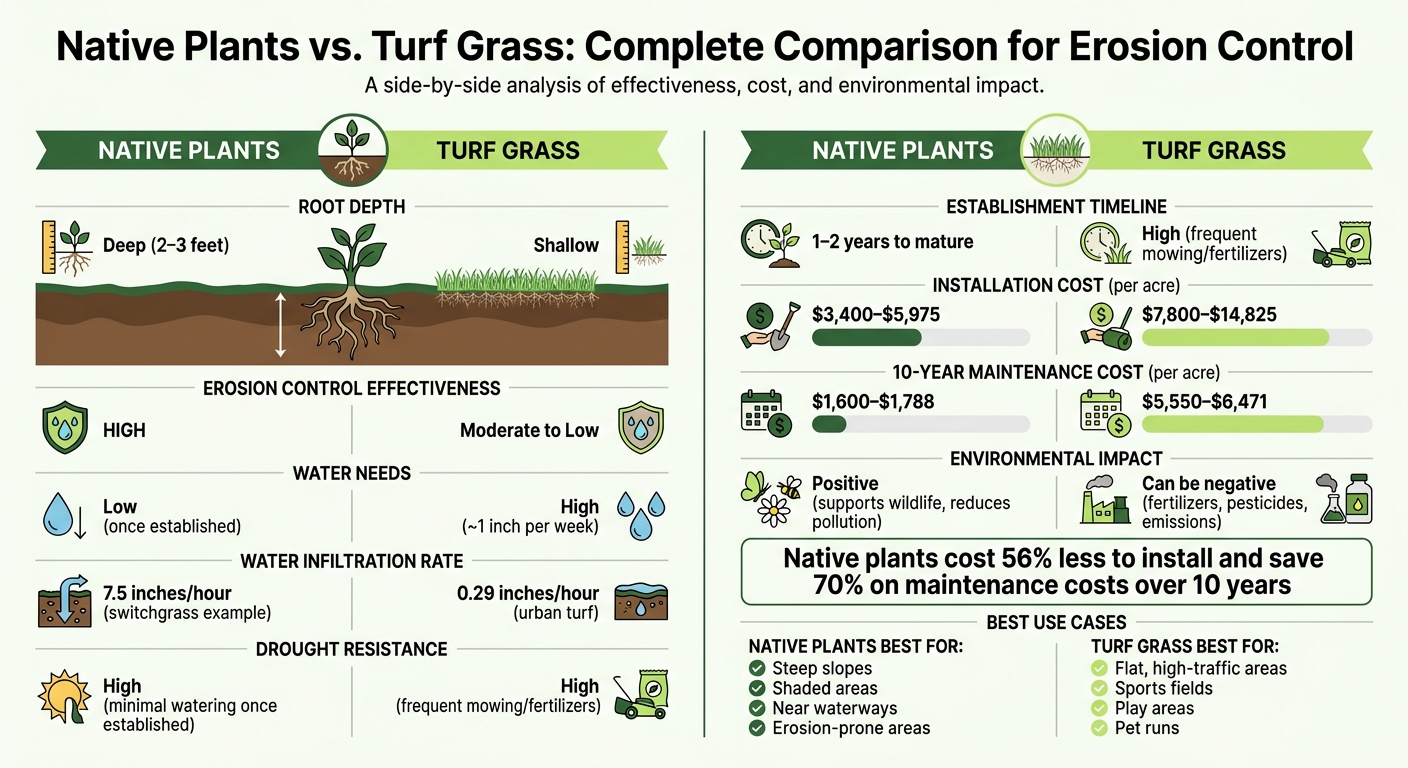
Native Plants vs Turf Grass Comparison for Erosion Control
Native Plants for Erosion Control
Root Systems and Soil Stabilization
Native plants are excellent for erosion control, thanks to their deep and varied root systems. For instance, native grasses like switchgrass (Panicum virgatum) and little bluestem (Schizachyrium scoparium) grow roots that can reach depths of 2 to 3 feet, creating a sturdy network that anchors the soil effectively [3].
In addition to depth, many native species use different root strategies to stabilize the ground. Pennsylvania sedge (Carex pensylvanica) forms dense underground mats with its lateral roots [5]. Meanwhile, plants like common milkweed (Asclepias syriaca) and white wood aster (Eurybia divaricata) spread through rhizomes, producing continuous ground cover [4][6]. Trees also play a key role by intercepting raindrops with their canopies and leaf litter, while their widespread roots strengthen the soil from multiple directions [6].
Benefits for the Environment
Native plants offer more than just physical stabilization – they also bring ecological advantages. By supporting local pollinators, they provide essential habitat, nectar, and pollen for bees, butterflies, and other beneficial insects [1][2]. Compared to turf grass, which often relies on synthetic fertilizers and pesticides, native plants thrive naturally after establishment. This reduces the risk of harmful chemicals polluting Maryland’s waterways.
Additionally, native plants improve water infiltration better than turf grass, reducing stormwater runoff that can cause flooding and erosion [1]. Acting as natural filters, they capture sediments and excess nutrients before these pollutants reach streams and rivers [3]. The Maryland 2021 Low-Impact Landscaping Law highlights these advantages by protecting residents’ rights to maintain pollinator and rain gardens, further encouraging their use [2].
Native Plant Species for Maryland
Selecting native plants suited to Maryland’s diverse conditions ensures effective erosion control. For sunny slopes with good drainage, butterfly milkweed (Asclepias tuberosa) develops a deep taproot for long-term stability, while black-eyed Susan (Rudbeckia hirta) germinates quickly and persists through winter [4]. Virginia wildrye (Elymus virginicus) offers year-round soil protection with its evergreen basal blades [4].
In shaded areas, wild hydrangea (Hydrangea arborescens) thrives on steep slopes and cliffs, and Christmas fern (Polystichum acrostichoides) provides winter cover while being resistant to deer [4][6]. For wetter spots at the base of slopes, golden groundsel (Packera aurea) and mistflower are great choices, flourishing in moist to wet conditions [4][6]. When planting near existing trees, opt for small plugs or quart-sized plants to avoid disturbing established root systems [6].
sbb-itb-843f8be
Best Plants for Erosion Control | How to Protect Your Landscape with Native Plants 🌿
Turf Grass for Erosion Control
Unlike native plants, turf grass provides only surface-level soil stabilization, which can be a drawback in Maryland’s more demanding landscapes.
Shallow Roots and Erosion Control
Turf grass primarily anchors the topsoil, making it less effective on steep slopes or along shorelines. Its shallow root system doesn’t provide the deep structural support needed for areas prone to severe erosion. As noted by Natural Shore:
"Deep rooted native vegetation is replaced with shallow rooted turf grass. This is often a recipe for disaster… Without this natural erosion control mechanism, shores are extremely susceptible to soil loss" [3].
While turf grass can stabilize soil on flat or mildly sloped areas, it lacks the 2-to-3-foot root depth that native plants offer [3]. This limitation makes it better suited for areas with minimal erosion concerns.
Best Uses for Turf Grass
Despite its shortcomings in erosion control, turf grass shines in high-traffic areas where durability is a priority. It’s ideal for spaces like sports fields, playgrounds, and pet runs, where its ability to recover from wear and tear is essential. It also works well for decorative purposes, such as framing entryways or garden borders [2].
For Maryland homeowners, fine leaf fescues offer a practical, lower-maintenance option. Varieties like hard fescue and sheep fescue thrive in full sun, while creeping red and Chewings fescues perform better in shadier spots [2].
Maintenance Requirements
Turf grass comes with ongoing maintenance demands to maintain even basic soil stabilization. The University of Maryland Extension highlights these challenges:
"Turfgrasses are challenging to grow in Maryland’s climate. They require constant maintenance that comes with costs – pesticide exposures to humans and pets, pollution, and water waste" [2].
Keeping turf grass healthy involves regular mowing, fertilizing, and watering. Fine fescues also need dethatching to prevent thatch buildup, which can block water and nutrients. During hot and dry summers, reducing mowing frequency can prevent stress and die-back. However, these maintenance needs can lead to higher long-term costs and environmental concerns, such as increased pesticide use, pollution, and water consumption [2]. These factors highlight the importance of choosing erosion control solutions that align with the specific conditions of a site.
Native Plants vs. Turf Grass: Side-by-Side Comparison
Let’s dive deeper into how native plants and turf grass stack up against each other. If you’re deciding on the best erosion control method for your Maryland property, comparing these two options across key factors can make the choice much clearer. The differences affect not only costs but also maintenance demands and their impact on the environment.
Comparison Table
Here’s a breakdown of how native plants and turf grass compare when it comes to erosion control and related factors:
| Feature | Native Plants | Turf Grass |
|---|---|---|
| Root Depth | Deep (2–3 feet) | Shallow |
| Drought Resistance | High (minimal watering once established) | Moderate (requires ~1 inch per week) |
| Maintenance Needs | Low (minimal mowing/chemicals) | High (frequent mowing/fertilizers) |
| Establishment Timeline | Longer (1–2 years to mature) | Shorter (weeks to months) |
| Erosion Control Effectiveness | High (creates soil matrix) | Moderate to Low (susceptible to loss) |
| Environmental Impact | Positive (supports wildlife, reduces pollution) | Can be negative (fertilizers, pesticides, emissions) |
| Water Infiltration Rate | High (e.g., 7.5 inches/hour for switchgrass) | Low (e.g., 0.29 inches/hour for urban turf) |
| Installation Cost (per acre) | $3,400–$5,975 | $7,800–$14,825 |
| 10-Year Maintenance Cost (per acre) | $1,600–$1,788 | $5,550–$6,471 |
Looking at the numbers, native plants are far more cost-effective. They cost 56% less to install than turf grass and require much less maintenance over time [7]. For instance, at Prairie Crossing in Grayslake, Illinois, native prairie landscapes saved $3,400 per acre annually in maintenance costs [7]. When it comes to shoreline projects, the price difference becomes even more striking: native plant restoration runs about $50–$150 per linear foot, compared to $300–$500 per linear foot for traditional rock rip-rap [3].
The environmental benefits of native plants are also hard to ignore. Switchgrass, for example, absorbs water at a rate of 7.5 inches per hour, while compacted urban turf only manages 0.29 inches per hour [7]. This means native plants significantly reduce runoff and the risk of flooding, all while helping to replenish groundwater. On the flip side, turf grass maintenance has a notable environmental cost – maintaining 1,000 acres of turf lawn releases 18 tons of Volatile Organic Compounds (VOCs) into the air annually [7]. Plus, just one hour of using a gas-powered mower creates as much pollution as driving a car for 20 miles [7].
These comparisons make it clear why native plants are often the better choice for erosion control, especially when considering long-term costs and environmental benefits.
Choosing the Right Option for Your Maryland Property
When deciding between native plants and turf grass for your property, it’s essential to let the property’s conditions guide your choice – not personal preferences. Factors like soil type, moisture levels, and how you use the space are key to determining which option will be more effective at controlling erosion.
For example, moss growth often signals excessive moisture or poor soil conditions, which make it tough for turf to thrive [2]. In such areas, native groundcovers are a better fit because they’re naturally suited to Maryland’s soil chemistry and structure [2]. These site-specific details are crucial in making the right choice.
Moisture management is another major consideration. Native plants generally allow for better water infiltration compared to turfgrass [1]. In areas prone to high moisture or poor drainage, native rain gardens can slow runoff and enhance water absorption. Turfgrass, on the other hand, often struggles in these conditions, becoming waterlogged and ineffective at preventing erosion [2]. For larger properties, consider maintaining a small lawn for recreational purposes near the home while transitioning outlying areas into native meadows. This approach not only reduces maintenance but also saves money [2].
Steep Slopes and Waterway Buffers
When it comes to steep slopes, sharp angles, or areas near streams, native plants are the clear choice. Their deep-rooted systems are excellent at absorbing water and holding soil in place [3]. These roots create a strong, interconnected network that resists erosion caused by heavy runoff, ice, or wave action [3]. Turfgrass, with its shallow roots, simply can’t compete and often leads to soil instability and bank failure in these challenging areas [3].
For steep slopes, Maryland native groundcovers like wild ginger (Asarum canadense), alumroot (Heuchera americana), or green-and-gold (Chrysogonum virginianum) are particularly effective [2]. These plants suppress weeds, stabilize the soil, and eliminate the need for risky mowing on steep angles [2]. Near waterways, a rain garden or native buffer zone can help slow rainwater runoff and filter pollutants before they reach streams [2]. Additionally, native buffers are a more cost-effective solution for stabilizing shorelines [3].
Flat Lawns and High-Traffic Areas
On the other hand, turf grass remains a practical choice for flat areas with heavy foot traffic. Spaces where kids play, pets run, or sports are played require the durability of turf [2]. Grass handles trampling and compaction better than most native plant options, making it the logical choice for these active zones.
That said, it’s wise to limit turfgrass to areas where it’s truly necessary. Not all turf varieties are equally durable – fine-leaf fescues like hard, creeping red, Chewings, and sheep fescue don’t hold up well under heavy use [2]. For high-traffic areas, tall fescue is a better option, as it performs well in Maryland’s climate and can withstand wear and tear. In shaded, low-traffic areas where grass struggles, consider applying 2 to 3 inches of wood mulch under tree canopies instead of forcing turf to grow where it won’t thrive [2].
Ultimately, the best erosion control method depends on your property’s specific features – slope, moisture, soil, and intended use. Tailoring your approach to these factors ensures effective and lasting results.
Installation and Long-Term Care
Site Preparation and Planting
Getting the site ready is a crucial step for successful erosion control. If you’re working with native plants, the first task is to clear out any existing turfgrass to reduce competition [2]. One effective approach is the no-till method: layer several sheets of newspaper or a single layer of unwaxed cardboard, then add 4–8 inches of shredded leaves or grass clippings, and finish with 2–4 inches of compost [2]. For sunny areas, solarization can be an option – cover the ground with a reusable tarp or woven fabric weed barrier for two to three months. Once that’s done, add 2–4 inches of compost and start planting [2].
Since Maryland native meadow seeds are hard to find commercially, native plant plugs are a better choice for establishing plants successfully [2]. On sites prone to erosion, temporary bio-engineering methods can help stabilize the soil until the plants’ roots take hold [3]. To protect young trees, consider using tree tubes, as they shield seedlings from deer browsing during their critical growth phase [2].
For turf grass, preparing the site is simpler – standard soil grading and seeding are usually sufficient. However, on steep slopes, turf’s shallow roots often fail to provide the necessary stability, making this option less effective in the long run [3]. Once the groundwork is completed and the plants are in place, the focus shifts to maintaining the site over time.
Ongoing Maintenance
How well the site is prepared will significantly affect the effort needed for future upkeep. Once established, native plants are low-maintenance compared to turf. For example, ornamental grasses only need an annual trim in early spring [2]. During the first three years, as the meadow takes shape, you’ll need to weed regularly to prevent invasive plants from gaining ground [2]. After that, maintenance becomes minimal – there’s no need for mowing, fertilizers, or pesticides [7].
Turf, on the other hand, requires consistent attention. Weekly mowing during the growing season, regular fertilization, at least an inch of water per week during summer, and aeration or de-thatching every two years are all part of the routine [7]. Over a decade, maintaining turf can cost between $5,550 and $6,471 per acre. In contrast, native landscaping costs significantly less – about $1,600 to $1,788 per acre over the same period [7]. That’s a 70% cost savings with native plants, along with improved erosion control and environmental benefits.
Financial and Ecological Advantages
Water and Soil Quality
Native plants can transform how water moves across your property. Their deep-root systems improve water infiltration on-site while creating a strong, interwoven network that anchors soil far better than the shallow roots of turf grass [3]. This not only prevents erosion but also allows more water to seep into the ground, significantly reducing the amount of stormwater runoff leaving your property [1].
"Established gardens provide greater water infiltration, habitat and soil stabilization than turfgrass." – University of Maryland Extension [1]
But the benefits don’t stop at soil stabilization. Native plants act as natural filters, removing excess nitrogen and phosphorus from the water, which helps prevent nutrient runoff into nearby waterways. In contrast, turf grass often depends on fertilizers and pesticides, which can lead to harmful algal blooms [1][3]. By cutting back or eliminating the need for these chemicals, native plantings safeguard Maryland’s waterways and help recharge groundwater supplies [1].
Long-Term Cost Savings
The financial perks of native plants are just as compelling as their environmental benefits. Installing native plantings costs between $50 and $150 per linear foot, compared to $300 to $500 for rock rip-rap solutions – a savings of 66% to 80% upfront [3]. And the savings don’t end there. Once established, native landscapes require minimal upkeep: no weekly mowing, no fertilizers, and no need for costly irrigation systems [2].
Maryland homeowners can also take advantage of programs to lower initial costs. For example, the Maryland Department of Natural Resources offers a $25 coupon for approved tree species [2]. Additionally, many counties provide rebates or tax credits for stormwater management projects like rain gardens [2]. Thanks to Maryland’s 2021 Low-Impact Landscaping Law, residents now have the legal right to install these water-efficient alternatives, even in neighborhoods where homeowners’ associations previously mandated turf-only lawns [2].
Conclusion
Deciding between native plants and turf grass for erosion control means finding the best fit for your property’s unique conditions. Native plants, with their deep root systems, are excellent for stabilizing soil, especially in areas like steep slopes, waterway buffers, or other challenging spots. On the other hand, turf grass works well in high-traffic areas such as play zones for kids or spaces for pets [1][2]. The key is to use each option where it excels: native plants for damp, shaded, or sloped areas, and turf grass for flat, functional spaces. Many Maryland landscapes thrive with a combination approach, blending turf for practicality and native plants for erosion control and environmental benefits.
Maryland’s climate presents its own set of challenges, as highlighted by the University of Maryland Extension:
"Turfgrasses are challenging to grow in Maryland’s climate. They require constant maintenance that comes with costs – pesticide exposures to humans and pets, pollution, and water waste" [2].
This underscores the importance of professional guidance, especially for properties with varied terrain or complex drainage needs.
For tailored solutions, Pro Landscapes MD serves central Maryland and Washington, DC, providing expert erosion control assessments and installations. Their experience in landscape design and stormwater management ensures your property gets the attention it needs.
The right erosion control plan not only safeguards your land but also minimizes upkeep and reduces environmental strain. Whether you choose native plants, turf grass, or a mix of both, professional installation can help deliver results that last.
FAQs
How can I tell if yard erosion is a serious problem?
Look for indicators such as noticeable soil loss, exposed roots, or the formation of gullies. Another warning sign is soil being carried away during rainstorms. Native plants with deep root systems – some reaching depths of up to 16 feet – are excellent at holding soil in place and reducing erosion. If you observe heavy rain actively washing soil away, it’s a strong signal that the erosion is severe and might need action, like planting native vegetation to help stabilize the area.
What native plants work best for my specific spot?
The ideal native plants for your slope depend on its sunlight exposure and soil conditions. Here are some suggestions based on these factors:
- Sunny Slopes: Look into hardy plants like Broomsedge (Andropogon virginicus), which thrives in poor soils, or Common Milkweed (Asclepias syriaca), known for its vigorous spreading ability.
- Shady Slopes: Consider Eastern Columbine (Aquilegia canadensis) or Eastern Bottlebrush Grass (Elymus hystrix). Both are deer-resistant and well-suited to low-light areas.
For the best results, reach out to local gardening experts who can recommend plants tailored to your specific site conditions.
Can I combine native plants and grass in one yard?
Absolutely! Native plants and turf grass can thrive together in the same yard. Thanks to their deep root systems, native plants are fantastic for controlling erosion and stabilizing soil. When paired with turf grass, they create a diverse landscape that’s not only low-maintenance but also boosts water infiltration and supports local wildlife. This combination is a smart and eco-conscious choice, particularly for yards in Maryland.
Chat with Us