








- bhavya gada
- No Comments
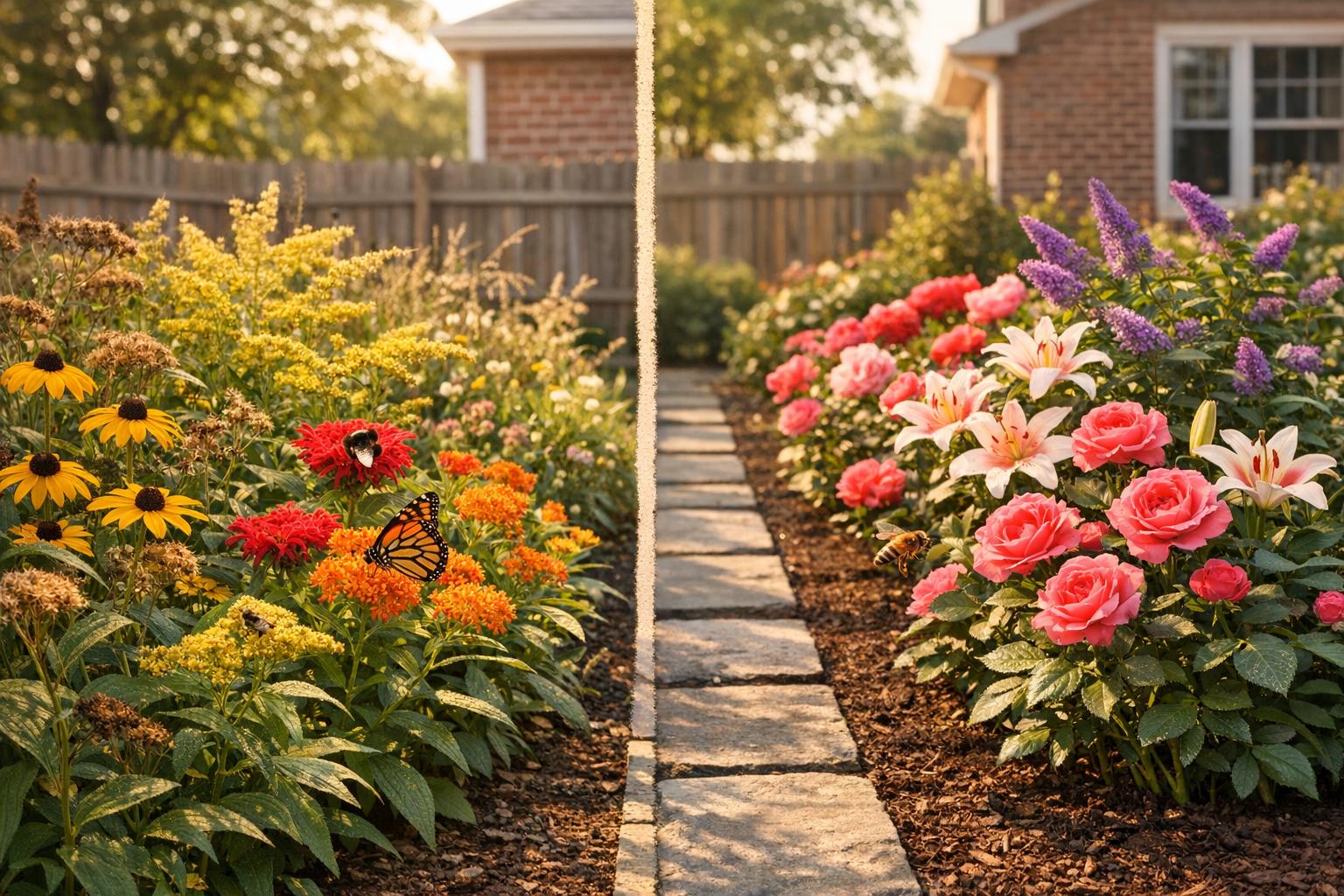
When creating a pollinator garden in Maryland, you face a choice: native plants like milkweed and coneflowers or non-native species such as cosmos and marigolds. Native plants are naturally suited to the region and support specialized pollinators, while non-natives often attract generalist species like honeybees. Here’s a quick summary:
- Native plants: Essential for Maryland’s biodiversity, supporting specialist pollinators, local food webs, and requiring less maintenance due to their natural compatibility with the environment.
- Non-native plants: Can extend bloom periods and offer visual variety but may disrupt local ecosystems, favor generalist pollinators, and pose risks like spreading uncontrollably.
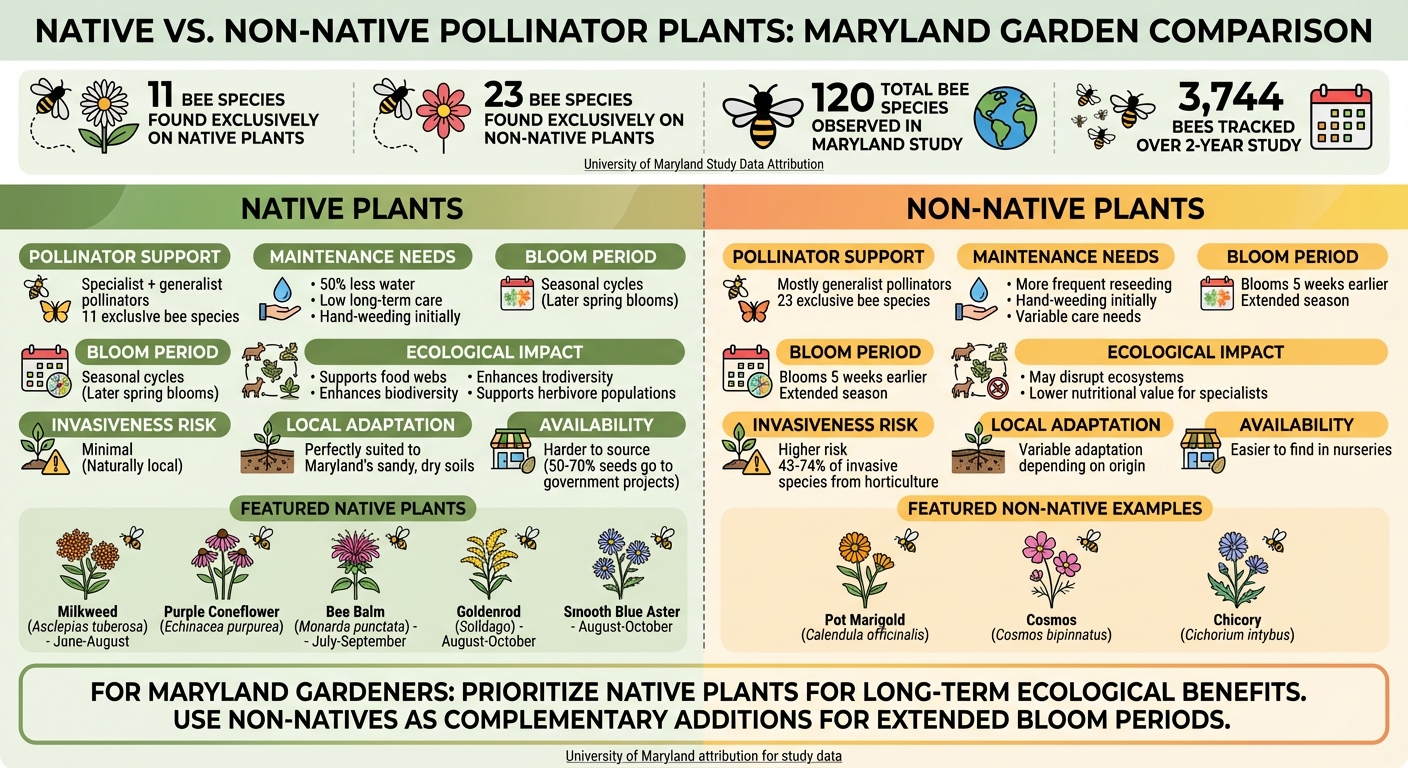
A study at the University of Maryland found that native plants hosted 11 bee species exclusively, while non-natives attracted 23 species not found on native plots. While both have their uses, native plants provide critical ecological support for Maryland’s pollinators and wildlife.
Quick Comparison
| Feature | Native Plants | Non-Native Plants |
|---|---|---|
| Pollinator Support | Specialist and generalist pollinators | Mostly generalist pollinators |
| Maintenance | Lower water and care needs | May need more care and reseeding |
| Bloom Period | Seasonal cycles, typically later | Extends bloom season (early and late) |
| Ecological Impact | Supports food webs and biodiversity | May disrupt local ecosystems |
| Availability | Harder to source | Easier to find in nurseries |
For Maryland gardeners, prioritizing native plants like milkweed, bee balm, and coneflowers ensures long-term benefits for pollinators and ecosystems, while non-native plants can serve as complementary additions when chosen carefully.
Native vs Non-Native Pollinator Plants: Complete Comparison for Maryland Gardens
Benefits of Native Pollinator Plants
Support for Local Pollinators
Native plants and Maryland’s local insects share a deep-rooted history, having evolved together over thousands of years. This unique relationship allows native plants to meet the specific needs of local pollinators in a way that non-native species simply cannot. For instance, Monarch caterpillars rely entirely on milkweed for survival – without it, their lifecycle comes to a halt [4].
Studies have shown that native plants attract a greater variety of specialized bees. Some bee species, such as Osmia distincta, are found exclusively in areas with native plants like Penstemon laevigatus (Eastern Smooth Beardtongue) [1]. These plants provide nectar and pollen with the precise nutrients that Maryland pollinators require.
"Native plants hosted more specialized plant–bee visitation networks than non-native plants."
– Nicola Seitz, Department of Entomology, University of Maryland [1]
These specialized interactions not only sustain pollinator diversity but also highlight the practical advantages of incorporating native plants into local gardens.
Low Maintenance Requirements
Native plants are perfectly suited to Maryland’s soil and climate, which means they thrive with very little help. They need less water, fertilizer, and pesticides compared to non-native plants, which often require intensive care and resources. This makes native plants a more eco-friendly option for landscaping [4].
For example, species like Schizachyrium scoparium (Little Bluestem) are not only low-maintenance but also help prevent soil erosion and provide overwintering habitats for beneficial insects [1]. Similarly, native perennials like Solidago nemoralis and Symphyotrichum laeve bloom consistently from late summer to fall, adding vibrant color to gardens with minimal effort [1].
"Grasses are typically added to pollinator friendly meadows as they also provide nesting or overwintering sites for insects and can protect wildflowers by preventing soil erosion."
– Nicola Seitz, Department of Entomology, University of Maryland [1]
By choosing native plants, gardeners can enjoy beautiful, thriving landscapes without the constant upkeep that non-native species often demand. Homeowners can view professional landscape designs that successfully integrate these hardy species.
Ecological Benefits
Native plants do more than just support pollinators – they play a key role in maintaining healthy ecosystems. By fostering native insect populations, these plants form the backbone of the local food web, benefiting birds, mammals, and other wildlife [4].
Gardens filled with native species also contribute to the health of nearby natural areas. They promote cross-pollination and seed dispersal, which helps sustain wild plant populations and, in turn, supports pollinators and songbirds [4]. Research even shows that plots with native plants host a higher abundance of invertebrates compared to those with exotic species [2].
"When the plant you have included is locally native, your garden actually benefits wild plant populations, and… that benefits pollinators and songbirds, too."
– University of Maryland Extension [4]
Additionally, native plants help protect the environment in practical ways. Their dense root systems prevent soil erosion and safeguard waterways, a critical consideration for areas near the Chesapeake Bay watershed. By creating habitats rich in beneficial invertebrates, native plants further enhance the resilience of local ecosystems [2].
Transforming a Maryland Landscape with AMAZING Native Plants!
Drawbacks of Native Pollinator Plants
While native plants bring ecological benefits, they come with challenges that gardeners should keep in mind when designing a pollinator garden.
Limited Availability
Finding native plants can be tricky. Many nurseries prioritize patented non-native cultivars because they yield higher profits. On top of that, a significant portion – 50% to 70% – of native seeds are allocated to government projects, leaving fewer options for individual consumers. Even when native plants are available, they might not have the polished look of non-native varieties, which are often bred for uniformity and visual appeal [7].
This scarcity, combined with aesthetic concerns, can make integrating native plants into residential gardens more complicated.
Aesthetics and Design Limitations
Although native plants support local ecosystems, their natural growth patterns can sometimes clash with traditional garden designs. Homeowners often associate them with untamed, wild landscapes, which might not fit neatly into more formal or structured yard layouts [4]. That said, as the University of Maryland Extension points out:
"What your landscape looks like is influenced more by design and maintenance style than by the plants you use."
– University of Maryland Extension [4]
Beyond aesthetics, native plants can pose practical challenges. In the nutrient-rich soils of home gardens, they may grow taller and bulkier than they would in their natural environments. This can lead to maintenance headaches, such as the need for "Chelsea chopping" – a pruning technique where plants are cut back by one-third to one-half in early summer to prevent them from toppling over in strong winds. For example, species like Joe Pye Weed and New England Aster can grow aggressively, crowding out other plants unless regularly thinned [6].
Balancing these challenges with the ecological rewards is key to creating a pollinator garden that is both functional and visually appealing.
Benefits of Non-Native Pollinator Plants
While native plants are known for their ecological importance, non-native pollinator-friendly plants bring their own advantages, making them a valuable addition to any garden.
Extended Bloom Periods
Non-native plants can help bridge seasonal gaps by blooming earlier than native species. Research from the University of Maryland’s Beltsville research farm revealed that non-native pollinator plants, such as Calendula officinalis (Pot Marigold) and Cosmos bipinnatus, began flowering about 5 weeks earlier than native plants. This early blooming period boosts bee abundance and species diversity during the spring and early summer months [9].
This is particularly important for early-emerging pollinators that rely on immediate food sources. The study found that non-native plant plots attracted bee species absent from native-only areas during these early weeks. By providing nectar and pollen before native plants start blooming – and continuing to do so late into the fall – non-native plants ensure a steady food supply throughout the growing season. This extended flowering period complements the shorter bloom cycles of many native species, supporting pollinators when native resources are scarce.
In addition to their functional role, non-native plants also contribute to a garden’s visual appeal.
Aesthetic Variety
Non-native plants bring a fresh layer of visual interest to gardens. Suzanne Bontempo from the Sonoma County Beekeepers Association highlights this benefit:
"Some non-native plants offer aesthetic design appeal, adding unique colors or forms to a garden space." – Suzanne Bontempo, Sonoma County Beekeepers Association [8]
Plants like bright blue chicory (Cichorium intybus), vibrant cosmos, and delicately textured Queen Anne’s Lace (Daucus carota) introduce colors, shapes, and textures that might not be found in native plant selections.
This variety makes it easier to design gardens that cater to both pollinators and personal taste. Plus, non-native plants are often easier to find at local garden centers, offering a practical option for gardeners who want quick results without the challenge of sourcing native plants from specialty nurseries.
Drawbacks of Non-Native Pollinator Plants
Non-native plants, while often visually striking and known for longer bloom periods, pose serious risks to Maryland’s pollinator populations and ecosystems as a whole.
Risk of Invasiveness and Competition
Non-native plants have the potential to disrupt local ecosystems in significant ways. Studies show that between 43% and 74% of invasive plant species originated from horticultural introductions, highlighting the ecological stakes of garden choices [3]. Globally, non-native species are the second leading cause of extinction across all taxonomic groups [3].
One issue is their earlier blooming period – up to five weeks ahead of native plants – giving them an edge in attracting early-season pollinators [1]. This can shift pollinator activity patterns and reduce resources available to native plants.
A University of Maryland study conducted between April 2016 and October 2017 compared 20 native and 20 non-native plant species. The research documented 3,744 bees from 120 species and found that native and non-native plots attracted distinctly different bee communities [1][9]. Non-native plantings altered the structure of bee populations, favoring species that differ from those supported by native plants.
Nicola Seitz, from the University of Maryland’s Department of Entomology, emphasized the importance of careful placement of non-native plants:
"Adding non-native plants to native pollinator friendly plantings can be beneficial to wild bees, but should be confined to already disturbed human-dominated landscapes to exclude potentially negative effects on native plant communities." – Nicola Seitz, Department of Entomology, University of Maryland [1]
In addition to competition, non-native plants often fail to meet the specific nutritional needs of local pollinators.
Lower Ecological Support
Beyond competition, non-native plants fall short in providing the ecological benefits that native species offer. While they may look appealing, their pollen and nectar often lack the nutrients required by specialist pollinators that have co-evolved with native plants [1][9].
The Maryland study found that non-native plants primarily supported generalist bee species, while native plants were crucial for specialist bees [9]. This shift toward generalist species can disrupt the local food web, as specialist pollinators play key roles in maintaining ecological balance.
Additionally, native plants support a richer abundance of herbivores and other invertebrates, which are essential food sources for birds and other wildlife [2][9]. Andrew Salisbury of the Royal Horticultural Society underscores this point:
"We therefore advise gardeners and managers of cultivated green spaces who wish to provide maximum resources for invertebrate abundance to select plantings biased towards native and near-native plants." – Andrew Salisbury, Royal Horticultural Society [2]
A review of 165 studies found that 120 of them concluded native plants outperformed non-natives in supporting biodiversity and ecosystem services [3]. While adult pollinators like butterflies and bees may visit non-native flowers for nectar, these plants rarely support the larval stages – such as caterpillars – that are vital to sustaining healthy ecosystems [2][3].
sbb-itb-843f8be
Direct Comparison Table
Here’s a breakdown of how native and non-native pollinator plants stack up against each other. A two-year study by the University of Maryland at Beltsville Research Farm observed 3,744 bees from 120 species, uncovering fascinating differences in pollinator activity [1].
While both plant types required hand-weeding during their initial growth phase, native plants showed an edge in adapting to Maryland’s sandy, dry soils, which reduced long-term upkeep [9].
| Feature | Native Pollinator Plants | Non-Native Pollinator Plants |
|---|---|---|
| Pollinator Attraction | Draws both specialist and generalist pollinators. Notably, 11 bee species were found exclusively on native plots, highlighting their importance for specialist bees [1]. | Mainly attracts generalist pollinators. Interestingly, 23 bee species were exclusive to non-native plots, and these plants often support higher bee numbers during early and late seasons [1]. |
| Maintenance Needs | Needs hand-weeding at first but requires less upkeep over time due to better adaptation to local soils; uses about 50% less water [9] [10]. | Also requires hand-weeding early on but may demand frequent reseeding, especially for annual varieties [9]. |
| Risk of Spreading | Minimal, as they are naturally part of the local ecosystem. | Higher risk of becoming invasive in natural areas [8]. |
| Local Adaptation | Well-suited to Maryland’s sandy, dry soils and climate [9] [10]. | Adaptation varies depending on the plant’s origin and how well it matches regional conditions [8]. |
| Ecological Impact | Supports specialist pollinators and enhances food web complexity by boosting herbivore populations [2]. | Helps generalist pollinators but may disrupt foraging patterns and often offers less nutritional value for specialists [8]. |
| Bloom Period | Follows natural seasonal patterns, typically blooming later in spring. | Flowers up to 5 weeks earlier, extending the bloom period [9]. |
The findings suggest that while non-native plants can be useful for early-season pollinator support, native plants provide unmatched ecological advantages, particularly for Maryland’s specialist pollinators and overall ecosystem balance [1]. This sets the stage for exploring specific native plant options tailored to Maryland gardens. These selections can be beautifully integrated into landscaped garden walls to enhance both aesthetics and local biodiversity.
Native Plant Recommendations for Maryland
These native species are perfectly suited to Maryland’s environment and pollinator needs. They thrive in the state’s sandy, dry soils and play a critical role in supporting local bee populations. Data from a two-year study at the Beltsville Research Farm highlights their benefits for pollinators [1].
Milkweed
Butterfly Milkweed (Asclepias tuberosa) is a standout choice, blooming from June through August. It supports specialized bee networks that non-native plants simply can’t match [1]. This low-maintenance species thrives in Maryland’s medium-to-dry, sandy soils and requires minimal watering once established. Plant it in full sun, spacing 18–24 inches apart. Its vibrant orange flowers not only attract monarch butterflies but also provide essential resources for native bees that have co-evolved with this plant over millennia.
Coneflowers
Purple Coneflower (Echinacea purpurea) is a must-have for pollinator gardens in Maryland. Known for its striking purple petals and prominent seed heads, it offers extended blooms and exceptional drought tolerance once established. This plant attracts both pollinators and seed-eating birds. For best results, plant in full sun with 18–24 inches of spacing.
Bee Balm
Spotted Bee Balm (Monarda punctata) blooms from July through September, filling the mid-summer gap with nectar-rich flowers [1]. According to the Maryland study, this species is particularly attractive to native bees. It tolerates dry conditions and forms appealing clumps as it spreads. Space plants 12–15 inches apart in full sun for optimal growth.
Goldenrod
Sweet Goldenrod (Solidago odora) and Gray Goldenrod (Solidago nemoralis) are invaluable for late-season pollinators, blooming from August through October [1]. These hardy plants require little maintenance and thrive on neglect once established. Despite common myths, goldenrod does not cause allergies. Plant them 12–18 inches apart in full sun or part shade for best results.
Asters
Smooth Blue Aster (Symphyotrichum laeve) extends the flowering season from August through October, complementing goldenrod to provide vital late-season forage [1]. The study noted that carpenter bees (Xylocopa virginica) strongly preferred native plants, with 228 visits recorded for native species compared to just 16 for non-natives [1]. Asters perform best in full sun with well-drained soil and should be spaced 15–18 inches apart.
Joe-Pye Weed
Common Boneset (Joe-Pye Weed) (Eupatorium perfoliatum) blooms from July through September, thriving in moist, sunny areas typical of Maryland [1]. This tall perennial, reaching heights of 3–5 feet, is perfect for the back of garden borders and attracts large numbers of butterflies. It tolerates clay soils better than most native species and requires minimal care after establishment. Space plants 24–30 inches apart to accommodate their mature size.
How Pro Landscapes MD Can Help Create Pollinator Gardens

Pro Landscapes MD specializes in designing pollinator gardens that incorporate native plants, providing both ecological benefits and aesthetic appeal. Serving central Maryland, they craft low-maintenance gardens that ensure a continuous bloom cycle, offering vital support to local bee populations.
Their approach goes beyond simple planting. By focusing on overlapping bloom periods and strategic garden layouts, they maximize the ecological impact of native species. Drawing from established research, they handle every detail – spacing, soil preparation, and plant placement – to create gardens that are both functional and visually appealing [5].
Pro Landscapes MD also integrates pollinator gardens with rain garden designs, addressing stormwater management while enhancing habitats. These gardens help filter pollutants from runoff before it reaches the Chesapeake Bay, all while supporting dense vegetation that attracts and sustains invertebrate populations [2]. Plants like cardinal flower and blue flag iris flourish in the moist conditions these gardens create.
For homeowners seeking a blend of beauty and environmental responsibility, Pro Landscapes MD offers "near-native" garden designs. These combine native Maryland plants with carefully chosen non-invasive species, extending bloom periods and adding visual diversity. This thoughtful approach ensures ecological balance while supporting the 120 bee species found in Maryland [5].
Key Takeaway: Prioritizing Native Plants for Maryland Biodiversity
Choosing native plants over non-native ones plays a crucial role in preserving Maryland’s food web. Over thousands of years, native plants and insects have developed deep, interdependent relationships, with many species relying on the plants they evolved alongside.
A Maryland study spanning two years tracked 3,744 bees across 120 species and revealed how non-native plants disrupt bee community dynamics. Native plants, on the other hand, consistently supported specialist bees. Researcher Nicola Seitz highlighted this in her findings:
"Native plants hosted more specialized plant–bee visitation networks than non-native plants."
In experimental plots, 11 bee species were found exclusively on native plants, proving that these specialists depend entirely on their evolutionary plant partners [5]. This underscores how vital native plants are for maintaining Maryland’s intricate pollinator networks.
But the importance of native plants doesn’t stop with pollinators. They also sustain healthy populations of herbivorous insects, which are a critical food source for baby songbirds [4].
For Maryland homeowners, the benefits are practical too. Native plants are perfectly suited to the state’s soil and climate, requiring less water, fertilizer, and pesticides [4].
Pro Landscapes MD incorporates this ecological wisdom into their pollinator garden designs. By focusing on native species like milkweed, coneflowers, and bee balm, they help homeowners create landscapes that are both visually appealing and environmentally responsible. Opting for native plants is more than a gardening choice – it’s a commitment to the long-term health of Maryland’s ecosystems.
FAQs
How many native plants should I include to make a difference?
Planting a mix of 10 to 15 native plant species in your pollinator garden can make a big difference for pollinators and the environment. Native plants provide a reliable habitat and food sources, which are essential for supporting pollinator populations. Plus, a diverse garden helps create a healthier, more balanced ecosystem overall.
How do I pick non-native flowers that won’t become invasive in Maryland?
To select non-native flowers that won’t disrupt Maryland’s ecosystem, avoid any species labeled as invasive by local experts. Resources like native plant guides can help you find safe, non-invasive alternatives. Be cautious of aggressive plants such as Mile-a-minute vine or Kudzu, which can quickly overtake local habitats. Make sure the flowers you choose are well-suited to Maryland’s specific climate and growing conditions. For the most reliable advice, always consult trusted local resources.
What should I plant for early spring blooms before natives flower?
For those looking to brighten their garden in early spring, try planting native species such as serviceberries, choke cherries, and wild violets. These plants not only bring vibrant color but also serve as a critical food source for pollinators when few other flowers are available. By choosing these, you’re giving local ecosystems a boost during this seasonal transition.
Chat with Us