









- bhavya gada
- No Comments
If I want one simple takeaway, it’s this: pick a native tree that matches your yard first, then let pollinator value guide the final choice. The list covers 10 Maryland native trees that help bees, butterflies, moths, and birds, with options for small yards, big lots, dry ground, and wet spots. It also points out a key fact: native oaks can host more than 500 caterpillar species, which shows how much one tree can support in a landscape.
Here’s the article in plain terms:
- Best for small yards: Serviceberry, Flowering Dogwood, Eastern Redbud
- Best for large yards: White Oak, Northern Red Oak, Tulip Tree, American Basswood, Black Cherry
- Best for wet areas: Black Willow, Sweetbay Magnolia
- Early bloomers: Serviceberry, Redbud, Dogwood, Black Willow
- Later bloomers: Tulip Tree, Black Cherry, Basswood, Sweetbay Magnolia
- Top host trees: White Oak, Northern Red Oak, Black Cherry, Tulip Tree
The main things I’d check before planting are simple:
- Size at maturity so the tree fits the space
- Sun exposure so flowering stays strong
- Soil moisture and drainage so the tree can settle in well
- Distance from structures and utilities – large trees should usually be planted at least 15 feet away
A mixed planting works better than relying on one tree alone. For example, an early bloomer like Eastern Redbud, a summer bloomer like Sweetbay Magnolia, and a host tree like White Oak can stretch food and habitat from spring into summer.
Quick Comparison
| Tree | Best Fit | Bloom Window | Size |
|---|---|---|---|
| Serviceberry | Small yards | Early spring | Small |
| Black Willow | Wet, open areas | Early spring | Large |
| Eastern Redbud | Small to medium yards | Early spring | Small |
| Flowering Dogwood | Shaded or part-shade yards | April | Small |
| White Oak | Large sunny lots | Spring | Very large |
| Northern Red Oak | Large sunny lots | Spring | Large |
| Tulip Tree | Open yards with room | Late spring | Very large |
| Black Cherry | Open lawns, edges | Late spring | Large |
| American Basswood | Big properties | Late spring to early summer | Large |
| Sweetbay Magnolia | Damp or low spots | Early summer | Small to large |
If I were reading this to make a planting choice fast, I’d start with yard size, then wet vs. dry soil, then bloom timing. That narrows the list down fast and makes the article easy to use.
Buttonbush: A Maryland Native Shrub for Pollinators
sbb-itb-843f8be
What Makes A Tree Good For Maryland Pollinators
Not every flowering tree helps pollinators in the same way. The best ones do more than look nice in bloom or complement your Baltimore hardscaping. They provide nectar, pollen, or larval host support. Black Cherry offers all three.
Bloom time matters too. Early bloomers like Serviceberry and Eastern Redbud feed pollinators at the start of the season. Midseason trees like Tulip Tree and Black Cherry keep that food supply going from early spring into summer.
Then there’s size. A big tree can be a great fit for an open lot, but it can overwhelm a small yard. Understory trees make more sense in tighter spaces. Serviceberry grows about 15–25 feet tall, and Flowering Dogwood reaches 15–30 feet, so both fit well in compact areas. A White Oak, on the other hand, needs room to grow to 80 feet tall with a 60-foot spread. As a general rule, plant any large tree at least 15 feet away from structures, utility lines, and underground pipes [2].
Soil plays a big part as well. In Maryland, the Piedmont often has heavy clay soil, while the Coastal Plain tends to drain fast. Those same conditions help sort the tree profiles below.
1. Eastern Redbud (Cercis canadensis)
Eastern redbud is one of the best compact spring-blooming trees for pollinators in Maryland.
Bloom Time
In Maryland, Eastern redbud usually blooms in April or May. Its pink-purple flowers open before the leaves appear, which gives bees and butterflies an early food source when many other trees still haven’t started flowering.
Mature Size
Eastern redbud is a small understory tree. At full size, it grows to 20–35 feet tall with a spread of 15–30 feet [4][7]. That smaller footprint makes it a good fit for many residential yards where space is limited.
Light and Soil Needs
Eastern redbud grows in full sun to partial shade, but full sun tends to bring more flowers and more pollinator activity [1][7]. It does best in moist, well-drained soil and doesn’t handle poor drainage or overly wet soil very well [4][7].
Pollinator and Landscape Value
The flowers attract honeybees, carpenter bees, and butterflies. The tree also supports Io Moth and White-Marked Tussock Moth caterpillars [4]. Eastern redbud is insect-pollinated.
In home landscapes, it works well as a focal tree, along woodland edges, or as part of layered plantings.
2. Flowering Dogwood (Cornus florida)
Flowering dogwood is another early bloomer that fits well in Maryland yards, especially smaller ones. This native understory tree brings spring color and gives pollinators something to visit early in the season.
Bloom Time
Flowering dogwood usually starts blooming in April [1], which puts it among Maryland’s early spring bloomers. Its showy bracts come in white, pink, or red cultivars.
Mature Size
This is a small-to-medium understory tree that grows to about 15–30 feet tall with a spread of 15–25 feet [7].
Light and Soil Needs
Dogwood does best in partial shade and rich, well-drained, slightly acidic soil. In Maryland, partial shade is the better choice. Full sun can cause heat stress and may increase borer risk [7].
It also needs slightly acidic soil, with a pH of 5.6 to 6.5 [6][7]. Skip poorly drained areas and compacted soil. If disease is a concern, cultivars like ‘Cherokee Brave’ or ‘Weaver’s White’ can help lower the risk of powdery mildew and anthracnose [7].
Pollinator and Landscape Value
Its April flowers draw mining bees, and it also serves as a host plant for Spring Azure caterpillars [1][4]. In fall, the red berries feed birds [4].
Because it stays fairly compact, flowering dogwood is easy to work into mixed native plantings and woodland edges. It also fits nicely as a focal tree or beneath taller canopy trees.
3. Tulip Tree (Liriodendron tulipifera)
If you’ve got a larger yard in Maryland, Tulip Tree is the kind of tree that can anchor the whole space. It grows to canopy size, feeds a lot of pollinators, and adds long-term shade.
Bloom Time
Tulip trees bloom in spring, usually in April and May. A single tree can produce thousands of large, tulip-shaped flowers in green, yellow, and orange [2][7]. That’s a lot of nectar and pollen packed into one tree, right when spring pollinators need it.
Mature Size
This is a big tree. At maturity, it reaches about 60 to 120 feet tall with a spread of 30 to 50 feet [7]. It also sticks around for a long time – tulip trees can live up to 400 years [7]. So yes, planting one is a long-game move. It’s not a good pick for small lots or cramped spaces.
Light and Soil Needs
Tulip trees do best in full sun to partial shade. They can handle sandy, loamy, and clay soils [7]. Soil pH can range from slightly acidic to slightly alkaline, about 5.0 to 8.0 [7]. If you want the strongest flower show, full sun is your best bet.
Plant it well away from buildings and power lines [2][7].
Pollinator and Landscape Value
Tulip trees draw bees and hummingbirds, and they also host Eastern Tiger Swallowtail butterflies and several moth species, including the Tulip Tree Leaftier Moth [2][8]. In the landscape, they work best as a shade tree or street tree [7].
4. American Basswood (Tilia americana)
American Basswood keeps nectar available into early summer, right when many spring bloomers are done. That timing matters. Its small, fragrant flowers are rich in nectar, so this tree helps pollinators when food sources start to thin out.
Bloom Time
Basswood blooms in early summer, which helps fill the gap after most spring-flowering trees have finished [5]. If you want to keep supporting pollinators past the spring rush, this tree is a smart pick.
Mature Size
American Basswood is a large tree, so it fits best in spacious yards, back lots, or open landscapes [5]. It needs plenty of room to grow without pressing up against buildings, fences, or nearby plantings.
Light and Soil Needs
It can handle tough sites, but it flowers best in full sun [5]. Its large, heart-shaped, dark green leaves leaf out fast and cast dappled shade through the summer.
Pollinator and Landscape Value
Basswood draws strong pollinator activity, especially from honeybees and butterflies [5]. Its nectar-rich flowers provide strong support for bees and other pollinators, which makes it a good fit for gardeners who keep bees or want to help local beekeepers in Maryland [5]. Because it gets so large, it works much better in open lawns and bigger properties than in small planting beds.
5. White Oak (Quercus alba)
If you’ve got space for a canopy tree, white oak is a strong pick. In larger Maryland yards, it offers early-season pollen and long-term habitat. It’s also Maryland’s state tree, so it makes a fitting centerpiece in a pollinator-friendly yard [2].
Bloom Time
Its spring catkins feed bees [1][8]. That matters early in the season, when native bees need steady food sources [1][8].
Mature Size
This is a big tree. At maturity, white oak can reach 80 feet tall with a spread of 60 feet or more [1][2]. Because it gets so large, plant it at least 15 feet from houses, garages, utility lines, and pipes [2].
Light and Soil Needs
White oak grows best in full sun [1][7]. It can handle loamy, sandy, or clay soil, and it does well in both acidic and alkaline pH [7]. Once established, it also tolerates drought, salt, and strong winds [7].
Pollinator and Landscape Value
Its large size comes with major habitat value. The leaves support hundreds of caterpillar species, which makes white oak a key host tree [2]. Bees use the spring catkins for pollen [1]. On large properties, it also works well as a shade tree and can help reduce runoff [1][2][7].
6. Northern Red Oak (Quercus rubra)
Northern red oak is another large native oak that keeps spring pollen in the mix and adds years of habitat value. It’s a big canopy tree, so it fits best in spacious Maryland yards.
Bloom Time
Northern red oak blooms in spring and produces drooping catkins that bees visit for pollen [1]. Its bark also shelters native insects [1]. That early pollen gives native bees a helpful start to the season.
Mature Size
At maturity, northern red oak usually grows 40 to 80 feet tall, with a spread of up to 80 feet wide [1][7].
Light and Soil Needs
Northern red oak does best in full sun [1]. It can grow in loamy, sandy, and clay soils, and it handles a wide pH range [7]. It also stands up well to drought, salt, and strong winds [7].
Pollinator and Landscape Value
Its leaves are a major host plant for caterpillars [2]. Its acorns feed birds and mammals [7]. And because it’s tough, it works well in open, roomy sites where smaller trees might struggle.
7. Black Cherry (Prunus serotina)
Black cherry is a strong pick if you want a native canopy tree that does more than fill space. In spring, its insect-pollinated flowers feed bees. Later on, the fruit helps feed birds. So you’re not just planting a tree – you’re adding a food source for local wildlife.
Bloom Time
Black cherry blooms in late spring. It produces clusters of white flowers that feed bees[1][8].
Mature Size
At maturity, black cherry grows to about 60 feet tall. That means it works best in yards with enough room for a full canopy tree[1].
Light and Soil Needs
Black cherry grows best in full sun to part shade and prefers medium to dry soil[1]. Give it space to grow. Plant it at least 15 feet from structures, underground pipes, and overhead wires[2]. Because of that, it’s a good match for open lawns, woodland edges, and other roomy spots.
Pollinator and Landscape Value
Black cherry supports swallowtail caterpillars, feeds bees, and attracts birds with its berries[1][8].
8. Serviceberry (Amelanchier canadensis)
Serviceberry is a compact understory tree that sits nicely after dogwood and before larger canopy trees. It brings a lot to the yard through the year: spring flowers, summer fruit, fall color, and bark that still looks good in winter.
Bloom Time
Serviceberry blooms in early spring, usually in April in Maryland. Those early flowers help honeybees and mining bees right when they first emerge and need nectar most [1][8].
Mature Size
Serviceberry grows 15–25 feet tall with a spread of about 20 feet [3][7]. In plain terms, it works well in smaller yards, foundation beds, or beneath taller trees as an understory layer.
Light and Soil Needs
Serviceberry grows well in full sun to part shade [1]. It handles many Maryland soil types, but it flowers best in full sun.
Pollinator and Landscape Value
Serviceberry does more than put on a good spring show. Its white flowers turn into edible Juneberries in late May or early June, feeding both birds and people [3]. Then fall brings red-orange color, and the smooth gray bark gives the tree shape and interest through winter [3][7].
9. Black Willow (Salix nigra)
For the wetter parts of a yard, Black Willow plays a very different part. It’s a strong early-spring tree for moist spots, and it gives native bees an early pollen source when not much else is going on [8].
Bloom Time
Black Willow blooms in early spring in Maryland [8].
Mature Size
This tree can grow 50–80 feet tall and spread out wide, so it needs plenty of space.
Light and Soil Needs
It does best in full sun and moist to wet soil.
Pollinator and Landscape Value
Willow leaves support swallowtail caterpillars [8]. That gives the tree value beyond spring bloom, which is a big deal if you’re trying to build a yard that supports insects through more than one season.
It fits best near streams, ponds, rain gardens, and other low, wet areas. Its broad canopy makes the most sense in larger yards where the soil stays damp, and it adds habitat long after the flowers are gone [8].
For smaller, drier, or more ornamental yards, the next trees are a better fit.
10. Sweetbay Magnolia (Magnolia virginiana)
Sweetbay Magnolia is a strong pick for damp, poorly drained areas. It does especially well in wetland soils across the Chesapeake Bay watershed [2].
Bloom Time
It blooms in early summer and produces large, creamy white flowers [2].
Mature Size
Cultivars range from about 15 feet tall to more than 80 feet, with spreads up to 40 feet [7]. The larger forms make more sense for bigger yards.
Light and Soil Needs
This tree grows well in full sun or partial shade and prefers moist, acidic, well-draining soil [7]. Add mulch around the base to help protect its shallow roots and keep the soil from drying out [7].
Pollinator and Landscape Value
Sweetbay Magnolia is a larval host plant for the Eastern Tiger Swallowtail butterfly and several moth species, including the Magnolia Serpentine Leafminer [2]. It also helps slow runoff [2], which makes it a smart choice for rain gardens, low spots, and pond edges.
Next, use bloom time, mature size, and site conditions to narrow the best tree for your yard.
How To Pick The Right Native Tree For Your Yard
Before you plant, match each tree to your site using the profiles above. The first thing to look at is space. Small yards usually do better with understory trees, while larger properties can handle canopy trees.
Then check drainage. If you have a wet spot or you’re planting in a rain garden, go with Sweetbay Magnolia or Black Willow. If your yard has drier, well-drained slopes, White Oak or Black Cherry will usually be a better fit [1].
Placement matters too. Keep trees at least 15 feet from foundations, garages, overhead wires, and underground utilities, based on the tree’s full mature size [2].
It also helps to plant trees alongside other natives. A mix of canopy trees, understory trees, and native shrubs can support pollinators through the full growing season [3][8].
Use these site checks to narrow your options before you compare the trees below.
Quick Comparison Table
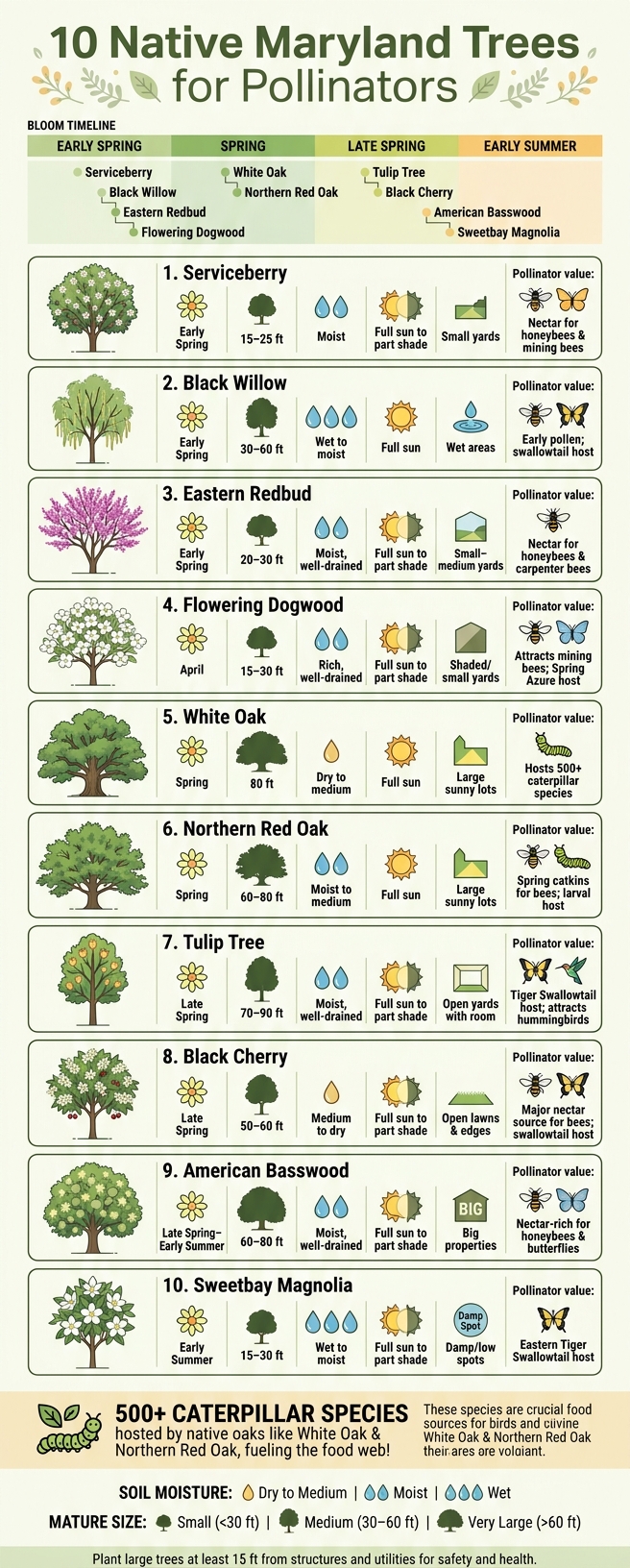
10 Native Maryland Trees for Pollinators: Quick Comparison Guide
Use the chart below to compare bloom timing, size, and site fit at a glance.
| Common Name | Botanical Name | Bloom Period | Mature Height / Spread (ft) | Sun Exposure | Soil Moisture | Pollinator Value |
|---|---|---|---|---|---|---|
| Serviceberry | Amelanchier canadensis | Early spring | 15–25 / 15–20 | Full sun to part shade | Moist soil | Nectar for honeybees and mining bees |
| Black Willow | Salix nigra | Early spring | 30–60 / 30–60 | Full sun | Wet to moist | Early pollen source; swallowtail host |
| Eastern Redbud | Cercis canadensis | Early spring | 20–30 / 25–35 | Full sun to part shade | Moist, well-drained | Nectar for honeybees and carpenter bees |
| Flowering Dogwood | Cornus florida | April | 15–30 / 15–30 | Full sun to part shade | Rich, well-drained | Attracts three types of mining bees [1] |
| White Oak | Quercus alba | Spring | 80 / 60+ | Full sun | Dry to medium | Larval host for 500+ caterpillar species [2] |
| Northern Red Oak | Quercus rubra | Spring | 60–80 / 40–60 | Full sun | Moist to medium | Spring catkins for bees; larval host |
| Tulip Tree | Liriodendron tulipifera | Late spring | 70–90 / 35–50 | Full sun to part shade | Moist, well-drained | Host for Tiger Swallowtail caterpillars; attracts hummingbirds |
| Black Cherry | Prunus serotina | Late spring | 50–60 / 30–50 | Full sun to part shade | Medium to dry | Major nectar source for bees; requires pollinators to set fruit [1] |
| American Basswood | Tilia americana | Late spring / early summer | 60–80 / 30–50 | Full sun to part shade | Moist, well-drained | Nectar for honeybees |
| Sweetbay Magnolia | Magnolia virginiana | Early summer | 15–30 / 15–25 | Full sun to part shade | Wet to moist | Host for Eastern Tiger Swallowtail |
Bloom timing starts in early spring and stretches into early summer. That gives you room to stagger nectar and pollen sources instead of putting all the action into one short window.
The size and moisture columns help you rule options in or out fast. If your yard stays damp, trees like Black Willow or Sweetbay Magnolia make more sense. If space is tight, Serviceberry or Flowering Dogwood may be a better fit.
Conclusion
After looking at bloom time, mature size, and growing needs, the right tree usually comes down to one thing: fit. The best pick depends on your space, how much sun the spot gets, and how well the soil drains. Small, shaded yards often work best with Flowering Dogwood or Serviceberry. Bigger, sunny spaces are a better match for White Oak or Tulip Tree.
That’s also why a mixed planting often works better than relying on just one tree. A mix of early bloomers, summer bloomers, and host trees helps support habitat across more of the season. For example, pairing an early spring bloomer like Eastern Redbud with a summer-blooming tree like Sweetbay Magnolia, then adding a high-value host tree like White Oak, can extend pollinator support from early spring into late summer.
Use the comparison table to match each tree to your site conditions. Start with the tree that fits your yard, then build the rest of the habitat around it.
FAQs
Which native tree is best for a small Maryland yard?
Several native trees are a good fit for small Maryland yards, and they do double duty by helping pollinators too:
- Flowering dogwood
- Serviceberry
- Eastern redbud
- Fringe tree
Flowering dogwood is a prized pick that’s easy to grow. Serviceberry tops out at about 20 feet and offers nectar-rich flowers along with berries. Eastern redbud grows 20 to 30 feet and gives pollinators nectar early in the season. Fringe tree is a good match for home landscapes because it’s adaptable and showy.
What should I check before planting a native tree?
Before you plant a native tree in Maryland, take a close look at your site. Check how much light the area gets, how wet or dry the soil stays, how well it drains, and how much room the tree will have to grow.
Space matters more than many people think. Look at the tree’s mature height and spread, not just its size at planting time. Give it at least 15 feet of clearance from structures, utility lines, driveways, sidewalks, and septic systems.
You’ll also want to make sure the species matches your local USDA growing zone, which in Maryland ranges from 5b to 8a. And think about what you want the tree to do in your yard, whether that’s providing shade, helping pollinators, or both.
How can I support pollinators all season with trees?
Plant native trees to give pollinators a steady food source, especially in early spring when many other plants are still dormant. Eastern redbud and tulip poplar are strong picks because they offer nectar right when insects need it most.
For support through the whole growing season, mix trees, shrubs, and perennials with bloom times that overlap. And in winter, leave some leaf litter and fallen stems in place. That extra mess does more than people think – it gives overwintering insects a place to shelter.
Chat with Us