









- bhavya gada
- No Comments
Native vegetation is one of the most effective ways to protect shorelines from erosion. It stabilizes soil with deep roots, reduces wave energy, and filters runoff, preventing sediment and nutrients from entering waterways. For Maryland homeowners, this natural solution is especially important given the challenges posed by tidal activity, storms, and varying soil types. Here’s how native plants work:
- Deep Roots Hold Soil: Native plants, unlike turf grass, have roots that extend 3–10 feet, securing the soil and resisting erosion.
- Above-Ground Protection: Stems and leaves absorb wave energy and slow rainwater, reducing soil displacement.
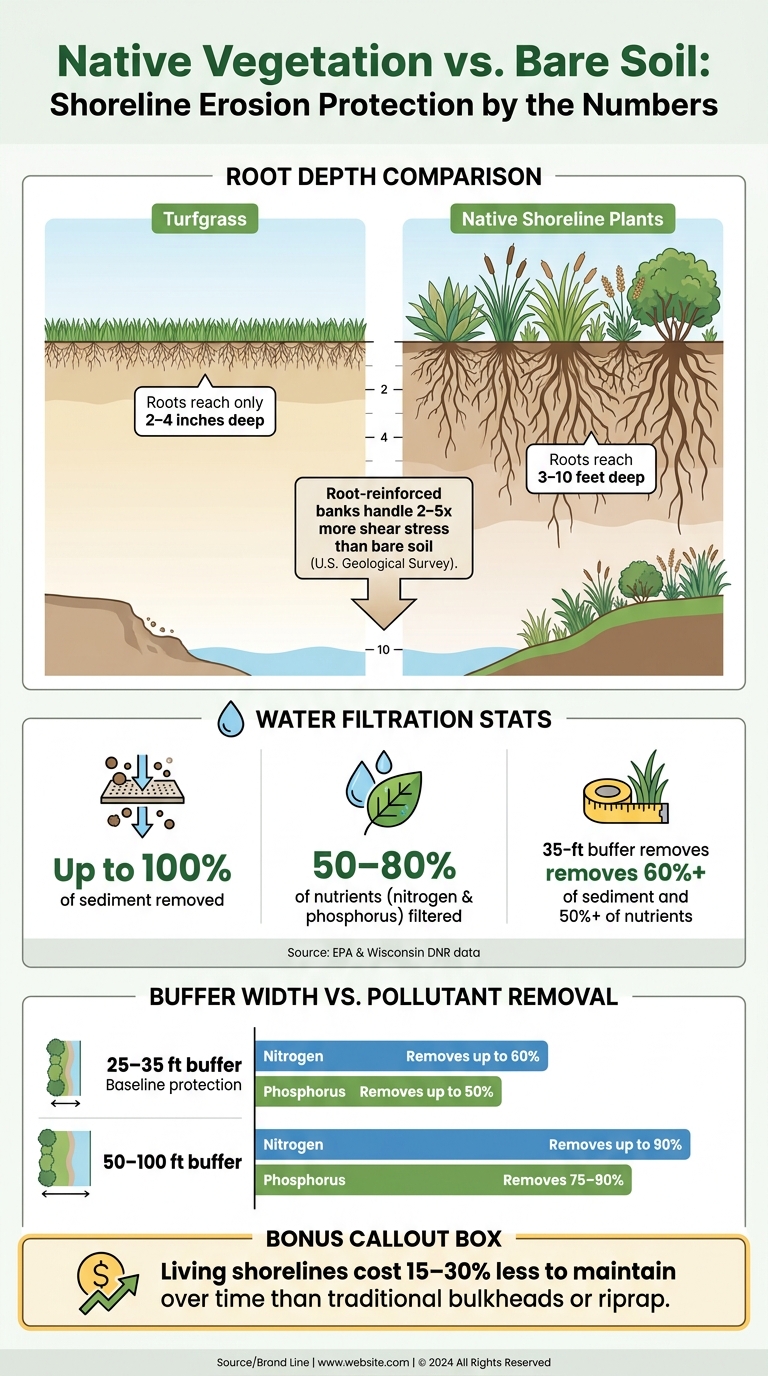
- Water Filtration: Vegetated buffers trap up to 100% of sediment and 50–80% of nutrients in runoff, protecting water quality.
- Wildlife Habitat: These plants support local ecosystems by providing shelter and food for pollinators, birds, and aquatic species.
Establishing a shoreline buffer involves assessing your property, selecting the right native plants, and planting in layers to maximize protection. Maintenance and landscape projects during the first two growing seasons are key, with tasks like watering, mulching, and monitoring for weeds. Over time, native vegetation becomes self-sustaining, offering a cost-effective and natural solution to erosion while enhancing the landscape.
Understanding the Shoreline Zones & Suitable Native Plants for Each Zone #shorelines #nativeplants
sbb-itb-843f8be
How Native Vegetation Stops Erosion
Native Vegetation vs. Bare Soil: Shoreline Erosion Protection by the Numbers
Root Systems: How They Hold Soil in Place
The real magic of native plants happens underground. While turfgrass roots only reach about 2–4 inches, native shoreline grasses, sedges, and shrubs send their roots 3–10 feet deep into the soil. This depth is a game-changer, especially during storms.
Think of these deep roots like rebar in concrete – they bind soil particles together, strengthen the ground, and form a dense network that resists being torn apart by waves or fast-moving water. Research from the U.S. Geological Survey shows that root-reinforced banks can handle 2–5 times more shear stress than bare soil, depending on the plant species and root density. Different types of roots work in tandem: fibrous roots from grasses and sedges secure fine particles in the top 12–24 inches, while deeper shrub roots stabilize the bank at greater depths, preventing large-scale collapses. Meanwhile, rhizomatous plants quickly fill in bare patches, knitting the soil together where it’s most vulnerable.
But the benefits of native plants don’t stop underground. Their above-ground growth also plays a critical role in protecting against erosion.
Above-Ground Growth: Reducing Water Impact
The stems and leaves of native plants act as a natural shield, absorbing the energy of water before it can erode the soil. Waves or boat wakes lose momentum as they pass through a dense wall of stems. Leaves catch falling raindrops, preventing them from hitting the soil directly. On sloped banks, tall grasses and shrubs force surface runoff to slow down and spread out as it winds through the vegetation, carrying far less sediment in the process.
For homeowners in Maryland living along tidal creeks or lakes with boat traffic, a strip of knee- to waist-high native grasses and wildflowers between the lawn and the water can dramatically reduce soil erosion and bank undercutting. In higher-energy areas, like tidal rivers, taller and denser vegetation – 3 to 6 feet high, including native shrubs – is necessary to absorb the stronger wave forces.
This combination of underground and above-ground landscaping services not only protects your shoreline but also supports the surrounding environment, creating a win-win for erosion control and biodiversity.
Water Filtration and Wildlife Habitat
Native plants don’t just stabilize soil – they also filter water. According to EPA data, vegetated buffers can remove 50–100% of sediment from runoff, depending on their width and density. For example, the Wisconsin DNR found that a 35-foot-wide vegetated buffer can filter out over 60% of sediment and up to 50% of nutrients like nitrogen and phosphorus before they reach nearby lakes or streams. Without these buffers, those nutrients could fuel harmful algal blooms in waterways like the Chesapeake Bay.
The benefits extend beyond filtration. A diverse native buffer attracts pollinators, birds, amphibians, and aquatic life, creating a thriving ecosystem. This biodiversity strengthens the buffer’s resilience – if one plant species struggles due to pests or drought, others can step in to maintain protection. Over time, as leaves decompose and roots replenish the soil, organic matter builds up, further improving the soil’s structure and enhancing the shoreline’s ability to withstand extreme weather events.
Planning a Native Shoreline Buffer
Creating an effective shoreline buffer with native vegetation involves assessing your property, selecting the right plants, and designing a layout that addresses erosion and runoff challenges.
How to Assess Your Shoreline
Start by observing how your shoreline behaves under different conditions. After a heavy rain, walk along the bank to identify areas where runoff concentrates or where waves hit hardest. Look for signs of erosion like exposed roots, vertical drop-offs, slumping soil, or sediment plumes in the water – these are the spots that need immediate attention.
Take note of your shoreline’s characteristics, including the height and slope of the bank, the type of waterbody (tidal creek, freshwater pond, or non-tidal stream), and exposure to factors like boat wakes or open-water winds. Soil type matters too: sandy soils drain quickly and suit drought-tolerant plants for higher areas, while clay soils retain moisture and require water-tolerant species. Also, map out where runoff enters from areas like driveways or downspouts, as dense plantings in these zones can significantly reduce erosion.
Before starting, check local regulations. In Maryland, properties within the Chesapeake Bay Critical Area typically require a 100-ft natural vegetation buffer along tidal waters. Your county’s planning or environmental office can guide you on permits, allowable activities, and whether replanting a native buffer can help meet mitigation requirements for past shoreline modifications. This ensures your efforts align with regulations and maximize the protective benefits of native vegetation.
Use this assessment to guide your plant selection, ensuring the species you choose match your shoreline’s unique conditions.
Choosing Native Plants for Maryland
Shoreline buffers in Maryland are typically divided into three functional zones, each suited to specific conditions and plant types:
| Zone | Conditions | Native Species Recommendations |
|---|---|---|
| Water’s edge / low bank | Periodically flooded, wave splash | Spartina alterniflora (smooth cordgrass), Juncus effusus (soft rush), Schoenoplectus tabernaemontani (softstem bulrush), Carex spp. (sedges) |
| Mid-bank / wet meadow | Periodically saturated, drains between storms | Panicum virgatum (switchgrass), Elymus virginicus (Virginia wildrye), Iris versicolor (blue flag iris), Verbena hastata (blue vervain) |
| Upper bank / upland edge | Drier, occasional saturation | Itea virginica (Virginia sweetspire), Cornus amomum (silky dogwood), Clethra alnifolia (sweet pepperbush), Acer rubrum (red maple), Nyssa sylvatica (black gum) |
If you live in the Piedmont region, where soils are rockier and drain well, focus on species that thrive in coarser, shallower soils on upper slopes. For the Coastal Plain, with its sandy or poorly drained soils and occasional tidal or salt exposure, choose plants adapted to higher water tables and brackish conditions, such as Morella cerifera (wax myrtle). Always source plants from regional native nurseries and prioritize local ecotypes, as these are better suited to Maryland’s climate and provide greater benefits to local wildlife.
Designing Your Buffer for Best Results
Once you’ve chosen the right plants, design your buffer to optimize soil stability and water filtration. A buffer width of 25–35 ft works for most properties, but if space allows, go wider – buffers between 50 and 100 ft can remove up to 90% of nitrogen and 75–90% of phosphorus from runoff. On steep or eroding banks, wider buffers are especially effective.
For best results, arrange your plantings in layers. Use grasses and sedges at the water’s edge to stabilize surface soil, shrubs mid-slope to add woody root systems and absorb wave energy, and trees on the upper bank to anchor larger soil volumes with their extensive roots. This layered approach ensures full coverage, reducing weak spots prone to erosion.
If your property has steep slopes or concentrated runoff, contour planting can make a big difference. Planting along lines of equal elevation or combining plantings with shallow swales spreads runoff over a broader area, slows it down, and allows water to soak into the ground before reaching the shoreline. For properties needing additional grading or drainage adjustments, Pro Landscapes MD offers services like land leveling and drainage installation, which can complement your native buffer plan to address water flow challenges effectively.
How to Plant Native Vegetation Along Shorelines
Once you’ve planned and selected the right plants, proper installation becomes the key to ensuring long-term shoreline stability.
Best Times and Methods for Planting
The best times to plant are early spring and early fall, as these seasons offer mild temperatures and consistent rainfall. In spring, the warming soil and regular rain help plants emerge from dormancy and establish themselves quickly. Fall planting, on the other hand, allows roots to grow during the cooler months, giving plants a solid foundation before winter and the following storm season.
Avoid planting during the heat of summer or during drought conditions, as new plants are particularly vulnerable until their roots are well established. If your shoreline has invasive species like Phragmites or Japanese stiltgrass, remove them before planting. Dig out their roots carefully, but leave any existing deep-rooted native plants intact – they’re already contributing to soil stability. After clearing invasive plants, tailor your planting techniques to suit your site’s specific conditions.
Planting Techniques for Different Site Conditions
Once you’ve chosen the right planting time, it’s crucial to adapt your methods to your site’s unique characteristics. The right technique can be just as important as selecting the right plants.
- Gentle slopes with mild erosion: Use plugs of native grasses and sedges, spacing them 12–18 inches apart. To further stabilize the soil and reduce runoff, apply 2–3 inches of shredded hardwood mulch above the high-water line.
- Steep or actively eroding banks: For these areas, plant densely and use coir (coconut fiber) matting to secure the plugs. Stake the matting across the slope, cutting X-shaped slits to insert the plants. Pin the mat tightly to the soil. Coir mats are biodegradable and last 2–10 years, giving roots enough time to stabilize the bank before the material naturally decomposes.
- Moist, water-saturated banks: Live stakes are an affordable and effective solution here. Use dormant willow or dogwood branches, 2–3 feet long, and drive at least two-thirds of each cutting into the soil with the buds facing upward. Space them 2–3 feet apart. These stakes will root directly into the bank and start sprouting within weeks, quickly reinforcing soil stability. In high-energy areas, additional structural support may be needed before planting.
Pairing Plants with Structural Features
In high-energy environments, natural planting methods may not be enough on their own. Combining vegetation with structural supports can create a more resilient buffer.
For Maryland’s high-energy shorelines, rock toes or low offshore sills are excellent options when paired with marsh vegetation. The rocks absorb wave energy, while the native plants behind them trap sediment and stabilize the bank with their roots. This combination, often referred to as a "living shoreline", has been Maryland’s preferred erosion control method since 2008. Hundreds of projects using this approach have been permitted in the state since then.
Where access paths cut through the buffer, you can incorporate natural stone steps or small terraces into the planting zones. Surround these features with deep-rooted plants like Cornus amomum (silky dogwood) or Panicum virgatum (switchgrass) to prevent soil erosion at these gaps. For larger projects involving grading, retaining walls, or drainage improvements, companies like Pro Landscapes MD offer integrated solutions. They can handle tasks like land leveling and drainage installation while coordinating them with native vegetation planting, ensuring a seamless approach to shoreline stabilization.
Maintaining Your Shoreline Buffer
Caring for New Plantings
For the first two growing seasons, new plantings require extra attention because their root systems haven’t yet developed the depth that makes native buffers so effective.
Watering is your top task. Aim to water deeply 2–3 times a week for the first 6–8 weeks if rainfall is less than 1 inch. Deep watering encourages roots to grow downward, improving drought resilience over time. Avoid shallow, daily watering – it keeps roots near the surface, making plants more vulnerable. After the first season, you’ll only need to water during dry periods or heat waves, focusing on shrubs, trees, and plants located higher on the bank.
Adding a 2–3 inch layer of mulch around new plants helps retain moisture and suppress weeds. However, keep the mulch 2–3 inches away from stems to prevent rot. After heavy rains, check that the mulch hasn’t shifted or piled up against plant crowns. On steep slopes, skip the mulch and use coir matting instead to stabilize the soil.
Weed control is critical in the first two years. Regularly inspect for invasive species like Japanese knotweed, reed canary grass, and Phragmites. Hand-pulling weeds is safer near the waterline than using broad-spectrum herbicides, which can harm both native plants and water quality.
These early efforts lay the groundwork for a stable and thriving shoreline buffer.
Protecting Plants from Physical Damage
Proper care alone isn’t enough – protecting young plants from physical harm is just as important. Foot traffic can compact soil and damage stems, creating weak spots that are prone to erosion. The easiest solution? Direct all access to one designated path, about 3–4 feet wide. Natural stone steps or stabilized gravel work well for this purpose, especially on slopes leading to the water.
During the first two growing seasons, install temporary fencing, rope lines, or low edging to mark off areas where people and pets shouldn’t tread. Planting dense, low-growing shrubs at the upland edge of the buffer can also serve as a natural barrier. In areas with heavy deer activity, protect young shrubs and trees with tree shelters or wire cages to prevent damage.
Monitoring and Managing Your Buffer Over Time
Once your buffer is established, regular monitoring ensures its long-term success. Inspect it twice a year – once in spring and again in late summer or early fall – and always after major storms. Look for exposed soil, undercut banks, widening gaps between plants, or signs of runoff concentrating in a single spot. These issues are early indicators that the buffer’s density is decreasing, which can lead to larger erosion problems.
If you notice bare patches, replant them promptly. Open soil invites erosion and invasive species. Use the original native species to fill gaps, and plant during spring or early fall for the best results. According to Maryland conservation districts, buffers usually become self-sustaining within three to five years. At that point, dense plant cover and natural leaf litter help suppress weeds and retain moisture.
However, if you’re dealing with ongoing problems like bank slumping, stormwater channels cutting through the buffer, or slope instability, it’s time to call in a professional. Maryland homeowners can reach out to Pro Landscapes MD for expert help with drainage fixes, grading, and adding structural features like retaining walls or stone steps. These solutions can address the upland runoff issues that often challenge even the best-planted buffers.
Conclusion: Why Native Vegetation Is a Smart Long-Term Investment
A native shoreline buffer does more than just prevent erosion – it also filters pollutants, supports local wildlife, and protects property features. Research shows that a vegetated buffer between 35 to 100 feet wide can trap 50–90% of sediment and 40–80% of nitrogen and phosphorus from runoff before it reaches streams, rivers, or Chesapeake Bay tributaries [1].
When compared to traditional structures like bulkheads or riprap, living shorelines are also more affordable to maintain, costing 15–30% less over time [1]. After native plants are established – typically within two to three growing seasons – maintenance becomes minimal, focusing mainly on tasks like spot replanting and weed control. This balance of ecological benefits and cost savings makes native buffers a practical choice.
Beyond functionality, native vegetation offers aesthetic and property value benefits that hardscaping simply can’t. A natural, stable shoreline holds strong appeal for buyers in Chesapeake Bay communities, where shoreline health and stormwater management are top priorities. A well-cared-for buffer not only boosts curb appeal but also protects outdoor spaces like patios and walkways from damage.
To create a lasting buffer, start by evaluating your site, choosing plant species suited to Maryland’s conditions, and planting in layers. Proper care during the first two to three growing seasons is key. Once established, these systems largely sustain themselves, requiring only annual inspections to address any potential issues early.
FAQs
How wide should my shoreline buffer be?
The width of a shoreline buffer depends on a variety of factors, including soil type, the layout of your property, and how runoff is managed. To design an effective buffer, a professional evaluation is key. Pro Landscapes MD can assess your property to recommend the ideal dimensions, ensuring your buffer enhances stability and supports ecological balance with solutions customized to your unique landscape.
Which native plants work best for my shoreline zone?
Choosing native plants is a smart way to build a durable, environmentally friendly shoreline that helps combat erosion. Species like black-eyed Susans and New England asters are well-suited to local conditions, requiring less water and maintenance. To get the best outcome, it’s a good idea to work with professional horticulturists. They can assess factors like soil quality, sunlight, and overall site conditions to create a planting plan that keeps your shoreline stable and healthy.
Do I need a permit to plant a buffer in Maryland?
Whether you need a permit to plant a vegetative buffer in Maryland depends on several factors, including the specifics of your project, the site conditions, and local regulations. Maryland has stringent standards for managing runoff and maintaining water quality, so projects related to stormwater management often require adherence to these rules. To make sure your vegetative buffer aligns with all necessary guidelines, it’s a good idea to consult with an experienced professional who can help determine if you’ll need formal permits before getting started.
Chat with Us