









- bhavya gada
- No Comments
Stabilizing shaded slopes in Maryland can be challenging due to clay-heavy soil, low light, and frequent storms causing erosion. Choosing the right plants is crucial for holding soil, reducing runoff, and maintaining slope stability. Here’s what you need to know:
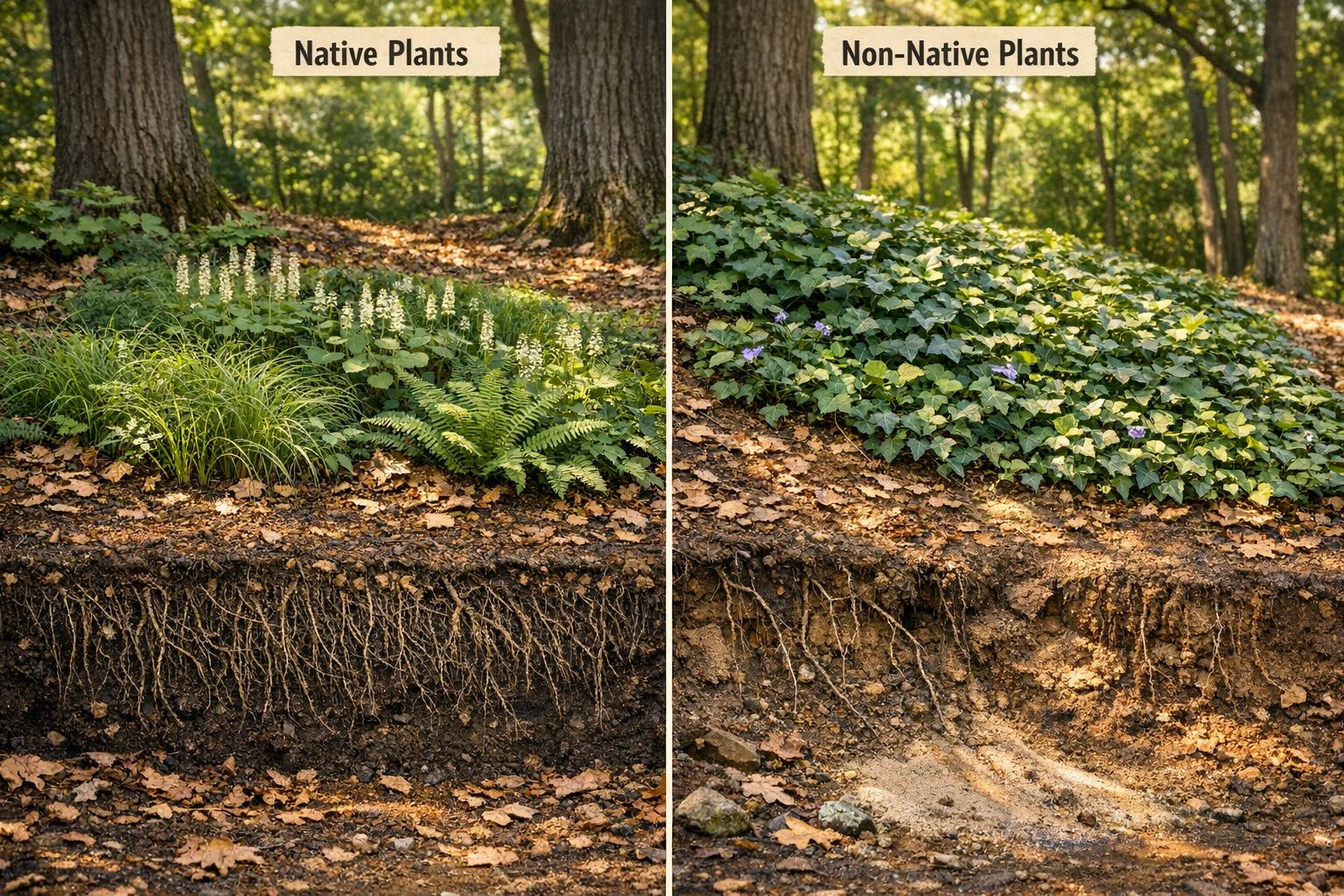
- Native plants: Offer deeper roots, better erosion control, and support local ecosystems. Examples include Golden Ragwort, Wild Ginger, and Pennsylvania Sedge.
- Non-native plants: Provide faster initial coverage but often require more maintenance and may disrupt local habitats. Common choices include Japanese Pachysandra and English Ivy.
Quick Comparison
| Feature | Native Plants | Non-Native Plants |
|---|---|---|
| Erosion Control | Strong – deep, fibrous roots | Moderate – shallow root systems |
| Wildlife Support | High | Limited |
| Maintenance Needs | Low after establishment | High |
| Growth Speed | Slower for some species | Faster |
Native plants are generally better for long-term slope stabilization and ecological balance, while non-native plants may work for short-term needs. Pairing vegetation with structural solutions like coir netting or retaining walls can further protect slopes from erosion.
Landscaping for Shade with Native Plants
sbb-itb-843f8be
Key Factors for Selecting Shade Plants for Slopes
When choosing plants for a shaded slope, it’s crucial to understand the structural role they’ll play. On sloped terrain, plants do more than just beautify – they stabilize the soil, slow water runoff, and prevent erosion over the long term.
Plant Performance Criteria for Slopes
The root structure of a plant is the most critical factor. Look for species with deep, fibrous roots, upright stems, and the ability to spread quickly through stolons or rhizomes. These traits help secure soil, reduce erosion, and provide quick ground coverage on bare slopes.
| Plant Trait | Role on Slopes | Native Examples |
|---|---|---|
| Deep/Fibrous Roots | Anchors soil and improves water infiltration | Carex species, Panicum virgatum (Switchgrass) |
| Fast Spreading | Covers exposed soil quickly to prevent splash erosion | Packera aurea (Golden Ragwort) |
| Upright Stems | Slows water runoff and traps sediment | Chasmanthium latifolium (Inland Sea Oats) |
| Winter Presence | Protects soil year-round, even in dormant seasons | Polystichum acrostichoides (Christmas Fern) |
It’s also important to match plants to the specific shade conditions they’ll face – whether deep shade, filtered light, or edge shade – so they can thrive.
Maryland-Specific Considerations
Maryland’s unique environment, with its clay-heavy soils and fluctuating wet-dry weather, requires careful plant selection. For example, plants suited to dry, hilltop conditions may not thrive in moisture-rich valleys, where supplemental irrigation might be necessary to maintain a healthy landscape. [2]
Two additional factors to consider in Maryland:
- Proximity to roads: Slopes near streets treated with ice-melt products in winter require salt-tolerant species. Options like Muhly grass and Common juniper are better equipped to handle these conditions.
- Mislabeled "native" plants: Not all plants marketed as native are truly local to Maryland. For instance, Allegany pachysandra originates from the southern Blue Ridge mountains, and Yellow wood poppy, though often sold as native, can spread aggressively and isn’t native to the state. [2]
"Recent research suggests that if biodiversity is your motive, you’d do well to use at least 80% natives by cover, rather than just planting a few." – University of Maryland Extension [2]
Lastly, avoid using synthetic landscape cloth on slopes. While it might seem like a good erosion solution, it actually increases surface runoff, harms soil health over time, and can worsen erosion. Instead, opt for biodegradable coir netting as a temporary measure while plants establish themselves.
These guidelines provide a strong foundation for comparing native and non-native plants in the next section, ensuring your slope remains stable and sustainable.
Native Shade Plants for Slope Stabilization
Native plants, perfectly suited to Maryland’s unique soils and climate, are excellent for stabilizing shaded slopes. Their deep root systems provide strong, natural erosion control, requiring little maintenance once they’ve taken hold.
Pros and Cons of Native Plants
The Master Gardeners of Northern Virginia explain:
"The deep root systems of native grasses and the spreading lateral roots of sedges are particularly effective at holding the soil and keeping it from washing away." [5]
In addition to stabilizing soil, native plants attract pollinators and beneficial insects, boosting local ecosystems. They also absorb rainwater, helping it seep into the ground instead of rushing off the slope.
That said, native plants often take longer to establish compared to some non-native varieties. Many species also go dormant in winter, leaving the soil briefly exposed. Another challenge is deer browsing, though the steepness of slopes can sometimes deter them.
These factors are worth considering when selecting groundcovers and shrubs for Maryland’s shaded slopes.
Recommended Native Groundcovers
Native groundcovers offer practical solutions for slope management.
- Golden Ragwort (Packera aurea): This plant seeds quickly and provides winter cover, protecting soil year-round. It thrives at the base of slopes, where the soil tends to stay moist.
- Wild Ginger (Asarum canadense): Perfect for full shade, it forms a dense mat that shields soil from rain impact, making it ideal under heavy tree cover.
- Foamflower (Tiarella cordifolia): With its spreading growth, this plant stabilizes soil effectively in shaded, mid-slope areas of wooded properties [3].
When planting groundcovers near existing trees, use small pots (like plugs or quarts) to minimize disturbance to the tree roots, which already play a role in holding the slope together [6].
Native Shrubs and Grasses for Shaded Slopes
In addition to groundcovers, certain shrubs and grasses provide added stability for shaded slopes.
- Wild Hydrangea (Hydrangea arborescens): Naturally found on cliffs and steep slopes, this shrub reinforces the soil structure. It grows best in moist soil with a good calcium supply [6].
- Fragrant Sumac (Rhus aromatica): A strong choice for drier, partially shaded areas. Its suckering growth spreads over time, knitting the slope together. The "Grow-Lo" variety is a great option for shorter coverage.
- Pennsylvania Sedge (Carex pensylvanica): With semi-evergreen foliage and lateral roots, this sedge is ideal for dry, upper slopes.
- Eastern Bottlebrush Grass (Elymus hystrix): It germinates quickly and remains visible through winter, making it a great option for immediate stabilization [6].
| Plant | Type | Best Slope Position | Moisture |
|---|---|---|---|
| Golden Ragwort (Packera aurea) | Groundcover | Bottom of slope | Wet to moist |
| Wild Ginger (Asarum canadense) | Groundcover | Mid to upper slope | Moist |
| Foamflower (Tiarella cordifolia) | Groundcover | Mid-slope | Moist |
| Wild Hydrangea (Hydrangea arborescens) | Shrub | Mid to lower slope | Moist |
| Fragrant Sumac (Rhus aromatica) | Shrub | Upper to mid-slope | Dry to medium |
| Pennsylvania Sedge (Carex pensylvanica) | Sedge | Upper slope | Dry to medium |
| Eastern Bottlebrush Grass (Elymus hystrix) | Grass | Mid to upper slope | Moist to dry |
Non-Native Shade Plants for Slope Stabilization
Non-native shade plants are widely used in Maryland, valued for how quickly they establish themselves. But while they can provide rapid coverage, they don’t always guarantee long-term stability – especially on shaded slopes where tree roots already play a key role in anchoring the soil. Let’s explore the benefits and drawbacks of these species compared to native options.
Pros and Cons of Non-Native Plants
Non-native groundcovers are often chosen for their ability to quickly cover bare soil and create a uniform appearance in areas where grass struggles to thrive. This makes them a tempting solution for short-term erosion control. However, planting them as monocultures – where a single species dominates – can create vulnerabilities. These monocultures are more susceptible to pests and diseases, which could lead to widespread slope instability if the plants fail [1]. Additionally, non-native groundcovers typically provide little support for local wildlife compared to native plants [1][3].
The way these plants are installed can also disrupt existing ecosystems. For example, planting dense non-native groundcovers often disturbs the established tree roots that are already stabilizing shaded slopes. In Maryland, soil that looks bare on the surface is often held together by a hidden network of tree roots just beneath [6].
Popular Non-Native Shade Plants
Despite the potential downsides, some non-native species are commonly used in Maryland landscapes for specific purposes:
- Japanese Pachysandra (Pachysandra terminalis): This low-growing groundcover performs well in deep shade and spreads steadily. However, it provides minimal value to wildlife and can encroach on nearby natural areas. A native alternative like Allegheny Spurge (Pachysandra procumbens) offers similar coverage while blending better with the local ecosystem [5].
- English Ivy (Hedera helix): Known for its fast growth, English ivy is often used to quickly cover slopes. Unfortunately, it’s highly invasive in Maryland, frequently spreading into forests and choking out native understory plants. Its roots are also relatively shallow, offering less effective long-term soil stabilization compared to native shrubs or perennials like Wild Hydrangea [5][6].
- Periwinkle (Vinca minor): This evergreen groundcover is favored for its low maintenance and ability to spread quickly. However, it often escapes into natural areas and provides almost no support for local wildlife.
While these plants are widely available and easy to establish, their long-term risks – like invasiveness and limited ecological contribution – make them less suitable for Maryland’s natural environment. Native alternatives not only provide comparable coverage but also offer deeper root systems and greater benefits to local ecosystems.
Native vs. Non-Native Shade Plants: A Direct Comparison
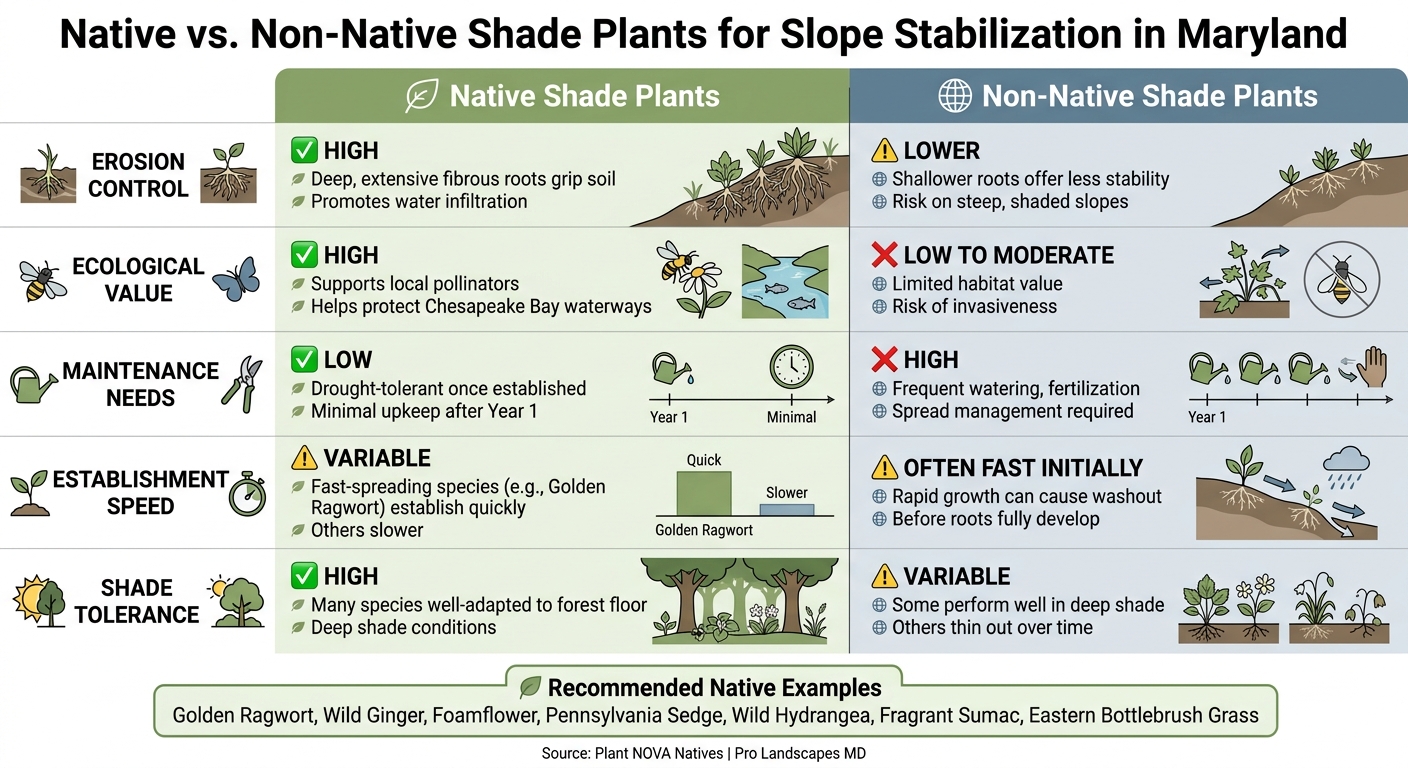
Native vs. Non-Native Shade Plants for Slope Stabilization in Maryland
When it comes to addressing slope challenges, native and non-native shade plants bring distinct advantages and drawbacks. These differences play a critical role in soil retention, ecological benefits, and maintenance requirements.
Comparison Table: Native vs. Non-Native Plants
| Feature | Native Shade Plants | Non-Native Shade Plants |
|---|---|---|
| Erosion Control | High – deep, extensive roots grip soil and promote water infiltration | Lower – shallower roots offer less stability on steep, shaded slopes |
| Ecological Value | High – supports local pollinators and helps protect sensitive waterways like the Chesapeake Bay | Low to moderate – can provide limited habitat and may become invasive |
| Maintenance | Low – typically drought-tolerant once established and require minimal upkeep | High – often need frequent watering, fertilization, and careful management |
| Establishment Speed | Variable – fast-spreading species (e.g., Golden Ragwort) can establish quickly | Often fast initially, but rapid initial growth can result in washout before root systems develop fully |
| Shade Tolerance | High – many species are well-adapted to forest floor conditions | Variable – some perform well in deep shade while others thin out |
Source: Plant NOVA Natives [4]
"By gripping the soil with their more extensive roots, certain native plants can do a better job at erosion control than turf grass, especially in shade areas where grass grows poorly." – Plant NOVA Natives [4]
Native shade plants excel in erosion control and require less maintenance over time. While non-native plants might establish quickly, they often lack the stability and ecological benefits that native species provide. These differences are crucial when deciding how to pair vegetation with engineered solutions.
Combining Native and Non-Native Plants with Structural Solutions
Even with the advantages of native plants, steep slopes or high runoff areas often require additional support to prevent erosion. As Plant NOVA Natives notes, "if the velocity is too high, smaller plants will just wash away, and the roots of shrubs and trees will become exposed." In these cases, combining vegetation with structural solutions is essential.
Options like retaining walls, French drains, and biodegradable erosion blankets can complement native shrubs such as Wild Hydrangea, providing extra stability in areas with heavy runoff. Pre-fabricated terrace logs, designed to slow water flow, are another effective tool for reinforcing slopes. A practical approach might involve prioritizing native plants for most of the slope, with non-native groundcovers confined to controlled areas where their spread can be managed.
Pro Landscapes MD demonstrates how combining smart plant choices with drainage systems and hardscaping can create durable, long-lasting solutions for Maryland homeowners dealing with slope stabilization challenges.
Maintenance and Long-Term Performance
Routine Maintenance for Slope Plantings
Once you’ve chosen the right plants, keeping up with regular maintenance is key to ensuring slopes remain stable over time. The first year after planting is especially important. During this period, water new plants weekly to help their roots establish. After that, native species typically become drought-resistant and require much less attention [7].
Young plants leave exposed soil vulnerable to erosion, so cover bare areas immediately with a 2-inch layer of organic mulch like wood chips, shredded bark, or composted leaves. This not only protects the soil but also keeps weeds at bay [1].
"It is not recommended to use plastic or synthetic landscape cloth on top of or under the soil. These can increase erosion and water runoff." – Deb Christopher, Master Gardener, Penn State Extension [1]
Avoid digging too much near mature trees to prevent damaging their roots. If planting near established trees, use smaller pots like plugs or quart containers to minimize soil disruption.
Once native groundcovers take hold, they require much less upkeep. Dense plantings naturally suppress weeds, and fallen leaves in autumn provide free mulch, insulating roots and enriching the soil. For example, Pennsylvania sedge thrives when trimmed to about 3 inches in late winter [1]. After heavy rains, inspect the slope for signs of exposed roots or shifting soil to address small problems before they escalate into larger, more expensive issues.
| Maintenance Task | Timing | Purpose |
|---|---|---|
| Watering | Weekly during Year 1 | Helps roots establish [7] |
| Mulching | At planting; refresh annually | Protects soil and prevents weeds [1] |
| Weeding | Pre-planting, then as needed | Reduces competition for plants [4] |
| Pruning/Thinning | As needed after Year 2 | Controls growth and promotes plant health [7] |
| Post-storm structural check | After heavy rain events | Detects early erosion or root exposure [4] |
In more severe situations, consulting a professional can ensure the slope remains stable and secure.
Pro Landscapes MD‘s Role in Slope Care

Even with healthy vegetation, some slopes in Maryland may need extra structural support, particularly during the early stages when plant roots aren’t yet deep enough to fully stabilize the soil. Pro Landscapes MD steps in to assist homeowners during this critical period. They combine expert planting techniques with solutions like French drains and drainage repairs to manage water flow and prevent erosion.
Their approach includes analyzing specific site conditions such as soil pH, moisture levels, and whether the slope is in a dry or wet area. This attention to detail ensures the right plants are chosen and positioned for success. As Penn State Extension highlights, "In many ways, choosing native plants is the best solution possible since many have deeper roots and, once established, may require less water and maintenance than non-native plants." [1]
Serving communities in Howard County, Montgomery County, Carroll County, and beyond, Pro Landscapes MD provides the expertise needed to design and maintain slopes that remain stable for years to come.
Conclusion: Choosing the Right Plants for Your Shaded Slope
Stabilizing a shaded slope is all about selecting plants that match the specific conditions of your site. Native plants, such as Christmas Fern (Polystichum acrostichoides) and Golden Ragwort (Packera aurea), are excellent choices. They establish deep root systems, provide continuous soil coverage, and contribute to reducing sediment runoff, which benefits ecosystems like the Chesapeake Bay. On the other hand, non-native plants can offer quicker coverage, but they often come with higher maintenance needs and less environmental impact.
A strong, stable slope thrives on a mix of plant species. Combining natives with thoughtfully selected non-natives in groupings (rather than uniform plantings) helps reduce the risk of pests or diseases wiping out the entire area. This approach also promotes a healthier and more balanced ecosystem over time.
That said, plant selection is only part of the equation. Soil management plays a critical role in ensuring long-term success. As Deb Christopher emphasizes:
"Proper site and soil preparation are extremely important to ensure low maintenance in the future." [1]
Testing your soil’s pH and moisture levels can help you tailor your planting strategy for the best results.
For slopes with steep inclines, heavy runoff, or tricky drainage, plants alone might not be enough. In these situations, adding structural supports, such as biodegradable coir netting or drainage systems, can provide the extra stability needed during the early stages of growth.
If tackling your shaded slope in Maryland feels like a daunting task, Pro Landscapes MD offers expert help. They specialize in evaluating site-specific factors like soil, moisture, light, and slope orientation to create planting plans that ensure long-term stability. Serving central Maryland homeowners, their team combines horticultural knowledge with practical drainage solutions to set your project up for success.
FAQs
How can I tell if my slope is ‘dry’ or ‘moist’ shade?
To figure out whether your slope falls under dry shade or moist shade, take a close look at the soil and the environment around it.
- Moist shade areas usually have soil that stays damp most of the time. You’ll often find plants suited to wetter conditions, like those you’d see in floodplains or low-lying areas.
- Dry shade, on the other hand, is common in well-drained spots, such as hilltops or slopes. The soil here dries out quickly, and the vegetation is typically made up of plants that can handle drier conditions.
Pay attention to the natural vegetation and how wet or dry the soil feels – these details can give you valuable hints.
What can I use instead of landscape fabric on a slope?
Native plants with extensive root systems are a great way to stabilize soil and prevent erosion on slopes. Shrubs such as chokeberry, pussy willow, and viburnum are excellent choices. For ground cover and perennials, consider options like asters, goldenrod, and wild ginger. These plants naturally anchor the soil, minimize runoff, and improve slope stability. To support their growth, adding mulch around the plants can help retain both soil and moisture during their establishment period.
When is a retaining wall or French drain necessary with plants?
Retaining walls are crucial for stabilizing steep slopes and preventing soil erosion, particularly when shallow-rooted plants are in place. For areas with poor water retention or excessive runoff, installing a French drain or similar drainage system is key. These solutions help prevent root rot and ensure the soil remains stable, safeguarding both the plants and the slope itself.
Chat with Us