









- bhavya gada
- No Comments
Pollinators in Maryland need support, and native wildflowers are the perfect way to help. These plants have evolved with local bees, butterflies, and other insects, offering food, shelter, and nesting spaces. Plus, they thrive in Maryland’s soils and climate, requiring less water and minimal care once established. Here are 10 native wildflowers that can transform your garden into a haven for pollinators:
- Black-Eyed Susan: Long bloom period (June–October), supports bees, butterflies, and birds.
- Butterfly Weed: Host for Monarch caterpillars, blooms June–August.
- Swamp Milkweed: Thrives in wet areas, supports Monarchs and bees, blooms June–August.
- Wild Bergamot: Summer nectar source, attracts bees, butterflies, and hummingbirds.
- Goldenrod: Late-season blooms (August–October), supports over 100 pollinator species.
- New England Aster: Fall blooms (September–October), vital for late-season pollinators.
- Wild Columbine: Early spring blooms (April–June), attracts hummingbirds and bees.
- Firepink: Bright red blooms (April–June), early-season nectar for hummingbirds.
- Joe Pye Weed: Tall plant with summer blooms (July–September), attracts butterflies.
- Cardinal Flower: Striking red flowers (July–September), ideal for moist gardens.
These wildflowers not only beautify your garden but also provide critical resources for Maryland’s pollinators year-round.
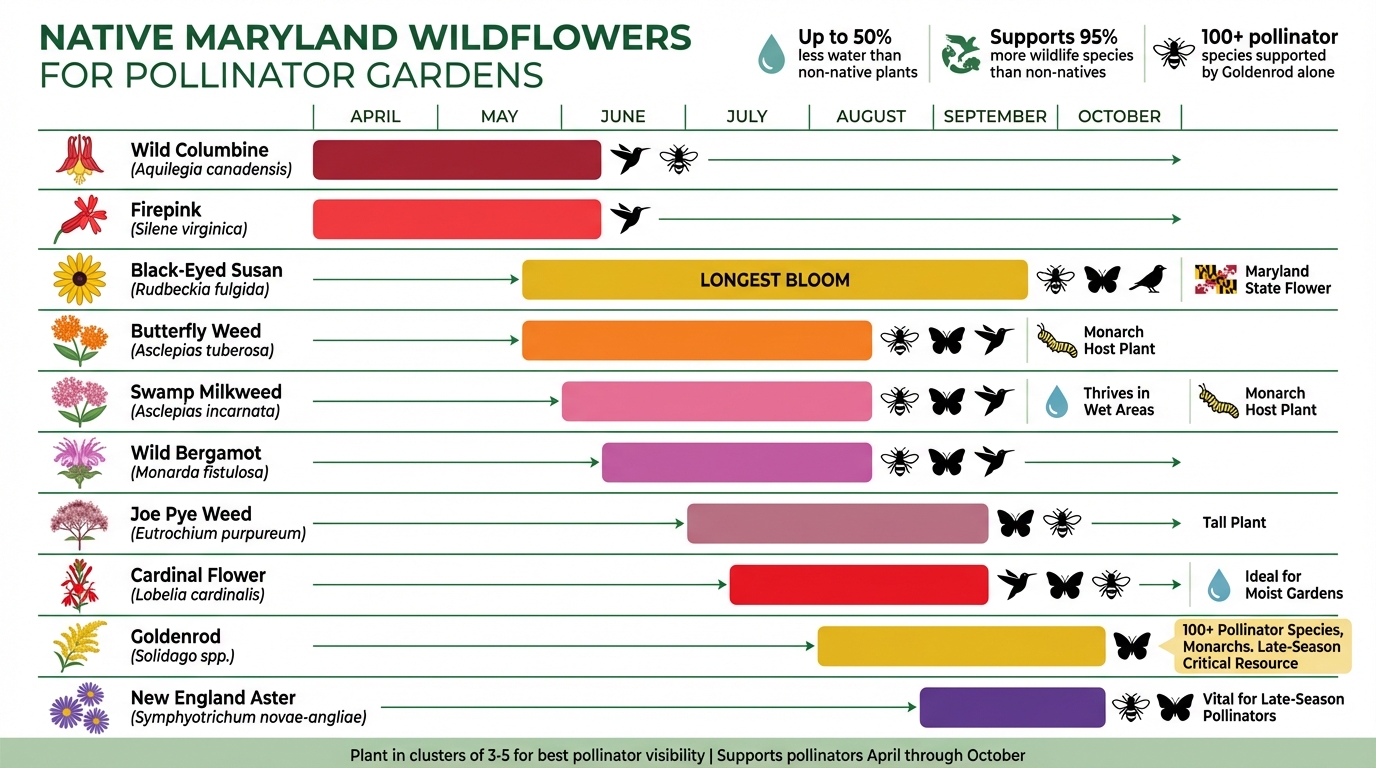
10 Native Maryland Wildflowers Bloom Times and Pollinator Benefits Chart
Maryland Native Plants Blooming in August
sbb-itb-843f8be
1. Black-Eyed Susan (Rudbeckia fulgida)
The Black-Eyed Susan, Maryland’s state flower, plays a key role in supporting pollinator gardens across the state. This vibrant wildflower offers nectar, pollen, and seeds, making it a favorite for native bees, migrating butterflies, and even birds.
Pollinator Appeal
During the height of summer, Black-Eyed Susans burst into bloom with their striking yellow petals and dark centers. These flowers provide a steady source of nectar from June through October, aligning perfectly with the active season for pollinators like bees and butterflies.
Perfect Fit for Maryland’s Environment
Black-Eyed Susans thrive across Maryland’s varied landscapes, from the mountainous west to the coastal plains. They flourish in full sun or partial shade and adapt well to the well-drained soils commonly found throughout the state. Once established, they handle dry spells with ease and require little intervention, thanks to their natural compatibility with Maryland’s climate.
"Mainly, they are adapted to the environment in which they naturally occur. This means they generally require less tending from gardeners because they are more resistant to regional pests, require less additional watering and fertilizing once established…" – University of Maryland Extension [1]
Low-Maintenance Beauty for Gardeners
These wildflowers are a breeze to care for. During their first year, a bit of watering helps them settle in, but after that, they thrive on their own. They self-seed, gradually expanding their presence without much effort from gardeners. Fertilizers aren’t necessary – lean soil suits them best. Letting the seed heads remain through winter not only provides food for birds but also shelters stem-nesting bees. A quick cut-back in early spring keeps things tidy.
Next up, discover another standout native plant: Butterfly Weed (Asclepias tuberosa).
2. Butterfly Weed (Asclepias tuberosa)
Butterfly Weed stands out as one of Maryland’s most important native wildflowers, playing a key role as a host plant for Monarch butterflies. Unlike the butterfly bush, which only offers nectar, this native species supports Monarch larvae while also attracting native bees, butterflies, and even hummingbirds with its nectar supply [2].
Attractiveness to Pollinators
The bright orange flower clusters of Butterfly Weed are a magnet for pollinators during the summer. Native bees rely on its rich nectar and pollen, while Monarch caterpillars depend on it as a primary food source. Beyond its role in supporting pollinators, the nectar contributes to the production of summer wildflower honey. Studies show native plants like Butterfly Weed can sustain up to 95% more wildlife species compared to non-native ornamental plants [2].
Seasonal Bloom Times for Continuous Pollinator Support
Butterfly Weed blooms from June to August, bridging the mid-summer gap between spring and fall flowering plants. This ensures a steady food supply for pollinators during the peak growing season, making it a vital resource for Maryland’s ecosystem [2].
Adaptability to Maryland’s Climate and Soil Conditions
This wildflower thrives in Maryland’s coastal plains and Piedmont regions, favoring full sun and sandy, well-drained soils. It adapts well to dry conditions and, once established, shows impressive drought tolerance [2].
Ease of Maintenance for Home Gardeners
Butterfly Weed is low-maintenance after its first growing season. It thrives in lean, dry soil, so fertilizers and frequent watering aren’t needed. For the best results, plant in small groups of 3 to 5. Leaving dead stalks through winter provides nesting sites for stem-nesting bees, like mason and leaf-cutter bees, enhancing its value to local wildlife [2].
Explore more native plants that support Maryland’s pollinators and enrich local ecosystems.
3. Swamp Milkweed (Asclepias incarnata)
Swamp Milkweed is a native wildflower perfect for gardens in Maryland that stay consistently moist or wet. Unlike Butterfly Weed, which thrives in dry, sandy soil, Swamp Milkweed thrives in rain gardens or low-lying areas where water collects easily[1].
A Magnet for Pollinators
Swamp Milkweed is a vital host for Monarch butterfly larvae and offers nectar that attracts bees, butterflies, and even hummingbirds. Its structure also provides shelter and nesting spots for these creatures[1][2]. The nectar is especially beneficial for bees, helping them produce complex, multi-floral honey[2].
Perfect Fit for Maryland’s Soil and Climate
This wildflower is well-suited to Maryland’s diverse landscapes, from the western mountains to the central Piedmont plateau and the coastal plain[1]. Plus, planting Swamp Milkweed can save up to 50% more water compared to non-native plants, making it an eco-friendly choice for local gardens[2].
Blooms That Support Pollinators All Season
Swamp Milkweed blooms from June through August, providing much-needed nectar during the heat of summer. To support pollinators year-round, pair it with spring and fall bloomers to ensure overlapping flowering times. Its extended bloom period and low-maintenance nature make it a smart option for gardeners looking to support wildlife.
Easy Maintenance
Once established, Swamp Milkweed requires minimal upkeep. Planting in clusters of 3–5 increases its visibility to pollinators[2]. Leave dead stalks standing through winter to create nesting spots for stem-nesting bees like mason and leaf-cutter bees[1]. To protect pollinators, avoid using pesticides in your garden[1].
4. Wild Bergamot (Monarda fistulosa)
Wild Bergamot (Monarda fistulosa) is a standout choice for Maryland pollinator gardens, offering vibrant mid-summer blooms that attract bees, butterflies, and hummingbirds. This native wildflower not only adds beauty to your garden but also provides essential nectar during the summer months.
A Magnet for Pollinators
Wild Bergamot is a vital nectar source for pollinators throughout the summer [2]. Its tubular flowers and large floral displays make it easy for bees, butterflies, and hummingbirds to find food. Plus, it has an added bonus: its hollow stems serve as nesting spots for insects like leaf-cutter and mason bees. To support these insects, leave the dead stalks standing through winter instead of cutting them back [1].
Perfect for Maryland’s Climate and Soil
This native plant thrives across Maryland [1]. For the best results, plant Wild Bergamot in full sun with moist, well-drained soil. This will not only enhance its blooms but also help prevent mildew [2]. Once established, it requires very little watering or upkeep, making it an ideal low-maintenance option.
Filling the Mid-Summer Bloom Gap
Wild Bergamot plays a key role in filling the mid-summer gap in your garden’s bloom cycle. Pair it with spring bloomers like Wild Columbine and late-season plants like Goldenrod to ensure pollinators have a steady food source from spring through fall [2].
Low-Maintenance and Multi-Purpose
This hardy perennial is a dream for home gardeners, needing little care once its roots are established. Skip the fertilizer – Wild Bergamot thrives in Maryland’s naturally lean soil [2]. Beyond its ecological benefits, its fragrant leaves can be used for herbal teas, and the plant even helps deter pests, making it a practical and versatile addition to your garden.
5. Goldenrod (Solidago spp.)
As summer fades into fall, Goldenrod steps in to keep pollinators buzzing when most other flowers have finished blooming. From August to October, this late-season bloomer provides nectar that fuels Monarch butterflies for their migration and supports over 100 species of moths and butterflies[2].
A Lifeline for Pollinators in Fall
Despite common misconceptions, Goldenrod’s heavy, sticky pollen doesn’t cause hay fever[2]. Instead, it’s a favorite for bees, who use its nectar to create rich fall wildflower honey. To keep pollinators fed year-round, pair Goldenrod with plants that bloom in spring and summer[1][2].
Perfect for Maryland’s Varied Landscapes
Goldenrod is right at home in Maryland, thriving in environments ranging from the western mountains to the Piedmont plateau and coastal plain[1]. Its ability to adapt to the local climate means it can cut garden water use by up to 50% compared to non-native plants[2]. Plus, this native plant does well in different soil types and naturally resists pests common to the region[1][2].
Low-Maintenance and Pollinator-Friendly
For maximum impact, plant Goldenrod in clusters of three to five to catch the attention of pollinators. It grows best in lean soils and doesn’t need fertilizer[2]. Let the stalks stand through the winter – those hollow stems provide nesting spots for beneficial insects like mason bees and leaf-cutter bees[1].
Up next: Learn how the New England Aster can add even more seasonal interest to your garden.
6. New England Aster (Symphyotrichum novae-angliae)
In October, the New England Aster’s striking purple flowers provide an essential lifeline for late-season pollinators [2].
Attractiveness to Pollinators
When most other flowers have faded, New England Aster steps in to keep pollinators buzzing. Its nectar-rich blooms are a favorite for bees and butterflies, ensuring they have a food source deep into the fall. Plus, the nectar plays a role in creating fall wildflower honey, known for its rich amber hue and bold flavor [1][2].
Adaptability to Maryland’s Climate and Soil Conditions
This resilient native plant thrives across Maryland’s diverse landscapes, from the rugged western mountains to the Piedmont plateau and the coastal plain [1]. Its natural resistance to local pests and reduced need for supplemental watering make it a practical choice for gardeners. On top of that, it can handle deer browsing, which is a bonus for those in areas with high deer activity.
Ease of Maintenance for Home Gardeners
New England Aster is a breeze to grow, even for those new to gardening. It does well in full sun to partial shade and benefits from pinching back the stems in early summer to encourage a bushier shape and more blooms [2]. Skip the heavy fertilizers – this plant thrives in lean soil. For an extra touch of ecological care, wait until late winter or early spring to cut it back. Its hollow stems provide critical winter shelter for stem-nesting bees, helping them complete their life cycles [1][2].
Next, discover how Wild Columbine can bring vibrant early-season blooms and attract hummingbirds to your garden.
7. Wild Columbine (Aquilegia canadensis)
With its striking red and yellow tubular flowers, Wild Columbine is a magnet for hummingbirds during its blooming period from April to June. This vibrant wildflower plays a pivotal role in supporting early spring pollinators, making it a fantastic addition to Maryland gardens.
Attractiveness to Pollinators
Wild Columbine is an essential nectar source for bees, butterflies, and other pollinators during early spring. Its blooms offer much-needed sustenance during the seasonal transition from early to late spring. Interestingly, its nectar even contributes to the creation of honey. As Bee Inspired Goods notes:
"Spring wildflower honey captures the delicate sweetness of early blooms like Wild Columbine and Spicebush, creating light, floral honey with complex botanical notes" [2].
Thriving in Maryland’s Climate and Soil
This native plant is well-suited to Maryland’s diverse landscapes, from the western mountains to the coastal plain. It flourishes in woodland and shaded gardens, preferring moist, well-drained soils. Once established, Wild Columbine can significantly reduce water usage – up to 50% less compared to non-native plants [2].
Supporting Pollinators Across the Seasons
Wild Columbine blooms from April through June, making it a cornerstone for early-season pollinator activity. It’s particularly valuable for hummingbirds returning from migration. To ensure a steady food supply for pollinators throughout the year, pair it with summer bloomers like Butterfly Weed and fall favorites such as New England Aster [2].
Easy to Grow and Maintain
For home gardeners, Wild Columbine is a dream. This perennial is low-maintenance and self-seeds, naturally spreading in your garden. Plant it in clusters of three to five in partial shade with moist, well-drained soil [2]. Allowing dead stalks to remain can provide nesting sites for bees [1]. Plus, there’s no need for pesticides – this native species is naturally resistant to local pests [1].
8. Firepink (Silene virginica)
Firepink brings a splash of bright red to Maryland gardens with its eye-catching tubular flowers. This native wildflower is a fantastic option for gardeners looking to support pollinators early in the season, just as these vital creatures begin their search for nectar.
Why Pollinators Love Firepink
The bold red tubular flowers of Firepink are practically a magnet for hummingbirds, along with bees and butterflies. These blooms not only stand out visually but also serve as an early-season nectar source, making them especially valuable to pollinators.
Early Blooms to Support Pollinators
Firepink typically blooms from April to June, filling an important gap before summer and fall flowers take over [2]. By planting Firepink, you can help ensure pollinators have a steady food supply throughout the growing season. Pairing it with other blooming plants can create a garden that supports pollinators all year long.
Low-Maintenance and Well-Suited to Maryland
Firepink thrives across Maryland’s varied landscapes, from mountainous regions to coastal plains. It’s naturally drought-tolerant and resists pests, so it requires little care. This makes it an easy addition to any garden, offering beauty and ecological benefits without extra effort.
Up next: Learn about another pollinator-friendly plant, Joe Pye Weed.
9. Joe Pye Weed (Eutrochium purpureum)
Joe Pye Weed is a tall, native perennial known for its clusters of dusty pink to purple flowers. These blooms are a favorite among butterflies, bees, and other helpful insects, making the plant an essential part of the late summer and early fall landscape when many other flowers have stopped blooming.
Appeal to Pollinators
The plant’s large flower clusters act as generous landing pads for pollinators like butterflies and bees. Its tubular-shaped flowers are especially appealing, offering both nectar and pollen. Beyond being a food source, Joe Pye Weed’s structure can also provide nesting opportunities for certain insects.
Suitability for Maryland’s Climate and Soil
Joe Pye Weed thrives in various parts of Maryland, from the Piedmont plateau to the coastal plains. It does well in sunny or partially shaded areas with moist to wet soil conditions, making it a perfect match for the state’s diverse environments. Its natural resilience to pests and compatibility with Maryland’s rainfall patterns make it a low-maintenance addition to native gardens.
Extended Bloom Period for Pollinator Support
Blooming from July through September, Joe Pye Weed fills the gap between early summer and fall flowers. This extended flowering period ensures that pollinators have a reliable food source during a critical time of the growing season.
Stay tuned to learn how the Cardinal Flower supports Maryland’s pollinators later in the season.
10. Cardinal Flower (Lobelia cardinalis)
The Cardinal Flower is a showstopper with its bright red tubular blooms that rise on tall spikes. These flowers make a striking addition to moist Maryland gardens from late summer into fall, while also providing essential support to local pollinators. Here’s why this plant is a favorite among gardeners and wildlife alike.
Why Pollinators Love It
The Cardinal Flower’s tubular blooms are perfectly designed to attract hummingbirds, butterflies, and specific bees capable of reaching its nectar. This makes it a go-to plant for anyone looking to create a pollinator-friendly garden.
Perfect Fit for Maryland’s Climate
This plant thrives in moist to wet environments, making it an excellent choice for rain gardens in Maryland’s varied landscapes. Its preference for these conditions ensures it flourishes in the state’s climate and soil.
Extending the Pollinator Season
With its blooms appearing from late July through September, the Cardinal Flower plays a crucial role in feeding pollinators during a time when many other plants have stopped flowering. It helps maintain a steady food supply into the fall months.
Low-Maintenance Beauty
Once established in moist soil, the Cardinal Flower is easy to care for. It resists common pests in the region and requires little supplemental watering or fertilization, making it an appealing choice for home gardeners looking for both beauty and simplicity.
How to Design a Pollinator Garden in Maryland
Creating a pollinator-friendly garden in Maryland means tailoring your design to the state’s diverse regions. Maryland’s three main areas – western mountains, central Piedmont, and coastal plain – each have distinct soils and climates. To give your garden the best chance to thrive, select plants that suit the specific conditions of your region [1].
When planning your garden, focus on grouping plants effectively. Clustering wildflowers in groups of 3–5 makes them easier for pollinators to spot and ensures sun-loving species get the light they need [1][2].
Another key strategy is ensuring that your garden blooms from early spring through late fall. For example, you can plant Wild Columbine and Spicebush for spring, Black-Eyed Susan and Butterfly Weed for summer, and Goldenrod alongside New England Aster for fall. This overlapping bloom schedule keeps nectar available throughout the growing season [1][2].
To further support pollinators, include a mix of nectar-rich flowers and host plants for larvae. Adding a water source, like a shallow dish or birdbath, is another thoughtful touch – just remember to change the water every other day to keep it fresh [1].
Be mindful of maintenance practices, too. Avoid using pesticides, and skip heavy fall cleanup. Leaving dead stalks in place provides nesting spots and food for wildlife. Plus, by using native plants, you can cut your garden’s water use by up to 50% compared to non-native varieties [1][2].
Working with Pro Landscapes MD for Native Plant Installation

Creating a thriving pollinator garden in central Maryland involves more than just selecting attractive flowers. Pro Landscapes MD brings deep knowledge of the region, understanding how Maryland’s Piedmont landscape provides the ideal conditions for native wildflowers to thrive [1].
The process begins with a customized site assessment. Their horticulture experts analyze factors like sunlight, soil moisture, and soil type to ensure plants are matched to the right conditions. For example, they might recommend shade-tolerant plants for areas with clay soil or sun-loving species for well-drained slopes [1][2].
To attract a wide range of pollinators, Pro Landscapes MD designs gardens with layers of structure, using plants of different heights, shapes, and colors. This ensures pollinators have food sources throughout the growing season. They also include host plants like milkweed for Monarch butterflies and spicebush for Spicebush Swallowtails, along with nectar-rich flowers. Additionally, they address invasive species by replacing non-native plants with native alternatives [1][2].
When it comes to installation, their team uses techniques that prioritize both pollinator health and visual appeal. For example, they employ no-till soil preparation methods to preserve the natural soil ecosystem, which is vital for plant growth [2]. They can also add features like birdbaths or nesting areas to support the entire pollinator life cycle [1].
Serving central Maryland, Pro Landscapes MD offers a combination of expert design, native plant installation, and ongoing care. Their pollinator gardens support up to 95% more wildlife species compared to non-native landscapes [2]. This approach not only enhances the beauty of your garden but also helps sustain Maryland’s essential pollinator populations.
Conclusion
Native wildflowers play a crucial role in maintaining Maryland’s ecosystem, offering essential support to pollinators throughout their life cycles. These plants have coexisted with local insects for thousands of years, forming intricate partnerships. For instance, Monarch caterpillars depend solely on milkweed, while many specialist pollinators require specific native plants to survive [3].
Beyond their ecological benefits, native wildflowers are practical. They use up to 50% less water compared to non-native species, need minimal fertilizers or pesticides once established, and attract songbirds by providing essential insect prey. Additionally, they draw beneficial insects that naturally manage garden pests [2][3].
Even a small native wildflower garden can make a big difference for Maryland’s pollinators [2]. The key lies in choosing species that are locally native and suited to your specific conditions.
For personalized advice on creating a flourishing pollinator habitat, reach out to Pro Landscapes MD. Their experienced horticulture team can recommend the best native plants for the diverse soils, sunlight, and moisture levels found across central Maryland.
FAQs
Which of these wildflowers fit my yard’s sun and soil?
To choose native wildflowers that will thrive in your yard, consider your yard’s sun exposure and soil type. Here are a few examples:
- Full sun with dry soil: Try Butterfly Milkweed or Golden Groundsel.
- Partial shade with moist soil: Consider Foamflower or Christmas Fern.
- Full shade with well-drained soil: Both Christmas Fern and Foamflower work well here.
Take time to evaluate your yard’s specific conditions to help your plants flourish.
How do I keep blooms going from spring to fall?
Planting a variety of native wildflowers that bloom at different times during the growing season is a great way to support pollinators. Flowers like Black-Eyed Susan, Butterfly Weed, and Great Blue Lobelia provide a steady supply of nectar and pollen throughout the year. Be sure to select plants that thrive in your local environment and care for them properly to keep them blooming as long as possible.
When should I cut back stems without harming bees?
Cut back stems once the flowering season is over, typically in late fall or early winter. This timing is crucial to avoid disrupting pollinators, such as bees, that might be nesting or overwintering in the plants. By waiting, you help protect these important insects and support their role in the ecosystem.
Chat with Us