









- bhavya gada
- No Comments
If your Maryland slope gets 6+ hours of sun, dries out fast, and keeps washing downhill, a mixed native planting usually works better than turf. I’d focus on deep-rooted flowers, fibrous-rooted grasses, and low groundcovers, then match them to the top, middle, and bottom of the slope.
Here’s the short version:
- Use plants in layers, not one species alone
- Match plants to slope grade
- Under 33%: plants + mulch
- 33% to 50%: plants + erosion-control blanket
- Over 50%: plants + retaining wall, terrace, or riprap too
- Pick flowers by slope position
- Upper slope: butterfly weed, threadleaf coreopsis
- Mid-slope: black-eyed Susan, purple coneflower, wild bergamot
- Lower slope/toe: wrinkleleaf goldenrod, moss phlox
- Build for bloom from spring to fall
- April–May: moss phlox
- June–September: black-eyed Susan, butterfly weed, purple coneflower, wild bergamot
- August–October: wrinkleleaf goldenrod
- Pair flowers with little bluestem and sedges so roots hold both the surface and deeper soil
- Fix drainage first if you see rills, gullies, slumping, undercutting, or water sitting for more than 48 hours
The 7 flowers covered here are:
- Black-Eyed Susan
- Butterfly Weed
- Purple Coneflower
- Threadleaf Coreopsis
- Wrinkleleaf Goldenrod
- Wild Bergamot
- Moss Phlox
My takeaway: for most sunny Maryland banks, the best setup is a layered mix with butterfly weed or coreopsis up top, coneflower/bergamot/black-eyed Susan through the middle, goldenrod lower down, and moss phlox at the edge or toe. That gives you longer bloom, better root coverage, and less bare soil.
Quick Comparison
| Plant | Best Spot | Bloom Time | Root Habit | Main Use |
|---|---|---|---|---|
| Black-Eyed Susan | Mid-slope | June–September | Deep/fibrous | Fast cover, long bloom |
| Butterfly Weed | Dry upper slope | June–August | Deep taproot | Anchor plant for hot, dry spots |
| Purple Coneflower | Mid-slope | June–September | Fibrous + taproot | Color and bird seed heads |
| Threadleaf Coreopsis | Upper to mid-slope | May–July | Dense fibrous/rhizomes | Surface cover in colonies |
| Wrinkleleaf Goldenrod | Mid to lower slope | August–October | Fibrous + short rhizomes | Late bloom, thicker lower cover |
| Wild Bergamot | Mid to upper slope | July–September | Fibrous/rhizomatous | Pollinator-heavy midsummer color |
| Moss Phlox | Toe, edge, transitions | April–May | Low fibrous mat | Early bloom and low groundcover |
If I were planting this slope, I’d start with the grade, drainage, and runoff pattern first, then choose the flower mix that fits each part of the bank.
How to Landscape a Steep Slope to Avoid Erosion Problems
sbb-itb-843f8be
What Makes a Native Wildflower Work on a Sunny Slope
Not every native wildflower belongs on a sunny slope. The best options do three jobs at once: hold soil, handle heat and dry weather, and bloom at different times so the area doesn’t go flat after one season. Use the points below to sort the plant list that follows.
Root Systems That Help Hold Soil
Root type matters more than anything else. Fibrous roots – the dense, fine networks found in many native perennials and grasses – stay packed into the top 4 to 8 inches of soil, where erosion usually begins.[9] That top layer is the one most likely to wash away first.
Think of those roots like a net. They tie the upper soil together and help cut down on washout. Deeper roots do a different job: they fasten that upper layer to the steadier soil below. That matters even more on steeper banks, where the whole surface can start to move.
Heat, Drought, and Runoff Tolerance
Sunny slopes in Maryland take strong sun for most of the day. The soil dries fast, and nearby hard surfaces – like driveways, patios, or roofs – can bounce back extra heat and send runoff downhill in a rush.
Plants that do well in this spot are built for lean, well-drained soil and dry stretches. The strongest picks can also handle short wet periods near the bottom of the slope after heavy rain. That mix matters, because a slope can be bone-dry at the top and soggy at the base on the same day.
Bloom Timing and Season-Long Coverage
Mix spring, summer, and fall bloomers so the slope keeps its color and continues to support pollinators over time.
Matching Plants to Slope Grade
Slope grade tells you how much help plants will need. On gentle slopes – under about 33% grade – native plants and mulch are often enough for stabilization.[5][6][8] On moderate slopes, roughly 33% to 50% grade, erosion becomes more common, so erosion-control blankets are often used to shield soil while roots get established.[4][6][8]
On steep slopes – over 50% grade – plants often can’t do the whole job alone. In those cases, runoff moves too fast for roots to keep up, so walls, terracing, or rock riprap may be needed too.[4][11]
| Slope Grade | Typical Approach |
|---|---|
| Under 33% | Native plants + mulch |
| 33% to 50% | Plants + erosion-control blankets |
| Over 50% | Plants + walls, terracing, or rock riprap |
Start by matching the species list to the slope grade.
When Planting Needs Structural Support
Sometimes plants aren’t enough. If runoff is concentrated or the slope is slumping, roots alone will not hold it in place. Common signs of deeper instability include rills, gullies, repeated washout, slumping, or undercutting.[4][5][6][8]
When those warning signs show up, deal with drainage or grading first. Then plant.
Quick Comparison of Maryland Native Wildflowers for Sunny Slopes
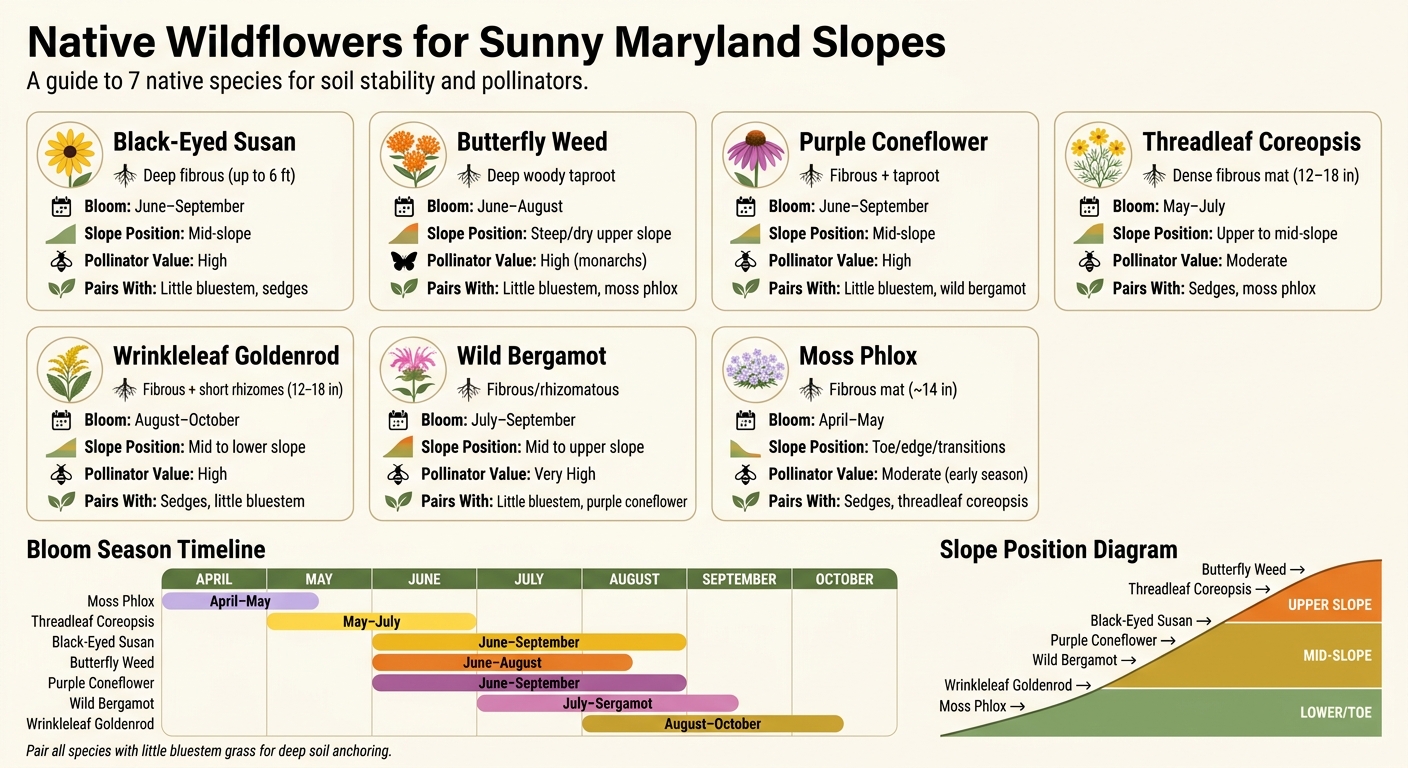
Native Wildflowers for Sunny Maryland Slopes: Plant Comparison Guide
Now that the slope grade is set and any necessary retaining walls are planned, this chart makes the shortlist a lot easier. You can scan root type, bloom timing, and slope placement in one spot.
| Plant | Root Type / Depth | Bloom Period | Pollinator Value | Best Slope Position | Suggested Pairings |
|---|---|---|---|---|---|
| Black-Eyed Susan | Deep roots; up to 6 ft in prairie conditions [25] | June–September [7][3] | High – bees, flies, beetles, moths; seeds feed goldfinches [24] | Gentle to moderate slopes | Little bluestem, sedges |
| Butterfly Weed | Deep woody taproot [26][27] | June–August [7][15] | High – monarchs, native bees [7][15] | Steep, dry upper slopes [26][27] | Little bluestem, moss phlox |
| Purple Coneflower | Fibrous root system | June–September [7][17] | High – bees, butterflies; seeds feed finches [22] | Mid-slope | Little bluestem, wild bergamot |
| Threadleaf Coreopsis | Fibrous, dense mat [10] | May–July [16] | Moderate | Upper terrace or gentle slope [10] | Sedges, moss phlox |
| Wrinkleleaf Goldenrod | Fibrous root system | August–October [14] | High – bees, butterflies, beetles [14] | Mid- to lower slope, especially where soils stay a bit moister [14] | Sedges, little bluestem |
| Wild Bergamot | Fibrous root system | July–September [20][23] | Very high – specialist and generalist bees, butterflies, moths, hummingbirds [19][23] | Mid-slope with good airflow [21][23] | Little bluestem, purple coneflower |
| Moss Phlox | Fibrous roots; minimum about 14 in deep [28] | April–May [18] | Moderate – early bees, butterflies [18] | Toe of slope, edges, transitions | Sedges, threadleaf coreopsis |
Moss Phlox is the only early spring bloomer in this group, filling the April–May gap before the summer flowers start. At the other end, Wrinkleleaf Goldenrod keeps color and nectar going into October [14]. Put those together, and you get bloom from early spring into fall.
If you need one top pick for a steep, dry upper bank, Butterfly Weed stands out. For placement across the slope, a simple layout works well: threadleaf coreopsis on upper terraces, wild bergamot through the middle, wrinkleleaf goldenrod lower on the bank, and moss phlox at the toe or along the edges.
Next, each plant profile shows where it works best on the slope and what to pair with grasses or groundcovers.
1. Black-Eyed Susan
Black-Eyed Susan (Rudbeckia hirta) is a fast-establishing native that works well on sunny slopes in Maryland.[24][34][28] University of Maryland Extension also lists it for sunny slope sites because it germinates fast.[2][40]
Root depth and soil-holding habit
Black-Eyed Susan forms a fibrous root network that helps hold topsoil in place.[36] Its thick growth can slow runoff by up to 65%.[36] It also re-seeds with little fuss, which helps keep the slope covered over time with less replanting.[35][37][43]
Once it settles in, it brings long-season color while still helping keep the slope in place.
Bloom season and height
Plants grow to 2–3 feet tall and produce flower heads that are 2–3 inches across.[30][24] In Maryland, bloom usually starts in June and runs through September. In some years, it can stretch into October, which means 8–10 weeks or more of color.[31][32][33]
Pollinator and wildlife value
The flowers draw bees, butterflies, hover flies, beetles, wasps, and moths.[38][39][41][42] Later on, the seed heads feed goldfinches and sparrows into winter.[38][39][41][42] Black-Eyed Susan is also a larval host plant for the Silvery Checkerspot butterfly (Chlosyne nycteis).[29][30]
That blend of slope cover, bloom time, and wildlife support makes it a strong choice for the middle part of a slope.
Best slope grade and companion pairings
On sunny, well-drained slopes, Black-Eyed Susan works best as a mid-slope filler. A simple setup is:
- Taller grasses or shrubs upslope
- Black-Eyed Susan through the middle
- Low groundcovers at the toe
2. Butterfly Weed
Butterfly weed (Asclepias tuberosa) is a strong fit for hot, dry, well-drained slopes in Maryland, especially sandy or rocky banks.[25]
Root depth and soil-holding habit
This plant grows a deep, woody taproot that can reach several feet into the soil.[51][46] That taproot helps hold the plant in place, stores moisture, and gives butterfly weed good drought tolerance once it’s settled in.[46][45]
But there’s an important catch: butterfly weed does not spread into a dense root mat. Unlike fibrous-rooted plants, it holds its own spot on the slope but doesn’t tie the soil surface together between clumps.[49][54] So it works best as an anchor plant, not as your only erosion-control choice.
Use it with plants that spread across open ground. Little bluestem can help cover the slope sideways, while moss phlox or low sedges can fill gaps near the toe and edges.[49][54][50][48] One more thing: plant butterfly weed where you want it to stay. Mature plants usually don’t like being moved.[52][46]
Use butterfly weed as a structural accent, not the only soil-holding plant.
Bloom season and height
Butterfly weed usually grows about 1 to 2.5 feet tall and produces clusters of bright orange flowers.[57] In Maryland, it most often blooms from June through August, and sometimes into early September.[25][47]
It can be a bit slow out of the gate. Many plants put on a better show in year two, after they’ve had time to settle in.[55][56]
Pollinator and wildlife value
Butterfly weed brings a lot of pollinator activity. It is a monarch host plant, and the flowers draw native bees, wasps, fritillary and swallowtail butterflies, and ruby-throated hummingbirds.[49][57][58] On a slope, that means steady midsummer nectar for monarchs and other native pollinators.
Best slope grade and companion pairings
Butterfly weed does best on slopes with full sun and well-drained soil, especially sites that stay dry to moderately dry.[53][47][48][13] Sandy, loamy, and rocky soils are a good match.[53][47][48][13]
Wet low spots are a bad fit. Heavy clay can also be a problem because poor drainage often leads to failure.[46][49][55][13]
Its main role in a mixed slope planting is to hold sunny, dry spots and add color in midsummer. Good plant partners include:
- Little bluestem for side-to-side soil cover
- Moss phlox or low sedges to close bare gaps at the toe and edges
- Black-eyed Susan and coreopsis to stretch bloom time and nectar flow through the season[49][54][50][48][44][25][53]
In plain terms, butterfly weed works best when you treat it like a strong focal plant and let spreading grasses and low groundcovers handle the spaces between clumps.
3. Purple Coneflower
Purple coneflower is a smart pick when a slope needs midsummer color and steady cover through the middle section. Purple coneflower (Echinacea purpurea) is a dependable mid-slope perennial for sunny, well-drained Maryland sites.
Root depth and soil-holding habit
Purple coneflower grows upright in clumps, with a strong fibrous root system and a deep taproot.[68] On dry, open banks, that root setup offers moderate soil-holding help. It works well as a filler between stronger anchor plants higher on the slope and lower groundcovers below. Plant it in drifts to get better surface cover and speed up erosion control.
Bloom season and height
Mature plants usually grow 3 to 4 feet tall, and some sources report heights up to 47 inches in good conditions.[65][66] Bloom time runs from early to late summer, often June through August.[68] That size makes it a strong fit for mid- to upper-slope planting. Leave the seed heads in place after flowering, and birds can keep using them through fall and winter.[67][69]
Pollinator and wildlife value
The flowers draw bees, butterflies, and hummingbirds. The seed heads feed birds into winter and also give the slope some structure during the colder months.[67][69]
Best slope grade and companion pairings
Purple coneflower does best on moderate, sunny slopes with well-drained soil.[63][64] Skip rich soil amendments and wet low spots, since both can weaken growth and root function. In mixed plantings, pair it with grasses that handle most of the erosion control work.
It goes well with little bluestem as the main grass layer for erosion control, plus black-eyed Susan and switchgrass for layered height and season-long interest.[59][60][61][62] Little bluestem helps bind the soil, while purple coneflower brings mid-slope color and nectar.
4. Threadleaf Coreopsis
Threadleaf coreopsis (Coreopsis verticillata) is a dense native perennial that fits sunny Maryland slopes well, especially in the middle section of a bank. It works best as mid-slope cover between stronger plants higher up and lower edging plants near the bottom.
Root depth and soil-holding habit
This rhizome-forming perennial spreads into tight colonies.[73] Its fibrous roots can reach about 12–18 inches deep in well-drained soil, with a dense layer of side roots close to the surface that helps tie the top layer of soil together.[73] That root mat can cut down on small rills and help slow runoff on moderate slopes, especially in sandy or loamy Maryland soils. For better hold, plant it with little bluestem or other deep-rooted grasses.
Bloom season and height
Plants usually grow 18–24 inches tall with about the same spread, forming light, airy mounds covered in small, bright yellow, daisy-like flowers.[70][72][73] In Maryland, bloom usually starts in late spring and runs through mid-summer, often peaking in June and July. If you deadhead or shear plants after peak bloom, you may also get some rebloom.[71][72][74]
Pollinator and wildlife value
The flowers draw native bees, hoverflies, and butterflies, including small sweat bees, mining bees, leafcutter bees, wasps, and syrphid flies.[70][71][72] It is not a specialist host plant like butterfly weed, but its long bloom period and clusters of flowers add a steady nectar source across the slope through early and mid-summer.
Best slope grade and companion pairings
It does best on gentle to moderate slopes, around 25% to 33% grade.[72][73] Space plants 12–18 inches apart so the foliage and roots fill in and knit together within one to two growing seasons. On steeper banks, threadleaf coreopsis needs help from deep-rooted grasses or other support to do its job well.
For mixed plantings, a simple setup works well:
- Pair it with little bluestem as the main grass layer for deep anchoring.
- Add low sedges like Carex pensylvanica along slope edges to help reduce undercutting.
5. Wrinkleleaf Goldenrod
Wrinkleleaf goldenrod (Solidago rugosa) keeps the planting sequence going into the lower, slightly moister part of a sunny slope. On sunny Maryland slopes, it adds late-season color and thick cover, often blooming into November.
Root depth and soil-holding habit
This plant grows in dense clumps with fibrous roots and short rhizomes that spread through the upper 12–18 inches of soil, right where slope erosion tends to hit hardest.[76] That root mat helps hold soil in place and slow runoff, even on clay soils.
Bloom season and height
Plants usually reach 3–5 feet tall, though some grow taller in richer soil. Bloom time runs from August through October, and sometimes into November, with upright clusters of yellow flowers along the upper stems.[75][79][81][82] In plain terms, it helps carry the slope from summer into fall after earlier bloomers start to fade.[80][82]
Pollinator and wildlife value
Wrinkleleaf goldenrod draws bumblebees, solitary bees, butterflies, and other beneficial insects.[76][82] That late-season nectar matters because pollinators are building reserves before winter. Its seeds also give birds forage later in the season.[78][82]
Best slope grade and companion pairings
It grows best on gentle to moderate slopes where soil stays evenly moist but still drains well between storms.[76][77] It does not do well in spots where water sits for long periods.[76][77][78] Space plants 18–24 inches apart in staggered rows so the clumps knit together into steady cover over time.[75][80]
For companion planting, pair it with little bluestem for anchoring. At the edges, add low sedges or moss phlox to help reduce undercutting.[76][80][82]
For the hotter, airier middle of the slope, the next plant fits that spot better.
6. Wild Bergamot
Wild bergamot (Monarda fistulosa) is a good fit for hot, dry mid- to upper-slope spots where you need soil held in place and want color through summer. It likes full sun and well-drained, dry, low-fertility ground, including clay and rocky soil. Think of it as a mid-slope filler, not an anchor plant.
Root depth and soil-holding habit
Wild bergamot forms a fibrous, rhizomatous root system that spreads sideways. That growth helps hold topsoil and slow surface runoff on well-drained banks. Give plants about 18–24 inches of space so the roots can knit together over time and form a soil-holding mat.[83][85][90]
Bloom season and height
Plants usually reach 2–4 feet tall and bloom from mid-June through August, often into early September in Maryland.[86][89][91] The pink to lavender tubular flower clusters bring mid-level color above shorter groundcovers. In practice, this midsummer bloom helps bridge black-eyed Susan and late-season goldenrod.[87][92]
Pollinator and wildlife value
Wild bergamot does more than fill space. Its flowers draw bees, bee flies, moths, skippers, and at times ruby-throated hummingbirds.[86][89][95] Planting it in groups of 5–7 or more tends to make the display stand out more and pull in more pollinators.[87][88][92]
Best slope grade and companion pairings
Wild bergamot does best on gentle to moderate slopes, around 25% to 33% grade, where water drains fast and the soil stays fairly dry. Put it in the middle and upper parts of the slope, and lean on deeper-rooted grasses for the steepest areas. It pairs well with little bluestem, while lower groundcovers can fill the edges.[83][86][88][90][93][94] Lower edge plantings like moss phlox can help close the toe of the slope.
One thing to watch: leave room for airflow. If plants are packed too tightly, powdery mildew can show up during humid Maryland summers.[84][86][87][91]
7. Moss Phlox
Moss phlox (Phlox subulata) is the low, spreading groundcover that finishes the toe of a sunny Maryland slope. In its natural range, it grows in rocky crevices, on slopes, in sandy spots, and in open areas with full sun across Maryland.[100][102][106]
Root depth and soil-holding habit
Moss phlox stays short at just 4 to 6 inches tall, but its root system does more work than you might expect. It has fibrous roots that reach about 14 inches deep, which helps hold topsoil in place and keeps mulch from washing downhill.[101][102][108][109][111]
Over time, it forms mats that spread 1 to 3 feet wide and fill in bare patches.[101][102][108][109][111] That’s why it works best as the front layer in a mixed slope planting.
Bloom season and height
In Maryland, moss phlox blooms from April through May, and the show usually lasts 4 to 6 weeks.[100][109] After flowering, it stays evergreen or semi-evergreen, so the slope still looks covered instead of bare.
Flower colors include:
- Rose
- Pink
- Lavender
- Purple
- White[109]
Pollinator and wildlife value
This plant offers early nectar for native bees and butterflies at a time when not many other slope flowers are in bloom.[99] That early spring timing matters.
It also tends to be left alone by deer and rabbits, which can make life a lot easier on suburban slopes where both can be a headache.[104][105][110]
Best slope grade and companion pairings
Use moss phlox on gentle to moderate slopes. If the grade is steeper than 15%, it’s better to pair it with deeper-rooted plants or some form of structural support.[107]
A simple way to use it is to plant it in drifts at the toe or front edge of the slope, with little bluestem or threadleaf coreopsis behind it and low sedges tucked between layers.[96][97][98] Think of it as the low edge that ties the whole planting together.
How to Pair These Wildflowers With Grasses and Groundcovers
On a sunny Maryland slope, wildflowers do best when you plant them in layers: deep-rooted grasses, low plants along the edges, and flowering perennials in the middle. Wildflowers on their own don’t give you root systems at enough depths to hold soil in place. When you pair them with native grasses and groundcovers, you get coverage where the slope needs it most. The goal is simple: put each plant where it can do the most work.
Use Little Bluestem as the Main Grass Layer
Little bluestem (Schizachyrium scoparium) is a solid backbone for most of the wildflowers in this list. Its fibrous roots help hold the soil, and its upright form gives the slope shape through winter. Plant it fairly densely so it knits together fast and secures the main slope face. Then bring in lower plants to close gaps and tighten up the edges.
Add Sedges and Low Groundcovers at Edges and Transitions
The first spots to wear out on a slope are usually the edges near paths, steps, walls, and terrace tops. That’s where native sedges (Carex spp.) and low groundcovers pull their weight. Compact sedges in the 8- to 12-inch range form dense, fibrous root mats that cling to shallow soil without blocking views.[113]
Moss phlox also fits well near stone and terrace tops. A practical setup is to plant these lower species in bands about 12 to 18 inches deep along path edges and hardscape transitions. From there, let the taller wildflowers and grasses take over as the slope opens up.[1][103][113] That low edge planting creates a neat transition and sets up the taller flowers behind it.
Arrange Plants by Height and Root Habit
An easy way to picture the slope is as three planting zones.
- Low spreaders like moss phlox and sedges fit best at the crest and along path edges, where they shield the most exposed soil and keep the line clean.
- Mid-height plants such as black-eyed Susan, threadleaf coreopsis, and wild bergamot work well across the main slope face.
- Taller species like wrinkleleaf goldenrod belong closer to the lower slope, while purple coneflower fits best in the mid-slope, where their roots can help slow runoff as it moves downhill.[1][112][114]
This kind of layering makes the planting feel planned instead of scattered. It also gives the slope root coverage at more than one depth. Once that framework is in place, bloom timing helps carry the planting through the year.
Plan for Bloom Succession and Year-Round Cover
When you mix these layers, the slope stays covered from spring into winter. Moss phlox brings spring color. Black-eyed Susan and butterfly weed keep the show going in summer. Goldenrod stretches bloom into fall. Little bluestem keeps its warm color well into winter, while semi-evergreen sedges and moss phlox help cover the soil when warm-season plants go dormant.[115][116]
When Slopes Need More Than Plants Alone
Even a strong native planting mix has limits. Native wildflower plantings can hold many sunny slopes in place, but they tend to fail when water moves too fast or gets funneled into one path. In those cases, the slope often needs drainage work or structural support before planting can do its job.
Signs That Planting Alone Will Not Solve the Problem
After a heavy rain, take a walk around the slope and look closely. Small rills or deeper gullies in the soil, mulch piled up at the bottom, or bare clay that seems to repel water are all warning signs. Exposed tree roots are another red flag. They usually mean soil has already washed away around them.
Trouble also starts when runoff gets pushed into narrow channels from a downspout, driveway, or a neighboring property. Once that happens, even thick plantings can keep washing out. The steepest slopes are the least stable.[12][117][118] When you see these signs, planting by itself usually won’t fix the problem. The slope needs drainage or grading work first.
Drainage and Grading Fixes That Support Planting
Each fix solves a different problem. Regrading can slow water on steep sections. French drains can move water below the surface away from the slope. Dry riverbeds can guide stormwater through a rock-lined channel. Terracing can shorten the distance water travels before it picks up speed.
If stormwater sits on your slope for more than 48 hours after a storm, that’s a clear sign the soil is not draining well enough. At that point, drainage work should come before planting.[119][120]
If erosion keeps coming back, it’s smart to bring in a professional to find the source of the water and steady the slope.
When to Call a Maryland Landscape Professional
If you’ve replanted or added mulch to the same slope more than once and the problem keeps coming back, that’s a sign you need more than another round of plants. The same goes if erosion is creeping toward a foundation, patio, or driveway.
Pro Landscapes MD works with homeowners across central Maryland. The team can inspect site drainage, plan grading changes and drainage systems, and build retaining walls, terraces, or stone steps where needed. From there, they can put together a native planting plan that fits your slope.
Conclusion
These plants work best as a layered system, not as a one-species fix. Planting a single species across a whole slope may look simple at first, but it usually doesn’t hold up for long. Mixed plantings do better because they combine different root depths with thicker soil cover.
Start with site fit first. Then think about bloom timing. Match the slope’s grade, soil drainage, and sun exposure to the plants you choose, and layer them so at least three species are blooming through the season.
After planting, early care matters just as much as the plants themselves. Keep the soil covered with 2–3 inches of shredded hardwood mulch, watch for erosion and invasive growth, and skip fertilizer on native slope plantings.
If the slope still needs grading or drainage correction, handle that before planting. On steep slopes or sites with poor drainage, fix those issues first. Pro Landscapes MD can take care of the grading, drainage, or retaining-wall work needed before planting.
FAQs
How many plants do I need per slope section?
There’s no one-size-fits-all number here. The right amount depends on each plant’s mature size, how it grows, and the conditions on your slope so you don’t crowd the space.
Pro Landscapes MD looks at those details during the design process. They place plants to allow proper coverage and healthy root development based on your slope’s grade and soil type.
What is the best time to plant a sunny slope in Maryland?
The best time to plant a sunny slope in Maryland is spring, after the last hard freeze has passed. That timing gives native wildflowers a better shot at settling in and building roots before the summer heat kicks in.
Pro Landscapes MD recommends native perennials with deep roots. They can help stabilize the soil and cope with Maryland’s dry stretches during the season.
How long does it take for a native slope planting to control erosion?
Native plants grow deep root systems that help hold soil in place and support healthier soil over time. How much erosion control you get depends on two main things: the species you plant and the conditions on your site.
As those roots grow and spread, they help steady the soil and improve water absorption. On steep or tricky slopes in Maryland, Pro Landscapes MD can help with planting plans, grading, and drainage work that supports long-term slope stability.
Chat with Us