









- bhavya gada
- No Comments
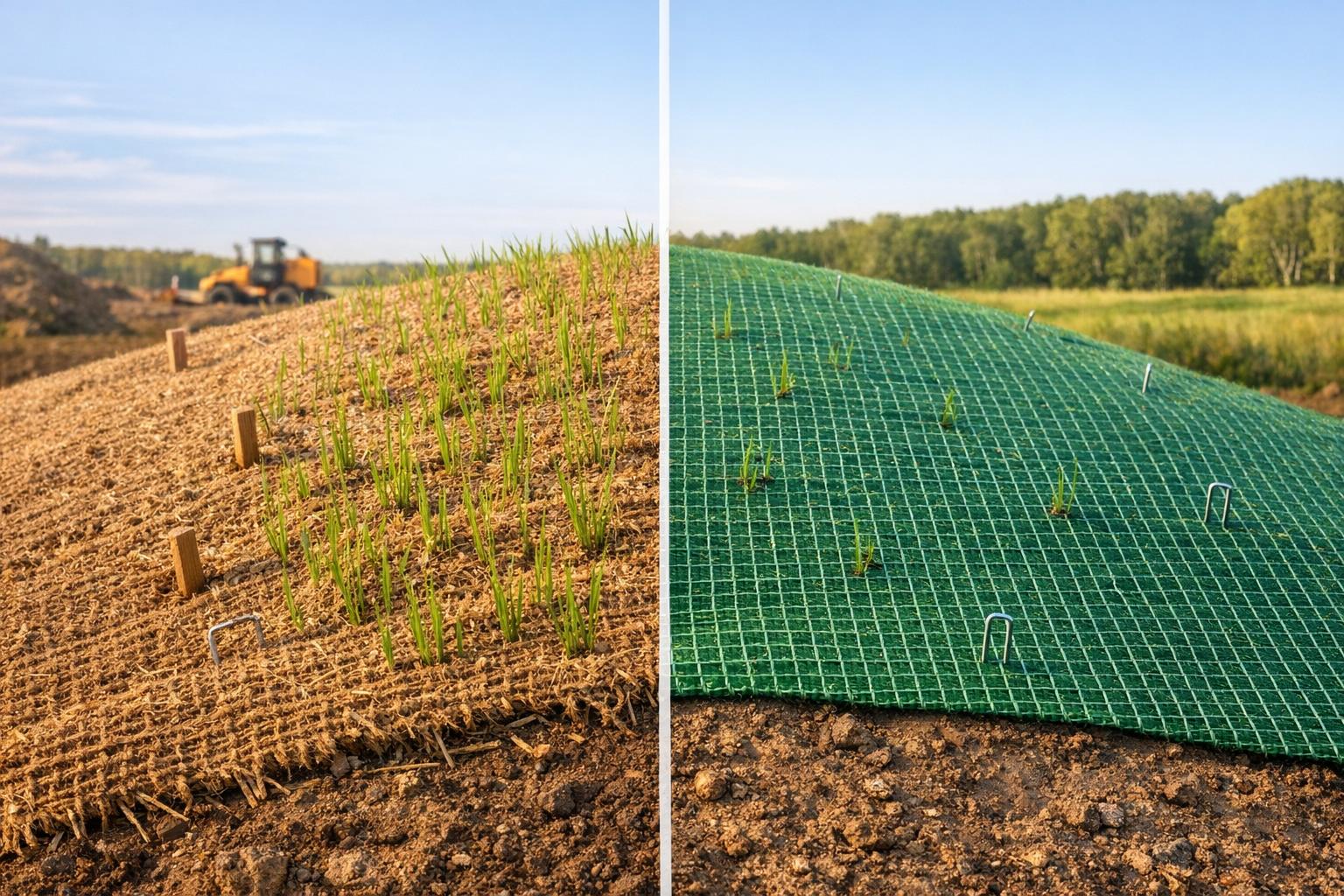
Choosing the right erosion blanket depends on your project’s needs. Natural fiber blankets like straw, coir, jute, and excelsior are biodegradable, support vegetation growth, and enrich the soil as they decompose. They are ideal for short-term use, especially near waterways or sensitive areas. Synthetic blankets, made from materials like polypropylene and nylon, offer durability, UV resistance, and long-term soil retention, making them suitable for steep slopes or permanent installations.
Key Takeaways:
- Natural Fiber Blankets: Biodegradable, cost-effective ($0.15–$0.45/sq. ft.), ideal for short-term use (6–24 months), better for germination (78%), and safer for wildlife.
- Synthetic Blankets: Long-lasting, higher upfront costs ($0.25–$0.60/sq. ft.), withstands extreme conditions, better for steep slopes and high-flow areas, but less eco-friendly.
Quick Comparison:
| Feature | Natural Fiber Blankets | Synthetic Blankets |
|---|---|---|
| Durability | 6–24 months | 3–10+ years |
| Cost | $0.15–$0.45/sq. ft. | $0.25–$0.60/sq. ft. |
| Vegetation Support | 78% germination rate | 65% germination rate |
| Slope Retention | Up to 3:1 slopes | Up to 4:1 slopes |
| Water Flow Resistance | Moderate (up to 7 fps) | High (10+ fps) |
| Eco-Friendliness | Biodegradable, enriches soil | Requires disposal |
Your choice should factor in slope, water flow, project duration, and environmental regulations. For Maryland stormwater projects, coir blankets are particularly effective in handling heavy rains and freeze-thaw cycles. Synthetic blankets excel in long-term, high-stress applications. Always match the material to your site conditions for the best results.
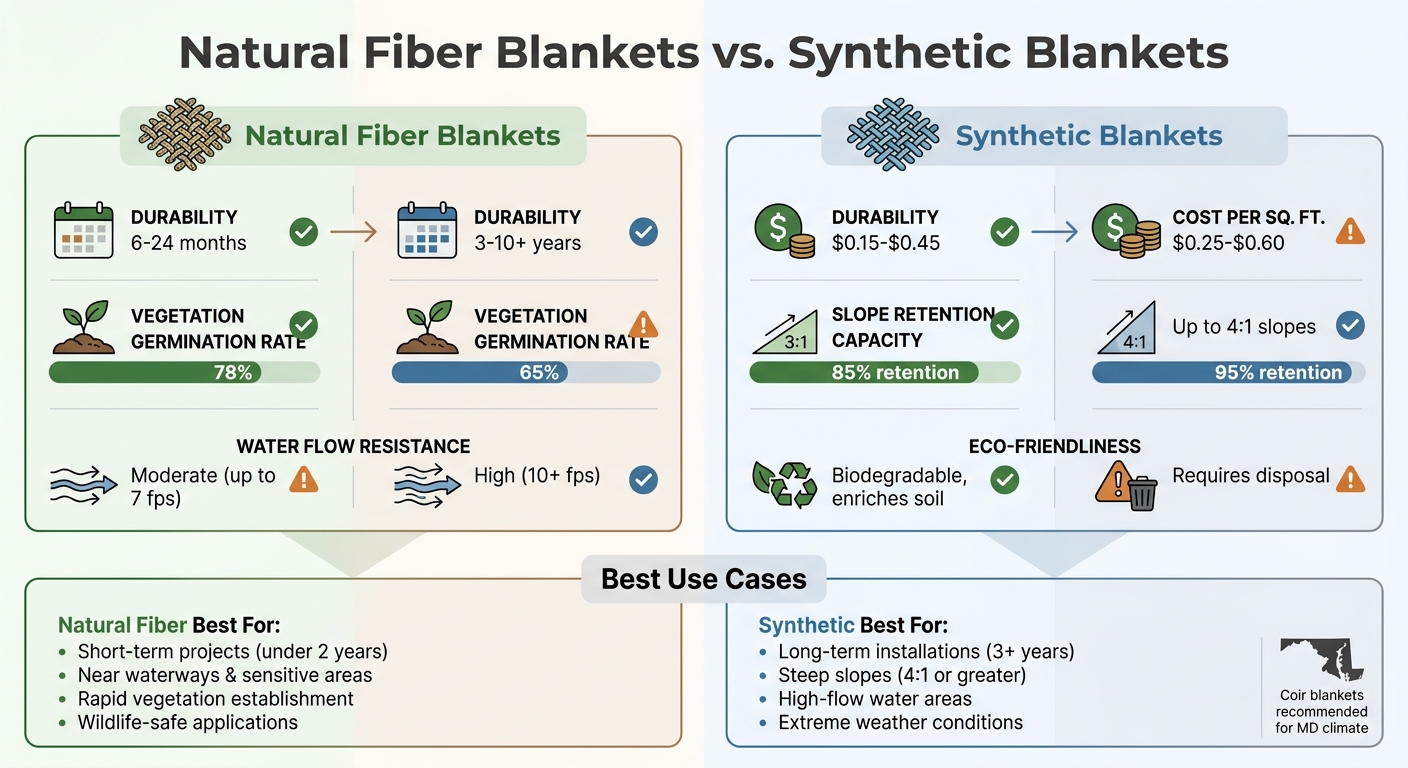
Natural Fiber vs Synthetic Erosion Blankets Comparison Chart
Comparison of Erosion Control Blanket Fibers
sbb-itb-843f8be
Natural Fiber Erosion Blanket Materials
Natural fiber erosion blankets are crafted from materials that naturally decompose over time, leaving no synthetic residue behind. The primary fibers used include straw, coir (coconut fiber), jute, and excelsior, each offering varying levels of durability and erosion control.
Straw blankets are made from 100% weed-free wheat straw and are designed for short-term use, lasting about 12 months. These blankets work best on flat slopes with low to moderate erosion and are the most budget-friendly option, with bulk pricing starting at $72.00 per roll [6][5]. For extended protection, straw/coconut blends (70% straw and 30% coconut fiber) can last up to 18 months [6].
Coir (coconut fiber) blankets are the longest-lasting natural option, with a durability range of 2 to 5 years, depending on site conditions [5][6]. Made from coconut husks, coir excels in water retention and is strong enough to handle steep 1:1 slopes and high-flow areas. For critical applications, high-strength 700-gram coir netting can last up to 4 years [6]. Prices range from $107.91 for mesh mats to $527.03 for heavy-duty varieties [5].
Jute blankets, woven from the stems of jute plants, offer a moderate lifespan of 6 to 24 months [5]. These blankets are well-suited for areas with low to moderate erosion and cost between $79.00 and $86.25 per roll [5]. Jute netting adheres to soil better than many synthetic alternatives and poses minimal risk to wildlife [6].
Excelsior blankets, composed of curled wood fibers, provide temporary stabilization for slopes while vegetation takes root. They offer moderate durability and are ideal for short-term erosion control.
All natural fiber blankets share some common benefits: they help retain soil moisture to promote seed germination, allow sunlight and water to penetrate the soil, and decompose over time, enriching the soil [5][7]. Additionally, BioNet biodegradable blankets don’t rely on direct sunlight to begin breaking down, making them effective even in shaded areas where plant growth may take longer [6].
Next, we’ll explore how synthetic materials compare in terms of performance and durability for erosion control.
Synthetic Erosion Blanket Materials
Synthetic erosion blankets serve as a durable, long-term option, especially when compared to natural fiber alternatives. These blankets are crafted from materials like polypropylene, polyester, or nylon, forming a strong mesh designed for permanent installations that demand reliable soil stabilization [3] [8] [10]. Take the P300, for example – made entirely from nylon fibers, it showcases the durability of synthetic solutions. This product works well as a ditch liner or a permanent substitute for rip-rap along shorelines, offering consistent performance even under tough conditions [3].
One of the standout features of synthetic blankets is their UV stabilization. This prevents degradation from prolonged exposure to sunlight, making them especially useful in arid or semi-arid regions [9]. Additionally, some synthetic mats are significantly stronger – up to ten times more so – than traditional turf reinforcement. This added strength allows them to withstand extreme hydraulic stresses, freeze–thaw cycles, and heavy runoff [9].
Their indefinite lifespan makes synthetic blankets a go-to choice for critical infrastructure projects. These include highway ditches, urban stormwater channels, landfill side slopes, and drainage systems – situations where long-term stability is non-negotiable [8]. However, their permanence can pose challenges in environmentally sensitive areas. Local regulations may require biodegradable materials, especially near waterways, so it’s crucial to ensure compliance before installation [1].
Synthetic blankets are particularly effective in locations that demand continuous root reinforcement and resistance to environmental stresses. They excel on steep or permanently exposed sites where natural fiber options would degrade too quickly [3] [8] [10].
Durability and Lifespan
When evaluating erosion control materials, understanding their durability is crucial for assessing both performance and long-term costs. Natural fiber blankets, for instance, degrade over time due to exposure to moisture and microbial activity. Among these, straw blankets break down the quickest, lasting only 45 to 90 days. This makes them ideal for areas with gentle slopes where vegetation can establish rapidly , unlike steeper grades that may require retaining walls [3][8]. On the other hand, excelsior blankets (made from curled wood fibers) hold up longer, maintaining their structure for 12 to 18 months [8]. If you’re looking for a natural option with extended durability, coconut (coir) blankets are a standout choice, with a lifespan ranging from 3 to 8 years depending on the product and environmental conditions [3][8].
Synthetic blankets, however, offer a completely different durability profile. Made from materials like polypropylene or nylon, they do not biodegrade, giving them an essentially indefinite lifespan [8]. For example, high-density polypropylene blankets retain 85% of their structural integrity even after 24 months of direct sunlight exposure. By comparison, natural fibers lose about 60% of their strength within just six months [11].
Temperature resilience is another key factor. Synthetic blankets can handle extreme temperature fluctuations, from -20°F to 180°F, without losing structural integrity [11]. Natural fibers like coir are better at withstanding freeze-thaw cycles compared to straw, but they eventually degrade under repeated exposure to environmental stress [8]. Additionally, in high-flow water conditions, synthetic blankets outperform biodegradable options, offering 40% better hydraulic performance [11].
Durability Metrics Comparison
| Material Type | Expected Lifespan | UV Resistance | Slope Retention | Temperature Range |
|---|---|---|---|---|
| Straw | 45–90 days [3][8] | Low (Photodegradable) | 85% on 3:1 slopes [11] | Limited |
| Excelsior (Wood) | 12–18 months [8] | Moderate | 85% on 3:1 slopes [11] | Moderate |
| Straw-Coir Blend | 12–24 months [8][11] | Moderate | 85% on 3:1 slopes [11] | Moderate |
| Coconut (Coir) | 3–8 years [3][8] | High (for natural fibers) | 85% on 3:1 slopes [11] | Good freeze-thaw resistance |
| Synthetic | Indefinite [8] | Very High (85% integrity at 24 months) [11] | 95% on 4:1 slopes [11] | -20°F to 180°F [11] |
These metrics highlight the strengths and limitations of each material, offering a clear picture of their performance in erosion control scenarios.
Synthetic blankets may seem pricier upfront but often save money in the long run. While they cost about 30% to 50% more initially – ranging from $0.25 to $0.60 per square foot compared to $0.15 to $0.45 for biodegradable options – they eliminate the need for frequent replacements [11]. For projects requiring protection beyond two years, the higher initial cost of synthetic blankets can translate into greater overall savings.
Performance in Erosion Control and Vegetation Support
The effectiveness of erosion blankets depends on their ability to retain soil and support vegetation growth. Natural fiber blankets show a germination rate of 78% compared to 65% for synthetic options [11]. This is largely because natural materials like straw, excelsior, and coir protect the soil from the impact of rainfall while maintaining moisture in the seed zone. As these materials decompose, they enrich the soil with organic matter, creating a fertile base for root development. These attributes highlight the differences in performance, especially on challenging terrains.
Synthetic blankets, however, outperform on steep slopes and in high-flow areas. They retain up to 95% of soil on 4:1 slopes, whereas natural blankets manage 85% on 3:1 slopes (see table) [11]. In areas with fast-moving water, like channels and ditches, synthetic materials provide 40% better hydraulic performance and experience 60% less displacement during intense rainfall [11]. While natural fiber blankets, such as those made from wood excelsior, can handle water flow velocities up to 5 feet per second, heavy-duty synthetic blankets can withstand 10 feet per second or more [3].
"Coconut fiber adds strength and durability to the blankets ability to withstand heavy runoff while retaining soil particles." – Landscape Architect and Specifier News [3]
Choosing between natural and synthetic depends on the project’s specific needs. Natural fiber blankets are ideal for rapid vegetation establishment, particularly near sensitive waterways (within 50 feet) or for projects aiming for LEED certification. On the other hand, synthetic blankets are better suited for long-term stabilization projects lasting over two years, areas with high chemical runoff (like those exposed to petroleum or fertilizers), or extreme slopes where replacement costs are a concern [11]. The decision ultimately comes down to matching the blanket type to the project’s duration and environmental conditions.
Advantages and Disadvantages
Here’s a comparison of the performance metrics for natural and synthetic blankets:
| Feature | Natural Fiber Blankets | Synthetic Blankets |
|---|---|---|
| Vegetation Success | High (78% germination rate) [11] | Moderate (65% germination rate) [11] |
| Best Slope Gradient | Up to 3:1 [11] | 4:1 and steeper [11] |
| Water Flow Resistance | Moderate (up to 5–7 fps) [3] | High (up to 10+ fps) [3] |
| Soil Retention | 85% on 3:1 slopes [11] | 95% on 4:1 slopes [11] |
| Environmental Impact | Positive – enriches soil | Negative – disposal required |
| Wildlife Safety | High (loose weave allows escape) [2] | Low (entanglement risk with plastic netting) [2] |
| Functional Longevity | 6–24 months [11] | 3–10 years [11] |
| Maintenance Needs | Higher (frequent anchor replacements) [11] | Lower (stable system) [11] |
Cost, Installation, and Project Suitability
Synthetic erosion control blankets generally cost 30–50% more upfront compared to natural fiber options. Natural fiber materials are priced between $0.15 and $0.45 per square foot, while synthetic options range from $0.25 to $0.60 per square foot. For a 1,000-square-foot slope, material costs would be about $150–$450 for natural fibers versus $250–$600 for synthetics[11].
If you’re hiring professionals, installation costs add $0.75–$1.50 per square foot. However, going the DIY route could lower labor costs to around $0.25–$0.50 per square foot[11].
When deciding which blanket to use, it’s important to consider the scope and duration of your project. For short-term projects (up to 90 days) on gentle slopes, straw blankets are often the most economical option[8]. On moderate to steep slopes, coir or straw-coconut blends can provide stabilization for up to 24 months[8]. Synthetic blankets, on the other hand, are ideal for long-term projects requiring 3–10 years of protection or for very steep slopes (greater than a 3:1 gradient), where replacing natural fiber options frequently would drive up costs[8][11]. In Maryland’s climate, coir blankets are particularly effective in withstanding heavy rains and freeze-thaw cycles[4][8].
Maintenance also plays a role in cost considerations. Natural fiber blankets often need more frequent anchor replacements, while synthetic systems are generally more stable and require fewer repairs over time[11]. Additionally, for projects near sensitive areas like Maryland waterways or the Chesapeake Bay, environmental regulations may require the use of biodegradable natural fiber blankets, making them the only feasible choice[8].
For those navigating these decisions, expert advice on selecting and installing the right erosion control blanket for Maryland-specific projects is available from Pro Landscapes MD.
Maryland Stormwater Project Guidelines
Maryland’s diverse landscape – from the sandy plains of the Eastern Shore to the clay-heavy hills of central counties – demands thoughtful material selection for stormwater projects. Heavy spring rains and frequent storms make it essential to choose materials that stay in place until vegetation takes hold. These conditions call for tailored solutions that address the state’s unique geographical needs.
Along the Chesapeake Bay and other coastal areas, regulations emphasize the use of biodegradable options like coir and straw blankets to minimize pollution risks. These materials are not only eco-friendly but also effective in stabilizing soil in these sensitive regions.
For different terrains, material selection should match the slope and soil type:
- Gentle hills: Wheat straw blankets work well here, offering sufficient erosion control.
- Severe runoff areas with sandy soils: Straw-coconut blends or wood excelsior blankets are ideal. Wood excelsior, in particular, can handle water flow velocities of up to 7 feet per second, making it a strong choice for sandy coastal areas.
Urban environments bring their own challenges. In stormwater channels and drainage systems, woven coir mats outperform non-woven options due to their durability and thickness. These mats, made from retted fibers submerged for 8–10 months to remove impurities, decompose over 4–8 years, enriching the soil as they break down. For shoreline and beach restoration projects, coir blankets provide effective soil stabilization while maintaining an eco-conscious approach.
For those seeking local expertise, Pro Landscapes MD offers customized stormwater management solutions across central Maryland. Their services include grading, land leveling, and stormwater systems designed to tackle the state’s climate and terrain challenges, ensuring compliance with local regulations and long-term performance.
Choosing the Right Erosion Blanket
When working on stormwater projects in Maryland, selecting the right erosion blanket is all about understanding your site’s specific needs. Factors like slope steepness, water flow, soil type, and project duration play a big role in making the right choice. For example, gentle slopes with moderate runoff can often rely on wheat straw blankets as a cost-effective option. On the other hand, steeper slopes or areas with heavy water flow may require something tougher, like straw-coconut blends or pure coir mats. These natural fiber options vary in durability, so picking the right material for your timeline is key.
Soil type is another major factor to consider. For sandy soils, like those found in Maryland’s coastal regions, wood excelsior blankets are a great choice. They’re specifically designed to handle high water velocities while keeping the soil in place.
If you’re working near waterways or wildlife habitats, environmental sensitivity is crucial. The U.S. Fish & Wildlife Service suggests using 100% biodegradable natural fiber blankets with a loose-weave design. These not only minimize environmental impact but also allow wildlife to move freely while helping vegetation grow faster.
For permanent installations, such as drainage channels or very steep slopes, synthetic polypropylene blankets are the way to go. They offer excellent soil retention and are built to last, even under harsh conditions like extreme temperatures and UV exposure.
If you’re unsure about which erosion blanket to choose, Pro Landscapes MD can help. They provide tailored erosion control solutions across central Maryland, offering expertise in stormwater management, grading, and land leveling. By considering your specific soil conditions, regulatory requirements, and performance goals, they ensure your project is set up for long-term success.
FAQs
How do I choose the right erosion blanket for my slope?
To choose the best erosion blanket, you’ll need to weigh several factors like slope grade, runoff levels, soil conditions, and surrounding environmental elements. For steep slopes (greater than 3:1), synthetic blankets are a solid choice because they’re built to last and handle tough conditions. On the other hand, natural fiber blankets, such as those made from straw or coconut fiber, are a good fit for areas with moderate runoff and where biodegradability is a priority.
Don’t forget to factor in costs, the potential environmental impact, and – most importantly – proper installation. A poorly installed blanket can lead to erosion underneath, defeating its purpose entirely.
Which erosion blanket is best near streams or wetlands?
Natural fiber erosion blankets, such as those made from coir or jute, are an excellent choice for areas near streams or wetlands. These materials are completely biodegradable and safe for wildlife, minimizing the chances of animals getting entangled. While synthetic blankets can help stabilize soil, they often include plastic netting, which can be hazardous to wildlife. To strike a balance between erosion control and ecosystem protection, go for natural, loose-weave designs that are both effective and environmentally considerate.
Do erosion blankets need to be removed after installation?
Erosion blankets usually don’t need to be taken out after they’ve been installed. Those made from natural fibers are often biodegradable, meaning they’ll break down naturally over time. On the other hand, synthetic blankets designed for short-term use might need to be removed and properly disposed of once their job is done.
Chat with Us