









- bhavya gada
- No Comments
If you want a hot tub surround that lasts longer and needs less work, natural stone is one of the strongest picks. Based on the article, stone often lasts 25–30 years, while concrete is often replaced in 10–15 years. It also stays cooler underfoot, can offer better grip when finished the right way, and can often be reused later instead of hauled off as waste.
Here’s the short version in plain English:
- Long life: natural stone can last 25–30 years
- Lower upkeep: basic cleaning plus sealing every 3–5 years
- Better for wet areas: textured finishes can improve traction
- More barefoot comfort: travertine can stay around 95–105°F in sun, while concrete pavers can reach 135–145°F
- Good fit for Maryland: it handles moisture and freeze-thaw conditions better than many other options when installed the right way
- Less replacement waste: longer life means fewer tear-outs over time
- Can be reused: stone can often be lifted, cut, and used again
If I compare the main surround choices, natural stone stands out for service life, maintenance, comfort, and reuse.
Quick Comparison
| Material | Typical Life | Upkeep | Wet-Area Use | Reuse |
|---|---|---|---|---|
| Natural stone | 25–30 years | Low | Good with proper finish | High |
| Concrete pavers | 10–15 years | Medium | Fair | Low |
| Porcelain / sintered | 7–15 years | Low to medium | Varies | Very low |
| Wood decks | 10–15 years | High | Lower in constant moisture | Medium |
So if I boil the article down to one point, it’s this: for a hot tub surround in Maryland, natural stone is a long-lasting, low-upkeep choice when the base, drainage, thickness, and finish are done right.
Environmental Benefits of Natural Stone
Low Processing and Reduced Life-Cycle Burden
Natural stone skips kiln firing, cement curing, and synthetic binders. Most of its energy use happens during extraction, cutting, and finishing [7][8].
That lighter processing load matters in life-cycle assessments. As the source puts it, "Sustainability is built into the material: how it is formed, how long it lasts, and how well it performs over time."
Stone is also nonreactive. It doesn’t release volatile organic compounds (VOCs) or leach harmful chemicals into nearby soil or groundwater [4][2]. For a wet, barefoot surface, that matters more than it might seem at first glance.
And the upside doesn’t stop at production. If the stone is removed later, it can still keep much of its material worth through reuse.
Reuse and Recyclability in Outdoor Hardscaping
Natural stone can be lifted, refinished, resized, and reused. That supports design for disassembly and helps keep the material useful after removal [7].
In plain terms, stone doesn’t have to become waste just because a layout changes. A patio, pool deck, or path can be taken apart and the same material can often be used again in another spot.
Long Service Life Reduces Replacement Waste
A long service life means fewer replacement cycles over the span of a project.
That leads to less demolition waste, less hauling, and fewer manufacturing runs. Sourcing from regional quarries can also reduce transport emissions [1].
Taken together, these traits can lower both upfront and long-term environmental costs.
sbb-itb-843f8be
Installing Natural Stone SPA | Swim Pond Build Part 3
Longevity and Spa-Area Performance
A long service life is the main reason natural stone can cut its footprint in day-to-day spa use. That matters most when the material also holds up well under wet conditions, foot traffic, and constant exposure to the elements.
Durability in Wet and High-Use Conditions
Natural stone holds up well in wet, busy spa settings. It resists rot, warping, and insect damage, which makes it a strong fit for areas around hot tubs, pools, and spa decks.
According to a 2023 study by the Commercial Pool Association, natural stone pool and spa decks usually last 25–30 years with proper care. Concrete, by comparison, often needs replacement after 10–15 years [1].
That gap becomes even more important in places like Maryland, where freeze-thaw cycles can be rough on hardscape materials. When the stone is chosen well and installed the right way, it resists cracking better than concrete in that climate [9][5].
Slip Resistance, Temperature Response, and Barefoot Comfort
In a spa area, surface feel is not just a nice extra. It affects safety and comfort every single day.
Textured and tumbled stone finishes give better traction on wet surfaces, which is a big deal around any hot tub surround. Slip resistance depends on the finish and stone type:
- Granite reaches a Coefficient of Friction (COF) of 0.60 or higher
- Slate reaches 0.50+
- Travertine comes in at 0.42+
All three are suitable for wet use when properly finished [1].
Heat is another factor people notice fast, especially barefoot in summer. In direct sun, travertine usually stays around 95–105°F, while concrete pavers can hit 135–145°F [3]. Light-colored stones such as travertine can also reflect up to 35% more sunlight than concrete, which helps limit heat buildup around the spa area [1]. That cooler surface can make a big difference when people are moving between the spa, deck, and seating area.
Low Maintenance as a Long-Term Advantage
Natural stone does not need a long care routine. In most cases, regular upkeep comes down to sweeping, rinsing, and using pH-neutral cleaners [6][5]. Pressure washing with too much force should be avoided because it can wear down mortar joints over time [5].
Sealing helps protect the surface from moisture and spa chemicals. A professional sealer every 3–5 years is usually enough to help protect and preserve the stone [1].
There is also a cost angle here. Yearly maintenance costs for natural stone are about 30% lower than those for concrete [1].
Stone choice matters too, especially in spots that take more abuse. For areas near steps and entry points, harder stones like granite handle repeated wear better. Softer stone like travertine works well in lower-traffic areas where underfoot comfort matters more [1].
These differences stand out most when natural stone is set next to other surround materials.
Natural Stone vs. Other Surround Materials: A Short Comparison
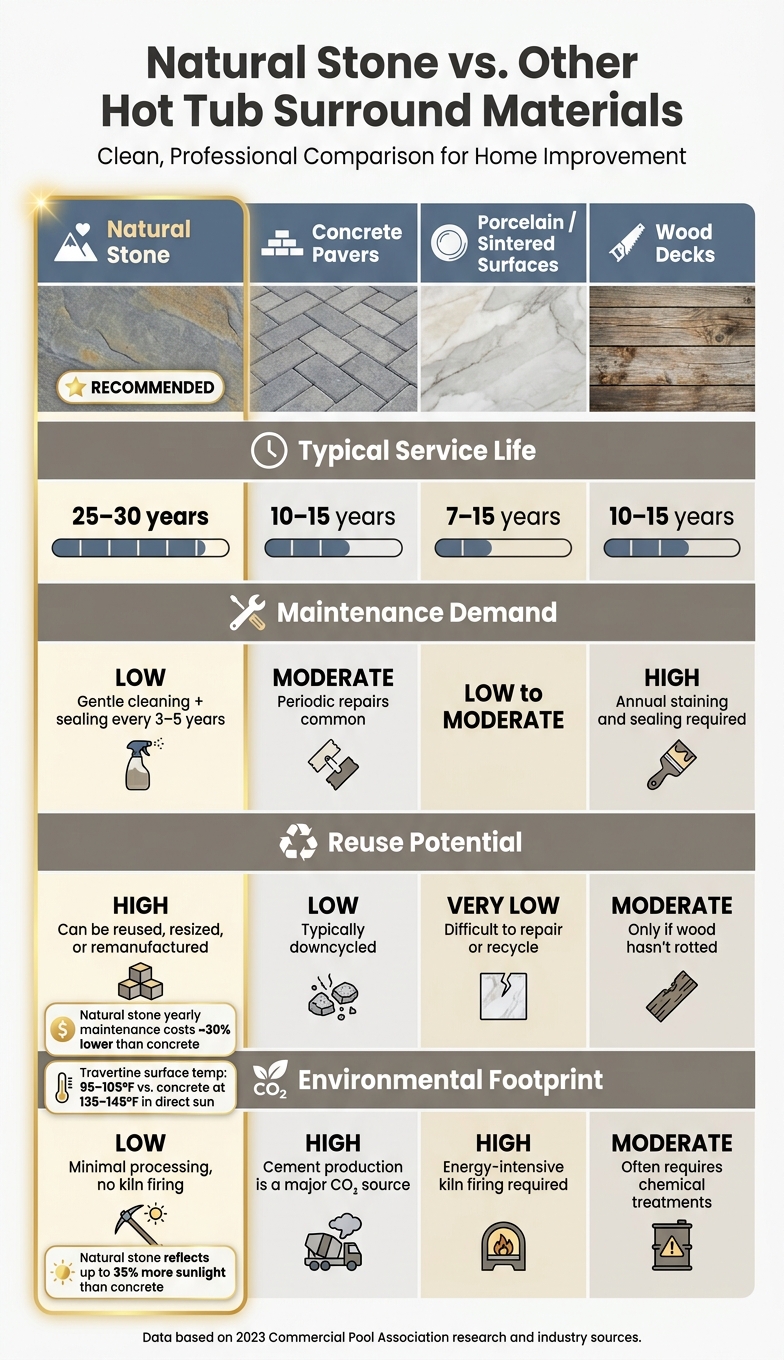
Natural Stone vs. Other Hot Tub Surround Materials: Full Comparison
When you line up natural stone against other surround materials, the gap gets pretty clear. In a hot tub area, the stuff that matters most is simple: how long it lasts, how much work it needs, whether it can be reused, and what it takes to make it in the first place.
The table below puts natural stone next to other common surround materials based on the factors that matter most in a spa area.
| Material | Typical Service Life | Maintenance Demand | Reuse Potential | Environmental Footprint |
|---|---|---|---|---|
| Natural Stone | 25–30 years in commercial settings; can last generations with proper care [1][8] | Low – gentle cleaning and sealing every 3–5 years [1] | High – can be reused, resized, or remanufactured without major performance loss [7] | Low – minimal processing [7] |
| Concrete Pavers | 10–15 years [1] | Moderate – periodic repairs are common [1] | Low – typically downcycled at end of life [7] | High – cement production is a major CO₂ source [7] |
| Porcelain or sintered surfaces | 7–15 years, depending on climate [7][1] | Low to moderate – depends on the material and binders [7] | Very low – difficult to repair or recycle [7] | High – requires energy-intensive kiln firing [7] |
| Wood Decks | 10–15 years [6] | High – annual staining and sealing needed [6] | Moderate – only if the wood hasn’t rotted | Moderate – often requires chemical treatments [6] |
In Maryland, these gaps tend to show up faster. Moisture and freeze-thaw cycles can wear down weaker materials, which is one reason natural stone often holds up better over time.
Maryland Applications and Conclusion
Why Natural Stone Works Well in Maryland’s Climate
In Maryland, outdoor materials take a beating. Freeze-thaw cycles, sticky summer air, and heavy rain can wear surfaces down fast. That’s why material choice matters so much around a hot tub.
Natural stone handles these seasonal swings better than many other options, especially when compared with concrete and wood [5][9]. It’s less likely to crack, warp, or hold moisture in the same way those materials can. And there’s a comfort angle too: light-colored stones like travertine can stay up to 30% cooler than concrete in direct sun [1]. If you’re walking barefoot near the tub in July, that difference is hard to ignore.
Installation Details That Support Long-Term Performance
Even the right material can fail if the setup underneath is poor. The base, drainage, and surface finish all play a big part in how well the surround holds up over time.
A few specs matter here:
- Use at least 4 inches of crushed stone or gravel for drainage [6].
- Use pavers that are at least 2 inches thick to handle weight and foot traffic [6].
The surface should also slope away from the tub so water doesn’t pool near the foundation. In Maryland, where heavy rain is common, that’s not a small detail [6]. Near the water’s edge, textured finishes like cleft slate give better grip underfoot [1]. And if the stone comes from nearby sources, transport emissions can be lower [1].
With the right install, natural stone is set up to deliver the long-term performance shown in the research.
Conclusion: Key Takeaways on Natural Stone for Hot Tub Surrounds
For Maryland homeowners picking a hot tub surround, the research lands in one place: natural stone lasts longer, needs less upkeep over time, and deals with local weather better than the main alternatives – as long as the base, drainage, and stone choice are handled properly.
FAQs
Which natural stone is best for a hot tub surround?
Granite, slate, and river rock are strong picks for a hot tub surround. They hold up well, give you better grip, and fit a clean, modern style.
Slate stands out because its natural texture helps with traction. Granite is often picked for its strength.
If foot comfort is your top concern, travertine is a smart choice. In direct sun, it usually stays around 95°F to 105°F.
No matter which material you go with, make sure it sits on a stable base. A layer of at least 4 inches of crushed stone helps with drainage and gives the surround solid support.
How do I know if my hot tub surround is installed correctly?
Check that the surround sits on a stable, safe base with at least 4 inches of crushed stone or gravel underneath for drainage. If you’re using pavers, they should be at least 2 inches thick so they can hold up over time.
The area should also drain well to help stop standing water and erosion. Look for a clean finish with no loose stones or sharp edges, and make sure sealants have been applied to help guard against moisture and chemical exposure.
Is natural stone worth the higher upfront cost?
Yes. Natural stone usually costs more upfront than options like concrete pavers. But in many cases, it’s worth it for the long-term value and lifespan. It often lasts 50+ years.
It also holds up well over time. Natural stone resists cracking, needs little upkeep, and can help balance out the higher starting cost. Pro Landscapes MD offers professional natural stone installation to help create a lasting investment for your property.
Chat with Us