









- bhavya gada
- No Comments
If you want better drainage, grass joints usually win. If you want a flatter, steadier surface with less yard work, solid joints are often the better choice.
I’d sum it up like this:
- Grass joints fit low-traffic areas, softer landscape style, and spots where runoff matters.
- Solid joints fit dining areas, front entries, and spaces that need a firm, even surface.
- In Central Maryland, freeze-thaw weather, clay soil, shade, and slope can make one option work much better than the other.
- Grass-joint systems can let water soak in and may help manage as much as 24,000 gallons of rain per year per 1,000 sq. ft.
- Cool-season grass often fills in within 3 to 6 months, while Zoysia may take 4 to 9 months and turns brown in winter.
- Tree roots within about 6.5 feet of a trunk can shift stone over time.
The short answer: if your main goal is drainage and a softer look, grass joints make sense. If your main goal is stability, easier upkeep, and better support for furniture, solid joints are usually the safer pick.
How to Grow Grass Between Flagstones
sbb-itb-843f8be
Quick Comparison
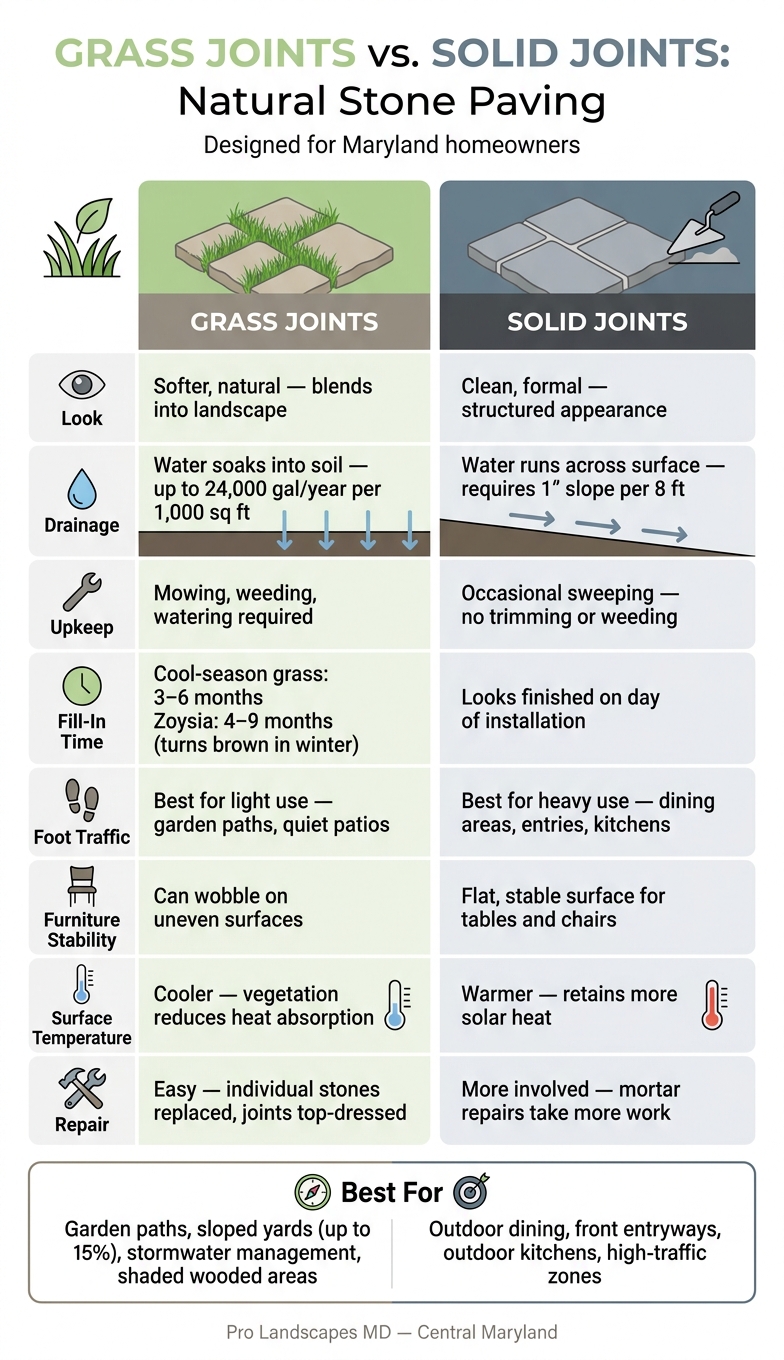
Grass Joints vs. Solid Joints: Natural Stone Paving Comparison
| Category | Grass Joints | Solid Joints |
|---|---|---|
| Look | Softer, more natural | Cleaner, more formal |
| Drainage | Water soaks into soil | Water runs across surface |
| Upkeep | Mowing, weeding, watering | Less day-to-day work |
| Foot traffic | Better for light use | Better for heavy use |
| Furniture | Can wobble on uneven areas | More stable for tables and chairs |
| Heat | Cooler surface | Warmer surface |
| Best spots | Garden paths, quiet patios | Outdoor dining, entries, kitchens |
I’d use grass joints only where the site can support plant growth and where a little movement in the surface is acceptable. For busy spaces, shaded trouble spots, or places where you want a level finish from day one, solid joints are often the better fit.
That’s the main tradeoff this article covers: drainage and softer appearance vs. stability and lower upkeep.
1. Natural Stone Paving with Grass Joints
Appearance
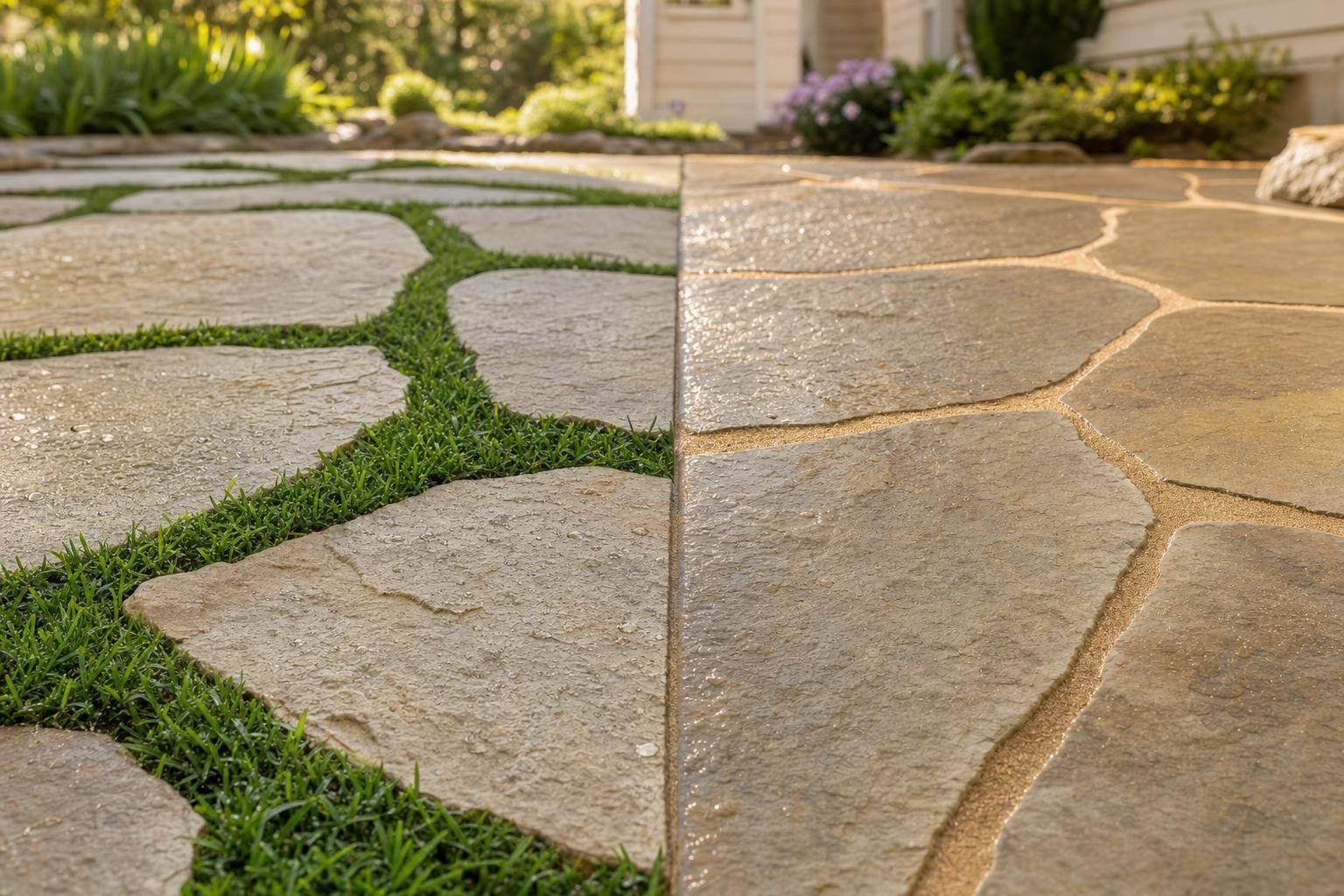
Grass joints can make heavy stone feel less harsh. The green strips between the stones add a softer, more natural look [1]. Instead of feeling separate from the rest of the yard, a patio or path tends to blend in.
In Maryland, that plant choice matters. Zoysia turns brown in winter, so creeping thyme or dwarf mondo grass can be a better pick if you want color through the colder months [7][10].
Drainage
One big plus is drainage. Grass joints let rain soak into the soil, which helps cut down on pooling, erosion, and surface runoff [1][5].
Maintenance
This look comes with lawn-type upkeep. You’ll need to mow, water, weed, and use light fertilizer as needed [3][11]. The first growing season usually takes the most work. After that, some joints may settle and need a bit of topping up [2][4][8].
Site Fit
Grass-joint paving fits best in low-traffic spaces like garden paths and courtyards [3]. It’s not a great match for steep slopes or busy areas, since wet grass can get slippery and wear down fast [8].
For Maryland sites, Tall Fescue works well in mixed sun and shade, while Fine Fescue is better for shadier spots [6].
Solid joints offer a different balance of stability, upkeep, and appearance.
2. Natural Stone Paving with Solid Joints
Appearance
Natural stone paving with solid joints puts structure first. Compared with grass-joint paving, it gives a space a sharper, more formal look. The lines between stones stay clean and even, which makes this style a strong fit for modern patios and more polished outdoor spaces.
Drainage
That cleaner look comes with a tradeoff: less permeability. Solid joints reduce infiltration, so rain moves across the surface instead of soaking through [3]. To keep that runoff moving away from the house, the surface should slope at least 1 inch for every 8 feet [4]. That grading has to be planned from the start, not added as an afterthought.
Maintenance
On the upkeep side, solid joints are simpler day to day. There’s no mowing, weeding, or watering between the stones [3]. But mortar can crack over time, and when that happens, repairs usually take more work than basic grass-joint upkeep [3].
Site Fit
Solid joints are often the better call for high-traffic areas, outdoor kitchens, and dining patios. They hold up well under heavy furniture and frequent use [3]. They also make sense for wooded Maryland properties, where seeds and debris can clog grass joints [4][9]. And this choice affects more than the surface look. It also changes the base system, especially when mortar is part of the build.
Pros and Cons by Performance Category
Here are the main tradeoffs for Maryland homes.
The easiest way to decide is to look at each category side by side.
| Performance Category | Grass-Joint Paving | Solid-Joint Paving |
|---|---|---|
| Appearance | Soft, natural look that blends into the landscape; cool-season grasses take 3–6 months to fill in | Looks finished the day installation is complete |
| Drainage | High permeability; can capture up to 24,000 gallons per year per 1,000 sq ft – a clear edge in Maryland [9] | Low-permeability; requires precise grading to move runoff away from the house |
| Maintenance | Mowing, weeding, watering, and fertilizing required; heaviest in the first growing season | Occasional sweeping; no trimming or weeding |
| Site Fit | Best for garden paths, low-traffic areas, and light-use drives | Best for dining patios, outdoor kitchens, and high-traffic zones |
| Surface Temperature | Cooler; vegetation reduces heat absorption | Warmer; retains more solar heat |
| Stone Stability | Stones may shift if grass dies back or thins | Helps keep stones from shifting |
| Furniture Placement | Can be uneven; chairs and tables may wobble | Flat, stable surface for outdoor furniture |
| Eco-Impact | Supports groundwater recharge | Increases hard surface area |
| Repair Complexity | Individual stones can be replaced; joints can be top-dressed or replanted | Mortar repairs are more involved |
The split comes down to this: grass joints help with drainage and give a softer feel, while solid joints give you a steadier surface with less upkeep.
That difference leads to two very different use cases, which the next section breaks down for Maryland homes.
Where Each Option Works Best for Maryland Homes
In Maryland, site conditions matter more than looks alone. The main issue is simple: which surface stays steady, drains well, and matches how you’ll use the space.
Grass-joint stone is usually the better pick for garden paths, secondary walkways, and quiet patio areas. It can also work on gently sloped backyards up to 15% grade[4]. But there’s a catch. If the groundcover dies off, the joints lose both function and support. For spaces with heavier foot traffic or where you need a flatter, more even surface, solid joints make more sense.
For central Maryland, cool-season grasses are the practical default. They fill in faster and handle winter better. Cool-season grasses usually establish in 3–6 months, while warm-season options like Zoysia take 4–9 months and turn dormant and brown in winter[4]. In most central Maryland settings, a cool-season mix is the safer call.
So this isn’t just a design choice. It’s a site choice.
| Condition | Grass-Joint Stone | Solid-Joint Stone |
|---|---|---|
| Garden or meandering path | ✓ Best fit | Poor fit |
| Sloped backyard (up to 15%) | ✓ Best fit | Poor fit without drainage |
| Outdoor dining or kitchen | Poor fit | ✓ Best fit |
| High-traffic front entryway | Poor fit | ✓ Best fit |
| Shaded wooded area | ✓ Best fit | Prone to moss buildup |
| Stormwater management priority | ✓ Best fit | Requires grading/drains |
Getting the site review right before installation matters more than most homeowners think. Maryland’s heavy clay soils can slow drainage, and tree roots within 2 meters of a trunk can lift and shift stones over time[4].
Conclusion
After you look at appearance, drainage, and upkeep, both options can work. The better pick depends on the site and how the space will be used.
Grass-joint stone works best in low-traffic areas where drainage matters and you want a more natural look. Solid-joint stone makes more sense when you need a stable, level surface and want less upkeep.
The choice should come down to a few site factors: drainage, traffic, sunlight, maintenance tolerance, and style.
Sunlight is the big one. It often decides which option will hold up well. Grass joints need sun and regular care. In shady spots, they often turn thin and patchy.
For Maryland homeowners, the best place to start is with the site itself: soil, slope, shade, and how much upkeep you’re willing to take on. Once you start there, the choice gets much simpler. Pro Landscapes MD can evaluate your site across central Maryland before you choose a paving system.
FAQs
Which option lasts longer?
Permeable pavers usually last longer than grass pavers. According to Pro Landscapes MD, permeable pavers can last 20 to 30 years.
Grass pavers are less durable because the turf wears down over time. They also need more upkeep, including trimming, weeding, and, in some cases, replanting. On top of that, root growth can loosen the stones as the years go by.
Can grass joints work in partial shade?
Yes. Grass joints can work in partial shade if you pick plants that fit the light in that spot.
A lot of installations do best in full sun. But shade-tolerant groundcovers, like moss and other hardy plants, can still give you that lush look. The main thing is matching the plant choice to the area’s light, moisture, and foot traffic.
How do I choose the right joint for my yard?
Choose based on the look you want, how you’ll use the space, and how much upkeep you’re willing to deal with.
Mortar joints fit a clean, structured design and don’t ask for much day-to-day care. But they need proper planning and pro installation from the start.
If you want something softer and more natural, greenery between stones can add charm and help with drainage. The trade-off? You’ll need to stay on top of weeding and trimming.
Loose aggregate is a good fit for a more relaxed, flexible style. It’s also easier to adjust later if your layout changes.
Chat with Us