









- bhavya gada
- No Comments
Maryland is leading a shift in stormwater management, focusing on nature-based solutions like grass swales and soil decompaction. These methods manage water at its source, reducing runoff and improving water quality while aligning with state regulations. Key findings include:
- Grass swales: Reduce runoff volume by 46–54%, peak flow by 50–53%, and pollutants like suspended solids (41–52%) and nitrite (56–66%).
- Soil decompaction: Improves soil infiltration and lowers maintenance costs, validated by field studies.
- Baltimore City: Combines stormwater solutions with municipal upgrades, improving urban spaces.
- Prince George’s County: Uses low-impact designs like rain gardens and swales to meet regulatory goals.
- Howard County: Revamps detention basins with vegetation and grading adjustments for cost-effective water management.
These methods offer practical ways to manage stormwater, reduce costs, and meet regulatory requirements across Maryland.
MDE Stormwater Regulations and Design Manual Updates Listening Session – January 20 (2026)
sbb-itb-843f8be
Baltimore City Green Stormwater Infrastructure

Baltimore City has embraced soil decompaction and amendment as a way to address stormwater challenges while meeting Maryland Department of the Environment (MDE) standards. Instead of relying solely on traditional infrastructure, the city has integrated these techniques into its stormwater management efforts. The goal? To restore natural infiltration in soils that have been compacted by years of urban development.
In July 2021, CUERE at UMBC, under the leadership of Stuart S. Schwartz and in collaboration with MDOT SHA, created a BMP protocol for soil decompaction and amendment, which was included in Maryland’s Stormwater Manual. Field monitoring showed that soil moisture dynamics aligned with modeling predictions, validating the approach and supporting the assignment of stormwater credits [2]. This connection between models and real-world outcomes highlights the practical benefits of non-structural ESD techniques in urban settings.
Schwartz emphasized the broader impact of these practices:
Soil decompaction and amendment can reduce costs for green asset maintenance while significantly expanding the opportunities for cost-effective stormwater management services from the pervious land uses in Maryland Department of Transportation State Highway Administration’s (MDOT SHA) managed landholdings [2].
Baltimore has also found ways to cut costs by incorporating green infrastructure into existing municipal operations. For example, the city integrates these elements during routine activities like road resurfacing, sidewalk repairs, or utility upgrades. This approach, often referred to as "green the gray", uses public right-of-ways to address stormwater needs without requiring separate, large-scale projects. It also simplifies maintenance and reduces long-term operational challenges [3].
But the benefits go beyond stormwater control. Investments in green infrastructure also improve community well-being. Research has shown that urban green spaces can help reduce inner-city violence and improve symptoms of attention deficit disorders [3]. For Baltimore, this means stormwater projects not only help meet regulatory requirements but also contribute to broader urban revitalization efforts. It’s a strategy that aligns with similar initiatives across Maryland counties, demonstrating how environmental solutions can also enhance public health and safety.
Prince George’s County and Low-Impact Development (LID)

Prince George’s County has taken a thoughtful, data-backed approach to stormwater management by incorporating features like grass swales, rain gardens, and sheet flow across open spaces. These elements are part of a broader low-impact development (LID) strategy, which focuses on managing runoff directly at its source. This approach not only alleviates stress on traditional drainage systems but also helps the county meet state regulatory requirements. It’s a system designed to address challenges while paving the way for a deeper understanding of swale performance in local projects.
Research from the University of Maryland highlights the importance of grass swales in treating stormwater runoff. These swales have shown strong performance in removing pollutants such as total suspended solids (41–52%), nitrite (56–66%), and zinc (30–40%). However, their effectiveness in removing nutrients like phosphorus and nitrogen varies widely, ranging from negligible removal (–1%) to as high as 60%. Another concern is the significant chloride export observed in swales, with levels between 216 and 499 mg/l. This issue is particularly relevant in areas near roads where de-icing salts are commonly used [1].
These findings have shaped the county’s regulatory policies. For example, stormwater credits are now offered for practices like soil decompaction and amendments, which improve infiltration in compacted urban soils. This approach not only enhances cost efficiency but also ensures compliance with Maryland Department of the Environment standards [2]. Additionally, while grass filter strips are occasionally used as pretreatment zones near swales, the University of Maryland study confirms that swales themselves are far more effective in reducing both runoff volume and peak flow. This insight helps the county allocate resources more effectively, echoing strategies already implemented in Baltimore City [1].
Baltimore County‘s Stormwater Management Plans
Baltimore County has adopted non-structural Environmental Site Design (ESD) methods as required by Maryland’s regulations, which prioritize these approaches before considering structural Best Management Practices (BMPs) [4]. This strategy reflects Maryland’s broader push toward nature-based stormwater solutions. The county focuses on preserving natural resources, reducing impervious surfaces, and incorporating features like green roofs and permeable pavement.
One of the challenges in implementing these ESD measures was updating local ordinances and public works codes to align with the new requirements. Baltimore County transitioned from traditional BMPs to smaller-scale practices, including landscape infiltration, rain gardens, and reinforced turf. These changes significantly reduce stormwater runoff and improve water quality [4]. Field data collected by the county further confirms the effectiveness of these non-structural methods.
For instance, grass swales in the county demonstrated impressive results, achieving peak flow reductions of 50–53% and total runoff volume reductions of 46–54%. They also delayed peak flow by 33–34 minutes [1]. In terms of water quality, grass swales removed 41–52% of total suspended solids, 56–66% of nitrite, and 30–40% of zinc [1]. However, nutrient removal by grass swales showed variability – nitrate, TKN, and phosphorus reductions ranged from –1% to 60%, while chloride levels in salt-exposed areas reached 216–499 mg/L [1].
In July 2021, Stuart S. Schwartz from the University of Maryland, Baltimore County‘s Center for Urban Environmental Research and Education completed research for the Maryland State Highway Administration. His study tested soil decompaction and amendment techniques, which were shown to restore infiltration and reduce runoff, earning stormwater credits [2]. This research played a key role in gaining institutional approval for soil decompaction as a BMP under Maryland’s Stormwater Manual [2]. As a result, Baltimore County now provides stormwater credits for these practices, making it more affordable for stakeholders to meet compliance while upholding environmental goals.
Howard County‘s Stormwater Basin Rehabilitation

Howard County has embraced a forward-thinking approach to stormwater management by revamping detention basins with non-structural Environmental Site Design (ESD) methods. Instead of relying on costly structural solutions, the county incorporates features like vegetated filters, swales, and careful grading adjustments. This approach aligns with Maryland’s ESD planning guidelines, which emphasize minimizing soil disturbance, mass grading, and compaction to meet essential control standards [4].
The county’s rehabilitation strategy prioritizes natural treatment systems. Swales and enhanced vegetated filters are the first line of defense, addressing stormwater runoff before any structural Best Management Practices (BMPs) are considered [4]. These systems effectively reduce peak flow volumes and pollutant levels, ensuring cleaner water reaches local streams and the Patuxent River watershed.
Key non-structural features, such as grass swales and vegetated filters, play a dual role. They not only lower peak runoff flow and overall volume to minimize downstream erosion but also filter out pollutants like suspended solids and heavy metals. These vegetated systems serve as the primary mechanism for treating non-point source pollutants [1].
From a financial standpoint, this approach offers clear benefits. By focusing on selective grading and natural filtration methods, Howard County achieves significant cost savings compared to traditional structural BMPs [2]. These methods also reduce long-term maintenance expenses and expand stormwater management across pervious surfaces [2].
Beyond cost savings, these rehabilitation projects align with Patuxent River conservation guidelines and improve the health of local waterways. By addressing stormwater challenges in an environmentally conscious way, Howard County protects sensitive watershed areas and sets the stage for assessing the effectiveness of non-structural ESD methods in future evaluations.
Research Findings on Non-Structural ESD Performance
Recent studies in Maryland have provided valuable insights into the effectiveness of non-structural Environmental Site Design (ESD) techniques for stormwater management. Building on earlier case studies, these findings quantify the benefits of such approaches. One key study, led by James Howard Stagge between 2004 and 2006, evaluated grass swales along a Maryland highway. Over 1.5 years and 22 rainfall events, the research revealed performance metrics consistent with prior county-level implementations. Stagge’s work, supervised by Allen P. Davis at the University of Maryland, emphasized the swale’s central role in stormwater treatment, finding that pretreatment filter strips offered no measurable advantage.
"Results suggest the pretreatment grass filter strip imparts no significant water quantity or quality improvement and that the swale itself is the most important treatment mechanism."
– James Howard Stagge, University of Maryland [1]
The study also highlighted pollutant reduction capabilities, including the removal of total suspended solids, nitrite, zinc, copper, and lead. Additionally, the swales delayed peak stormwater flow by an average of 33–34 minutes, allowing downstream systems more time to handle runoff. However, the research noted that chloride levels ranged from 216–499 mg/l, a factor to consider when managing winter road salt applications [1]. These consistent results provide a solid foundation for assessing the broader benefits of non-structural ESD practices.
In addition to swales, soil decompaction methods have shown promise in improving runoff management. Stuart S. Schwartz from the Center for Urban Environmental Research and Education (CUERE) at UMBC completed a report in July 2021 for the Maryland State Highway Administration (MDOT SHA). His research developed a prototype Best Management Practice (BMP) protocol for soil decompaction and amendment. Field data confirmed that these methods restore soil infiltration and provide stormwater management credits.
"Soil decompaction and amendment can reduce costs for green asset maintenance while significantly expanding the opportunities for cost-effective stormwater management services from the pervious land uses in Maryland Department of Transportation State Highway Administration’s (MDOT SHA) managed landholdings."
– Stuart S. Schwartz, Center for Urban Environmental Research and Education (CUERE) [2]
These findings underline how non-structural techniques can effectively manage stormwater volume, reduce pollutants, and cut costs. The documented metrics align with Maryland’s regulatory focus on nature-based ESD approaches rather than traditional structural systems.
Case Study Results Comparison
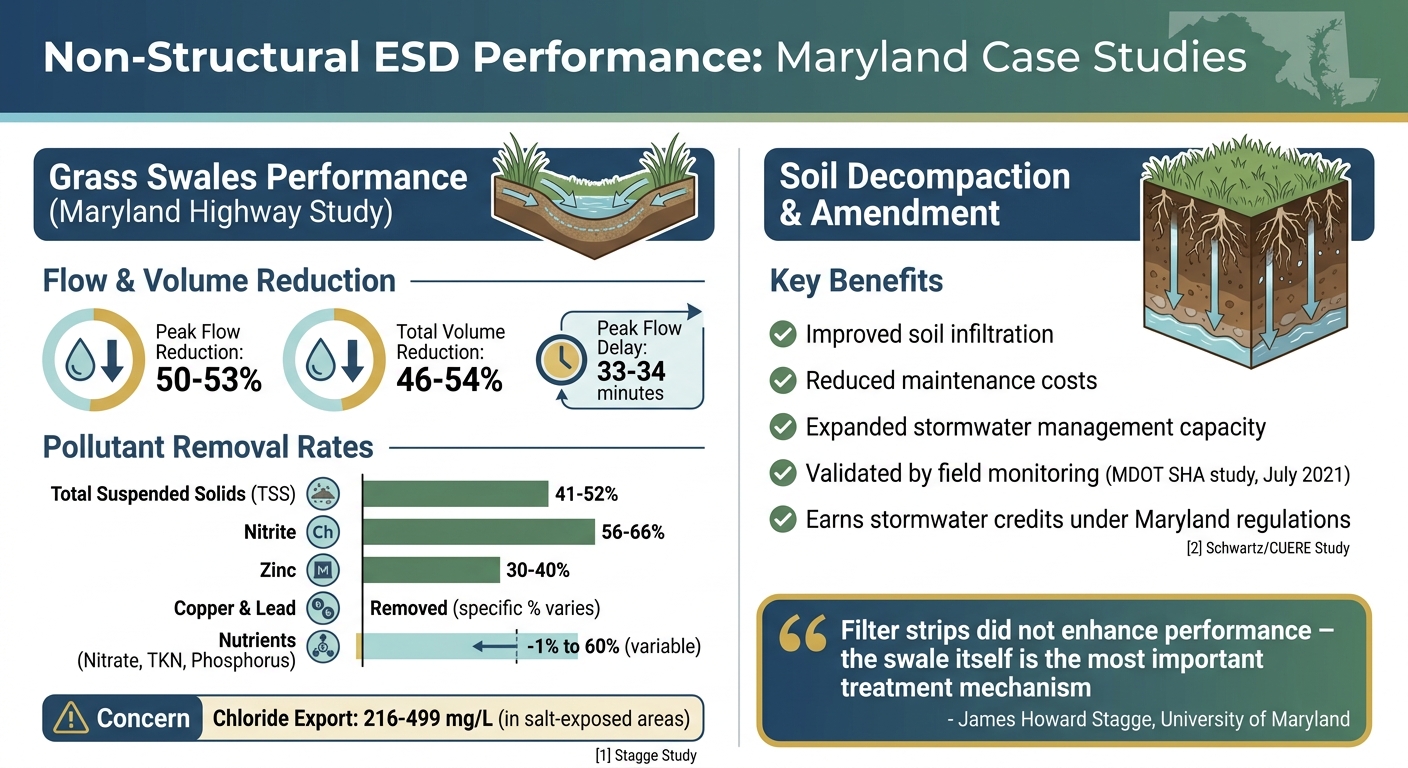
Maryland Grass Swales Performance: Stormwater Reduction and Pollutant Removal Statistics
Studies in Maryland consistently highlight the effectiveness of non-structural ESD techniques in managing stormwater. These approaches, which work with natural systems, show clear benefits in reducing pollutants, controlling water flow, and cutting costs.
For instance, research by James Howard Stagge on Maryland highways revealed that grass swales could reduce peak flow by 50–53% [1]. This study underscores the strong pollutant removal abilities of grass swales. Below is a table summarizing the performance indicators from various studies.
Comparison Table
| Location/Study | Technique Used | Volume Reduction | Peak Flow Reduction | TSS Removal | Nitrite Removal | Zinc Removal | Chloride Export | Key Finding |
|---|---|---|---|---|---|---|---|---|
| Maryland Highway (Stagge Study) | Grass Swales | 46–54% [1] | 50–53% [1] | 41–52% [1] | 56–66% [1] | 30–40% [1] | 216–499 mg/L [1] | Filter strips did not enhance performance [1] |
| MDOT SHA Landholdings (Schwartz Study) | Soil Decompaction & Amendment | Improved infiltration | N/A | N/A | N/A | N/A | N/A | Reduced maintenance costs while expanding stormwater management capacity [2] |
Grass swales stand out for their ability to remove pollutants like nitrite and total suspended solids (TSS). On the other hand, soil decompaction techniques focus on enhancing natural infiltration, which can lower maintenance costs over time. These findings align well with Maryland’s ESD program goals and regulatory benchmarks.
Conclusion
Case studies from Maryland highlight the effectiveness of non-structural ESD techniques like grass swales and soil decompaction in managing stormwater. For instance, grass swales have been shown to reduce peak flow by 50–53%, while soil decompaction helps restore natural infiltration patterns. These methods provide measurable results in improving stormwater management.
Field research demonstrates that grass swales not only treat stormwater effectively but also eliminate the need for additional pretreatment. Similarly, soil decompaction enhances infiltration rates and reduces maintenance expenses over time [1][2].
The performance data – ranging from pollutant removal to runoff reduction – gives engineers and planners the confidence to integrate these non-structural techniques into their designs. Regulatory validation further underscores their practicality and value for various stakeholders.
For property owners and developers in Maryland, adopting these methods offers a cost-effective way to meet environmental standards while minimizing long-term expenses. By prioritizing non-structural solutions, they can often avoid the need for more expensive structural alternatives.
The success of these projects serves as a practical model for wider adoption. Techniques like grass swales and soil restoration provide a clear, effective path for communities to meet stormwater management goals, reduce costs, and protect water quality.
Pro Landscapes MD specializes in helping central Maryland communities implement these sustainable stormwater solutions with expert guidance.
FAQs
When should I use grass swales instead of structural BMPs?
Grass swales are a great option for handling small to moderate stormwater runoff. They work by allowing water to infiltrate the soil, filtering out pollutants, and reducing peak flow rates. These swales are best used when the aim is to slow down runoff, improve water quality, and manage stormwater without needing complicated infrastructure. They shine in scenarios where straightforward, low-maintenance solutions are enough to get the job done.
How do soil decompaction and amendments qualify for stormwater credits in Maryland?
Soil decompaction and the use of amendments can earn stormwater credits in Maryland. These practices help water soak into the ground more effectively and boost soil health. They align with Maryland’s stormwater management goals, which focus on mimicking natural hydrology and minimizing runoff and pollutants through better infiltration methods.
How can projects reduce chloride impacts from road salt near swales?
Projects can help lower chloride impacts from road salt near swales by focusing on nonstructural stormwater practices. For instance, redirecting runoff to vegetated areas allows for natural infiltration, reducing the amount of chloride that reaches water bodies.
Another approach is designing swales with salt-tolerant plants, though results can vary depending on the specific vegetation used. When paired with reduced road salt usage and thoughtful vegetation choices, these strategies can work together to limit chloride levels in runoff and safeguard nearby waterways.
Chat with Us