









- bhavya gada
- No Comments
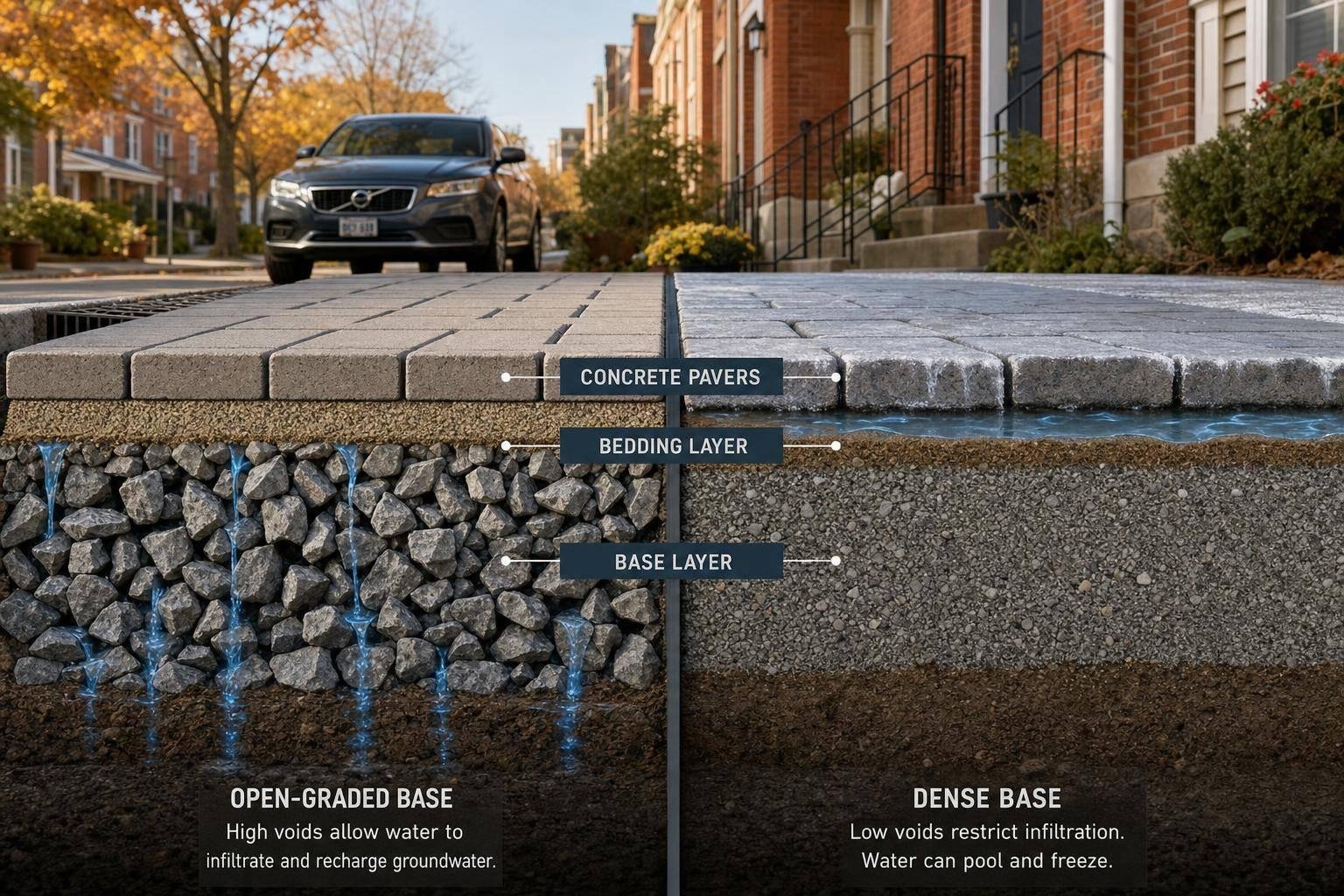
If I’m building a permeable patio, walk, or driveway in Maryland, I’d choose open-graded stone base in most cases. It stores water, drains it through the system, and helps limit winter damage. Dense base like CR-6 is fine under standard surfaces, but under permeable systems it can trap water and lead to ponding, frost trouble, and early wear.
Here’s the short version:
- Open-graded base has little to no fines, so it leaves about 30% to 45% void space for water.
- Dense base (CR-6) packs tight because fines fill the gaps, which cuts water flow.
- For permeable work, the base must do two jobs: support weight and hold/drain stormwater.
- In much of central Maryland, clay-heavy soils slow infiltration, so base design matters even more.
- A 12-inch open-graded subbase can hold about 4 to 5 inches of rain across the area.
- Typical depth is about 6 to 8 inches for patios and walks, and 8 to 12 inches or more for driveways, depending on soil and load.
- In freeze-thaw weather, water that stays trapped in a dense layer can lead to heaving and settlement.
My bottom line: if the surface is meant to let water through, the base below it also needs to let water move and sit for a short time. That’s why open-graded stone is usually the right match in Maryland.
Quick Comparison
| Category | Open-Graded Base | Dense Base (CR-6) |
|---|---|---|
| Water flow | High | Low |
| Water storage | Yes | Very little |
| Fines | Little to none | High |
| Best use | Permeable paver systems | Standard non-permeable surfaces |
| Freeze-thaw risk | Lower when drained well | Higher when water gets trapped |
| Repair scope | Often near the surface | Can involve deeper rebuilds |
If I want a permeable system to work as intended in Maryland, this is the base choice that matters first.
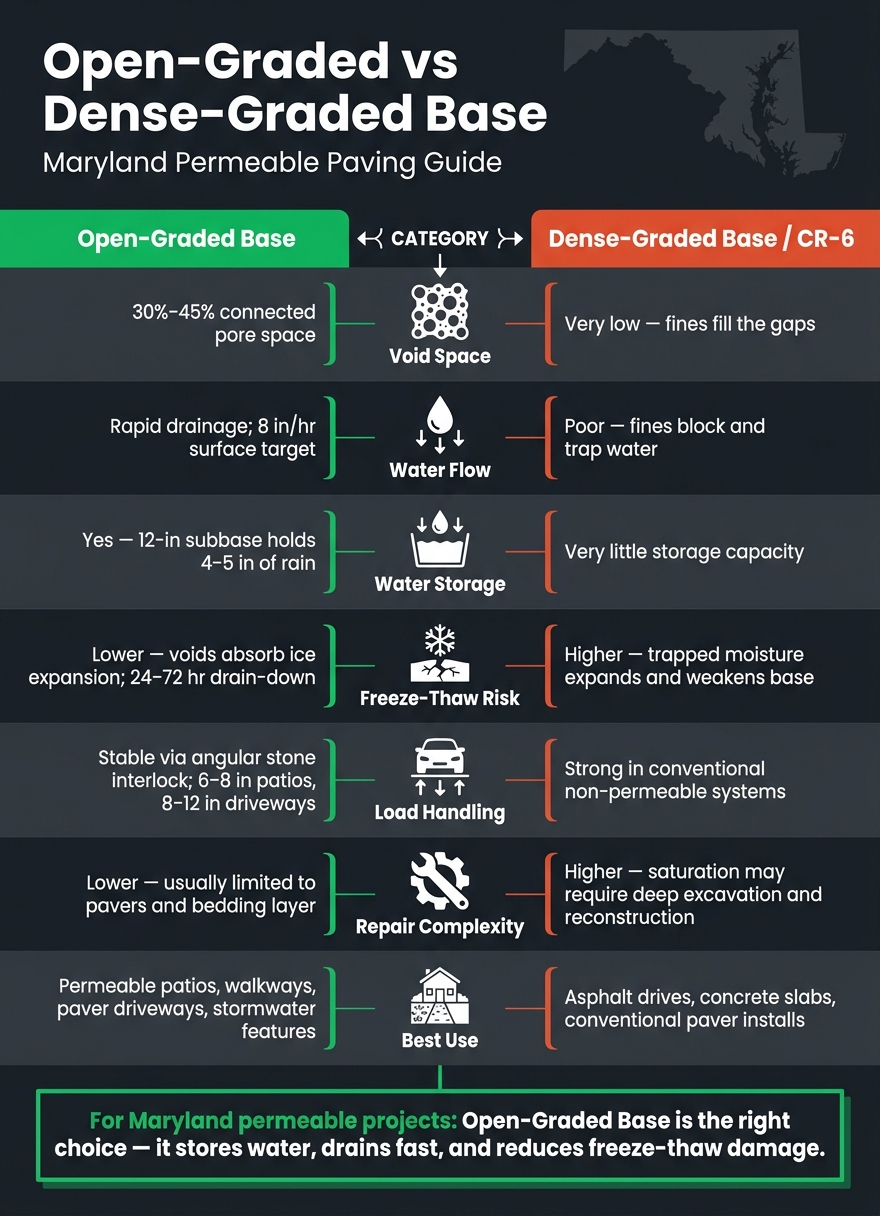
Open-Graded vs Dense-Graded Base: Maryland Permeable Paving Guide
How to Build an Open-Graded Paver Base (Permeable Base)
sbb-itb-843f8be
Open-Graded and Dense-Graded Bases: Definitions and Key Differences
For Maryland permeable projects, the main difference comes down to one thing: can the base store and move water, or not?
Both open-graded and dense-graded bases use crushed stone. But only open-graded stone leaves enough void space for drainage in a permeable system.
A dense-graded base – often called crusher run or CR-6 in Maryland – mixes many stone sizes, from larger pieces down to fines. Once compacted, those fines fill the gaps between the bigger stones. That creates a tight, stable layer with low permeability. It’s the standard base under regular concrete, asphalt, and non-permeable pavers. It compacts hard, stays put, and resists water flow.
An open-graded base uses clean, angular crushed stone that is all about the same size, with no fines mixed in. Since the stones are similar in size, they lock together well but still leave connected voids where water can pass and sit for a period of time.
| Property | Open-Graded Base | Dense-Graded Base (CR-6) |
|---|---|---|
| Fines content | Little to none | High |
| Void space | High and interconnected | Very low |
| Water movement | Designed to drain freely | Limited drainage |
| Primary use | Permeable paver systems | Conventional patios, driveways |
Those differences shape how each base deals with water, compaction, and weight.
Open-Graded Base: Water Storage and Drainage
A full open-graded system under permeable pavers has three layers. At the bottom is the subbase, made from larger stone such as ASTM No. 2 or No. 3. This layer acts as the storage reservoir. It holds stormwater in its voids until that water can slowly soak into the soil below or leave through an underdrain pipe. A 12-inch-thick subbase can store about 4–5 inches of rainfall equivalent across its footprint.[2][7]
Above that is a 4-inch base layer of ASTM No. 57 stone. This layer handles structural loads while still letting water move down and sideways. On top sits a 2-inch bedding layer of ASTM No. 8 stone, which creates a level, permeable setting bed under the pavers.
Here’s the flow: rain passes through the paver joints, then through the No. 8 bedding and No. 57 base, and finally into the larger subbase. That’s where the water is stored before it infiltrates or drains through underdrains.
That drainage path is the whole reason open-graded base works under permeable hardscaping.
Dense-Graded Base: Tight Compaction and Conventional Pavement Support
Dense-graded base works well under standard hardscaping because the fines help it compact into a tight mass. That gives you a dense, stable platform with high shear strength – exactly what a standard driveway or patio needs.
The issue is simple: that same tight structure works against a permeable system. Water has almost no path through it. It can’t be stored well, it can’t infiltrate fast, and it can’t reach an underdrain in an efficient way.
That’s why dense-graded base belongs under conventional paving, not permeable systems.
Open-Graded Base for Permeable Installations
Open-graded stone is the reservoir base that makes permeable pavers work. Its angular, evenly graded pieces create connected voids throughout the base layer. Those voids let water move down fast, then hold it for a short time until the native soil takes it in or an underdrain moves it out. That storage role is the big difference between open-graded base and standard stone base.
Water Flow, Compaction, and Load Handling
Maryland stormwater guidance describes permeable pavement subbases as clean, open-graded, washed aggregate with about 30% porosity, and it prefers 1.5-inch to 2-inch stone for the storage layer.[1] In practice, a 10-inch stone layer can hold about 3–4 inches of rainfall within the aggregate itself.[9][11]
Here’s how the system works: water moves through the paver joints, passes the bedding and base layers, and then collects in the subbase reservoir. Maryland guidance also sets a surface permeability target of 8 inches per hour or more so water can enter the base fast enough for the system to do its job.[17]
Load support comes from stone shape and fit. Angular crushed stone locks together, so it can handle weight without fines. Put simply, the base stays stable because of interlock, not because small particles fill the gaps.
For sizing, the usual ranges are pretty straightforward:
- Patios and walkways: 6–8 inches of open-graded base over competent subgrade
- Residential driveways: 8–10 inches or more for cars and light trucks, with added depth on weaker soils[8][10][12]
The key point is simple: size the base for whichever controls more – load demand or water storage volume.
Freeze-Thaw Performance, Maintenance, and Repair Access
Frost heave starts when water gets stuck in the base or subgrade and then freezes. Open-graded stone helps avoid that problem because it drains fast and usually has about 35%–45% pore space.[16] So when water freezes, it has room to expand into those voids instead of forcing the pavement upward.
Maryland guidance adds another guardrail: water levels in the base should not rise into the pavement layer during the 10-year, 24-hour storm.[17][1] A base that drains within 24–48 hours, with 72 hours as the outer limit, is far more likely to meet that target than a dense base that hangs onto moisture.[9][13]
Most trouble shows up at the surface first. Sediment and organic debris can clog the joints over time, which is why routine vacuum sweeping matters so much.[14][15] If repairs are needed, they usually stay near the top. Contractors can lift the pavers in the problem area, refresh the bedding and joint stone, and reset the units. In many cases, the clean stone base underneath remains in place.[6]
| Category | Open-Graded Base Performance |
|---|---|
| Water Flow | Rapid drainage through connected voids; 8 in/hr surface permeability target |
| Compaction | Stability through angular stone interlock; no fines required |
| Load Capacity | 6–8 in. for patios and walkways; 8–10 in.+ for residential driveways |
| Freeze-Thaw | Low heave risk; voids help absorb expansion; 24–72 hr drain-down target |
| Maintenance | Surface-focused: sweep joints and refresh bedding before base repair is needed |
That need for open voids is exactly why dense-graded base fails under permeable surfaces.
Dense-Graded Base Under Permeable Surfaces
Dense-graded base packs tight and works well under standard paving. The problem is simple: permeable pavement needs open space in the base to store and move water, and dense-graded base doesn’t give you that.
That clash is the main issue in permeable installs.
Drainage Limits, Saturation Risk, and Structural Tradeoffs
When fines fill the voids, drainage drops fast and water gets stuck. Dense-graded bases with more than 15% fines drain poorly and are prone to drainage trouble.[18][19] In a permeable pavement system, that’s a big deal.
Water moves through the paver joints and into the base. But if the base can’t move that water down, it has to go somewhere else. It spreads sideways or pools above the dense layer. On Maryland’s clay-heavy subgrades, that trapped moisture can lead to perched water and long saturation periods after storms.
And once a base stays wet too long, problems pile up. The support layer softens. The risk of deformation goes up. The whole point of using a permeable surface starts to fall apart.
There’s the tradeoff in plain terms: more density means more stiffness, but less permeability. Permeable pavement needs a base that can carry loads and move water at the same time. Dense-graded base does the first part well, but it blocks the drainage path, which makes it a poor fit here.
Repair Complexity and Why Dense Base Fits Non-Permeable Work Better
Saturation can set off a chain reaction in dense-graded bases. Trapped water and fines may pump up through the joints, which leaves voids in the base course below. Once that starts, pavers settle, soft spots show up, and repairs often mean excavation and reconstruction.
FHWA guidance warns against using retrofit edge drains on pavements with dense-graded bases that contain more than 15% fines, because the fines clog the drains and their migration causes base erosion.[19]
Maryland’s freeze-thaw cycles make this even harder to manage. If moisture stays trapped in a dense base through winter, it freezes, expands, and weakens the base-to-subgrade layer. Then comes the thaw. For a while, that layer loses support, which makes pumping and differential settlement more likely, especially on sites that go through repeated freezing, thawing, and re-saturation each season.
| Category | Dense-Graded Base |
|---|---|
| Drainage | Poor; fines fill the voids and water is easily trapped |
| Compaction Strength | High; tight particle packing provides a stiff, stable layer |
| Load Handling | Strong in conventional, non-permeable systems |
| Freeze-Thaw Risk in Maryland | Higher; trapped moisture can expand and weaken the base-to-subgrade layer |
| Repair Complexity | High; saturation or fines migration may require deep reconstruction |
| Typical Use | Conventional asphalt drives, concrete slabs, and non-permeable paver installs |
That’s why dense-graded base makes sense in conventional work, not in permeable systems. The contrast stands out even more in the side-by-side Maryland comparison below.
Open-Graded Base vs. Dense Base: Which Fits Maryland Projects Better
Side-by-Side Decision Table for Maryland Permeable Installations
For permeable projects in Maryland, the base choice comes down to four things: drainage, strength, freeze-thaw behavior, and ease of repair.
| Category | Open-Graded Base | Dense-Graded Base |
|---|---|---|
| Drainage | Rapid; connected voids move water through the base | Low; fines block flow and trap water |
| Compaction | Stable and porous; compaction must preserve voids | Dense and stiff; fines lock particles together |
| Load Handling | Adequate for residential patios, walks, and driveways with proper layering[4][5] | Strong in conventional, non-permeable systems |
| Freeze-Thaw Performance | Better; water drains away instead of staying trapped[23][24] | Higher risk; trapped moisture can weaken the base |
| Repair Complexity | Lower; repairs are usually limited to pavers and bedding[4][5] | Higher; moisture-related problems can require more invasive structural repair[21][22] |
| Typical Maryland Applications | Permeable patios, walkways, paver driveways, stormwater features | Asphalt drives, concrete slabs, conventional paver installs |
Applying the Right Base Choice to Hardscaping and Drainage Work
Once you see how each base performs, the next step is matching it to the site. That means looking closely at soil and slope.
In Maryland, clay-heavy soils and freeze-thaw cycles often make drainage the main issue. Sandy soils that drain well can often support an open-graded base that lets water move out through the ground. On clay-heavy sites, or near foundations, an open-graded base usually works best when it’s paired with perforated underdrains that carry water to a safe outlet. That helps keep stored water from sitting too long or moving toward the house[3][4][5].
Slope also changes the plan. Open-graded base works well with French drains, dry wells, and subsurface trenches, so it’s easier to tie a patio or driveway into the full drainage layout[3][20][5]. Dense-graded base, by contrast, blocks water movement beneath permeable pavers. If infiltration is part of the design, that’s a bad match.
Typical depth matters too:
- Permeable driveways usually need 8–12 inches or more of combined open-graded base and subbase.
- Patios and walkways usually need 6–8 inches.
Those details need to be sorted out before installation. If the soil, slope, and drainage plan aren’t set first, the system can struggle later.
Conclusion: Why Open-Graded Base Works Better for Most Maryland Permeable Projects
For most Maryland permeable projects, open-graded base is the better fit. It stores water, drains fast, and lowers the risk of freeze-thaw damage and repair issues. Dense-graded base is better suited to conventional paving.
FAQs
Do I need an underdrain in Maryland?
In Maryland, the answer depends on your site conditions, including soil type, slope, and site features like retaining walls or permeable pavement.
Underdrains are often needed when soils don’t drain well, especially heavy clay, or when surface drainage alone can’t manage runoff. They’re also required in many engineered systems, such as bioretention and rain gardens, to keep water moving at a steady rate and help prevent hydrostatic pressure behind retaining walls.
How do I know if my soil can handle a permeable base?
You’ll need a site evaluation to check how well your soil drains. Soil type matters a lot here. If your yard has clay-heavy soil, it often drains slowly, which can lead to water pooling.
One easy clue is this: if the soil holds its shape when you squeeze it, it may have a high clay content. Since soil conditions can vary across Maryland, Pro Landscapes MD recommends professional soil testing to confirm your soil makeup and spot any potential issues early.
Can open-graded base support a driveway?
Yes. An open-graded base can support a driveway when it’s used as part of an engineered permeable pavement system.
The aggregate base does two jobs at once: it supports vehicle loads, and it creates space for water to drain through and soak into the ground.
Chat with Us