









- bhavya gada
- No Comments
If your Maryland flower beds struggled last season, the issue likely lies in the soil. Preparing your soil organically can significantly improve plant health, growth, and drainage. Here’s how:
- Key Materials: Use compost, organic mulch, and natural soil conditioners (like leaf mold or aged manure) to improve soil structure, drainage, and nutrient levels.
- Maryland’s Soil Challenges: Common issues include compacted clay, poor drainage, and nutrient depletion. Freeze-thaw cycles and heavy rainfall add complexity.
- Steps to Prepare Soil:
- Test soil for pH, nutrients, and organic matter levels.
- Clear weeds and loosen soil with a garden fork.
- Add organic amendments (compost, leaf mold, aged bark) to enrich the soil.
- Adjust pH with lime (for acidic soil) or sulfur (for alkaline soil) as needed.
- Apply a 2–3 inch layer of mulch to retain moisture and suppress weeds.
- Long-Term Benefits: Organic prep improves soil health over time, supports plant growth, and reduces nutrient runoff into waterways.
For persistent drainage or compaction issues, professional help may be necessary. Healthy soil is the foundation for thriving flower beds, and these steps can set your garden up for success season after season.
How to Make Healthy Garden Soil and Keep it That Way
sbb-itb-843f8be
Understanding Maryland Soil and Its Challenges
Maryland’s soil is incredibly varied, thanks to its mix of coastal plain, piedmont, and mountain regions. This means that even your neighbor’s yard might have soil entirely different from yours. According to the USDA Natural Resources Conservation Service, there are over 400 distinct soil series in Maryland, illustrating how quickly conditions can change across short distances. For gardeners, this diversity is crucial because what works for one soil type might backfire for another. A customized organic approach is key to keeping each garden thriving.
In central Maryland, particularly in the Baltimore–DC corridor where many homes are located, the most common issue is dense, clay-heavy subsoil. Clay particles are tiny – less than 0.002 mm in diameter – which allows them to hold nutrients well. However, this same characteristic makes clay prone to compaction and poor drainage. For example, compacted clay absorbs water at a sluggish rate of less than 0.1 inch per hour, compared to the 0.5–1.0 inch per hour absorption rate of well-structured loam.
Maryland’s winters add another layer of complexity. The region’s mid-Atlantic climate brings repeated freeze-thaw cycles, where water in the soil expands as it freezes and contracts when it thaws. Over time, this weakens the soil structure and can push shallow-rooted perennials out of the ground – a phenomenon known as frost heaving. Combine this with Maryland’s 40–50 inches of annual rainfall, much of it delivered in intense bursts, and poorly prepared soil can quickly become a gardener’s nightmare.
Why Organic Soil Prep Matters in Maryland
Given these challenges, organic amendments are essential for improving and maintaining healthy soil in Maryland. Most residential soils in the state contain only 2–3% organic matter, while the University of Maryland Extension recommends aiming for 4–6% for optimal garden performance. That difference is critical because organic matter helps bind soil particles into loose, workable clumps. These aggregates improve root penetration, water drainage, and air circulation. In compacted clay, the air spaces needed for root health can drop below 10%, while healthy garden soil requires at least 15–25% air-filled pore space to support proper root function.
What Healthy Flower Bed Soil Looks Like
Healthy flower bed soil has a crumbly, workable texture that loosely holds its shape when squeezed but crumbles apart easily. It drains well after rain without becoming waterlogged, encourages visible earthworm activity, and avoids forming a hard crust when it dries. For most flowering plants in Maryland, the ideal pH range is 6.0 to 6.8, which is slightly acidic to neutral. Even soil packed with nutrients can underperform if the pH is off, making soil testing a crucial first step before adding amendments.
Assessing and Preparing Your Flower Bed Soil
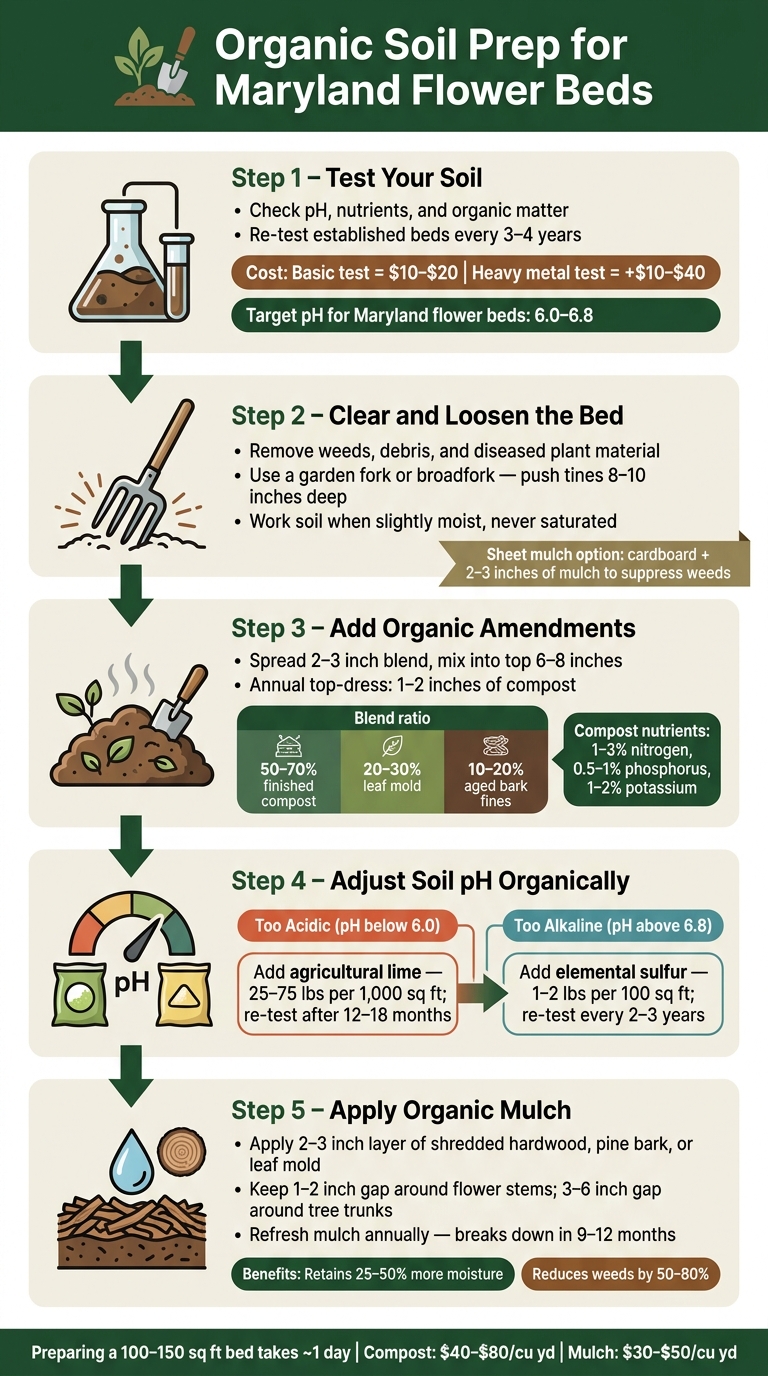
Organic Soil Prep for Maryland Flower Beds: Step-by-Step Guide
How to Evaluate Your Current Soil Conditions
Before improving your soil, it’s essential to understand what you’re working with. Start your assessment after a rain or deep watering session. If water lingers on the surface for more than 24 hours, your soil likely has poor drainage. On the other hand, if the water vanishes almost immediately, it might be too sandy to retain moisture effectively.
To get a hands-on feel for your soil type, dig about 4–6 inches deep, grab a moist sample, and squeeze it. Clay soil will form a tight, sticky ball, sandy soil will crumble easily, and loamy soil – what you want – will hold its shape but break apart with gentle pressure. Soil color can also tell you a lot. Dark brown or black soil with an earthy smell often indicates plenty of organic matter, while pale or grayish soil suggests it’s lacking.
For a more detailed analysis, consider sending a soil sample to a lab. To do this, gather 8–12 small samples from the top 6 inches of soil, mix them thoroughly in a clean bucket, and submit about a cup following the lab’s instructions. A basic test, which checks pH, organic matter, and essential nutrients like nitrogen, phosphorus, and potassium, typically costs $10–$20. If your home was built before 1978 or is near a busy road, you might want to test for lead or heavy metals, which can add another $10–$40. Remember, soil with lead levels above 400 ppm is considered unsafe for children, according to the EPA. The University of Maryland Extension recommends testing established garden beds every 3–4 years, or more frequently if you suspect issues.
"Poor drainage can lead to a variety of problems that can damage your landscape, home foundation, and overall property." – Pro Landscapes MD [1]
Once you’ve assessed your soil, you’ll be ready to move on to organic clearing and loosening techniques.
Clearing and Loosening Soil Without Synthetic Chemicals
After understanding your soil’s condition, the next step is clearing the bed to prepare it for organic improvements. Start by removing large debris by hand. Cut back any spent annuals and dispose of plant material that showed signs of disease last season – don’t compost it. For weeds, use tools like a sharp hoe or a hori-hori knife to slice roots just below the surface. For tougher perennial weeds like dandelions, a narrow weeding tool can help you pull out as much of the taproot as possible. If weeds are widespread, consider sheet mulching. Cover cut vegetation with cardboard or overlapping sheets of uncoated newspaper, water the area thoroughly, and then top it with 2–3 inches of organic mulch. This method blocks sunlight and can take a few weeks to months to work.
Once the bed is cleared, it’s time to loosen the soil. Skip the rototiller and opt for a garden fork or broadfork instead. Push the tines 8–10 inches deep into the soil, gently rock the handle back to crack and lift the soil, then move back 6–8 inches and repeat. If the soil is heavily compacted, work in parallel passes and then cross at a right angle. The goal is to loosen the soil without flipping it over, which could disrupt beneficial organisms and bury surface organic matter. Always work the soil when it’s slightly moist – never when it’s saturated. In areas with heavy clay, like Maryland, working wet soil can smear and compact it further, undoing your hard work.
Finally, spread 1–2 inches of finished compost over the loosened soil and lightly rake it into the top few inches. Avoid disturbing the deeper layers, where many beneficial organisms reside. This method not only enhances the current soil structure but also lays the groundwork for a thriving garden in the seasons to come.
Adding Organic Amendments to Your Soil
Using Compost and Natural Soil Conditioners
Once your soil bed is loosened, it’s time to enrich it with organic amendments. In Maryland flower beds, four key options stand out: finished compost, leaf mold, aged shredded bark (fine pine bark works great), and well-rotted manure. Here’s why these are excellent choices:
- Finished compost: This improves soil structure, nourishes microbes, and provides a balanced, slow-release supply of nutrients. On average, compost contains 1–3% nitrogen, 0.5–1% phosphorus, and 1–2% potassium by dry weight.
- Leaf mold: Made from decomposed oak and maple leaves (common in central Maryland), this boosts moisture retention and creates a light, crumbly texture that flower roots thrive in.
- Aged bark fines: These help break up heavy clay, improve drainage, and resist rapid decomposition.
- Well-rotted manure: Packed with nitrogen and trace minerals, this must be fully aged to avoid burning roots or introducing weed seeds.
For new beds, spread a 2–3 inch layer of a blend (about 50–70% compost, 20–30% leaf mold, and 10–20% aged bark) and mix it into the top 6–8 inches of soil. For established beds, top-dress with 1–2 inches of compost or leaf mold, keeping it a few inches away from plant stems. Over time, worms and soil organisms will naturally incorporate it into the root zone. The University of Maryland Extension suggests adding 1–2 inches of compost annually to maintain healthy soil structure.
What to avoid:
- Never mix fresh wood chips or raw sawdust directly into the soil, as they deplete nitrogen during decomposition, leaving plants undernourished.
- Use high-carbon materials like wood chips only as surface mulch.
- Limit manure applications to 1 inch at a time to avoid salt buildup and phosphorus overload.
- Avoid piling on thick layers of amendments; gradual, annual additions of 1–3 inches work much better than a single heavy application.
Once your soil is enriched, the next step is adjusting its pH and nutrient balance to create the perfect growing environment for your flowers. You can see examples of these landscaping and drainage solutions in our recent project gallery.
Adjusting Soil pH and Nutrient Levels Organically
Your soil test results are your guide here. Maryland soils tend to be naturally acidic, with pH levels often between 5.5 and 6.5 due to rainfall and leaching. Most garden flowers, like coneflowers, daylilies, and zinnias, thrive in a slightly acidic range of 6.0–6.5, so many gardeners will need to raise pH rather than lower it.
If your soil is too acidic, agricultural lime is your solution. Depending on the severity of acidity and your soil type (clay versus sandy), you’ll need 25–75 pounds of ground limestone per 1,000 square feet – clay soils require more lime than sandy ones. Apply lime in the fall or early spring, mix it into the top 6 inches of soil, and re-test after 12–18 months, as lime takes time to work.
If your soil is too alkaline (common with disturbed fill soils from construction), you can lower the pH with elemental sulfur. Use about 1–2 pounds per 100 square feet to drop the pH by roughly one unit in loamy soil, but always follow your specific test recommendations. Like lime, sulfur works slowly, so patience and periodic re-testing every 2–3 years is essential.
For nutrient deficiencies, compost should handle most of the work. However, if your soil test or plant performance suggests a specific shortfall, you can use targeted organic fertilizers:
- Bone meal for phosphorus, applied at planting time.
- Blood meal or alfalfa meal for a nitrogen boost.
- A balanced slow-release organic flower fertilizer applied according to label directions (typically a few pounds per 100 square feet).
Maryland’s warm, humid summers accelerate nutrient release from organic matter, so it’s better to apply slightly less fertilizer and monitor plant response. Over-fertilizing, especially with nitrogen, can lead to overly lush, floppy growth instead of strong, healthy flowers.
Mulching and Keeping Soil Healthy Through the Season
Benefits of Organic Mulch for Maryland Flower Beds
Once you’ve enriched your soil with organic amendments, applying mulch helps preserve those benefits throughout the growing season. Adding a 2–3 inch layer of organic mulch – like shredded hardwood, pine bark, or leaf mold – provides multiple advantages. It minimizes moisture loss, which is crucial in Maryland’s climate. Spring rains quickly give way to hot, humid summers and occasional droughts, which can stress shallow-rooted ornamentals. Mulched soils retain 25–50% more moisture during heat waves compared to bare soil. Plus, a proper mulch layer can reduce weed growth by 50–80%, especially in well-prepared flower beds.
As organic mulch decomposes, it enriches the soil by feeding beneficial microbes and adding organic matter. This is particularly helpful for Maryland’s heavy clay and compacted suburban soils, making your flower beds healthier over time.
How to Apply Mulch Correctly
Start by removing any weeds and watering dry beds before applying mulch. Spread the mulch evenly across the bed, adjusting the thickness based on the material. Use 2–3 inches for coarser mulches like bark chips, and 1–2 inches for finer options like shredded leaves or compost to avoid compaction.
Keep mulch away from plant stems and trunks to prevent problems. Maintain a 1–2 inch gap around flower crowns and stems, and leave 3–6 inches of space around tree trunks, ensuring the root flare is visible. This spacing is especially critical in Maryland’s humid summers, where trapped moisture can lead to rot, fungal issues, or pest infestations. Always aim for a flat, even layer of mulch instead of piling it into mounds. Proper application now will make ongoing yard maintenance and landscape projects easier and more effective.
Checking and Adjusting Soil Health Over Time
Mulch isn’t a one-and-done solution – it requires regular attention. Every few weeks, check soil moisture by digging a finger into the mulch to a depth of 2–3 inches. If the soil feels dry, it’s time to water. If it feels cool and moist, you can hold off. Most mulched flower beds in Maryland benefit from deep watering once or twice a week during dry spells, but always let soil conditions guide you rather than sticking to a rigid schedule.
After heavy storms, check that water drains within 24–48 hours. Persistent pooling might signal deeper drainage problems. If the mulch becomes crusted or compacted – common with fine shredded hardwood in humid weather – rake or loosen the top inch to improve air and water flow. Organic mulch typically breaks down within 9–12 months, so plan to refresh it annually to maintain the ideal depth of 2–3 inches. Mid-season, you can also temporarily remove some mulch and add a ½–1 inch layer of compost around plants to boost nutrients without disturbing roots. With consistent care, your flower beds will thrive, building on the foundation of your earlier soil preparation efforts.
When to Call in a Professional
Even the best DIY efforts for organic soil preparation can only go so far. If you notice water pooling in your yard after a typical rainstorm, it could point to poor grading or drainage – problems that soil amendments alone can’t resolve. Similarly, if your soil remains hard as a rock despite regular organic treatments, plants repeatedly fail in the same area, or mulch washes away with every storm, it’s time to consider how water moves through your landscape. These are signs that a professional evaluation may be necessary.
Large-scale landscaping projects can also bring challenges that go beyond DIY capabilities. For example, transforming a large lawn into multiple garden beds or integrating those beds with patios requires careful grading and drainage to avoid future headaches. The University of Maryland Extension highlights compaction and poor drainage as two of the most frequent causes of plant failure. In fact, studies on urban landscapes suggest that up to 80% of newly planted trees and shrubs in compacted or poorly drained areas may start to decline within just a few years if soil preparation and drainage aren’t addressed properly.
Newly constructed homes often come with an added hurdle: post-construction soil. In Maryland, new builds typically leave a thin layer of poor-quality topsoil over a dense, compacted subgrade. Surface composting alone isn’t enough to fix this issue – it requires deeper intervention to create a healthy growing environment. Tackling these problems professionally not only resolves immediate drainage concerns but also ensures your garden thrives for seasons to come. When regular organic amendments fail to make a difference, it’s time to bring in expert help.
How Pro Landscapes MD Can Help With Soil Prep and Landscaping

When DIY solutions fall short, professional services can step in to restore your soil and improve drainage. Pro Landscapes MD offers a range of services to homeowners across central Maryland, including areas like Columbia, Ellicott City, Bethesda, Silver Spring, Gaithersburg, and Germantown. Their team combines horticultural expertise with specialized equipment to tackle problems beyond the scope of typical DIY fixes.
For uneven slopes, their grading and land-leveling services ensure water flows away from garden beds and foundations, preventing pooling and erosion. If your yard has persistent wet spots, they provide drainage solutions such as French drains, dry riverbeds, drain pipe installations, and stormwater management systems. Beyond fixing drainage, Pro Landscapes MD also offers landscape design, planting, and soil restoration services. They incorporate organic amendments like compost evenly across your garden beds, complementing your DIY efforts and helping you build a healthier, more resilient landscape.
Conclusion
Creating healthy flower beds in Maryland starts with the soil. By testing your soil, loosening compacted areas, adding 2–3 inches of finished compost, and topping it all off with a layer of organic mulch, you provide your plants with a strong base to thrive. These steps are manageable and affordable – preparing a 100–150 square-foot bed can typically be done in a day, with compost costing around $40–$80 per cubic yard and mulch priced at $30–$50 per cubic yard. This initial effort sets the stage for a flourishing garden.
The benefits extend well beyond the first planting. As the University of Maryland Extension points out, adding organic matter is "the single most important thing you can do" to improve most Maryland soils. With annual top-dressing, the soil structure gets better over time – it becomes looser, drains more effectively, and holds moisture longer, which is especially helpful during Maryland’s hot, dry summers. While clay-heavy soils in areas like Howard, Montgomery, and Carroll Counties won’t transform overnight, consistent care brings lasting improvements.
This approach isn’t just good for your garden – it’s good for the environment, too. Soil enriched with compost and protected by mulch slows down rainwater, reducing nutrient runoff into local waterways. Considering that urban and suburban runoff contributes to about half of the Chesapeake Bay‘s nutrient pollution, your gardening practices can make a meaningful difference.
When your soil preparation efforts need to go beyond DIY solutions – like addressing drainage issues, fixing post-construction compaction, or tackling larger-scale projects – calling in professionals might be the way to go. Pro Landscapes MD offers services across central Maryland. You can reach them at 410-940-9664 for a free proposal tailored to your property’s unique needs.
FAQs
When is the best time to amend flower-bed soil in Maryland?
While most people think of spring as the time to prep their gardens, fall is actually prime time for getting your flower-bed soil ready in Maryland. The cooler autumn temperatures combined with naturally moist soil create the perfect environment for plants to develop strong roots before winter sets in.
By working on your soil in the fall, you’re giving your garden a head start for spring. It helps protect plant roots, keeps the soil moist, and even cuts down on pesky weeds. When spring rolls around, your garden will be ready to thrive.
How can I fix drainage in heavy Maryland clay without tilling?
To enhance drainage in heavy clay soil without resorting to tilling, you can rely on natural methods such as berms and swales. Berms are raised mounds of soil designed to redirect water flow, while swales are shallow, sloped channels lined with vegetation that help capture and gradually absorb runoff. If water issues persist, Pro Landscapes MD offers expert solutions, including French drains and pipe systems, to efficiently handle excess water and safeguard your property.
How do I know if I should use lime or sulfur in my flower bed?
To figure out whether your soil needs lime or sulfur, it’s essential to perform a soil test. Maryland soils have specific characteristics, and testing will give you accurate pH readings along with personalized recommendations for adjustments.
Pro Landscapes MD specializes in soil preparation services, ensuring your flower beds are amended correctly to support strong, thriving plants. They can help fine-tune your soil conditions to create the perfect setting for your garden to flourish.
Chat with Us