









- bhavya gada
- No Comments
If I want the short answer: use drawers for the items I grab all the time, and use doors for large gear and service access. That’s the core decision.
In this comparison, I’d keep it simple:
- Drawers are best for fast access, small tools, and daily cooking items
- Doors are best for tall, bulky, or awkward items
- Access doors are the right pick for gas, plumbing, wiring, and propane connections
- In a place like central Maryland, humidity, rain, and temperature swings put more stress on slides, hinges, and seals
- Most outdoor kitchens work best with both, not one or the other
A few points stand out right away:
- Full-access storage matters more when I’m standing at a hot grill
- Door cabinets need about 36 to 48 inches of clear space in front to open well
- Drawer cutouts should leave about 2 inches below the countertop edge for full extension
- Propane storage behind a door needs low venting because gas can settle near the bottom
- Gaskets may need replacement every 1 to 3 years depending on exposure
Outdoor Kitchen Drawers vs Doors | What’s the Difference?
sbb-itb-843f8be
Quick Comparison
| Factor | Drawers | Doors / Access Doors |
|---|---|---|
| Best use | Everyday cooking tools | Bulk storage and utility access |
| Access | Items pull out into view | More bending and reaching |
| Good for | Tongs, thermometers, foil, towels, spices | Stockpots, platters, charcoal, propane, wood chips |
| Weather concerns | Slides can wear from grit and moisture | Hinges are simpler, but sealing varies |
| Placement | Near grill and prep space | Below grills, sinks, and tall storage zones |
If I’m planning an outdoor kitchen, I’d treat this as a layout choice first and a style choice second. What I store and how often I reach for it should decide where drawers and doors go.
Outdoor Kitchen Drawers: Better for Fast Access and Everyday Items
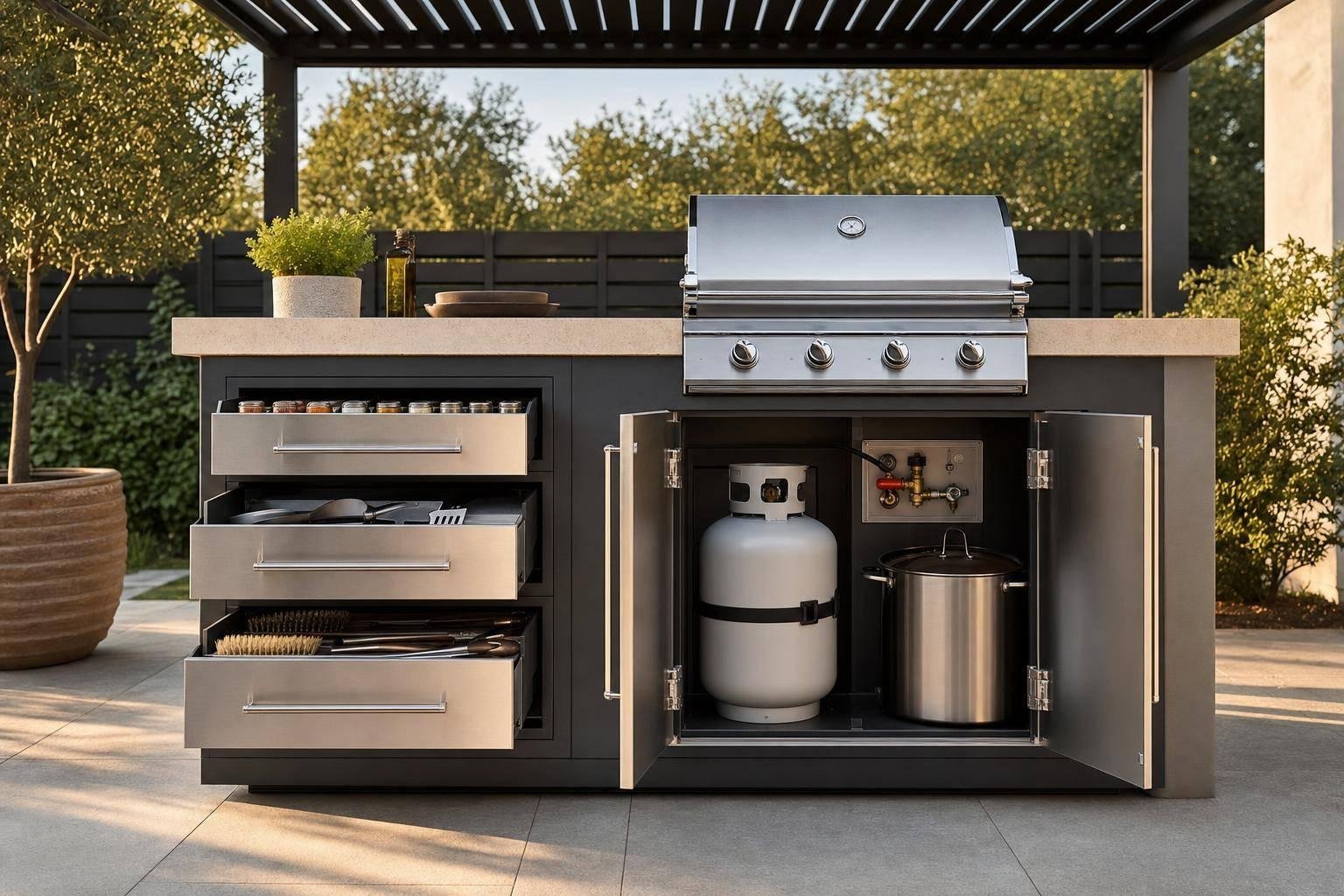
Drawers make a lot of sense next to the grill because they bring your gear to you. Open one, and you can see everything at once. That kind of fast access helps when the grill is hot and you need tongs or a thermometer right now. Drawers also tend to seal more tightly than standard access doors, which can help keep dust, moisture, and insects off utensils and linens [3][4][5]. From there, the next big choice is drawer depth.
For day-to-day outdoor cooking, drawers are best for the items you grab all the time: grill tools, flatware, spices, seasonings, meat thermometers, grilling gloves, and folded towels. Full-extension slides help you reach items in the back instead of digging around for them [3][6]. For care, wipe stainless surfaces with mild soap and water, and keep the slides free of grit. Check gaskets once a year and swap out any seals that are cracked or compressed [6].
What Fits in Shallow vs. Deep Drawers
Match the drawer depth to what you plan to store most often.
| Drawer Type | Best For | Common Items |
|---|---|---|
| Shallow | Small, flat, often-used tools | Tongs, spatulas, thermometers, lighters, spices, cutlery, napkins |
| Deep | Bulkier or stacked items | Grill baskets, serving bowls, small pots, foil rolls, grilling gloves, cleaning supplies, folded towels |
| Sealed | Items that need more protection from moisture | Dry goods, clean linens, thermometers |
Before you finalize cabinet cutouts, measure your tallest bottles and bulkiest items so they fit the drawer depth you have in mind [6].
Where to Place Drawers in the Layout
Place your main drawer unit beside or below the grill. That keeps the tools you use most within easy reach. A second drawer group near the prep counter also works well for wraps, cutlery, and towels used during plating and cleanup.
Leave at least 2 inches between the drawer cutout and the countertop edge so the drawer can extend all the way [3][6]. Doors are still the better pick for larger items and utility access.
Cabinet Doors and Access Doors: Better for Large Items and Utility Access
Drawers are great for the stuff you reach for all the time. Doors do a different job.
Cabinet doors handle bulky storage. Access doors give you a clean way to reach gas, plumbing, wiring, and other service lines. In a well-planned outdoor kitchen, both matter for different reasons.
Use access doors for gas shutoffs, plumbing, wiring, and propane connections. Putting them right below built-in grills and sinks makes those points much easier to reach [1][6]. If a propane tank sits behind a door, that cabinet needs venting at the lowest point so heavier-than-air gas can escape safely [6]. Because of that, door storage is a better match for oversized items than for tools you grab every day.
What Fits Best Behind Doors
Cabinet doors work best when an item is too tall, too wide, or just too awkward for a drawer.
Good fits include:
- Stockpots
- Dutch ovens
- Sheet pans
- Large serving platters
- Charcoal
- Wood chips
- Fuel canisters
All of these sit more naturally in the open vertical space behind a door [3][6]. Double doors, which are often 30 to 42 inches wide, can handle the bulkiest gear. Single doors in the 14- to 24-inch range are a good fit for narrower utility access or smaller cleaning supplies [1][3].
There is a tradeoff, though. Deep cabinets mean more bending, more reaching, and more digging around. And without shelves, bins, or some kind of internal setup, that space can turn into a catch-all fast. That’s why doors make the most sense for large, awkward, or service-related storage.
Door Swing, Service Access, and Moisture Control
Before you lock in the layout, map out the full swing of each door. It’s a small detail that can save a lot of frustration later. You need at least 36 to 48 inches of clear space in front of a cabinet door so it can open all the way without running into seating or another part of the island [2].
Moisture control matters too, especially outdoors. Use continuous gaskets and magnetic latches to help block water and pests [3][6]. In Maryland’s humid, four-season climate, check hinges and gaskets once a year, and expect to replace gaskets every 1 to 3 years based on exposure [6].
Drawers vs. Doors: Side-by-Side Comparison
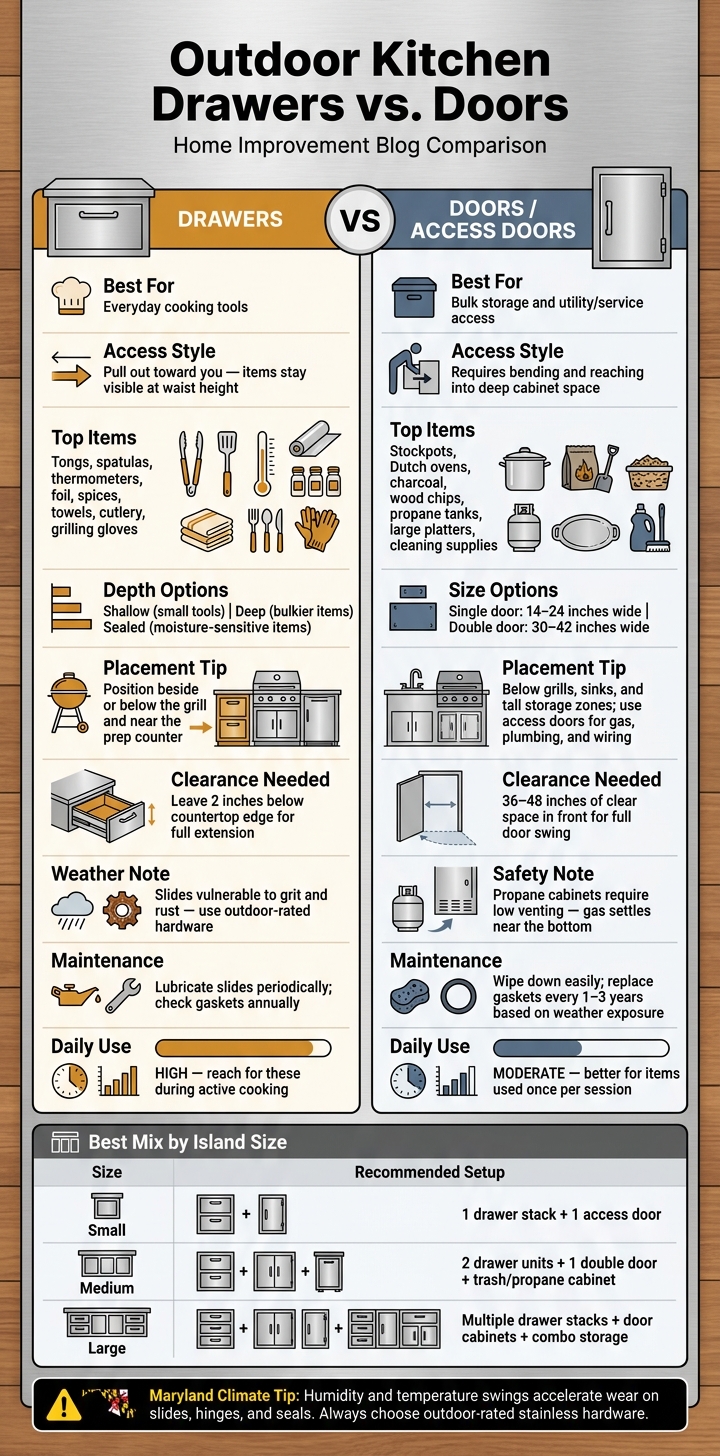
Outdoor Kitchen Drawers vs Doors: Which Storage Is Right for You?
Use this quick side-by-side view to pick the right storage for each job.
| Factor | Drawers | Doors / Access Doors |
|---|---|---|
| Access | Pull out toward you, so items stay visible and at waist height | Requires bending and reaching into deep cabinet space |
| Depth/Capacity | Best for neat layers; full-extension slides let you reach items in the back | Better for tall or bulky items like propane tanks, charcoal, and large pots |
| Best Item Types | Utensils, thermometers, foil, towels, seasonings, and small tools | Utility shutoffs, propane tanks, charcoal bags, bulk wood chips, oversized platters, and cleaning supplies |
| Maintenance | Tighter seals help cut down dust and pest intrusion; slides need periodic lubrication | Easy to wipe down; hinges may need occasional adjustment |
| Weather Performance | Slides are more likely to suffer from grit and rust, so outdoor-rated hardware matters | Hinges are simpler, but doors are not automatically weather-sealed unless specified |
| Daily Use | High; keeps tools within arm’s reach during active cooking | Moderate; better for items you use once per session |
The pattern gets easier to see once you match storage to what actually goes inside. Drawers shine when you need fast access during cooking. Doors make more sense when the item is big, awkward, or only comes out once in a while.
Which Option Works Better for Utensils, Cookware, Platters, and Cleaning Supplies
For everyday tools, drawers usually win. They keep utensils, thermometers, foil, towels, seasonings, and small tools easy to grab without digging around in the back of a cabinet. If you cook often, that matters. Nobody wants to crouch down just to find tongs.
Doors work better for bulky or less-frequent items. That includes cookware, oversized platters, cleaning supplies, charcoal bags, propane tanks, and wood chips. These items don’t stack neatly in drawer layers, and many need taller openings anyway.
How Maryland Weather Affects Slides, Hinges, and Seals
Maryland weather can be hard on outdoor hardware. Humidity and temperature swings put more stress on slides, hinges, and seals, especially if the parts are low grade. In plain terms: cheap hardware tends to wear out sooner.
That’s why outdoor-rated stainless slides, hinges, and seals are the safer pick. Slides, in particular, need extra attention because grit and moisture can shorten their life. Hinges are simpler, but that doesn’t mean every door is sealed well. If weather protection matters, check the product details instead of assuming the door will block moisture and debris on its own.
Choosing the Right Mix for Your Outdoor Kitchen
Once you’ve compared access and storage space, the last step is simple: put each storage type in the right spot.
The best mix depends on your island size, where your appliances sit, and what you plan to store. In most setups, drawers belong near the grill and prep area, while doors make more sense for tall items and utility access.
A Simple Planning Guide for Most Backyards
Think about each zone based on what goes inside it. Drawers are a good fit near the grill for utensils, thermometers, and towels. Doors make more sense for cookware, platters, cleaning supplies, and service access.
For most backyard layouts, the setup usually looks like this:
- Small islands: one drawer stack and one access door
- Medium islands: two drawer units – one beside the grill and one near the prep zone – plus a double door for bulk storage and a trash pullout or propane cabinet
- Large islands: multiple drawer stacks, door cabinets, and combo storage
That planning logic points to one clear rule: most outdoor kitchens need both.
Conclusion: Most Outdoor Kitchens Work Best with Both
Drawers and doors do different jobs. Pick the mix that fits what you cook with, how often you grab it, and where your service connections are located.
Pro Landscapes MD designs outdoor kitchens across central Maryland with storage layouts suited to weather exposure, drainage, and daily use.
FAQs
How many drawers and doors do I need?
It comes down to two things: the size of your island and how you cook outside.
A 6- to 8-foot island usually needs:
- one double-drawer unit
- one access door
A 10- to 14-foot kitchen often works well with two double-drawer units, one double access door, and a trash or propane pullout.
Once you get to 14+ feet, you have more room to build storage by zone. That can mean adding more drawer stacks, double doors, and combo units based on how the space is set up.
As a rule of thumb, use drawers for the items you reach for all the time. Use doors for bulkier gear, propane tanks, or plumbing access.
Are outdoor drawers worth the extra maintenance?
Yes – if you choose quality hardware, outdoor drawers are worth it for the practical upsides.
They usually cost more upfront than door cabinets. But they make it much easier to organize your space and grab the items you use all the time.
The big thing is build quality. Full-extension ball-bearing slides help drawers open smoothly, without the sticking and binding that can happen outside. And weather-sealed, thick-gauge stainless steel units help keep out moisture, dust, and insects.
That means less mess inside the cabinet and, in many cases, less cleaning and upkeep than standard cupboards.
What should never be stored in drawers?
Outdoor kitchen drawers are best for the items you reach for all the time, like tools, utensils, and linens.
They’re not the right spot for bulky or utility-focused items, such as:
- Large oversized kitchen essentials
- Plumbing access components
- Propane tanks
Anything that needs more vertical room, like large platters or charcoal bags, usually fits better in full-height pantries or large door cabinets.
Chat with Us