









- bhavya gada
- No Comments
A well-lit patio isn’t just about looks – it’s about safety, functionality, and even increasing your home’s value. Here’s a quick breakdown of patio lighting options and their costs:
- String Lights: Affordable ($50–$300 per string), easy to install, but less durable (1–3 seasons). LED versions save energy and last longer.
- Lanterns: Mid-range ($50–$1,000 per fixture). Wall-mounted options are simpler to install, while post-mounted ones require trenching and wiring. Solar-powered versions save on electricity.
- Built-in Fixtures: Long-lasting and professional-grade ($85–$400 per fixture). Higher upfront cost but durable (up to 15 years) and energy-efficient with LED technology.
Most homeowners spend $2,000–$4,500 for a professionally installed system, with $3,250 being the average. Factors like material (brass, copper, or aluminum), labor ($45–$100/hour), and wiring complexity impact costs. LEDs are a top choice for energy savings and longevity, while solar options eliminate operating costs.
The right choice depends on your budget, patio size, and long-term goals.
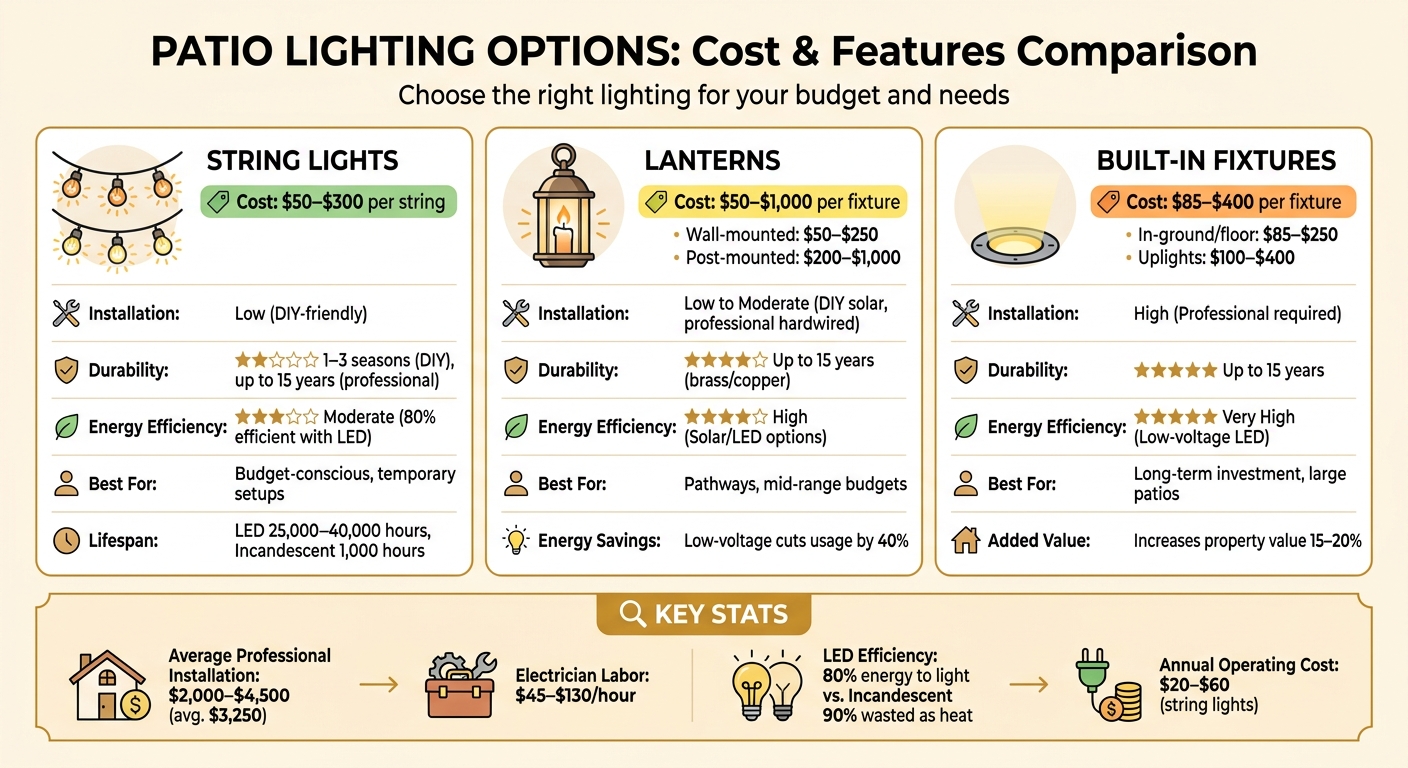
Patio Lighting Options Cost and Features Comparison
1. String Lights
Cost Range
String lights are a budget-conscious choice, typically costing between $50 and $300 per string, depending on the power source – solar, hardwired, or battery-powered [1] [2] [3]. Labor costs for installation generally range from $50 to $130 per hour [1] [2] [3]. If you’re working with a tight budget, installing the lights in stages can help spread out the expense [1].
Installation Complexity
String lights are among the simplest lighting options to install, especially when compared to more intricate setups like recessed lighting or lamp posts. Solar-powered string lights are particularly DIY-friendly since they don’t require wiring or access to electrical outlets [1]. Battery-operated options are similarly convenient, as they eliminate the need for any wiring. However, if you’re opting for hardwired string lights, hiring a professional is a smart move to ensure safety and compliance with electrical codes [1] [4]. For reference, a standard 120-volt, 15-amp circuit can typically support up to 100 bulbs, depending on their wattage [2].
Durability
Durability is a key consideration when choosing string lights. The type of bulb used significantly impacts their lifespan. LED bulbs can last between 25,000 and 40,000 hours, which translates to about 10 to 12 years of use. In comparison, halogen bulbs last around 3,600 hours (2 to 3 years), and incandescent bulbs only about 1,000 hours [1]. High-quality, professional-grade outdoor string lights can last up to 15 years, whereas lower-cost DIY options might only endure a few seasons [1]. Investing in durable lights ensures your patio remains inviting over time.
Energy Efficiency
LED string lights are highly efficient, converting about 80% of their energy into light [1]. On the other hand, incandescent bulbs waste approximately 90% of their energy as heat, which not only drives up electricity costs but also poses a fire risk when placed near wooden structures or plants [1]. Operating costs for string lights typically range from $20 to $60 annually [2]. For zero operating costs, solar-powered string lights are a great option, though they tend to emit softer, less intense light compared to hardwired LED systems [1]. Understanding these efficiency differences can help you make an informed choice as you explore other patio lighting options.
sbb-itb-843f8be
2. Lanterns
Cost Range
Lanterns come in a variety of price points, depending on whether you opt for wall-mounted or post-mounted fixtures. Wall-mounted lanterns, often referred to as porch lights, are among the more affordable permanent lighting options. These typically cost between $50 and $250 per installed fixture [2][4]. They’re budget-friendly because they attach directly to exterior walls and generally take less than an hour for a professional to install [4].
On the other hand, post lanterns are more expensive, with installation costs ranging from $200 to $1,000 per fixture [1][2][4]. The higher price reflects the extra work involved, such as trenching and installing underground wiring, which costs $10 to $25 per linear foot [2]. If your patio doesn’t already have a nearby outdoor outlet, you’ll need to account for an additional $150 to $400 to install a new GFCI outlet [1][2]. Alternatively, solar-powered lanterns can bypass these electrical costs entirely, as they don’t require trenching or wiring.
Installation Complexity
Replacing an existing wall-mounted lantern is a relatively simple task, typically completed in under an hour [4]. However, installing new post lanterns is a more labor-intensive process. It involves trenching to a depth of 5 to 13 feet (depending on local codes) to safely run underground power lines [1]. Electricians charge between $45 and $130 per hour for this type of work [1][2]. For added safety, outdoor lanterns should be connected to a separate 15-amp circuit. This prevents indoor breakers from tripping in case of an electrical issue [2].
Durability
Lanterns designed for outdoor use can last up to 15 years with proper care [1]. The material of the fixture plays a big role in how well it holds up over time. Brass, copper, and stainless steel are excellent choices for resisting weather damage, while plastic and aluminum fixtures are less durable [2]. Copper, in particular, develops a natural patina as it ages, but it remains highly reliable in outdoor conditions.
Energy Efficiency
LED lanterns are a smart choice for energy savings, converting about 80% of the energy they use into light. In contrast, incandescent bulbs lose 90% of their energy as heat [1]. Low-voltage systems (12V) can cut energy usage by up to 40% compared to standard 120-volt setups [1]. Solar-powered lanterns offer the advantage of zero operating costs but typically emit softer, less intense light than hardwired LEDs [1]. To further reduce energy expenses, consider adding a timer or remote control to your lanterns for about $100. This ensures the lights operate only when needed [1].
Next, we’ll explore built-in fixtures to round out the patio lighting cost comparison.
Landscape Lighting Costs Explained 2025
3. Built-in Fixtures
Built-in fixtures offer a long-lasting and integrated lighting option for patios, combining functionality with aesthetic appeal.
Cost Range
These fixtures are a permanent solution, and their costs reflect the complexity of installation. For in-ground or in-floor lights, expect to pay between $85 and $250 per fixture, while uplights range from $100 to $400 per fixture [1][4]. Low-voltage systems are priced lower, typically $100 to $150 per fixture, and they provide notable energy savings [1][2].
Timing can significantly impact total project costs. Adding built-in lights during the initial patio construction is more cost-effective than retrofitting them into an existing patio, which increases labor expenses [1][4]. If you opt for a low-voltage system, you’ll also need a 12-volt transformer, which costs between $200 and $500 [2]. While the upfront investment may be higher, built-in fixtures can save money in the long run and enhance the overall appearance of your patio.
Installation Complexity
Installing built-in fixtures is not a DIY project – it requires professional expertise to comply with local electrical codes and ensure proper weatherproofing. The process often involves tasks like trenching, drilling through hardscape materials, or placing sleeves before pouring concrete. For low-voltage systems, a step-down transformer is required to convert 120-volt household power to 12 volts [1][2]. It’s also recommended to connect these fixtures to a separate 15-amp circuit to prevent outdoor electrical issues from interfering with indoor systems [2].
Durability
Built-in fixtures are built to last, far outliving temporary lighting options. When constructed with materials like brass or copper, they can remain functional for up to 15 years with proper maintenance [1]. Compared to string lights or lanterns, their permanent installation and sturdy design provide greater stability. Additionally, professionally installed landscape lighting can increase property values by 15% to 20%, making it a worthwhile investment [1].
Energy Efficiency
LED technology makes built-in fixtures an energy-efficient choice. These bulbs convert 80% of their energy into light, reducing heat output and making them safer for use near plants or wood structures [1]. LEDs have an impressive lifespan of 25,000 to 40,000 hours, minimizing replacement costs [1]. Low-voltage setups can lower energy bills by up to 40% compared to standard 120-volt systems [1]. Plus, the reduced electrical load allows for smaller transformers and thinner wiring, which can help cut installation expenses. Built-in fixtures are a practical, long-term solution for patio lighting.
Advantages and Disadvantages
Each lighting option brings its own mix of benefits and drawbacks, depending on factors like cost, durability, and energy efficiency.
String Lights stand out for their affordability and simplicity. With prices ranging from $50 to $300 per string, they’re an economical choice that adds a festive touch to outdoor spaces – perfect for social gatherings[1][2]. However, they typically last only one to three seasons with DIY setups, and their energy efficiency is moderate unless you opt for LED or solar versions.
Lanterns strike a middle ground between temporary and permanent solutions. They’re great for illuminating pathways and improving safety around patios[1]. Solar-powered lanterns cut operating costs entirely, though their light output is softer compared to hardwired options[1]. Installation ranges from easy DIY solar models to more complex hardwired versions that may require professional trenching and wiring.
Built-in Fixtures demand the highest upfront investment but offer long-term advantages. Professional installation is essential to ensure proper electrical work and weatherproofing. These fixtures boast exceptional durability and can last up to 15 years, while low-voltage LED systems can reduce energy consumption by up to 40%[1]. Additionally, high-quality landscape lighting can boost home value by 15% to 20%[1].
| Lighting Type | Cost Range (per fixture/string) | Installation Complexity | Durability | Energy Efficiency |
|---|---|---|---|---|
| String Lights | $50–$300 | Low (DIY) | Low (1–3 seasons) | Moderate |
| Lanterns | $50–$1,000 | Low to Moderate | Moderate to High | High (Solar/LED) |
| Built-in Fixtures | $85–$400 | High (Professional) | High (Up to 15 years) | Very High (Low-voltage LED) |
Conclusion
When selecting patio lighting, it’s important to match your choices to both your budget and your specific needs. For smaller patios or pergolas, string lights are a budget-friendly option that adds ambiance without breaking the bank. If you’re looking for an energy-efficient solution, solar-powered lanterns are a great middle-ground choice. They’re ideal for pathways, offering soft illumination without adding to your energy bill.
For larger patios or long-term projects, investing in a professionally installed low-voltage LED system can be a smart move. These systems are durable, lasting up to 15 years, and can cut energy consumption by up to 40%. While the initial installation costs – ranging from $2,000 to $4,500 – might seem steep, the long-term savings and functionality make them worthwhile for extensive outdoor spaces [1][2].
The type of fixture also matters. Motion-sensor lights, priced between $100 and $500, are a practical security option for targeted areas [2][4]. Meanwhile, the design and placement of your lights should complement your patio’s structure and usage for the best effect.
If you’re in Maryland, Pro Landscapes MD offers expert assistance in integrating custom lighting into patio designs. Their team specializes in flagstone and paver patios and can plan lighting placement during the construction phase. This approach not only saves money compared to retrofitting but also ensures proper electrical work, high-quality materials like brass or copper fixtures, and compliance with National Electrical Code standards [1].
Finally, opt for LED bulbs for all your lighting needs. These bulbs, priced between $2 and $8 each, last an impressive 25,000 to 40,000 hours and convert about 80% of energy into light. In comparison, incandescent bulbs waste 90% of their energy as heat. Switching to LEDs reduces both maintenance and electricity costs, making them an economical and energy-efficient choice [1]. Thoughtful lighting decisions can enhance your patio’s aesthetics, improve energy efficiency, and even boost your property’s value.
FAQs
How many lights can I run on one outdoor circuit?
On a 15-amp circuit, you can safely operate around 140 to 144 LED lights, provided each light consumes 10 watts. This calculation is based on the 80% safety rule, which helps prevent overloading the circuit by keeping its usage below maximum capacity.
What factors increase patio lighting installation costs?
When it comes to patio lighting, costs can vary based on a few key factors. These include the complexity of the design, the type and quality of the fixtures you choose, the size of your patio, and labor charges. For larger patios or setups with intricate designs, the price tends to climb due to the need for additional time and higher-grade materials.
When should I choose low-voltage vs. 120-volt lighting?
Low-voltage lighting works well for residential spaces like landscapes, pathways, and garden accents because it’s safe, uses less energy, and is easy to install. On the other hand, line-voltage (120V) lighting is more appropriate for larger or commercial projects where higher power and brightness are needed.
Chat with Us