









- bhavya gada
- No Comments
When deciding between flagstone and pavers for your patio, the choice comes down to cost, durability, and style. Here’s a quick breakdown:
- Flagstone: Natural stone with a high-end, irregular look. Costs more due to materials and skilled labor. Typically priced at $27.50–$35.00+ per sq. ft. installed. Lasts for centuries but may require occasional mortar repairs.
- Pavers: Man-made, uniform shapes. More affordable and easier to install, with costs ranging from $8.00–$15.00 per sq. ft. installed. Lifespan is 50–100 years with proper care, and repairs are simple.
Key factors to consider:
- Budget: Flagstone is pricier but offers a premium appearance. Pavers are cost-effective and versatile.
- Maintenance: Flagstone needs less frequent upkeep, while pavers require periodic sealing and sand replenishment.
- Maryland Climate: Both materials handle freeze-thaw cycles, but proper installation is critical to prevent cracking or shifting.
Quick Comparison
| Feature | Flagstone | Pavers |
|---|---|---|
| Installed Cost | $27.50–$35.00+ per sq. ft. | $8.00–$15.00 per sq. ft. |
| Lifespan | Centuries | 50–100 years |
| Maintenance | Low (mortar repair ~10 yrs) | Moderate (sealing, sand) |
| Appearance | Natural, irregular | Uniform, structured |
| Repair Process | Complex (if mortared) | Easy (replace units) |
Bottom line: Choose flagstone for a timeless, upscale look or pavers for affordability and ease of maintenance.
Flagstone vs Pavers: Which is Best for Your Patio?
sbb-itb-843f8be
Main Cost Factors for Patio Installation
Before diving into the comparison between flagstone and pavers, it’s important to understand the major expenses that influence any patio project.
Site Preparation and Drainage Costs
Site preparation is often overlooked but plays a critical role in the overall cost. Before laying any stone or paver, the ground must be excavated, leveled, and compacted. A sturdy base – built with layers of compacted gravel and sand – is essential for a durable patio.
"A properly compacted base is not optional – it’s the foundation that determines whether your patio lasts 5 years or 25+ years." – Michael Barbieri, Owner, Carolina Paver & Turf [1]
In Maryland, clay-heavy soils, particularly in areas like Prince George’s County, often require deeper excavation and additional stabilization. This can add $500 to $1,000 to the preparation budget [2]. Drainage is another key consideration. If water tends to pool near your home’s foundation, grading adjustments or a drainage system will need to be factored into the plan early. Catching these issues upfront is far more cost-effective than addressing them mid-project.
Once the groundwork is complete, the choice of materials and labor requirements will significantly influence your final costs.
Material and Labor Costs
Materials and labor typically make up about 90% of the total project cost, with labor alone accounting for 40% to 50% of the installed price [2].
Concrete pavers are uniform in size, which makes them quicker and easier to install. On the other hand, flagstone, being a natural material with irregular shapes, demands skilled labor to cut, sort, and fit each piece – making the process more time-intensive. For a standard 400 sq. ft. patio, here’s a general breakdown of installed costs:
- Basic concrete pavers: $6,000–$8,500
- Mid-range architectural pavers: $8,500–$11,000
- Premium natural stone (e.g., flagstone): $11,000–$14,000+ [1]
Design complexity also affects labor costs. Patterns like herringbone or circular layouts require more precision and time, increasing the overall expense compared to simpler designs like a basic rectangular layout.
But materials and labor aren’t the only factors impacting your budget – local conditions can also play a big role.
How Local Conditions Affect Costs
Maryland’s climate, with its freeze-thaw cycles, can be tough on outdoor surfaces. As the soil expands during freezing and contracts during thawing, it can cause shifting and cracking. Patios that aren’t installed with these conditions in mind often crack within 5 years, potentially leading to repair costs of $1,000 or more [2].
Hilly terrain, found in areas like Montgomery County, can add 10% to 20% to labor costs due to the extra effort needed for leveling and cutting [2]. In urban neighborhoods like Bethesda, where backyard access is limited, manual labor may be required instead of machinery, adding $200 to $500 to the total [2]. Additionally, permit fees can vary widely depending on location. For patios over 500 sq. ft., fees range from $50 in Howard County to $300 in Baltimore County [2].
These site-specific, labor, and environmental factors all play a part in shaping the overall cost, setting the stage for a direct comparison between flagstone and pavers.
Cost Comparison: Flagstone vs. Pavers
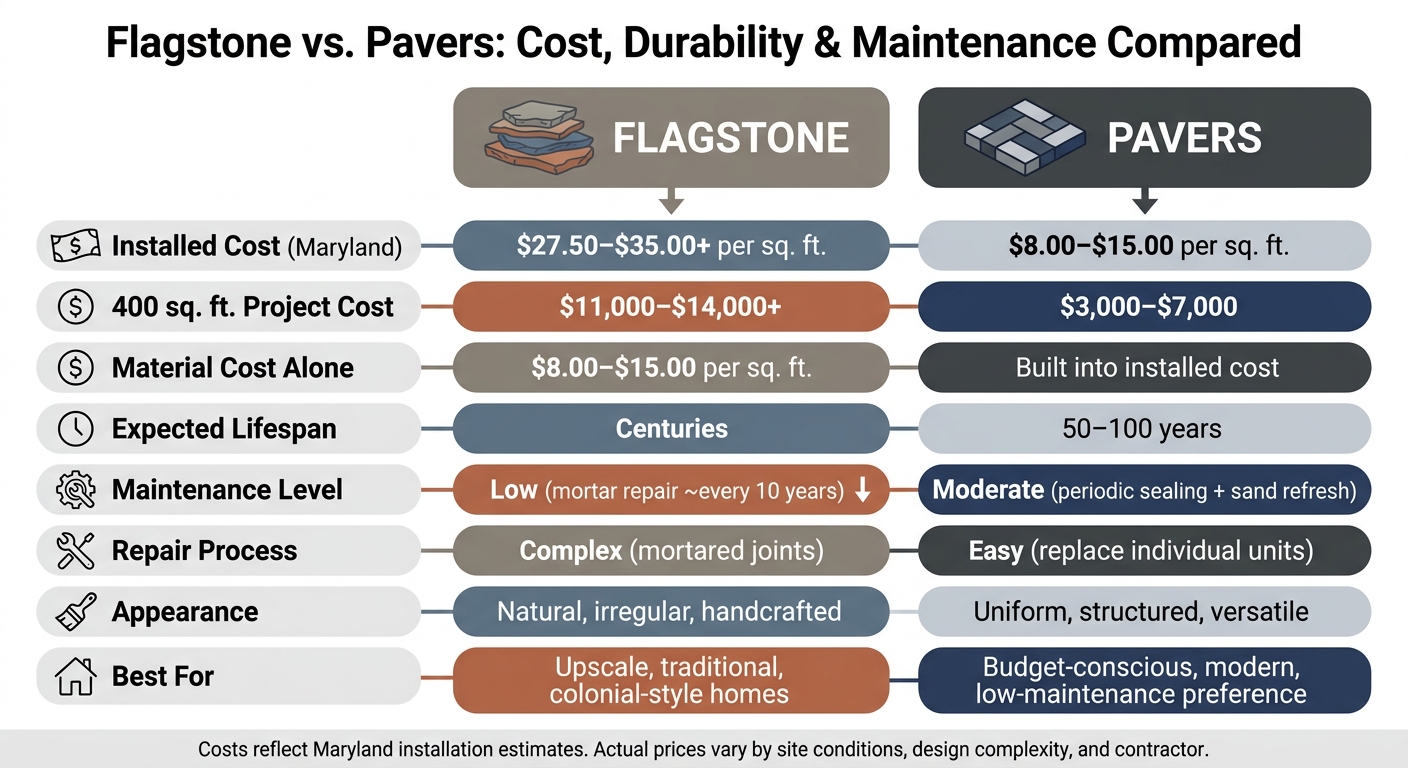
Flagstone vs. Pavers: Cost, Durability & Maintenance Compared
Flagstone Patio Cost Ranges
Flagstone stands out as a high-end option, with its pricing reflecting its premium quality. In Maryland, flagstone materials alone typically cost $8 to $15 per sq. ft., meaning a 200 sq. ft. patio could set you back $1,600 to $3,000 before installation even begins [3]. Once you factor in labor, the total installation cost averages around $27.50 to $35.00+ per sq. ft. for a 400 sq. ft. area [1].
When gathering quotes, it’s crucial to clarify whether the price includes materials only or full installation – this distinction can result in a price difference of thousands of dollars [3].
Paver Patio Cost Ranges
Pavers, being mass-produced, come with lower material and labor costs. Their uniform sizes and pre-cut shapes make installation quicker and less labor-intensive.
"Pavers are generally cheaper than flagstone. Pavers are mass-produced, making them more affordable and uniform in size, while flagstone is a natural stone that is often more expensive due to quarrying and transportation costs." – StonesDirect.com [4]
In Maryland, a fully installed paver patio usually costs between $8 and $15 per sq. ft., translating to $3,000 to $7,000 for a 400 sq. ft. area [4]. However, factors like the type of paver, intricate patterns, or additional drainage work can push costs toward the higher end of that range.
Cost Comparison Table: Flagstone vs. Pavers
Here’s a side-by-side breakdown of the costs and features of flagstone and pavers:
| Feature | Flagstone | Pavers |
|---|---|---|
| Maryland Material Cost | $8.00–$15.00 per sq. ft. [3] | Built into installed cost |
| Maryland Installed Cost | $27.50–$35.00+ per sq. ft. [1] | $8.00–$15.00 per sq. ft. [4] |
| Expected Lifespan | Centuries [5] | 50–100 years (with proper care) [5] |
| Maintenance | Low; mortar repair every ~10 years if mortared [5] | Occasional sealing and sand refresh [5] |
| Repair Process | Complex for mortared joints [5] | Simple – replace individual units as needed [5] |
| Design Style | Natural, rustic, irregular [3] | Versatile, uniform, modern [4] |
When considering long-term expenses, remember that mortared flagstone may require joint repairs approximately every 10 years, as mortar tends to crack over time [5]. On the other hand, pavers allow for easier maintenance since damaged pieces can be swapped out individually [5].
Durability and Maintenance: Flagstone vs. Pavers
How Each Material Handles Maryland’s Climate
Maryland’s weather can be tough on outdoor surfaces. With its freeze-thaw cycles, high humidity, and frequent rain, materials need to hold up under constant stress. Both flagstone and pavers are built to endure these challenges, though they manage it in distinct ways.
"Flagstone is highly durable and weather-resistant, able to withstand heavy foot traffic, temperature changes, moisture, and environmental conditions without significant deterioration." – Stones Direct [7]
Flagstone’s natural density gives it an edge in resisting moisture, which helps prevent cracking during freeze-thaw cycles. Its slip-resistant surface is also a bonus during icy winters and rainy seasons. Pavers, on the other hand, perform well when installed correctly. Their durability hinges on proper base preparation and compacted joint sand. If the foundation isn’t solid, pavers are more prone to shifting or heaving after a freeze. These differences in performance also shape how each material needs to be maintained.
Maintenance Requirements and Costs
Flagstone is relatively low-maintenance. For dry-laid installations, occasional releveling is enough, while mortared setups might need joint repairs after about a decade. Pavers, however, require more regular upkeep, including replenishing joint sand and periodic sealing. On the plus side, replacing a damaged paver is simple and quick.
"If a paver cracks, it’s also a quick fix to remove it and put in a new one." – Linnemann Lawn Care & Landscaping [5]
Over time, joint sand in pavers can wash away, leading to weed growth. Sealing the surface every few years helps stabilize the sand and preserve the material’s color. For cleaning, a mix of Dawn dish soap and water works well for everyday grime, while tougher stains may call for a specialized paver cleaner to avoid damage [7].
These maintenance habits directly affect the long-term value of each material.
Long-Term Value
How much care a material requires plays a big role in its overall value. Pavers have an impressive lifespan of 50–100 years, while a well-installed flagstone patio can last for centuries [5].
"Flagstone is also more durable overall than pavers, so it can last for centuries without breaking down." – Linnemann Lawn Care & Landscaping [5]
Flagstone’s classic, high-end look and longevity often stand out in Maryland’s upscale neighborhoods, where natural materials are highly regarded. While pavers may not carry the same prestige, they still enhance curb appeal and offer the advantage of easy repairs or layout changes. Whether you prefer a surface that requires minimal attention or one that’s adaptable and budget-conscious, both options provide excellent long-term value.
Aesthetic and Design Differences
How Flagstone and Pavers Look
Flagstone brings a natural, irregular look, giving patios a unique and handcrafted charm. Each piece varies in shape, color, and texture because it’s quarried rather than manufactured. This means no two installations are ever the same, which adds to its one-of-a-kind appeal.
On the other hand, pavers offer a more uniform and consistent appearance. They’re pre-cut and available in a wide array of manufactured colors, finishes, and patterns. Whether you want classic brick tones or sleek, slate-gray textures, pavers make it easier to achieve a structured and repeatable design.
| Feature | Flagstone | Pavers |
|---|---|---|
| Appearance | Natural, irregular | Uniform, structured |
| Color and pattern options | Varies by stone type (e.g., slate, bluestone, limestone); custom-fitted by hand | Wide range of manufactured colors; easy to arrange in set patterns |
| Overall feel | Traditional, high-end masonry | Modern or classic depending on style |
This difference in style also plays a role in how design complexity impacts overall costs.
How Design Complexity Affects Cost
Design complexity can significantly influence costs for both materials. Flagstone often requires custom cutting, which increases labor expenses, especially for intricate designs. For pavers, while complex patterns like herringbone or circular layouts also raise labor costs, their pre-cut nature keeps the baseline cost lower compared to flagstone.
Adding extra features such as built-in seating, fire pits, or integrated lighting can further elevate costs for either material. These additions typically range from $1,500 to $6,000 or more, depending on the scope of the project [1]. Such customizations not only enhance functionality but also help tie the patio design to the home’s architectural style, ensuring a cohesive look.
Aesthetic Factors Specific to Maryland
In Maryland, local architecture and climate greatly influence material choices. Colonial and craftsman-style homes often pair well with flagstone’s traditional masonry, while newer developments in areas like Clarksburg or Bowie tend to favor the clean, structured lines of pavers. Balancing these aesthetic preferences with budget considerations and long-term maintenance needs is key for Maryland homeowners.
Additionally, many Maryland residents are transforming their patios into complete outdoor living spaces. Features like retaining walls, seat walls, and outdoor kitchens are becoming popular [6]. In these cases, the choice between flagstone and pavers becomes part of a larger design plan. Collaborating with a contractor experienced in hardscaping in Baltimore ensures the final result complements both the home’s architecture and the surrounding environment [6].
Conclusion: Picking the Right Patio Material
Key Takeaways for Maryland Homeowners
When it comes to choosing between flagstone and pavers for your Maryland patio, both options bring something unique to the table. The best choice depends on your design vision, site specifics, and how much maintenance you’re willing to take on. Flagstone stands out for its natural, irregular beauty. In Maryland, you can expect materials for a 200 sq. ft. flagstone project to cost between $1,600 and $3,000 [3]. Options like quartzite and bluestone allow for custom layouts that complement traditional or eclectic styles.
On the other hand, pavers offer precision and uniformity, making them a go-to for homeowners who prefer low-maintenance, structured designs. Keep in mind that Maryland’s climate and soil conditions should influence your decision, as these factors impact durability and upkeep.
Here’s a quick side-by-side comparison to help you decide:
| Factor | Flagstone | Pavers |
|---|---|---|
| Appearance | Natural and irregular | Uniform and consistent |
| Design Flexibility | Custom, creative layouts | Structured, repeatable patterns |
| Long-Term Value | Extremely durable with minimal upkeep | Easy replacement of individual units extends lifespan |
Whether you favor the timeless charm of natural stone or the clean, organized look of pavers, these materials offer distinct advantages for your outdoor space.
How Pro Landscapes MD Can Help

Deciding between flagstone and pavers is all about finding the perfect fit for your home’s style, your yard’s layout, and Maryland’s specific climate challenges. Pro Landscapes MD has extensive experience designing and installing both types of patios across central Maryland. Their team handles everything – from site preparation and drainage solutions to material selection and installation. With their expertise, you can be confident your patio will be built to last and tailored to your vision.
FAQs
Which is cheaper long-term: flagstone or pavers?
Pavers tend to be a more budget-friendly option compared to flagstone in the long run. They come with a lower upfront cost, are simpler to install, and demand less maintenance over time. While flagstone provides a high-end, natural aesthetic and incredible longevity – sometimes lasting for centuries – it requires more labor and has a higher initial price tag. For most homeowners, the combination of pavers’ durability and ease of upkeep makes them the more economical choice over time.
Should I choose mortared or dry-laid flagstone?
Choosing between mortared and dry-laid flagstone comes down to what matters most to you: stability, maintenance, or aesthetics.
Mortared flagstone creates a solid, long-lasting surface, making it a great choice for high-traffic areas. It also helps minimize weed growth and prevents stones from shifting over time. On the other hand, dry-laid flagstone offers a more rustic, natural appearance. It’s easier to repair or adjust, but it may need more upkeep, especially in areas with heavy use or frequent freeze-thaw cycles.
What base and drainage work is needed for Maryland freeze-thaw?
In Maryland, where freeze-thaw cycles are common, a solid foundation is key to keeping patios intact. Start with a stable, compacted layer of gravel or crushed stone. This helps prevent shifting or cracking caused by the ground’s natural movement during freezing and thawing.
Equally important is proper drainage. Without it, water can accumulate, leading to frost heave damage. Common drainage solutions include:
- French drains: Subsurface systems that channel water away efficiently.
- Drainage pipes: Direct water flow to a safe location.
- Dry riverbeds: A decorative yet functional way to manage runoff.
To ensure your patio stands up to Maryland’s weather, consult a local expert for advice tailored to your specific site and conditions.
Chat with Us