









- bhavya gada
- No Comments
If I want the short answer: pavers are usually the better pick for lower cost, cleaner patterns, and easier repairs, while flagstone is the better pick for a natural look and a higher-end finish.
For most patios in central Maryland, I’d narrow the choice to 4 things right away:
- Price: pavers often run $10 to $25 per sq. ft., while flagstone is often $15 to $40 per sq. ft.
- Look: pavers give you straight lines and repeatable patterns; flagstone gives you a more organic look
- Upkeep: pavers need less routine care; flagstone often needs sealing every 3 to 5 years
- Site conditions: freeze-thaw cycles, clay soil, slope, and drainage can matter just as much as the surface material
A few facts stand out. Pavers can last about 25 to 50 years, and flagstone can last 50+ years when the base and drainage are done right. Base prep often adds $2 to $5 per sq. ft., and that part can make or break the whole job.
If I were choosing for function, I’d lean toward pavers. If I were choosing for character, I’d lean toward flagstone.
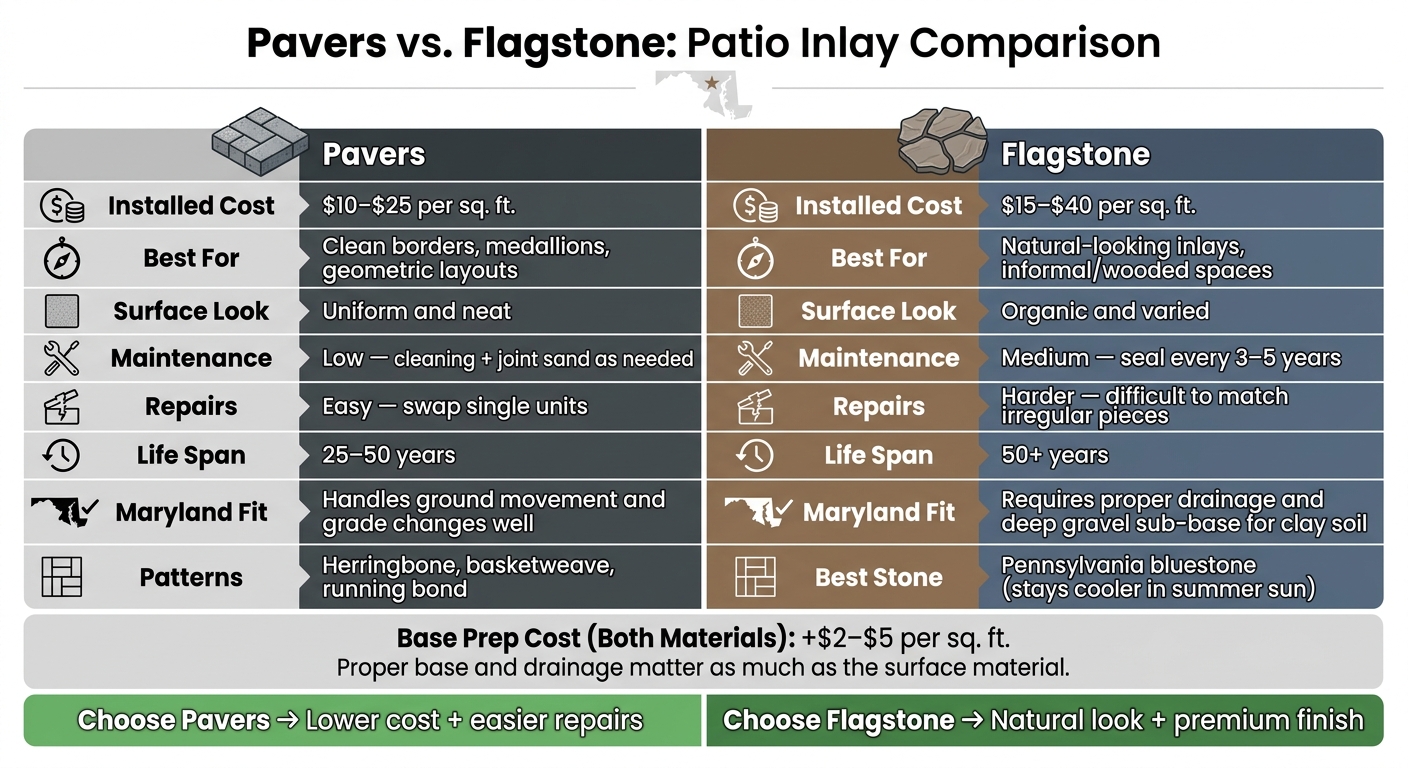
Pavers vs. Flagstone: Patio Inlay Comparison Guide
Flagstone vs Pavers: Which is Best for Your Patio?
sbb-itb-843f8be
Quick Comparison
| Feature | Pavers | Flagstone |
|---|---|---|
| Installed cost | $10 to $25/sq. ft. | $15 to $40/sq. ft. |
| Best for | Clean borders, medallions, geometric layouts | Natural-looking inlays, informal outdoor spaces |
| Surface look | Uniform and neat | Organic and varied |
| Maintenance | Low | Medium |
| Repairs | Single units are easier to replace | Repairs are harder to match |
| Life span | 25 to 50 years | 50+ years |
| Maryland fit | Handles ground movement well | Works well with proper drainage and base work |
Bottom line: if you want lower upfront cost and simpler fixes later, pavers make more sense. If you care most about the look and are okay paying more for labor and upkeep, flagstone may be the better fit.
Paver Inlays: Consistent Patterns, Lower Cost, and Easier Repairs
Pavers come in set shapes and sizes, which makes them a strong fit for patio inlays that need clean lines and exact placement. If you want crisp borders, medallions, or repeating patterns, that consistency makes the layout much easier.
When Paver Inlays Work Best
Paver inlays work best in planned, geometric designs. Patterns like herringbone, basketweave, and running bond are simpler to build when each piece is the same size. Borders also look cleaner when the pavers have matching dimensions and clear color contrast.
They also come in a wide range of colors and textures. That gives you room to mark off seating areas or add decorative medallions without making the layout feel messy.
Paver Inlay Costs and Routine Maintenance
Paver inlays are usually the lower-cost choice, with installed pricing often coming in below natural stone.
Routine care is pretty simple. In most cases, it comes down to cleaning and adding more joint sand when needed. Using polymeric sand helps reduce weed growth and help deter insects between the pavers [3].
If one paver gets stained or cracks, you can swap out that single unit without pulling apart the rest of the patio [2]. It also helps to keep a few extra pavers from the original install on hand, since that can make it easier to get a close color match later if one needs to be replaced [1].
If the design goal shifts from crisp precision to a more natural-looking finish, flagstone is the next option to look at.
Flagstone Inlays: Natural Look, Premium Finish, and Skilled Fitting
Flagstone gives a patio inlay a custom, organic look. The irregular shapes, mixed thicknesses, and color shifts create a finish that manufactured pavers just can’t match. That natural variation works best when you want the inlay to feel like part of the landscape, not something dropped on top of it.
When Flagstone Inlays Work Best
Flagstone fits best in wooded lots, cottage gardens, and other informal spaces where the inlay should blend in with the setting. Pennsylvania bluestone is a strong choice in the Mid-Atlantic. It also stays cooler underfoot in direct sun, which can make a big difference during hot Maryland summers [1].
Flagstone Inlay Costs and Long-Term Durability
That high-end look comes with more labor and a tougher install. Flagstone costs more because each piece has to be hand-fit, and many pieces need to be cut on site.
In Maryland, the base matters a lot. Clay-heavy soil can cause a poorly installed patio to sink or shift in as little as two seasons [2]. In places with heavy freeze-thaw cycles, dry-laid flagstone over a compacted gravel base often performs better than mortared installation because it lets the ground move without causing cracks [3].
Stone type matters too:
- Dense stones like bluestone or limestone tend to hold up well in high-traffic areas.
- Softer sandstones may show clear wear after 15–25 years [4].
- Sealing every 3–5 years helps cut down on stains from food, leaves, and rust.
Choosing the Right Material for Your Patio Inlay
Go with pavers if you want a lower upfront cost and simpler repairs. Go with flagstone if you want a more natural, high-end look. From there, the decision usually comes down to three things: cost, upkeep, and how the patio works with your site.
Choosing by Aesthetics, Budget, Repairability, and Longevity
Pavers make sense when future utility access is a concern. Since they come in individual units, sections can be lifted and reset without tearing up the rest of the patio [2].
Flagstone makes more sense when appearance is the top priority and the space calls for a finish that feels less manufactured.
Maryland Site Factors That Affect Both Materials
Site prep matters more than most people think. In many cases, local ground conditions have a bigger effect on patio performance than the material itself.
A few site factors affect both materials in much the same way:
- Slope and grading: If a patio settles and pitches the wrong way, water can drain toward your foundation [6]. On sloped lots, pavers often deal with grade changes better. Flagstone, on the other hand, may need to be mortared onto a poured concrete base to stay stable [6].
- Base depth: In central Maryland, a deep, well-drained gravel sub-base helps limit sinking and shifting in clay-heavy soil during winter freeze-thaw cycles [2].
Pro Landscapes MD checks drainage and soil conditions before installing patio inlays across central Maryland.
Conclusion: Matching the Right Inlay to Your Style, Budget, and Site
Pavers give you a more uniform surface, a lower price point at $10–$25 per sq. ft., and simpler replacement if one piece gets damaged [4][5]. Flagstone usually runs $15–$40 per sq. ft. and takes more time to install, but it gives the space a natural, custom look [1][4][5].
So the choice is pretty straightforward: pavers for function, flagstone for character.
Choose pavers if you want a flatter surface and easier repairs. Choose flagstone if you want a more natural, higher-end finish.
In Maryland, though, the decision isn’t just about looks. Site conditions matter too. Across central Maryland, grading and drainage can matter just as much as the material itself.
Pro Landscapes MD designs and installs paver and flagstone patio inlays across central Maryland.
FAQs
Which lasts longer in Maryland weather?
In Maryland’s climate, natural stone tends to last longer. You’re often looking at 50+ years, compared with about 25 to 50 years for concrete pavers.
It also holds up well against cracking, which matters a lot in a place with regular freeze-thaw cycles. Dense stones like granite or thermal bluestone are especially good at handling that kind of weather.
Concrete pavers are durable too, but they usually need resealing every 3 to 5 years and can fade with age. Natural stone, on the other hand, keeps its color much better.
Are pavers or flagstone better for sloped yards?
For sloped yards, the foundation matters most no matter which material you choose. Good grading and a solid, well-drained base help stop erosion and keep the surface steady.
Pavers are often easier to install on tricky layouts because they have a uniform shape and can shift a bit with ground movement. Flagstone can work well too, but its uneven thickness means it takes more skilled leveling to keep everything stable.
Which patio inlay is easier to repair later?
Concrete pavers are usually easier to fix than flagstone. Because they come in uniform shapes and sizes, you can remove and replace a single paver without messing up the area around it.
Flagstone is tougher to repair. Each piece has its own color, texture, and uneven shape, so finding a close match can be a hassle. Dry-laid flagstone may just need occasional re-leveling. Mortared installations, on the other hand, often need more involved joint repairs as the years go by.
Chat with Us