









- bhavya gada
- No Comments
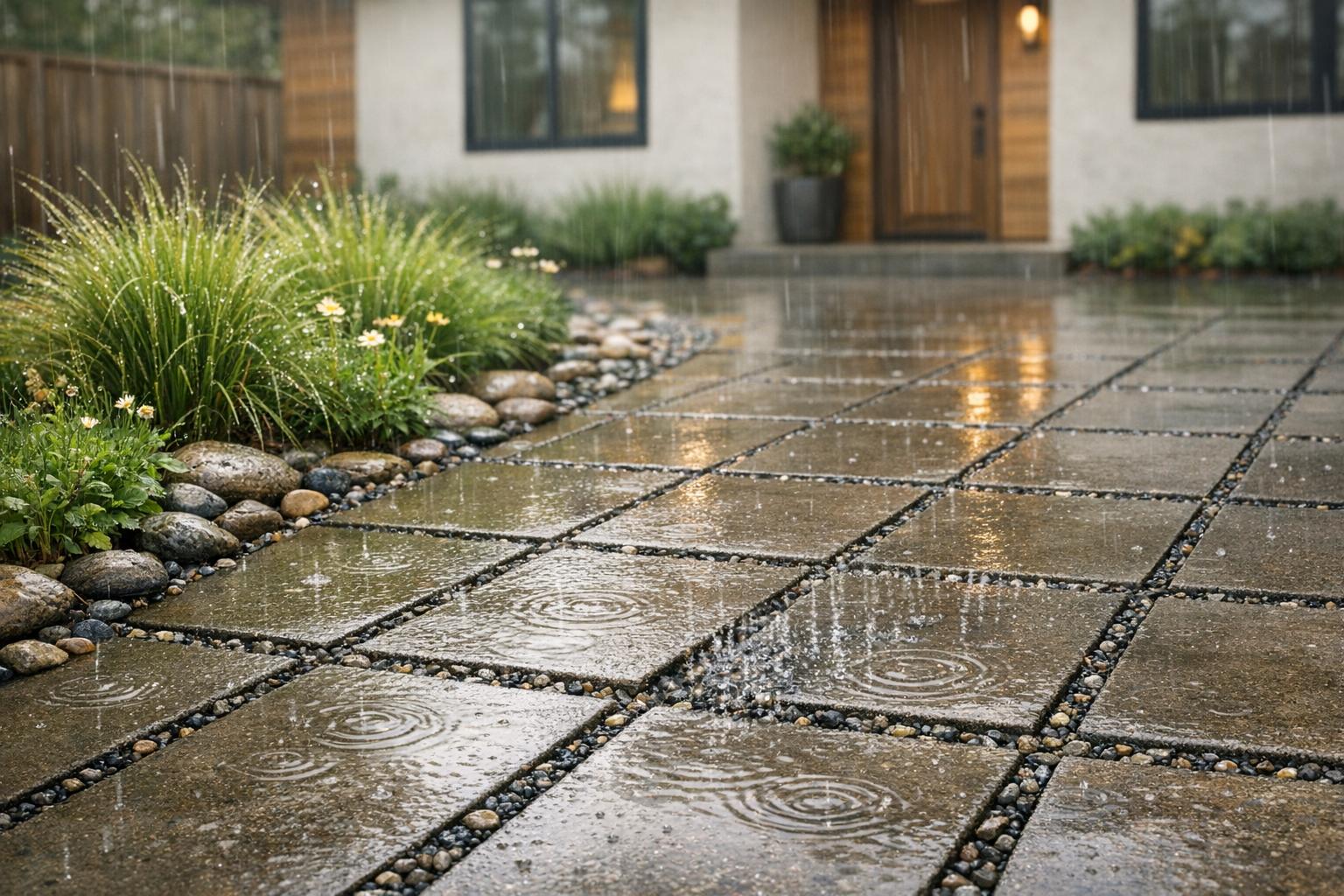
Permeable driveways are a smart solution for managing rainwater by allowing it to soak into the ground rather than running off into storm drains. Unlike solid concrete or asphalt, these driveways reduce flooding risks, filter out pollutants like motor oil, and help replenish groundwater. They also stay cooler, reduce ice formation in winter, and last longer than traditional options. While the upfront cost is higher – $10 to $30 per square foot – many Maryland homeowners can offset expenses with rebates and stormwater fee credits.
Key Points:
- Materials: Options include permeable interlocking concrete pavers, porous asphalt, and pervious concrete.
- Performance: Infiltration rates range from 5–20 inches per hour, managing up to 80% of rainfall.
- Maintenance: Annual vacuum sweeping and debris removal keep the system functional.
- Costs: Installation ranges from $6 to $40 per square foot, depending on material and site conditions.
- Incentives: Maryland offers rebates up to $14 per square foot and stormwater fee reductions.
Permeable driveways not only address water management challenges but also comply with local regulations, making them a practical and eco-conscious choice for homeowners.
How to Lay a Paver Driveway over a Permeable Base Construction
Types of Permeable Driveways
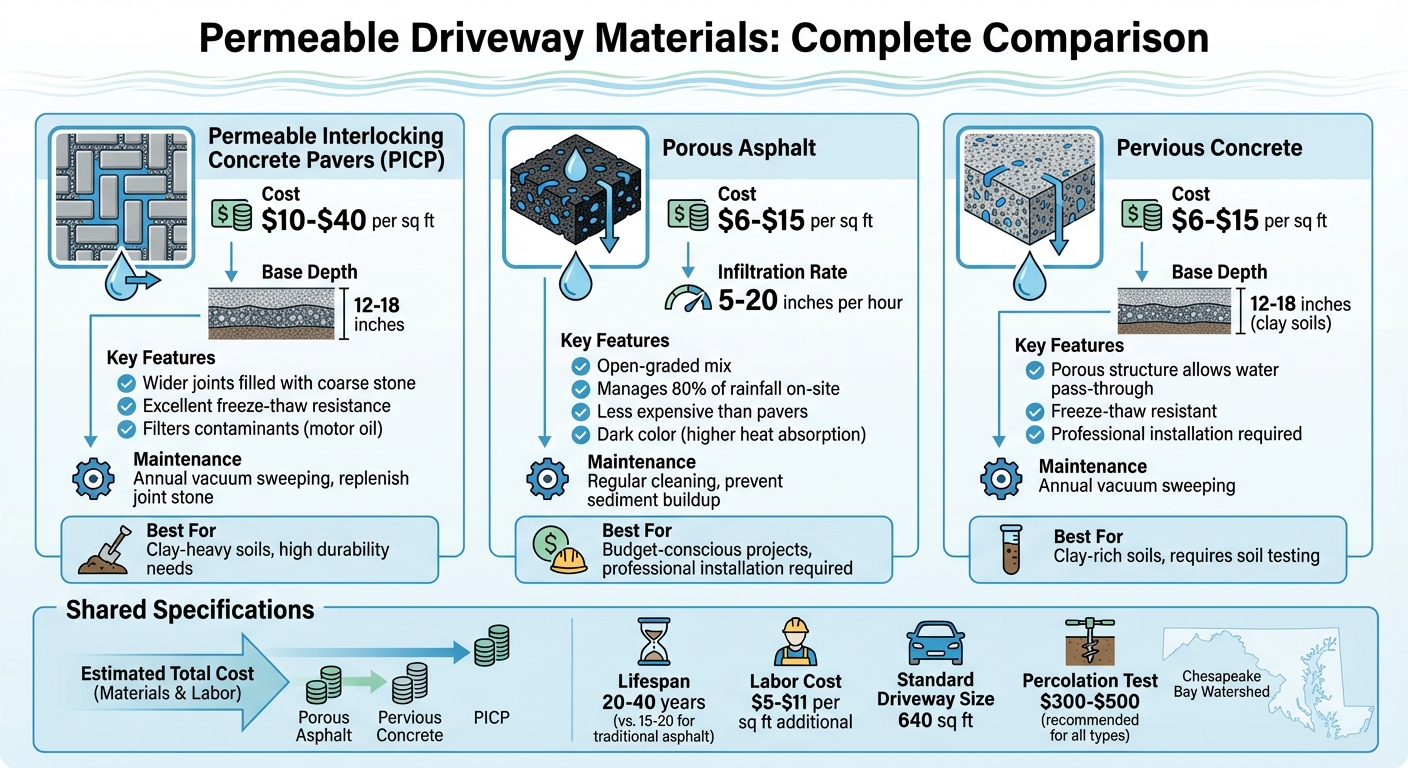
Permeable Driveway Materials Comparison: Costs, Performance & Maintenance
When it comes to permeable driveways, three primary materials dominate the market. Each option has its own characteristics, making it suitable for specific soil conditions and budgets. Here’s a closer look at these materials to help homeowners make informed decisions.
Permeable Interlocking Concrete Pavers (PICP)
PICP systems consist of concrete pavers with wider joints that are filled with clean, coarse stone. These joints allow water to flow through into an open-graded stone reservoir underneath, which is typically 12 to 18 inches deep for driveways [2]. This layered design helps distribute vehicle weight while also storing water, which gradually infiltrates into the ground. A key advantage is its ability to manage freeze-thaw cycles effectively, as water drains into the base rather than pooling on the surface. This reduces issues like ice formation and frost heave [2]. Additionally, the stone reservoir acts as a filter, trapping contaminants like motor oil before they reach waterways.
Maintenance is straightforward but essential. Annual vacuum sweeping removes fine sediments to keep the joints functional. Sand should be avoided for winter traction, as it can clog the joints; instead, opt for coarse stone or approved de-icing products. Occasionally, the joint stone may need to be replenished to maintain proper water flow. If you’re dealing with Maryland’s clay-heavy soils, a percolation test is recommended to determine whether an underdrain system is necessary [2].
Porous Asphalt
Porous asphalt is made with an open-graded mix that allows water to pass directly through the surface into the stone base below. As a poured material, it tends to be less expensive than interlocking paver systems, but professional installation is required [1][4]. It boasts impressive infiltration rates, ranging from 5 to 20 inches per hour, and can manage up to 80% of rainfall on-site [1]. However, its dark color absorbs heat, which may lead to higher surface temperatures during Maryland’s hot summers. Proper base depth and regular cleaning are crucial to prevent sediment buildup and maintain its functionality.
While porous asphalt shares many benefits with pervious concrete, their installation and upkeep differ, making it important to assess which option best suits your needs.
Pervious Concrete
Pervious concrete is designed with a porous structure that allows stormwater to pass directly through the material. Like porous asphalt, it requires professional installation and is resistant to freeze-thaw damage since water doesn’t linger on the surface [2]. For Maryland’s clay-rich soils, a 12 to 18-inch stone base is typically needed, and soil testing can help determine if underdrains are necessary [1][2]. To keep the pores open and functional, annual vacuum sweeping is recommended [2].
Each of these materials offers specific advantages, and understanding their performance and maintenance requirements can help homeowners choose the best system for effective water management.
Benefits of Permeable Driveways
Environmental Benefits
Permeable driveways act like a natural sponge, letting rainwater seep through the surface into a stone reservoir underneath instead of rushing into storm drains. This process not only slows water runoff but also filters out pollutants. As water moves through the stone layers, contaminants like spilled oil are removed before the water reaches local waterways. Jeanne Huber of The Washington Post explains:
"In a rainstorm, water washes off regular paving and flows untreated into storm drains… any spilled oil or other contaminants from driveways winds up in waterways, which can harm fish and other wildlife" [3].
By allowing water to soak into the ground, these driveways help replenish underground water supplies and stabilize local water levels [1][2].
They also reduce stress on municipal stormwater systems. Traditional paving can overwhelm sewage treatment facilities during heavy storms, sometimes causing untreated water to be released [2][3]. Additionally, permeable surfaces help combat urban heat buildup and manage freeze-thaw cycles more effectively, as water drains through the base instead of pooling on the surface [2].
Financial and Practical Benefits
Permeable driveways aren’t just good for the planet – they also offer practical and financial perks. In Maryland, for example, many jurisdictions provide stormwater fee reductions or credits for properties that use permeable surfaces to cut runoff [1][2]. These systems also eliminate the need for costly drainage infrastructure, like detention basins or underground pipes, as they serve as their own reservoir [1][2].
While the initial installation costs are higher – ranging from $10 to $30 per square foot compared to $3 to $5 for traditional asphalt [1] – the long-term benefits often outweigh the upfront expense. Permeable driveways last 20 to 40 years, outliving traditional asphalt, which typically lasts 15 to 20 years [1]. They also require less salt and fewer de-icing chemicals in winter since meltwater drains immediately rather than refreezing on the surface [1]. Plus, their eco-friendly appeal can boost property values, making them a smart investment [1].
Before installation, it’s a good idea to conduct a percolation test, which costs about $300 to $500. This test determines whether your soil can handle the water volume or if underdrains will be necessary [1].
Design and Site Considerations
Soil and Drainage Suitability
The first step in managing water effectively is understanding your site’s soil and drainage conditions. The type of soil you have plays a big role in determining whether a permeable driveway will work and what adjustments might be needed. For example, sandy or gravelly soils generally require a 12- to 15-inch stone base and don’t need underdrains. On the other hand, clay soils, which are common in Maryland, drain poorly. These require a deeper stone reservoir – 18 inches or more – and underdrain pipes to prevent water from accumulating underground. These adjustments not only improve the system’s efficiency but also ensure compliance with local regulations.
Before starting, a percolation test is essential. This test, which typically costs between $300 and $500, will help determine the necessary depth and spacing for drain pipes. The results will guide your contractor on how deep to dig and whether underdrains are needed to carry excess water away.
Slope also matters. The ideal slope for a permeable driveway ranges from 1% to 5% (about a 1-inch drop every 8 feet). This gentle incline helps water flow properly without creating surface puddles. While systems can manage slopes up to 12%, anything steeper will likely require terracing or barriers to slow down water flow and allow infiltration. For flat driveways (less than a 1% slope), underdrains are often needed to prevent standing water.
Another key component is geotextile fabric, which is placed between the soil and the stone base. This fabric stops fine particles from clogging the stone reservoir, a common problem in soft or organic soils. During installation, it’s crucial to keep the site free of fine silt and sand, as these materials can significantly reduce infiltration efficiency.
Once you’ve assessed your soil and drainage needs, the next step is ensuring your project complies with local regulations.
Compliance with Maryland Regulations
In Maryland, meeting Chesapeake Bay watershed regulations is a top priority. Many local jurisdictions require permeable surfaces for properties located within 1,000 feet of lakes or rivers. If you’re in a Sustainable Urban Drainage System (SUDS) zone, installing a permeable driveway isn’t optional – it’s mandatory.
Choosing a permeable system can also save you money. Some Maryland counties offer stormwater fee reductions, with credits of up to 80% off your annual stormwater management charges. Before starting your project, check with your county office to see if you qualify for tax breaks, cash-back rebates, or fee credits.
To get permits, you’ll need documentation, including soil test results and a drainage plan that outlines how water will infiltrate the ground. This process can feel overwhelming, but Pro Landscapes MD can help. Serving homeowners across Howard, Montgomery, Carroll, Frederick, Prince George’s, and Baltimore counties, Pro Landscapes MD specializes in stormwater management and permeable pavers. Their expertise ensures your project is designed correctly from the start, helping you avoid costly mistakes or regulatory headaches later.
sbb-itb-843f8be
Installation Process for Permeable Driveways
Excavation and Base Preparation
To start, excavate to a depth of 15–18 inches to make room for the subgrade, drainage layers, and paver seating. Clear away any debris from the subgrade and compact it to 95% density using a plate compactor with at least 5,000 pounds of force. This step is crucial to prevent settling over time.
Next, lay a permeable geotextile fabric over the compacted soil. This fabric acts as a barrier, keeping fine particles from clogging the stone reservoir’s voids.
The stone base is built in layers for stability:
- Begin with the main base, using 6–8 inches of washed, angular crushed stone sized between 3/4 inch and 2 inches. Compact the stone in 3–4 inch layers to ensure even density.
- Add a secondary base layer of 2–4 inches of smaller washed stone, ranging from 1/4 inch to 1.5 inches. This layer creates a smooth transition for the next steps.
- Finish with a 1–2 inch loose bedding layer of #8 or #9 stone chips. This layer helps ensure accurate placement of the pavers.
Surface Material Placement
Before laying the surface material, install edge restraints along the perimeter. These restraints – made from metal, plastic, or concrete – are secured with 10-inch spikes driven into the compacted base. Metal edge restraints are often preferred for driveways because they offer both strength and a clean look.
When placing the pavers, start at a straight edge or the lowest corner of the driveway. Carefully set each paver to protect the bedding layer, and use spacers to maintain 2–6 mm gaps between pavers. These gaps are vital for proper water infiltration.
Once all the pavers are in place, sweep angular #8 or #9 stone chips into the joints. Avoid using sand, as it can block the drainage voids. Finally, use a plate compactor fitted with a rubber mat to gently seat the pavers and settle the joint material. To ensure everything is working as it should, pour water over the surface. The water should infiltrate immediately without pooling.
For homeowners in Howard, Montgomery, Carroll, Frederick, Prince George’s, and Baltimore counties, Pro Landscapes MD offers a complete installation service. Their expertise in drainage systems and stormwater management ensures the job is done right – from excavation to final compaction. They also comply with Maryland’s watershed regulations, delivering a system that lasts. Routine maintenance after installation will keep the system functioning efficiently.
Maintenance Requirements
After installation, consistent upkeep is essential to keep your system performing efficiently. Over time, organic debris and fine sediments can accumulate in the joints and pores, which may hinder drainage. The good news? Most maintenance tasks are simple and don’t require any special expertise.
Cleaning and Debris Removal
Each month, sweep or blow away leaves, grass clippings, and soil. Clearing this debris before it decomposes in the joints helps prevent clogs that could block water flow [1][5].
For a deeper clean, use an industrial vacuum annually to remove fine sediments that regular sweeping might miss. If you opt for pressure washing, stick to a low setting to avoid disturbing the bedding layer beneath the surface [1][5]. After cleaning, refill the joints with 2–6 mm angular stone chips to maintain stability and infiltration [5].
To check for drainage issues, perform a simple test: pour water on the surface and see how quickly it absorbs. Ideally, water should infiltrate immediately at rates of 5 to 20 inches per hour. If puddles linger for more than 24 hours after rainfall, the system may be clogged and require attention [1][5].
These cleaning habits lay the groundwork for effective yearly inspections.
Annual Inspections
Conduct yearly inspections to catch potential problems early. Look for signs like slow drainage, missing joint aggregate, cracks, settling, or moss and weeds in the joints. The presence of moss or weeds often means organic material has built up enough to support plant growth, signaling a clog [1]. To prevent further issues, remove weeds by hand, as their roots can disrupt the sub-base or trap additional sediment [5].
During winter, take extra precautions. Raise snowplow blades to avoid scraping away joint aggregate, or better yet, use a snow blower. Avoid spreading sand or fine gravel for traction, as these can migrate into the pores and cause permanent clogs. Instead, stick to coarse abrasives or de-icers approved by the manufacturer [2][6]. Once winter ends, inspect the surface for any leftover anti-skid materials or salt debris that may need removal [1].
"Proper, proactive maintenance is the key to ensuring your driveway functions effectively for its entire lifespan, which can often exceed 30 years." – Tamura Designs [6]
For homeowners in Howard, Montgomery, Carroll, Frederick, Prince George’s, and Baltimore counties, Pro Landscapes MD offers professional maintenance and drainage repair services. Their expertise in stormwater management ensures your permeable driveway continues to perform as intended for years to come.
Costs and Incentives for Maryland Homeowners
When planning your permeable driveway project, understanding the associated costs and available financial incentives is crucial. These insights will help you make informed design choices while ensuring the durability and effectiveness of your investment. Maryland homeowners can take advantage of appealing rebate programs to offset a significant portion of the upfront costs.
Factors Influencing Costs
The cost of your permeable driveway largely depends on the materials you choose. Here’s a breakdown:
- Permeable pavers: Cost between $10 and $40 per square foot. For a standard 640-square-foot driveway, this translates to $6,400 to $19,200 [1].
- Pervious concrete and porous asphalt: Range from $6 to $15 per square foot [1].
Labor costs add another $5 to $11 per square foot, depending on the complexity of the project [1].
Site conditions also play a role. Maryland’s clay-heavy soil often requires deeper excavation – 15 to 18 inches minimum – and additional drainage solutions like underdrain systems or perforated pipes to prevent water pooling [1][5]. For steeper grades (over 12%), terracing may be needed to ensure proper water filtration [1]. If you plan to park heavy vehicles like RVs or trucks, you’ll need a thicker sub-base – 8 to 10 inches compared to the standard 6 to 8 inches for regular cars [5].
"Permeable pavers installation typically lasts 20-25 years with proper care, and some high-quality systems go beyond 30 years."
– Calvin van Eck, Paving Guide Author, Panda Pavers [1]
Rebates and Incentives
Maryland provides several rebate programs to help reduce installation costs for permeable driveways:
- Prince George’s County: Offers $12 per square foot for permeable pavement installations, with a maximum lifetime rebate of $6,000 for residential properties [7][8].
- City of Gaithersburg: Provides $14 per square foot [9].
- Montgomery County: Runs a cost-share program with a rebate ceiling of $7,500 per parcel [11].
These programs require pre-approval before starting your project, as retroactive rebates are not available [7][11]. Once approved, rebate checks are typically issued within 6 to 8 weeks in Prince George’s County [7] and 8 to 12 weeks in Montgomery County [11].
Montgomery County residents can also apply for a Water Quality Protection Charge (WQPC) credit after receiving their rebate, which helps lower property tax fees [11]. However, eligibility depends on whether your municipality manages its own stormwater funds. For instance, City of Bowie residents cannot access Prince George’s County programs because the city operates its own system [7][10].
For homeowners in Howard, Montgomery, Carroll, Frederick, Prince George’s, and Baltimore counties, Pro Landscapes MD offers guidance on navigating these rebate programs. They can also help design and install your permeable driveway to ensure it meets all requirements for maximum financial benefits.
Conclusion
Permeable driveways provide Maryland homeowners with a practical and environmentally conscious way to address stormwater issues while safeguarding local waterways. These driveways not only filter out pollutants and reduce stormwater runoff but also improve safety during winter months by allowing water to drain effectively. With infiltration rates ranging from 5 to 20 inches per hour, they turn your driveway into a proactive solution for Maryland’s stormwater challenges[1].
However, the key to reaping these benefits lies in proper installation. A professional installation ensures the system functions as intended, starting with a thorough site assessment. This includes steps like adequate excavation, ensuring proper drainage, and conducting a percolation test to confirm the soil’s suitability.
On top of the environmental perks, permeable driveways can also come with financial incentives. Some jurisdictions in Maryland offer rebates or stormwater fee credits, which can help reduce the overall cost of installation.
Pro Landscapes MD specializes in helping Maryland homeowners design, install, and maintain permeable driveways. Their team takes care of everything – from soil testing and navigating incentive programs to ensuring compliance with Maryland’s environmental standards. They’ll make sure your driveway not only meets structural demands but also contributes to protecting your property and the Chesapeake Bay for years to come. Reach out to them to turn your driveway into a sustainable and functional asset.
FAQs
Will a permeable driveway work with Maryland clay soil?
A permeable driveway can function effectively even with Maryland’s clay-heavy soil, but it requires careful planning and installation. Clay soil has naturally low absorption rates, so incorporating a layered base – typically 6 to 18 inches of stone or gravel – can help control water flow and improve drainage. To further address water management, additional measures like French drains might be necessary to prevent water from pooling.
Consistent upkeep is also crucial. Regularly clearing debris from the surface ensures the system remains efficient and prevents clogging over time.
Do I need an underdrain or percolation test?
Whether you need a percolation test or an underdrain depends on the specific conditions of your driveway. A percolation test helps determine how effectively your soil absorbs water, which is critical for permeable surfaces. On the other hand, an underdrain might be required if your soil has poor or uneven drainage or if the area struggles with water runoff issues. Both approaches play a key role in managing water properly for a functional permeable driveway.
What maintenance prevents a permeable driveway from clogging?
To keep your permeable driveway working as it should, make regular maintenance a priority. Start by sweeping the surface often to clear away debris like leaves and dirt. Once a year, give the joints a thorough cleaning to prevent buildup that could block water flow. Also, make sure the driveway was installed with a proper permeable base – this is key to maintaining its drainage capabilities. These simple steps can go a long way in preserving its effectiveness.
Chat with Us