









- bhavya gada
- No Comments
Permeable paver jobs often cost more than standard hardscape jobs because you’re paying for both the surface and the drainage layer below it. In most cases, I’d expect a project to land around $5,000 to $12,000, but the final number usually comes down to five things: the system you choose, the size and shape of the area, the base depth, the drainage plan, and labor plus upkeep.
If I had to boil the whole topic down, it would look like this:
- Material choice sets the starting price
- About $5 to $12 per sq. ft. for plastic grid systems
- About $6 to $18 per sq. ft. for pervious concrete
- About $7 to $15 per sq. ft. for porous asphalt
- About $10 to $20 per sq. ft. for interlocking concrete units
- Site conditions can swing the price fast
- Clay soil may add $3 to $8 per sq. ft.
- Old surface removal may add $2 to $5 per sq. ft.
- Curves and custom layouts may add $1 to $5 per sq. ft.
- The base below the surface is a major cost piece
- Driveways may need 12 to 24 inches of excavation
- Underdrains can add $4 to $8 per sq. ft.
- Geotextile fabric may add $0.50 to $2 per sq. ft.
- Drainage rules and permits matter
- Permit fees often run $100 to $500
- Some Maryland rebates may reach $10 to $20 per sq. ft.
- Some stormwater fee credits may be $5 to $25 per month
- Maintenance affects the long-term bill
- Plan on about $0.25 to $1 per sq. ft. per year
- Vacuum sweeping may cost $150 to $500 per visit
- <u>Standard sand should not be used in the joints</u>
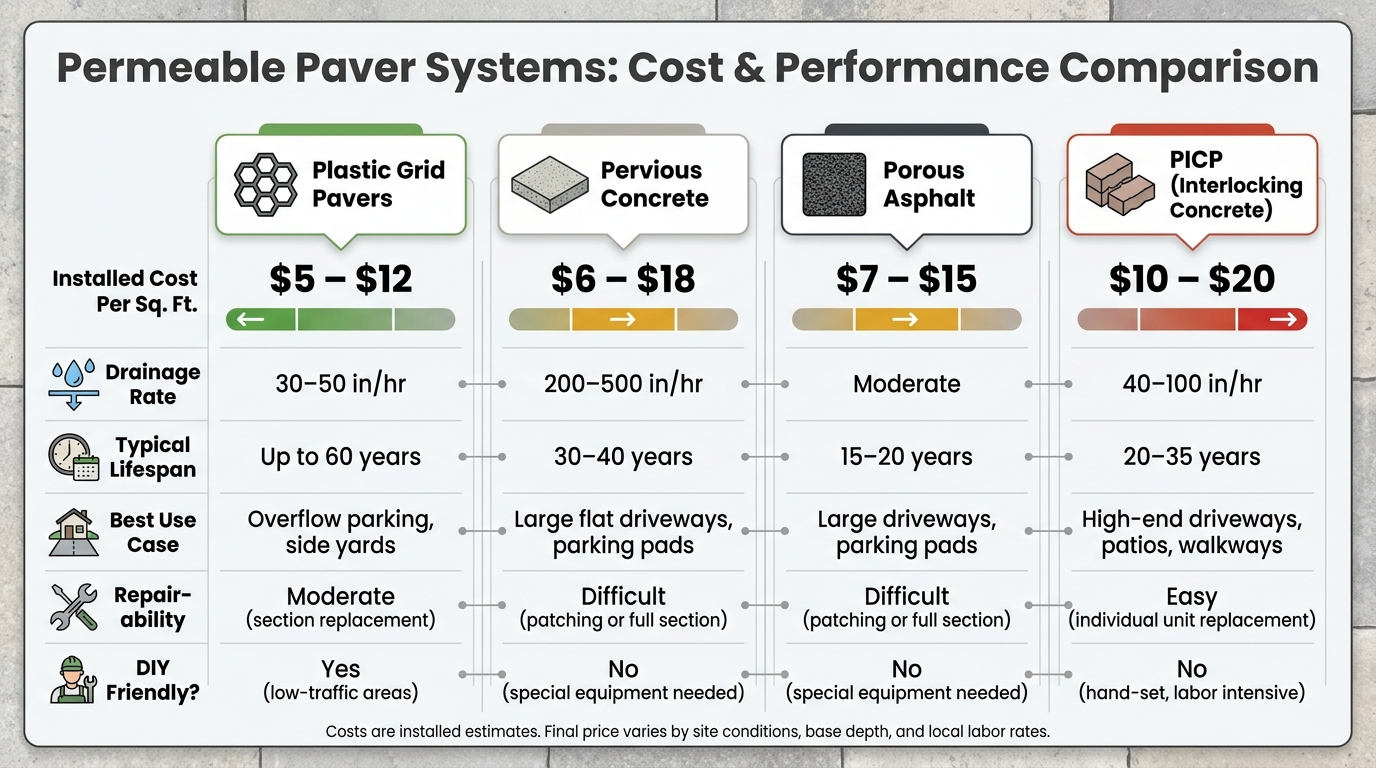
Permeable Paver Cost Comparison by System Type
How much do PERMEABLE pavers cost?
sbb-itb-843f8be
Quick Comparison
| Cost Factor | What changes the price most | Typical added cost |
|---|---|---|
| System type | Surface material and install method | $5 to $20 per sq. ft. total range |
| Site conditions | Clay soil, slope, access, tear-out | +$1 to $8+ per sq. ft. |
| Base work | Excavation, stone, fabric, drains | +$2 to $8 per sq. ft. plus materials |
| Drainage and permits | Testing, underdrains, local rules | $100 to $500 permits; drains extra |
| Labor and upkeep | Layout detail, access, yearly cleaning | Up to $15 per sq. ft. labor on hard jobs |
My takeaway: the lowest quote can miss the cost of deeper digging, more stone, or drainage parts. If you compare bids, I’d focus on what’s below the surface just as much as what you see on top.
Why Permeable Paver Costs Differ From Standard Paver Projects
Standard pavers are mostly about how the surface looks. Permeable pavers have to do more than that. They need to support traffic and handle water, which is why they usually cost more.
Put simply, permeable pavers work as both a finished surface and a drainage system.
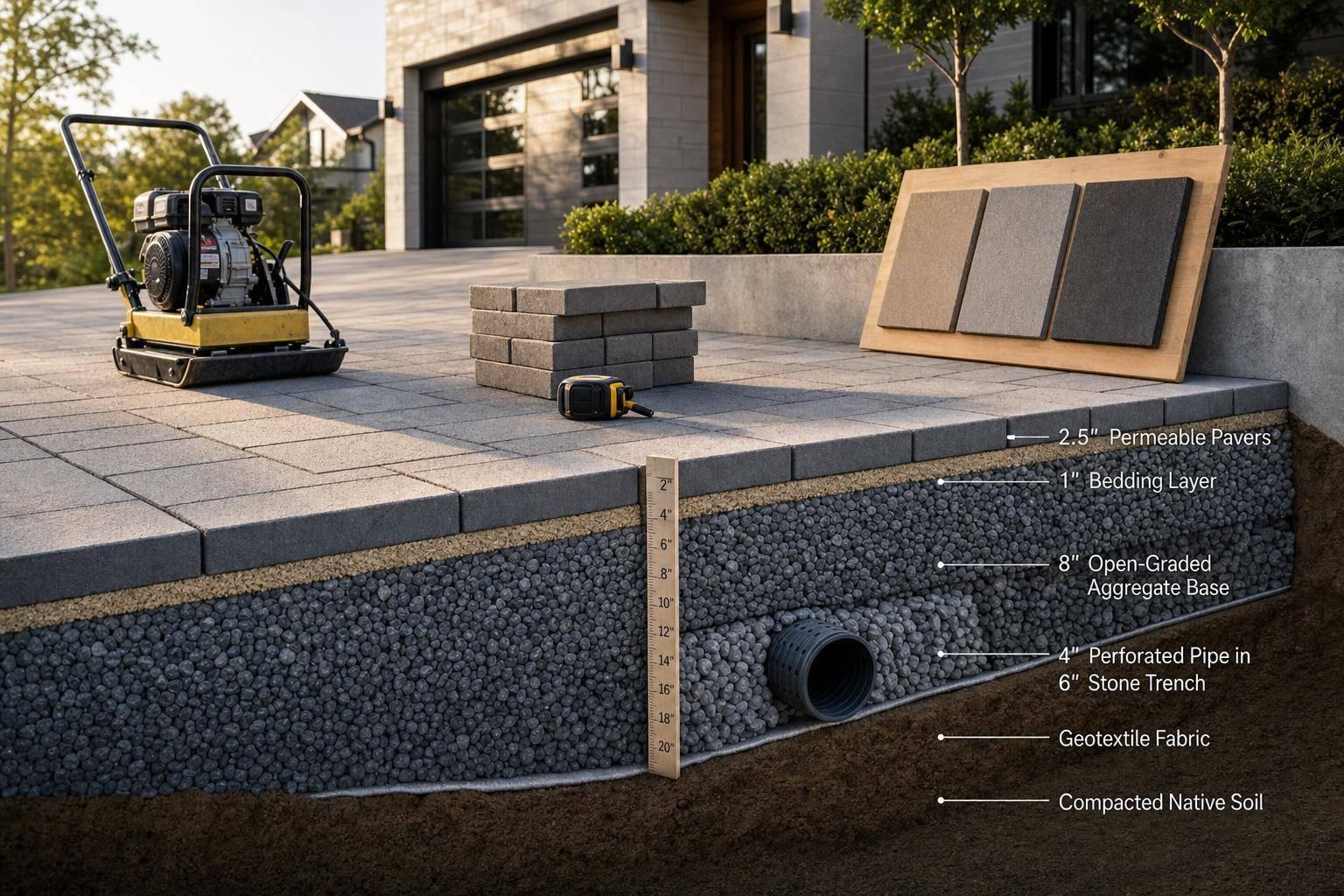
With a standard installation, crews often excavate about 4 to 8 inches and install compacted sand plus dense-graded aggregate. A permeable system usually calls for 12 to 24 inches of excavation for a driveway [2]. It also uses open-graded aggregate as both a structural base and a temporary reservoir for rainwater [1][2].
That difference adds up fast. More digging means more labor. More base material means higher material costs. And more planning on the front end means more time spent getting the system right.
Site conditions matter too. Contractors need to check how well the soil drains, because that affects the design. If the site drains poorly, the project may need underdrains or a deeper stone base [2]. Those drainage needs can add $3 to $8 per square foot [5]. On top of that, permeable pavers usually cost $3 to $5 more per square foot than standard concrete installations [2].
The biggest cost driver, though, is the paver system itself. That’s the next piece to look at.
1. Paver Material Type and System Selection
Material choice sets the baseline for price, drainage, labor, and upkeep. So if you’re trying to estimate costs, this is the best place to start.
Installed Cost Per Square Foot
Permeable systems have a pretty wide price range. Plastic grid systems are usually the lowest-cost way in, at $5 to $12 per square foot installed [7][2]. Pervious concrete sits in the middle at $6 to $18 per square foot [1][2]. Porous asphalt usually falls between $7 and $15 per square foot [7][2].
Permeable interlocking concrete pavers, or PICP, are often the top-end option. Homeowners often pick them for a more polished look and strong long-term wear [2][1].
Drainage Performance and System Selection
Drainage rate matters because it shapes the subgrade design and, in turn, the total cost. Pervious concrete moves water the fastest at 200 to 500 inches per hour. PICP handles 40 to 100 inches per hour through aggregate-filled joints. Plastic grids move about 30 to 50 inches per hour through open cells [7].
That difference can affect how much stone base you need and whether underdrains are needed at all. In some cases, a system with higher drainage can trim those added costs. For most homeowners, though, the choice usually comes down to three things: use, appearance, and budget.
Labor and Equipment Needs
Material type also shapes labor costs more than almost anything else. PICP takes more time because each unit has to be set by hand, and that pushes labor costs up [2][7].
Plastic grids go in much faster and can even work as a DIY option in low-traffic spots, like overflow parking [2][7]. Pervious concrete and porous asphalt are faster to install than PICP on large, flat areas, but they still need special equipment, which adds to the bill [2][7].
Lifecycle Cost
A higher upfront price doesn’t always mean a higher long-term cost. PICP has one big advantage here: crews can lift and replace damaged units one at a time without disturbing the rest of the surface [1][2].
Pervious concrete and porous asphalt are harder to deal with once cracks show up. They usually need patching or full-section replacement [2]. That’s why total ownership cost depends on more than lifespan alone. Repair options and maintenance frequency often matter just as much.
| System Type | Installed Cost (per sq. ft.) | Est. Lifespan | Maintenance |
|---|---|---|---|
| Plastic Grid Pavers | $5 – $12 | Up to 60 years | Mowing or gravel top-offs |
| Pervious Concrete | $6 – $18 | 30 – 40 years | Vacuuming/pressure washing |
| Porous Asphalt | $7 – $15 | 15 – 20 years | Resealing, vacuuming |
| PICP | $10 – $20 | 20 – 35 years | Vacuuming, joint aggregate top-offs |
Next, project size and site conditions decide how much excavation, stone, and labor the job needs.
2. Project Size, Layout, and Site Conditions
Material choice sets the system. But the site itself often decides how much the job will cost.
Once you’ve picked the material, the next big price shifts usually come from the size of the area, the shape of the layout, how easy it is to reach the site, and what the soil is like underneath.
Installed Cost Per Square Foot
Project size has a direct effect on the price per square foot. Small jobs usually land at the high end of the range. Bigger installs, like a 500-square-foot driveway, can drop to $8 to $20 per square foot because fixed mobilization and equipment costs get spread across more area [2].
Layout matters too. A curved or irregular design can add $1 to $5 per square foot in labor because crews have to do more cutting and fitting [5]. A simple rectangle is easier and cheaper. Lots of bends and odd edges? That’s where labor starts to climb.
Soil Drainage and Grading
After size and layout, soil and slope often decide how deep the base needs to be. Sandy soil usually allows for a shallower aggregate base with less excavation. Clay soil is a different story. It often means deeper digging, underdrains, and more labor [2][7].
Slope can push costs up as well. On a steep site, you may need extra grading, terracing, or even retaining walls on top of the base work [2][7]. So two driveways with the same square footage can end up with very different price tags just because one sits flat and the other doesn’t.
Labor and Equipment Needs
Access can change the whole math of a project. If equipment can get in and out without much trouble, the crew can move faster. If access is tight, labor costs can climb fast because materials may need to be moved by hand [2][6].
Removing an old surface adds another layer of cost. If there’s existing concrete in place, demolition and disposal can add $2 to $5 per square foot before the new installation even starts [2].
Long-Term Ownership Cost
The upfront bill is only part of the picture. Site conditions can also shape what you spend later.
Clay soil tends to clog joints faster, and steep slopes can wash out aggregate. That means more maintenance over time than you’d usually see on a large, flat site with good drainage [2][7]. On the flip side, a flat, open area is often the cheapest to install and may offer the best shot at stormwater fee rebates [2].
| Site Condition | Impact on Installation | Long-Term Cost Effect |
|---|---|---|
| Clay Soil | Deeper excavation and likely underdrains [2][7] | More frequent cleaning needed [2] |
| Steep Slope (>5%) | Grading and possible terracing or retaining walls [7] | Joint aggregate may need top-offs [7] |
| Limited Equipment Access | More manual labor and smaller equipment [2][6] | – |
| Existing Concrete | Demolition adds $2–$5 per square foot [2] | – |
| Large, Flat Area | Lowest per-square-foot cost; efficient machine use [2] | Best chance for stormwater fee rebates [2] |
3. Base Construction, Excavation, and Subgrade Preparation
After you pick the material and the site, the next big cost piece is the part no one sees. The pavers on top matter, sure. But the work below the surface often costs more than the surface units themselves.
Excavation depth, the size of the stone reservoir, and the condition of the soil under that base all shape the final price. In plain terms: what’s underground can make or break the budget.
Installed Cost Per Square Foot
Excavation and grading usually add $2 to $8 per square foot. Base aggregate runs $40 to $86 per cubic yard. Geotextile fabric adds $0.50 to $2 per square foot, and underdrains add $4 to $8 per square foot on sites with poor drainage.
Those numbers stack up fast, especially when the design calls for a deeper system.
Drainage Performance
Drainage needs are a big factor because they set the base depth. That base does two jobs at once: it supports the surface and holds water until the soil below can soak it in.
On sandy or loamy soils, the stone base often needs 6 to 12 inches. Clay soils can need 18 to 24 inches or more, plus underdrains [2][7].
That’s a huge difference. More depth means more stone, more digging, and more hauling.
Labor and Equipment Needs
A deeper excavation also means more labor and more machine time. Crews have to dig more, move more soil, and haul away more material.
A soil infiltration test before design helps set the needed depth and shows whether underdrains are required [2][7]. This step matters because it keeps the design tied to site conditions instead of guesswork.
Deeper bases also push up hauling and disposal costs, especially on clay sites where much more material has to come out [6].
Long-Term Ownership Cost
The base layer affects more than the install bill. It also shapes how the system holds up over time.
A well-built base can help the system last 20 to 30 years. Poor subgrade prep, on the other hand, can lead to settling and drainage problems [2][7].
| Base Component | Estimated Cost | What It Does |
|---|---|---|
| Excavation & Grading | $2–$8 per sq. ft. | Sets reservoir depth and drainage capacity |
| Base Aggregate | $40–$86 per cu. yd. | Provides structure and short-term water storage |
| Geotextile Fabric | $0.50–$2 per sq. ft. | Prevents soil from contaminating the stone base |
| Underdrain System | $4–$8 per sq. ft. | Helps manage water in clay or poor-draining soils |
| Annual Maintenance | $0.25–$1 per sq. ft. | Keeps joints clear and drainage performance intact |
4. Drainage Design and Stormwater Management Requirements
Even after the base is in place, drainage design can still move the budget up or down. One of the first checks is soil infiltration testing during site prep. That test helps show how deep the stone reservoir needs to be [2].
Installed Cost Per Square Foot
Drainage design adds project costs beyond the paver surface itself. Permit fees for stormwater work usually range from $100 to $500, depending on the local jurisdiction [4].
At the same time, a well-designed permeable system can cut down on – or even remove – the need for separate stormwater infrastructure. That can lower the total project cost [3].
Drainage Performance
For full infiltration without supplemental underdrains, a site needs at least 0.5 inches per hour of infiltration [7]. If the site falls below that mark, underdrains may be needed to carry stored water off-site.
Grading matters too. If the slope is off, runoff can be pushed away from the permeable area, which makes the design more complex [7].
Labor and Equipment Needs
Drainage needs also shape how hard the install will be. If a project calls for underdrains or other stormwater parts, the crew has more to coordinate. That usually means more labor time and more equipment on site.
Long-Term Ownership Cost
Some municipalities offer stormwater utility fee credits of $5 to $25 per month [2]. In Maryland, qualifying permeable projects may also receive rebates of $10 to $20 per square foot, and pre-approval is often required [2].
Those drainage choices also affect installation time and maintenance, which drive the next cost factor.
5. Labor, Installation Complexity, and Long-Term Maintenance
Installed Cost Per Square Foot
Labor is often one of the biggest cost drivers in a permeable paver project. And on more complex sites, that number can climb to $15 per square foot. If the design includes tight curves, borders, or other detailed patterns, expect another $1 to $5 per square foot on top of that [5]. Once installation is done, maintenance usually becomes the main long-term expense.
Labor and Equipment Needs
Retrofits tend to take more time. So do sites with limited access, where crews have to work around tight spaces and move equipment more carefully. That extra handling can slow the job down and push labor costs higher.
Winter Performance and Repairs
Properly designed drainage and storm water management systems are essential for maintaining these benefits year-round.
Permeable surfaces can help reduce ice buildup in winter and may cut down on salt use. But there’s a catch: if the joints get clogged, that advantage starts to fade.
One nice thing about pavers is repair work stays fairly contained. If a section gets damaged, crews can lift and replace individual pavers without tearing out the whole surface.
Long-Term Ownership Cost
Good installation makes a big difference later. If the base, joints, and surface are installed the right way, upkeep tends to stay simpler and lower over time.
Annual maintenance is pretty straightforward, but you can’t skip it. Vacuum sweep the surface at least once a year, and do it more often near construction zones or areas with heavy tree cover. A fair budget range is $0.25 to $1 per square foot per year [3].
One detail matters more than it sounds: do not use standard sand. It can clog the joints [2].
Cost Comparison Tables
These tables pull the five cost drivers into one place, so you can compare options fast.
By Material Type
| Permeable System | Typical Installed Cost (per sq. ft.) | Best Use Case | Typical Lifespan |
|---|---|---|---|
| Plastic Grid Pavers | $5 – $12 | Side yards, overflow parking | Up to 60 years |
| Concrete Grid Pavers | $4 – $18 | Driveways, grass-infill areas | 10 – 20 years |
| Pervious Concrete | $6 – $18 | Large flat driveways, parking pads | 30 – 40 years |
| Porous Asphalt | $7 – $15 | Large driveways, parking pads | 15 – 30 years |
| Permeable Interlocking Concrete Pavers (PICP) | $10 – $20 | High-end driveways, patios, walkways | 20 – 35 years |
A quick read of the table shows the tradeoff pretty clearly: lower upfront cost can come with a shorter service life, while higher-end systems often cost more at install but may fit better for finished outdoor spaces.
By Site Condition
| Site Condition | Cost Impact (per sq. ft.) | Primary Reason |
|---|---|---|
| Flat, simple site | Baseline | Standard excavation depth, grading, and minimal cutting |
| Sloped lot | +$2 – $10+ | Deeper stone reservoir, possible retaining walls |
| Complex layout | +$1 – $5 | Curves, borders, and intricate patterns increase labor time [5] |
| Old pavement removal | +$1 – $5 | Demolition, hauling, and disposal costs |
Site conditions can swing the final price more than many homeowners expect. A flat lot is the cleanest path. Once slopes, tear-out work, or detailed layout work enter the picture, labor and base prep start adding up.
Lifecycle and Maintenance
| System Type | Installation Cost (per sq. ft.) | Annual Maintenance | Typical Lifespan |
|---|---|---|---|
| Plastic Grid | $5 – $12 | Gravel top-offs; mowing if grass-filled | Up to 60 years |
| Concrete Grid | $4 – $18 | Weed control; mowing; occasional power washing | 10 – 20 years |
| Porous Asphalt | $7 – $15 | Periodic vacuuming; avoid standard sealants | 15 – 30 years |
| Pervious Concrete | $6 – $18 | Annual pressure washing or vacuuming | 30 – 40 years |
| PICP | $10 – $20 | Vacuum sweeping; joint aggregate refill every 2–5 years | 20 – 35 years |
Maintenance matters just as much as install price. Some systems need little more than topping off gravel or mowing, while others need vacuuming or joint refill on a set schedule to keep water moving through the surface.
Individual paver replacement keeps repair costs localized.
In Maryland, soil conditions, permit rules, and rebate eligibility can shift these totals further.
Maryland-Specific Cost Factors for Homeowners
Material choice and layout matter, but in Maryland, site conditions can push the price up fast.
Clay-heavy soils in central Maryland are a big one. They often need deeper base layers and underdrains, which can add about $3 to $7 per square foot [5].
Tree-heavy lots can also make the job more expensive. Roots make excavation harder, and falling leaves or organic sediment can clog the joints over time. So maintenance tends to come up more often. Vacuum sweeping usually runs $150 to $500 per visit. That extra upkeep hits hardest on properties with heavy tree cover and clay soil.
Local rules can change the final cost too. Freeze-thaw winters may mean more maintenance, although permeable surfaces may reduce deicing salt use to 0% to 25% of what standard concrete needs [1]. Permit fees often fall between $100 and $500, and some county programs offer $10 to $20 per square foot in rebates if you get pre-approval [2][4].
What to Ask a Contractor Before Work Begins
Before work starts, ask clear, direct questions about scope and pricing. That makes it much easier to compare bids based on the cost factors already covered above.
Start with the system itself. Ask which system the contractor recommends and what joint material they plan to use. If they mention standard sand, treat that as a red flag.
You’ll also want to pin down the underground setup. Ask about:
- planned excavation depth
- base stone depth
- bedding material
- whether infiltration testing is included
After that, move to pricing details. Ask if demolition and disposal of existing concrete or asphalt are part of the quote. Then request an itemized bid so those costs are broken out instead of buried in one total.
Finally, ask what annual maintenance looks like. That should include vacuum sweeping, washing, and aggregate top-offs.
Conclusion
Put side by side, it’s easy to see why two projects that look similar can end up with very different price tags. These five factors shape both the upfront cost and how the system performs over time. The lowest bid usually doesn’t mean the lowest total cost. If a quote cuts corners on excavation depth, leaves out the aggregate base, or skips soil infiltration testing, you might spend less at the start – but pay for it later through clogging, poor drainage, or early failure.
The aggregate base is the most important part of the system, and it’s also the most expensive.
Upfront cost isn’t the whole story. In Maryland, long-term savings depend on site conditions, permit approval, and proper installation. Permeable pavers may also help reduce salt use, lower stormwater fees, and open the door to local rebates when the project is pre-approved.
Pro Landscapes MD installs permeable pavers and drainage solutions across central Maryland, including Howard County, Montgomery County, Carroll County, Frederick County, Prince George’s County, and Baltimore County.
FAQs
How much do permeable pavers usually cost?
Permeable paver projects usually cost $10–$30 per square foot. In some cases, estimates fall as low as $8 per square foot or climb to $40 per square foot, depending on the material you choose, the shape of the site, and how simple or detailed the layout is.
For most homes, total project cost lands around $5,867–$13,209.
What moves the price the most? The big factors are the depth of the aggregate base, local labor rates, and whether the job calls for excavation or a more specialized drainage setup.
Why is the base layer so important?
The base layer does the heavy lifting. It forms the structure that supports heavy loads and also works as a stone reservoir for stormwater.
In permeable paver systems, this deep layer of crushed angular stone supports the surface, filters water, and helps it soak into the ground. Proper installation matters because it affects long-term performance and helps prevent drainage problems later on.
Do permeable pavers need special maintenance?
Yes. Permeable pavers do need some specific upkeep if you want them to keep draining the way they should over time.
The good news? The day-to-day cost is usually low. But routine care matters. It helps the system keep working well through its expected 20- to 30-year lifespan.
Most maintenance is pretty simple:
- Annual power-washing
- Sweeping
- Vacuuming to clear debris and sediment from the joints
If you have grass pavers, there’s one extra job: periodic mowing during the growing season.
Skip this upkeep, and the joints can clog. When that happens, water stops moving through the surface as intended.
Chat with Us