









- bhavya gada
- No Comments
If water sits in your yard after rain, permeable pavers can cut runoff by about 76% and peak flow by nearly 90% compared with hard, sealed surfaces.
I’d sum it up like this: permeable pavers let water pass through the surface, store it in stone below, and then let it soak into the soil or move out through a drain line. That helps with puddles, erosion, ice, and water near foundations. Even in Maryland clay soils, studies show these systems can still drain well when they’re sized right and kept clean.
Here’s the short version:
- Less runoff: studies found 64.4% to 85.7% lower runoff volume
- Lower peak flow: about 89.9% lower during storms
- Works in clay-heavy soil: Maryland field data showed 2.35 cm/h subsurface infiltration
- Helps water quality: suspended solids removal of 70% to 99%
- Long life: 30+ years with regular vacuum cleaning and joint stone upkeep
- Higher first cost: about 17.17% to 31.52% more than asphalt, but with less need for drains, pipes, and gutters
A few points stand out to me:
- You don’t just get a hard surface. You get a surface that drains where rain falls.
- The stone base below can hold a lot of water during storms.
- In Maryland case studies, these systems handled storms up to 4.1 inches and, in one site, up to 4.3 inches over 4 hours when sized right.
- If the soil drains slowly, an underdrain can move extra water out.
| What to know | Permeable pavers |
|---|---|
| Main job | Let rain pass through the surface |
| Best uses | Driveways, patios, walkways, courtyards |
| Main drainage gain | Less pooling and less fast runoff |
| Soil fit | Can work in clay with the right base and drain setup |
| Maintenance | Vacuum sweeping and joint stone replacement |
| Cost | Higher up front, lower stormwater system needs |
Bottom line: if you want a surface that helps move water away from problem spots instead of sending it across your yard, permeable pavers are one of the clearest options to look at.
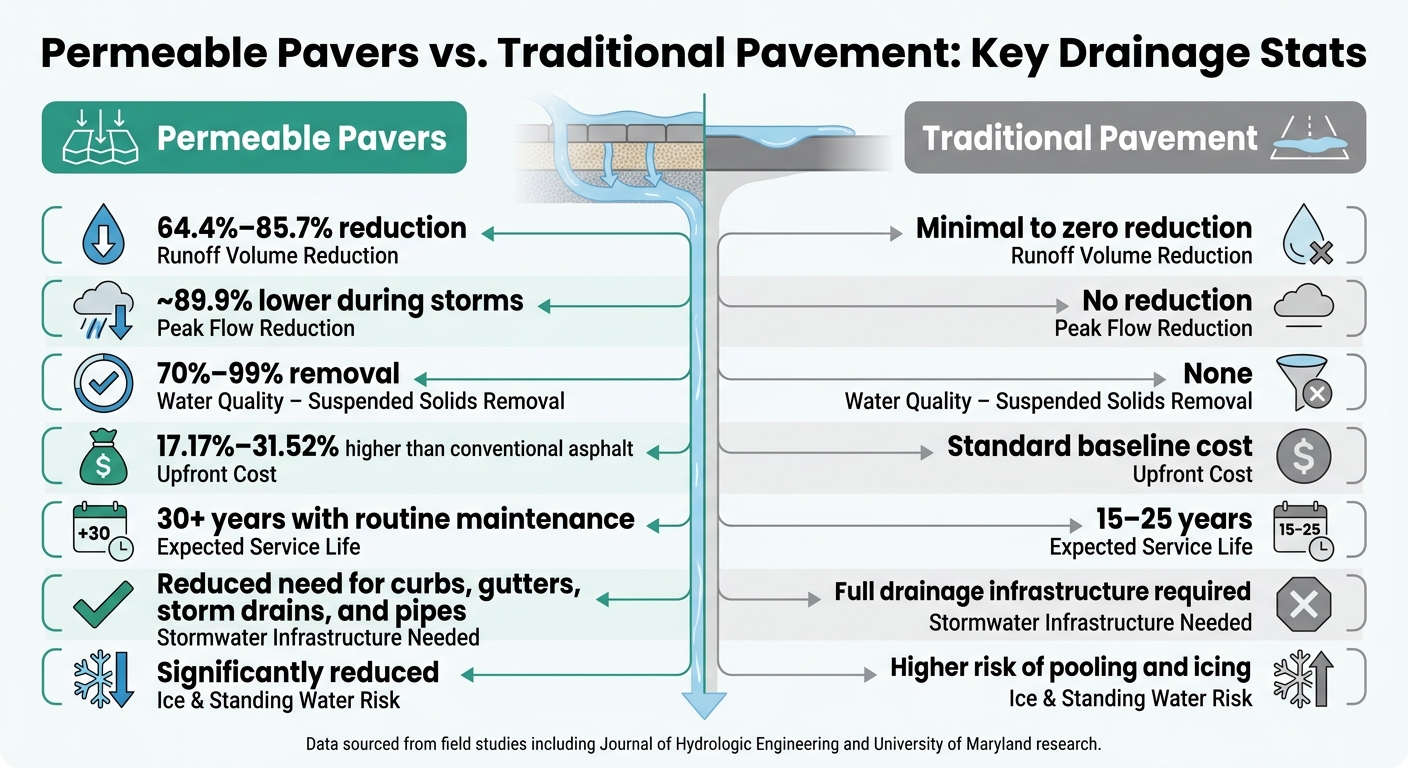
Permeable Pavers vs. Traditional Pavement: Key Drainage Stats
How Does Permeable Pavement Work?
sbb-itb-843f8be
Permeable Pavers in Modern Drainage Systems
Permeable pavers cut runoff where it starts. That’s why they’ve become a key part of modern stormwater design, especially in places where drainage control matters.
How Permeable Pavers Work
A permeable paver system moves water through the surface, holds it for a short time, and then lets it soak into the soil or flow into an underdrain. The pavers sit on top, and their wider joints are filled with small crushed stone so water can pass through. Under that sits a bedding layer, followed by a deeper open-graded stone base that acts like a reservoir. This base stores water while it slowly exfiltrates into the soil below [2].
If the soil drains slowly, that stored water needs another path. In clay-heavy soils, an underdrain can move extra water to a drain outlet when infiltration is limited [2].
| Layer | Role |
|---|---|
| Surface Pavers | Durable surface with permeable joints for water entry |
| Bedding Layer | Thin leveling course of open-graded stone |
| Stone Base | Deep reservoir that stores water during and after rain |
| Underdrain (Optional) | Perforated pipe that redirects overflow in clay-heavy soils |
Why They Matter for Yard Drainage in Maryland
This setup matters even more in places with slow-draining soil. Maryland is a good example. Many areas have clay soils that slow infiltration, which can lead to pooling near foundations and erosion in garden beds.
Permeable pavers help with exactly that kind of problem. Even in slow-draining clay soils, a Maryland study found a mean subsurface infiltration rate of 2.35 ± 1.88 cm/h in a permeable system [2]. That’s a useful result for sites where water tends to sit instead of soak in. The Maryland Department of the Environment also recognizes permeable pavement as a green infrastructure practice for stormwater management [2].
Where Permeable Pavers Fit in Home Projects
Permeable pavers are a strong fit for driveways, patios, walkways, and courtyards. When grading is done well, water can be directed toward the paver area and away from the foundation.
On sites with heavy ponding or saturated soil, they can also work alongside French drains or dry riverbeds to deal with tougher drainage problems [4]. The best results usually come when the paver system matches the property’s slope and the way water already moves across the site.
Key Drainage Benefits Documented in Studies
Field monitoring, lab testing, and city projects point to the same thing: permeable paver systems improve drainage in ways you can measure. The main results show up in three areas: runoff control, infiltration, and winter performance.
Reduced Runoff Volume and Peak Flow
The clearest win is much lower runoff than standard pavement. Studies show average runoff drops of 76%, while peak flow falls by about 90% [1]. That means less water rushing into low spots, planting beds, and storm drains during heavy rain.
Research also shows these systems can bring runoff close to predevelopment levels [3]. Put simply, a paved driveway or patio doesn’t have to act like a hard surface that sends water skimming across the yard. The stone storage layer below the pavers does a lot of that work.
Better Infiltration, Storage, and Surface Drainage
The open-graded stone base stores stormwater, then lets it move into the soil over time. Some systems can hold up to 70% of rainfall before releasing it [4].
A Howard County, Maryland, case study shows how that plays out on the ground. In 2018, the Elkridge Library & DIY Education Center installed a permeable paver system with stone-filled joints and an open-graded base. One year later, ASTM C1781 testing found an average surface infiltration rate of 155 inches per hour, enough to handle heavy local rainfall without expanding an existing onsite pond [5]. For a homeowner, that points to fewer puddles after a storm. It also sets up another perk: less winter icing.
Fewer Ice and Standing Water Problems
When water drains through the surface instead of sitting on top, less moisture is left behind to freeze overnight. That can mean fewer ice patches and less need for de-icing on driveways, walkways, and patios [4].
Property and Landscape Protection Benefits
Runoff control is a big part of the story. But permeable pavers also help protect the ground around your home, the water moving through it, and the surfaces nearby.
Water Quality and Green Infrastructure
When stormwater moves through the joints between pavers and the aggregate layers below, it gets cleaned as it passes through. That natural filtering process matters. PICP removes 70% to 99% of suspended solids, and zinc, copper, and lead often drop below detection limits [1]. PICP removes 30% to 65% of phosphorus and 5% to 30% of nitrogen [3].
That filtration does more than improve water quality. It also cuts down on the sediment that would otherwise wash into planting beds or spread across lawns.
Reduced Erosion in Yards and Garden Beds
Standard pavement pushes water across the surface fast. And when water picks up speed, it can tear into lawn edges, mulch, and garden beds.
Permeable pavers slow that process down. By reducing sheet flow, they lower the force that strips soil from those areas. It’s a simple idea: slower water does less damage.
A field study from central Maryland shows how this can play out on a property. In Colmar Manor, Maryland, a permeable articulating concrete block system captured runoff from a drainage area 8% larger than designed without overflow, even in low-permeability silty clay soil [2].
Protection for Foundations and Nearby Hardscapes
When runoff from a roof, driveway, or patio keeps collecting in one spot, the soil near a foundation can get saturated. That’s where trouble often starts. Water can pool, shift toward the house, and put stress on nearby surfaces.
Permeable pavers help by taking in that water and releasing it slowly on-site instead of letting it gather near the home.
One practical setup is to redirect downspouts into a permeable paver system and use an in-line filter to catch debris [4]. That can help keep roof runoff from collecting near the foundation while also reducing stress on nearby hardscaping services and surrounding soil.
Design, Maintenance, and Cost Findings from Research
Those drainage gains last only when the system fits the site and gets proper care.
Design Requirements That Affect Drainage Performance
Runoff results come down to design, upkeep, and cost tradeoffs. Before installation, run a site percolation test. Maryland soils vary too much for regional maps to tell the whole story.
Even slow-draining silty clay can work with a permeable system if the design is done right. In Colmar Manor, MD, a study reported a mean subsurface infiltration rate of 2.35 cm/h in that soil type, using a storage depth of 4 feet (1.2 m) with 40% porosity [2]. With proper sizing, the system can capture up to 4.3 inches (11.02 cm) of rainfall during a 4-hour storm event. When storm volume goes past base storage capacity, overflow outlets should be added [2].
That’s the line between a system that drains as planned and one that ends up with ponding later on.
Maintenance and Long-Term Drainage Reliability
Over time, performance drops when sediment and debris clog the joints [4]. That part is simple: if the joints fill up, water has a harder time moving through the surface.
Regular vacuum sweeping removes deep-seated debris from the joints. Replacing joint material helps keep both the structure and water flow in good shape. Surface cleaning also clears top-level buildup. With routine vacuuming and joint care, these systems can last 30+ years [4].
Once the system is built to drain well and kept clear, the next issue is cost up front versus value over time.
Upfront Costs vs. Long-Term Value
Permeable pavers cost more at the start. Research puts the initial installation cost at 17.17% to 31.52% higher than conventional asphalt pavement [3].
But that’s not the whole story.
Standard pavement usually needs curbs, gutters, storm drains, and pipes to move water off the surface. Permeable systems can cut much of that extra infrastructure because the pavement itself stores water [4]. Researchers note that the higher upfront cost can be offset over time through infrastructure and environmental savings [3].
| Feature | Permeable Pavers | Traditional Pavement |
|---|---|---|
| Upfront Cost | 17.17%–31.52% higher than conventional [3] | Standard baseline |
| Runoff Control | 64.4%–85.7% volume reduction [1] | Minimal to zero reduction |
| Expected Service Life | 30+ years with maintenance [4] | 15–25 years |
Case Studies and Key Takeaways for Maryland Homes
What Municipal and Pilot Projects Have Shown
Field studies back up the drainage gains of permeable pavers. One study in the Journal of Hydrologic Engineering compared four permeable pavement types with standard impermeable pavement across 11 rainfall events. The researchers found average runoff volume drops of 76% and peak flow drops of 89.9% [1].
Residential projects in the Chesapeake Bay watershed found something similar. When impervious concrete was replaced with permeable pavers, those sites showed better stormwater capture and more groundwater recharge [4]. Different settings, same result: permeable pavers cut runoff under everyday conditions.
How These Findings Apply to Central Maryland Properties
Maryland data shows that this pattern holds up under local soil conditions too. A University of Maryland team studied a permeable articulating concrete block system in Colmar Manor, MD, installed over silty clay soil. Across 50 rainfall events, the system captured storms up to 4.1 inches and handled runoff from a drainage area 8% larger than planned [2].
That matters for Central Maryland homes. If your yard has clay-heavy soil or spots where water tends to sit after a storm, this kind of result is hard to ignore. It shows that permeable pavers can still work well even where drainage is often a headache.
Conclusion: The Main Benefits of Permeable Pavers for Drainage
Taken together, these studies show that permeable pavers can reduce runoff and handle stormwater well, even on tougher sites, when they are designed and maintained the right way. For Maryland homeowners, that makes them a practical long-term drainage upgrade to weigh carefully before installation.
FAQs
Do permeable pavers work in clay soil?
Yes, permeable pavers can work in clay soil, but they need careful professional planning.
Research shows these systems can still manage stormwater well over low-draining soils, including silty clay.
That said, clay changes the game. Water moves through it more slowly, so the base, drainage setup, and site layout all need to be planned with care. A professional designer should assess the site to figure out whether added features, such as an underdrain, are needed for proper drainage and runoff control.
Pro Landscapes MD provides expert assessment and installation for these conditions.
How much maintenance do permeable pavers need?
Permeable pavers are built to last. With proper care, they can hold up for 20 to 25 years or more.
The main job is simple: keep the surface clear so water can pass through as it should. That means removing sediment, sand, leaves, and grass clippings before they clog the joints.
For most residential driveways, vacuuming twice a year is enough. Spring and fall are usually the best times to do it.
It also helps to check the area after heavy storms. Make sure water is still soaking in properly, and add more joint material if needed.
When does an underdrain make sense?
An underdrain makes sense when the soil below a permeable paver system doesn’t soak up water well, like in slow-draining soils. It can also help carry off extra water during heavy storms.
It becomes even more important when the drainage area is much larger than the hardscape itself.
Chat with Us