









- bhavya gada
- No Comments
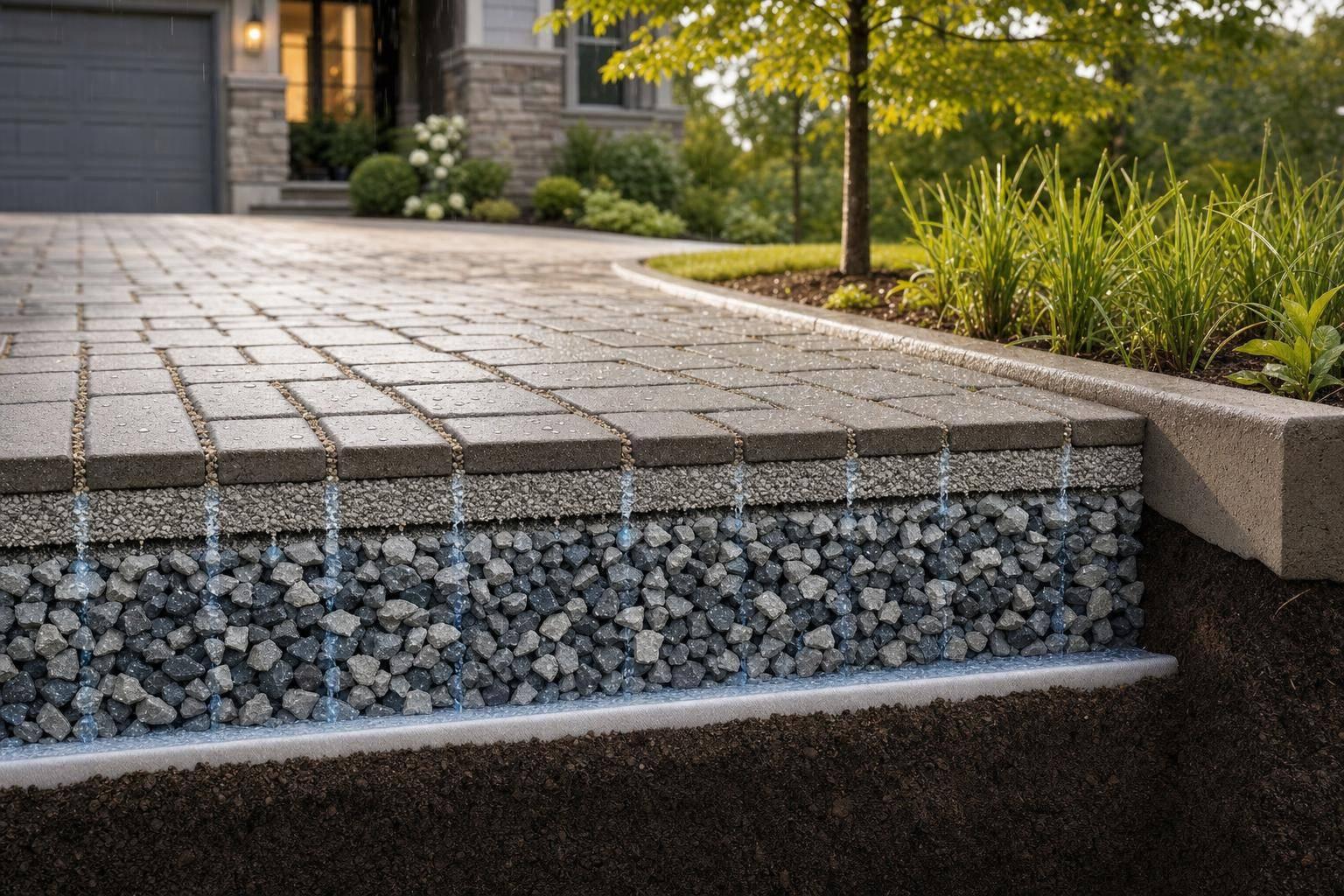
Permeable pavers help cut flood risk by moving rainwater into the ground instead of letting it rush across your property. I’d sum it up like this: they reduce runoff, store water in a stone base, and lower pooling, erosion, and pressure on drains during heavy storms.
If you want the short answer, here it is:
- Water goes down, not across
- The stone base holds rain for a time
- Soil type, slope, and grading affect results
- Driveways, patios, walkways, and low spots are common use cases
- Maintenance matters because clogged joints slow drainage
- Some systems can store up to 70% of rainfall, leaving about 30% as surface runoff
A few points stand out to me:
- A permeable system uses open joints, joint stone, and an open-graded base
- The base can act like a reservoir with about 40% porosity
- In tighter soils, a deeper base, underdrain, or overflow pipe may be needed
- A Maryland study found a 47-inch base over silty clay handled storms up to 4.11 inches
| Factor | What I’d keep in mind |
|---|---|
| How it helps | Sends water into the base and soil instead of across the surface |
| Best spots | Driveways, patios, walkways, and places where puddles form |
| What affects drainage | Soil, slope, grading, and nearby runoff |
| What supports flood control | Proper base depth, edge restraint, and the right joint stone |
| What keeps it working | Sweeping, washing, vacuuming when needed, and keeping debris out |
So if you’re dealing with puddles, runoff near your home, or washout after storms, permeable pavers are a simple way to slow water down and move it where it belongs.
Permeable Pavement Explained in 9 Minutes
sbb-itb-843f8be
How a Permeable Paver System Drains Water
How Permeable Pavers Drain Water & Reduce Flood Risk
A permeable paver system works like a layered drainage setup under the pavers. That setup matters most when site conditions affect how fast water can move through the ground.
Surface Joints, Stone Base, and Soil Infiltration
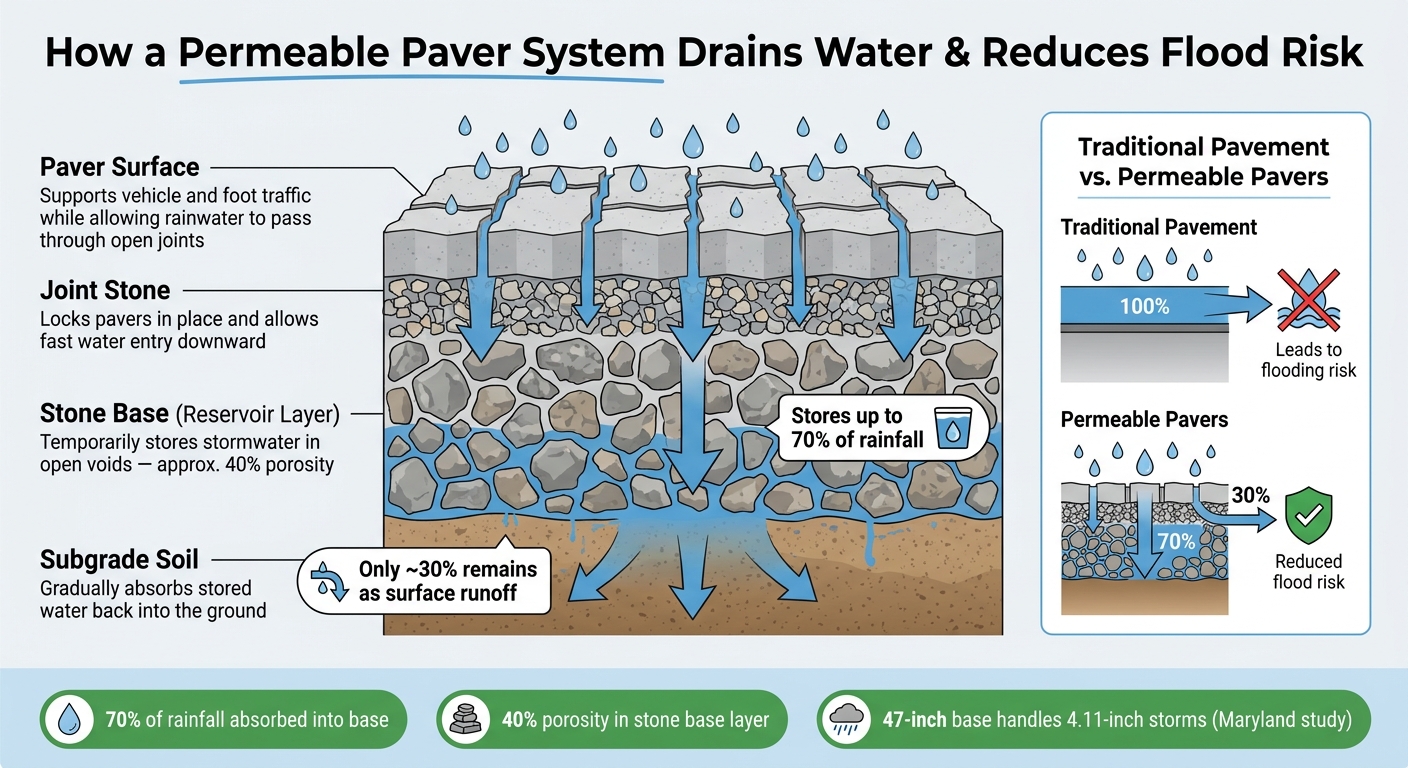
Each layer does a specific job. Water first moves through the open joints between pavers. Those joints are filled with joint stone, which keeps the pavers locked in place while still letting water flow down.
Under that, there’s an open-graded stone base. This layer acts like a temporary holding area for water. It stores runoff until the soil below can absorb it at its own speed.
| Layer | What It Does |
|---|---|
| Paver Surface | Supports traffic while letting water pass through the joints |
| Joint Stone | Keeps pavers locked in place and allows fast water entry |
| Stone Base | Stores water temporarily in open voids; operates at about 40% porosity |
| Subgrade Soil | Absorbs stored water gradually back into the ground |
The subgrade soil is where the water ends up. In well-drained soils, that happens fairly fast. In tighter soils, the system can still work, as long as the base is sized to let water drain out more slowly.
How Slower Water Movement Reduces Flood Risk
With standard concrete or asphalt, rain has nowhere to go. It runs off the surface fast and can pick up pollutants along the way. A permeable system changes that by moving water downward through the joints, into the stone base, and then into the soil at a slower rate.
Permeable paver systems can store up to 70% of rainfall, leaving only 30% as surface runoff [1]. That means less stormwater moves across the property during heavy rain. In plain terms, you get less erosion, less pooling, and lower downstream flood risk. As water passes through the stone, the system also filters sediment and slows runoff before infiltration.
Performance still depends on slope, soil, and grading.
Where Permeable Pavers Work Best and What Affects Performance
Best Uses for Driveways, Patios, Walkways, and Low Spots
Permeable pavers make the most sense when they replace hard, non-porous surfaces like concrete driveways, asphalt pads, and solid patios. They also tend to do their best work in areas where runoff already collects.
Driveways are one of the most practical places to use them. A typical home driveway takes up a lot of space, and during heavy rain, that surface can send a lot of water rushing off at once. With permeable pavers, water moves down through the joints instead of skimming across the top.
Patios, walkways, and low spots in the yard are also strong candidates. Those are often the first places where puddles form and runoff starts to move. If roof downspouts drain into that area, you can direct that water into the paver system too. Just add inline filtration so leaves, grit, and other debris don’t clog the stone base.
How Slope, Soil, Grading, and Local Drainage Affect Results
Soil and slope shape how well the system drains and how much water the base needs to hold.
Dense soils slow infiltration. When that happens, the stone base has to store stormwater for a longer time before it drains away. A 2021 Maryland study found that a 47-inch (1.2-meter) stone base over silty clay fully captured runoff from a large residential drainage area and handled storms up to 4.11 inches [2].
A percolation test helps show what the site needs. For example, it can point to a deeper stone base, an underdrain, or an overflow pipe. Slope matters too. On steeper grades, runoff moves faster, so the site may need grading changes or a terraced installation approach.
Those site conditions shape the base depth and drainage details covered next.
Design and Installation Choices That Improve Flood Protection
Choosing the Right Permeable Pavement Type
Once the drainage path is clear, the next step is picking the permeable surface that fits the site. Common options include permeable interlocking concrete pavers (PICP), pervious concrete, and porous asphalt. Each handles water a bit differently, but the goal stays the same: let rain soak down instead of rushing off the surface.
PICP is often a strong pick when you need both stormwater control and support for traffic. For flood control, permeable interlocking concrete pavers are the most common residential choice because they offer strength, drainage, and repairability.
Why Base Depth, Edge Restraint, and Joint Stone Matter
The surface only works if the base and joints are built to move water instead of trapping it. Flood control depends on the whole system, not just the pavers. In heavy rain, these parts do a lot of the hard work.
Base depth stores stormwater, while joint stone keeps water paths open. Edge restraints help keep the pavers stable over time [1]. Base depth, edge restraint, and clean joint stone need to match site conditions. The wrong joint fill can clog infiltration [1].
Professional Installation and Site-Specific Drainage Planning
Even the right material can fail if the grading doesn’t direct water into the system. A permeable paver setup should be planned around the site’s drainage patterns. That means the installation needs a drainage plan that fits the site, not a one-size-fits-all approach.
Once the system is installed the right way, long-term performance depends on simple upkeep.
Maintenance and Key Takeaways for Long-Term Flood Reduction
Routine Maintenance That Keeps the System Working
After installation, long-term flood control comes down to one simple thing: keep water moving.
Over time, sediment and organic debris can clog joints and slow infiltration. That’s why regular sweeping matters. Wash the surface when needed, and use a commercial vacuum if debris gets packed in. If joint stones settle or get pulled out during cleaning, add more back in based on the manufacturer’s recommendations. That helps keep the system stable and the drainage paths open.
It also helps to keep soil and mulch off the paver surface. If the system includes a roof-runoff in-line filter, clean it on a regular schedule so debris doesn’t end up in the stone base. Small maintenance tasks like these play a big part in how well the system cuts flooding over time. Routine upkeep helps the system perform for decades [1].
What Homeowners Should Remember
Long-term performance usually comes back to three choices: soil, base depth, and upkeep.
- Test the soil before design begins.
- Size the base for the site’s runoff and slope.
- Plan for cleaning and filter maintenance from the start.
Homeowners in central Maryland can work with Pro Landscapes MD for permeable paver installation and drainage planning.
FAQs
Are permeable pavers worth it in clay soil?
Yes, permeable pavers can work well in clay soil, but they need professional design and installation.
Here’s the catch: clay soil drains slowly. So the system may need an underdrain to carry excess water away when the soil can’t absorb it fast enough.
That said, a properly engineered system can still help reduce stormwater and manage runoff. Before installation, a qualified expert should perform a percolation test and review the site’s specific conditions.
How much maintenance do permeable pavers need?
Permeable pavers need regular care so the joints don’t clog with sediment, leaves, and other organic debris. For residential driveways, use a heavy-duty wet/dry vacuum at least twice a year, usually in spring and fall.
Sweep the surface as part of routine upkeep, and power wash the joints when needed. After storms that drop 3 inches or more of rain, check the system to make sure water is draining the way it should.
Can permeable pavers handle heavy rain?
Yes. Permeable pavers help manage stormwater and cut down on flooding by letting water soak into the ground instead of sitting on the surface.
For day-to-day rain, they usually work well. In many cases, they can reduce runoff by 70% to 90%. They’re also often built to let 1 to 3 inches of rain over 24 hours move through the system.
When rain gets very heavy, though, some overflow can still happen. That’s why many professional installs include an overflow path or underdrain as a backup.
Chat with Us