









- bhavya gada
- No Comments
Permeable pavers are a smart way to manage stormwater and reduce patio runoff. Unlike solid concrete or standard pavers, these systems allow rainwater to soak into the ground instead of running off into storm drains. Here’s why they matter:
- Runoff Reduction: Permeable pavers cut runoff by 70–90%, preventing flooding, erosion, and pollution.
- Water Filtration: They filter out pollutants like oil, sediment, and heavy metals, improving water quality.
- Groundwater Recharge: Excess water seeps into the soil, replenishing local groundwater supplies.
- Durability: These pavers prevent foundation damage, reduce hydrostatic pressure, and minimize freeze-thaw issues in winter.
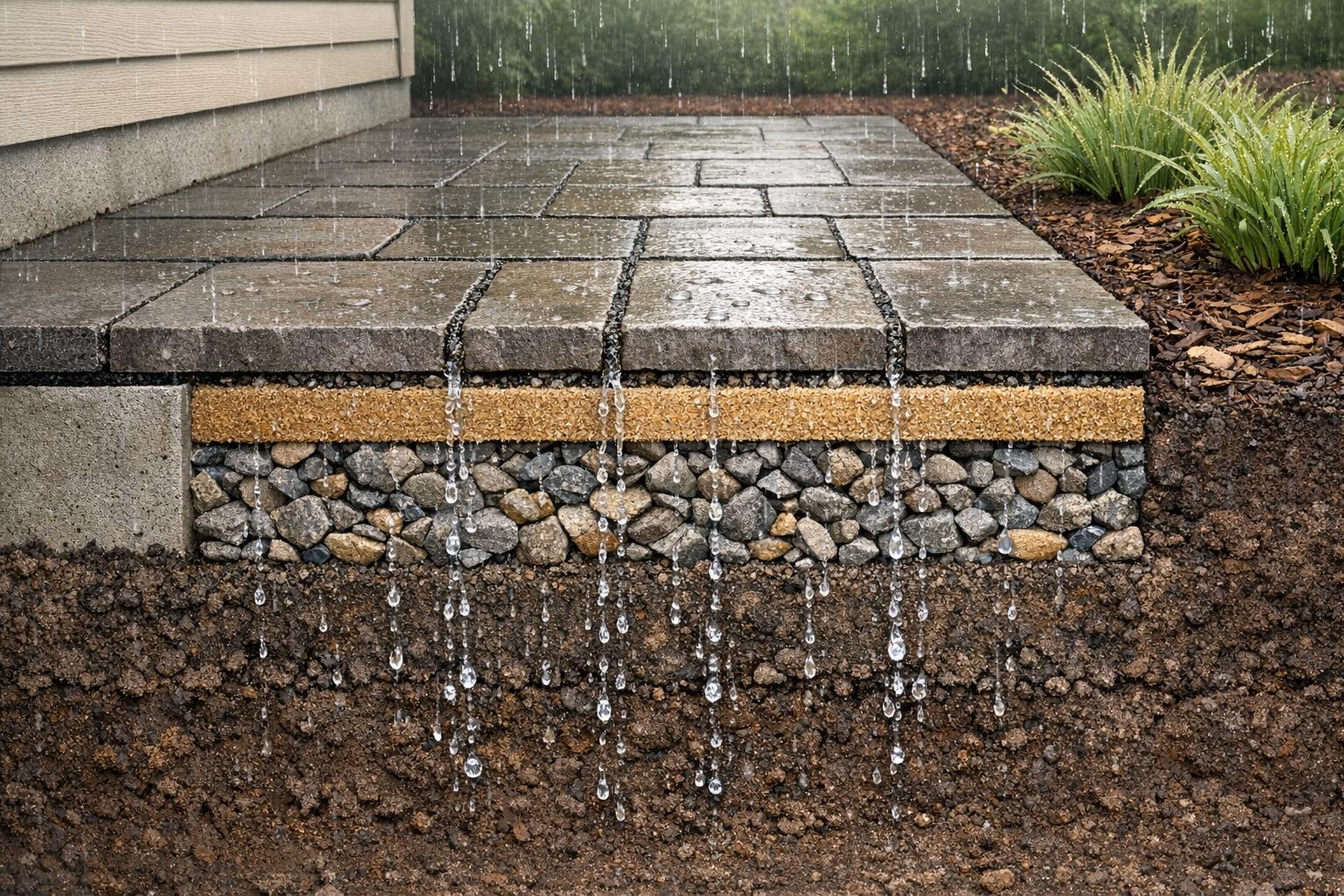
The system works through a layered design: water passes through wide joints filled with aggregate, into a stone base that temporarily stores and filters water before releasing it into the ground. This approach is especially useful in areas with heavy rainfall, like Maryland, where managing stormwater is crucial for protecting homes and local waterways.
Proper installation is key. It involves soil assessment, using specific stone layers, and ensuring the system’s drainage capacity. Regular maintenance, like cleaning the joints and avoiding clogging materials, ensures long-term performance. For homeowners, permeable pavers offer a practical solution to reduce runoff while protecting their property and the environment.
Laying a Permeable Paver Patio Using Open Graded Base
How Permeable Pavers Reduce Runoff
Permeable pavers are designed to manage runoff by allowing water to pass through wide joints filled with open-graded aggregate materials. This setup creates a layered system that both manages and filters water as it flows through.
Layered Design for Water Management
The magic happens in the layers beneath the surface. The joints, which make up about 5%–10% of the patio area, direct water into a bedding layer of small crushed stone, typically 1.5 to 3 inches thick. Below that, a base layer and a subbase reservoir are made up of progressively larger stone aggregates. This reservoir, usually 6 to 8 inches deep, serves as a temporary storage tank, holding 30% to 40% of its volume in water during storms. Over time, the stored water seeps into the underlying soil, helping to recharge groundwater. This multi-layered structure not only holds water but also starts the filtration process.
Infiltration and Filtration Process
As rainwater seeps through the layers, it undergoes a natural filtration process. Larger debris gets trapped at the surface, while the stone reservoir filters out finer particles, oil, and even heavy metals. A study conducted at the Old Woman Creek National Estuarine Research Reserve in Huron, Ohio, monitored a 2,900-square-foot permeable paver installation over poorly draining silty clay soil. From August 2014 to August 2015, the system reduced total suspended solids and turbidity by more than 96%. It also lowered nitrate levels by over 70%, thanks to anaerobic processes occurring in the stored water.
Runoff Reduction Rates
These systems are incredibly effective at reducing runoff. Permeable interlocking concrete pavement systems can cut peak flow by as much as 90%. On average, systems without an underdrain achieve an 85% runoff reduction, while those with an underdrain still manage about 45% reduction. For comparison, pervious concrete can handle water infiltration at rates ranging from 120 to 1,200 inches per hour, depending on its mix design. Even in areas with heavy clay soils, these systems far outperform traditional patios, which divert 100% of rainfall directly into storm drains.
Benefits of Permeable Pavers for Patios
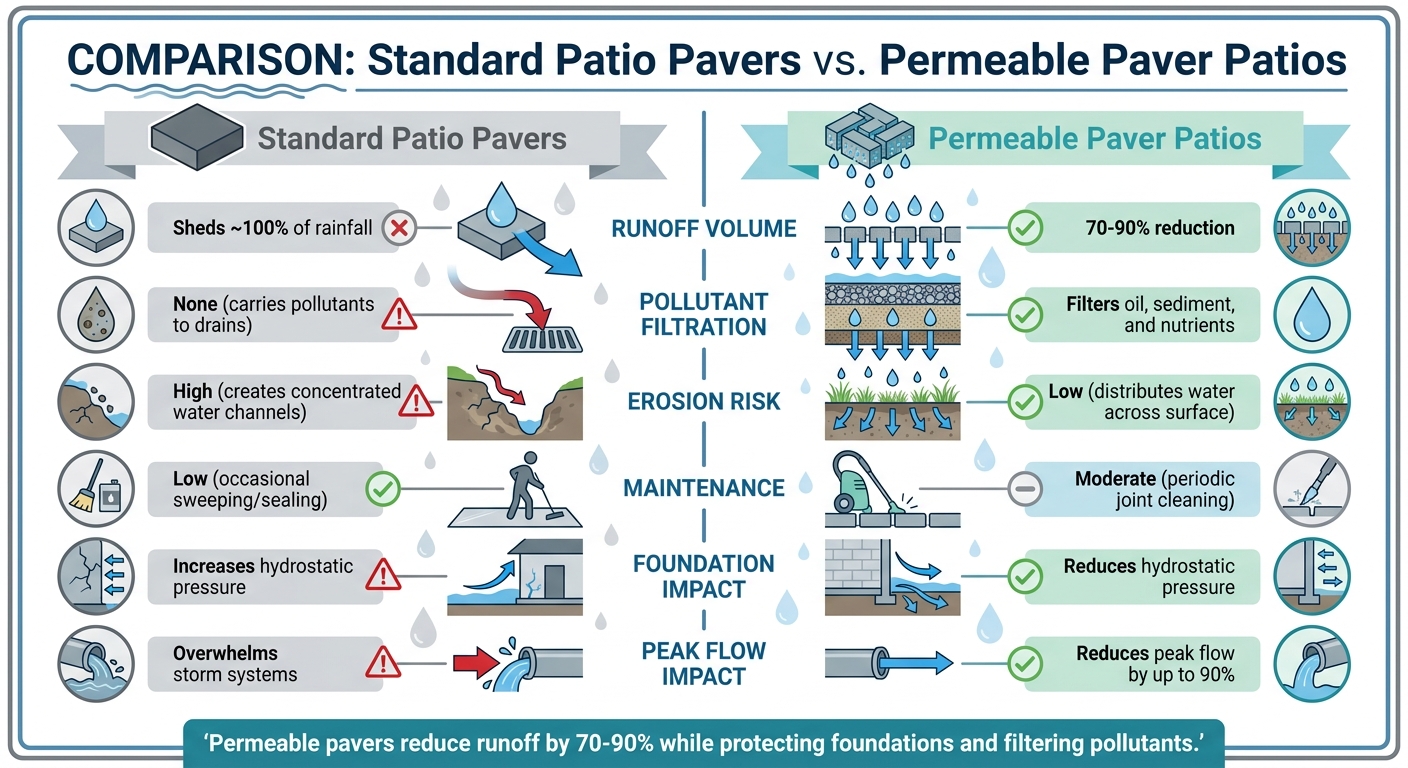
Standard Patios vs Permeable Paver Patios Comparison
Permeable pavers go beyond effective water management by offering additional perks that enhance patio usability and safeguard property.
Runoff Prevention and Erosion Control
Unlike traditional patios that channel rainwater directly into storm drains, permeable pavers evenly distribute water across their surface. This prevents the formation of high-speed water channels that erode topsoil and damage landscaping.
These pavers mimic natural rainfall by stabilizing soil and gradually releasing water into the ground. Beneath the surface, a stone reservoir temporarily holds excess water during storms and releases it slowly into the soil. This process helps avoid sudden water surges that could overwhelm city drainage systems or cause basement flooding.
Improved Water Quality and Groundwater Recharge
Water passing through the layers of aggregate beneath permeable pavers undergoes natural filtration. This process removes contaminants, with trapped pollutants broken down by beneficial microbes. The result? Cleaner water entering local groundwater basins instead of polluted runoff flowing into storm drains.
By replenishing groundwater, permeable pavers restore a vital part of the natural water cycle. This supports wells, springs, and stream flows – benefits that are lost with standard, non-porous surfaces. For example, the Elmer Avenue Retrofit Project in Los Angeles demonstrated how permeable pavements could increase groundwater recharge by over 50 acre-feet annually [3].
Better Durability and Foundation Protection
Permeable pavers help protect your home’s foundation by evenly managing water infiltration. Traditional patios often direct water toward foundation walls, which can lead to leaks and structural issues. Permeable systems prevent these problems by allowing water to sink gradually into the ground, reducing hydrostatic pressure.
Additionally, these pavers minimize freeze-thaw damage. Water drains quickly rather than pooling on the surface, and the system functions effectively through winter without requiring heavy salt treatments. This durability makes permeable pavers a practical and long-lasting alternative to standard patios.
Standard Patios vs. Permeable Paver Patios
Here’s a side-by-side comparison of how permeable pavers stack up against traditional patio options:
| Feature | Standard Patio Pavers | Permeable Paver Patios |
|---|---|---|
| Runoff Volume | Sheds ~100% of rainfall [1] | 70–90% reduction [1] |
| Pollutant Filtration | None (carries pollutants to drains) [1] | Filters oil, sediment, and nutrients [1] |
| Erosion Risk | High (creates concentrated water channels) [1] | Low (distributes water across surface) [1] |
| Maintenance | Low (occasional sweeping/sealing) | Moderate (periodic joint cleaning) [3] |
| Foundation Impact | Increases hydrostatic pressure [1] | Reduces hydrostatic pressure [1] |
| Peak Flow Impact | Overwhelms storm systems [1] | Reduces peak flow by up to 90% [3] |
Steps to Install Permeable Pavers for Patios
Site Assessment and Preparation
Start by evaluating your soil type. In Maryland, clay-heavy soils are common, and they drain slowly. This means you’ll need a deeper base layer to allow water to infiltrate properly. On the other hand, sandy soils, which drain quickly, require less depth [6]. For patios, excavation depths typically range from 0 to 5 inches, though areas with heavy clay may need more extensive digging [7].
Before adding materials, lightly compact the subgrade. Be careful not to overdo it, as this can reduce the soil’s ability to absorb water [5][7]. Once the subgrade is ready, cover it with permeable geotextile fabric. This fabric is crucial because it prevents soil particles from moving upward into the stone base and clogging it, while still allowing water to flow through [7][1]. Proper preparation here ensures effective water infiltration and helps manage runoff.
Base Layer Installation
For permeable systems, use open-graded aggregates – these are stones without small particles or "fines." The absence of fines creates voids that act as reservoirs for stormwater [6][1]. Start with coarse crushed stone, like No. 57 stone (sized 3/4 inch to 1.5 inches), and install it in layers no thicker than 4 inches. After placing each layer, compact it to reach 98% proctor density before moving on to the next [7][9].
A base course of 6 to 8 inches can store roughly 30 to 40% of its volume in water [1]. This storage capacity is essential for handling heavy rainfall without overwhelming local drainage systems.
Paver Placement and Joint Filling
Begin laying the pavers along a straight edge or guide string to keep everything aligned [7][5]. Fit the pavers snugly together, ensuring consistent joint spacing that allows water to pass through. To keep the pavers in place, install edge restraints [7].
For the joints, use angular chip stone (such as No. 8 or No. 9 stone) instead of rounded gravel. Angular stones lock together under pressure, providing stability, while rounded stones tend to roll and shift [9][7]. Screed the bedding layer with angular stone to a depth of 1–2 inches [9]. After securing the pavers and filling the joints, you can move on to the final steps of compaction and testing.
Compaction and Water Infiltration Testing
Use a plate compactor to secure the pavers and create a level surface [9]. Once compacted, perform infiltration tests using ASTM C1781 procedures to ensure the system drains properly [7][1]. This step verifies that your patio can handle Maryland’s rainfall and continue filtering water effectively for years to come.
| Material Type | Water Storage Capacity (% of Volume) | Typical Use in Permeable Systems |
|---|---|---|
| 3/4-inch Gravel | 48% [6] | Structural Base Layer |
| 3/8-inch Pea Gravel | 47% [6] | Bedding or Joint Fill |
| Open-Graded Base (General) | 30–40% [1] | Reservoir/Holding Tank |
sbb-itb-843f8be
Maintaining Permeable Paver Patios
Keeping your permeable paver patio in good condition ensures it continues to effectively manage water infiltration and filtration.
Regular Cleaning and Joint Maintenance
Twice a year, give your patio a thorough sweep with a stiff-bristle broom to clear away debris that could clog the joints. Professional Engineer Lincoln Paiva emphasizes that biannual inspections are crucial for keeping the joints unobstructed.
If you notice aggregate loss or deep-seated sediment, vacuum the joints and refill them with clean, angular chip stone (ASTM #8 or #9). Avoid using sand for joint filling or as winter traction material – it clogs the system quickly. For tougher debris, use a gentle mechanical sweep before vacuuming. Pete Baloglou from Techo-Bloc cautions against power washers:
Power washers can damage the integrity of the pavers… These ruin the surface of the concrete, and push sediment into the joints, further down where you can’t take care of it.
Inspect the system for sediment buildup regularly to maintain its performance. [9] [10] [11]
Inspecting for Sediment Buildup
After heavy rainstorms, check for standing water or sediment caked on the joints. If water pools for more than a few hours, vacuum the joints and refill them with angular chip stone. The system should ideally maintain an infiltration rate of over 250 mm/h (about 10 inches per hour).
Also, take a look at nearby garden areas. Stabilizing soil in these spaces with vegetation can prevent sediment from washing onto the patio. Early detection is vital, as most sediment tends to collect within the top inch of the joint openings. [10] [11]
Avoiding Sealants and Harmful Chemicals
Stay away from sealants that block the pavers’ pores, and avoid placing mulch, soil, or unwashed gravel directly on the surface. If you need to temporarily cover the patio, use a tarp or geotextile fabric. During winter, skip sand for traction and instead use fine washed gravel – the same material recommended for joint refilling. Thanks to their efficient drainage, permeable paver systems can reduce the need for de-icing salt by 64% to 77% when compared to traditional pavements. [10]
Adding Permeable Pavers to Eco-Friendly Maryland Patio Designs
Expanding on the benefits of managing runoff effectively, eco-friendly patio designs in Maryland can incorporate additional drainage features to enhance functionality and environmental impact.
In Maryland, permeable pavers are classified as "Individual Lot Facilities" or "BMPs" (Best Management Practices). These systems help minimize impervious surfaces and meet stormwater management regulations[8][12]. By capturing stormwater in their drainage layers and allowing it to seep into the surrounding soil, permeable pavers provide two key benefits: they recharge groundwater and improve water quality. At the same time, they help property owners comply with watershed protection guidelines[8].
Combining with Other Drainage Solutions
Permeable pavers pair well with other drainage systems to create a robust water management plan. For instance, French drains can handle overflow during heavy rains, while dry riverbeds serve to channel excess water away from critical areas like foundations. Additionally, rain barrels can collect runoff from non-permeable surfaces such as roofs[2]. However, it’s important to avoid directing runoff containing debris – such as soil or leaves – toward the patio, as this could clog the pavers[12]. Together, these strategies create a comprehensive solution that can be customized to Maryland’s unique environmental conditions.
Local Expertise for Maryland Properties
Pro Landscapes MD offers expertise in designing and installing eco-friendly patios featuring permeable pavers throughout Maryland. Their service areas include Howard County, Montgomery County, Carroll County, Frederick County, Prince George’s County, and Baltimore County. Their team combines hardscaping skills with a deep understanding of drainage needs, ensuring patios are tailored to Maryland’s soil types and climate.
From site assessments to installing base layers and integrating features like French drains or dry riverbeds, Pro Landscapes MD ensures every aspect is covered. They also address specific challenges like winter deicing. Thanks to the efficient drainage of permeable pavers, less deicing material is needed, making these patios particularly well-suited for communities such as Annapolis, Ellicott City, Gaithersburg, and Towson. This thoughtful approach not only protects properties but also helps meet local environmental regulations.
Conclusion
Permeable pavers are a smart solution for reducing runoff while safeguarding both your property and the surrounding environment. These systems can cut surface runoff by an impressive 70% to 90% compared to traditional paving methods, helping to prevent issues like erosion, foundation damage, and localized flooding[1][3]. By allowing water to pass through engineered joints and stone layers, they not only manage immediate drainage needs but also filter pollutants and recharge groundwater, contributing to healthier watersheds over time.
In addition to water management, permeable pavers offer other practical benefits. They remain cooler during summer and significantly reduce ice buildup in winter, requiring just 0% to 25% of the deicing salt typically used on traditional surfaces[4][13].
However, installing permeable pavers requires a specialized approach. Proper site preparation, soil analysis, and base construction are essential for long-term success[1][14]. Factors like soil infiltration rates, slope considerations, and integration with existing drainage systems must be carefully evaluated. This is why professional installation is key. Experienced installers ensure every detail is addressed, so your patio performs effectively for years to come.
Pro Landscapes MD specializes in designing and installing permeable paver patios across central Maryland, serving areas like Howard, Montgomery, Carroll, Frederick, Prince George’s, and Baltimore counties. Their team handles everything from site assessments to base layer construction, tailoring each project to Maryland’s unique soil and climate conditions. They also incorporate additional drainage solutions, such as French drains and dry riverbeds, to protect your property while meeting environmental guidelines.
FAQs
Will permeable pavers work in Maryland clay soil?
Permeable pavers can be used in Maryland’s clay soil, but their performance largely hinges on how well the soil allows water to pass through. Clay soil tends to have low permeability, which can limit water infiltration. To address this, you might need to incorporate a well-designed gravel base or even an underdrain system. These additions help manage stormwater effectively, reducing runoff even in tougher soil conditions.
Do permeable pavers need an underdrain?
Permeable pavers might require an underdrain if the soil below absorbs water at a rate of less than 0.5 inches per hour or if specific site conditions demand extra drainage solutions. These designs can range from basic underdrains to more advanced systems that incorporate elements like water quality filters and infiltration sumps, ensuring efficient stormwater management.
How do I keep the joints from clogging over time?
Regular upkeep is essential to keep the joints in permeable pavers clear and working properly. Make it a habit to inspect and clean them at least twice a year to get rid of debris and sediment. Occasional vacuuming can also go a long way in preserving their performance. Additionally, avoid piling snow on these surfaces, and make sure to quickly remove any sediment buildup to ensure the joints stay effective.
Chat with Us