









- bhavya gada
- No Comments
The best evergreen shrub for a Maryland yard is the one that fits the spot, not the one that looks best in a pot.
If I were picking shrubs for Maryland, I’d check 5 things first: hardiness zone, sun, drainage, deer pressure, and mature size. In much of central Maryland, winter lows can hit 0°F to 5°F, clay soil often drains slowly, and deer can strip shrubs up to 5–6 feet high. That means one bad site match can lead to weak growth, root rot, or a shrub that outgrows the bed in a few years.
Before I buy anything, I’d make sure to:
- Check whether the bed is in Zone 6b–7b
- Watch how much sun it gets: 6+ hours for full sun, 3–6 hours for part shade, under 3 hours for full shade
- Test drainage with a 12-inch hole
- Measure the space by the shrub’s mature spread
- Look for signs of deer browsing
- Match problem spots like wet areas, slopes, and narrow side yards to shrubs that can handle them
- Plant with enough room for airflow, access, and future growth
A few shrubs stand out for Maryland conditions. Inkberry holly works in spots that swing from dry to wet. American holly can take sun or shade and deals with clay better than many shrubs. Mountain laurel and leucothoe fit shaded beds with moist, acidic soil. Junipers do best in full sun and on dry slopes.
Quick Comparison
| Shrub | Best Light | Best Soil Moisture | Deer Pressure | Main Use |
|---|---|---|---|---|
| Inkberry holly | Full sun to part shade | Dry to wet | Lower browse risk | Wet spots, rain gardens, small beds |
| American holly | Full sun to full shade | Medium, clay-tolerant | Lower browse risk | Screening, larger beds |
| Mountain laurel | Part shade to full shade | Moist, acidic, well-drained | Lower browse risk | Shaded borders |
| Juniper cultivars | Full sun | Dry to average, well-drained | Less preferred | Slopes, banks, screens |
Bottom line: I’d let the yard make the choice. If the soil stays soggy, the area is tight, or deer are a problem, that should shape the shrub list before looks do.
Best Evergreen Shrubs for Year-Round Interest
sbb-itb-843f8be
Step 1: Check Your Yard Before You Buy
A shrub can do great in one bed and struggle just 20 feet away. That’s why it’s smart to check each planting area before you buy anything. Look at the basics first: hardiness zone, wind, sun, soil, drainage, space, and deer pressure.
Check Hardiness Zone, Wind Exposure, and Microclimate
Most of central Maryland sits in USDA Hardiness Zones 6b–7b, where winter lows can drop to 0°F to 5°F. Some Baltimore–Washington suburbs stay a bit warmer than nearby rural spots because of the urban heat island effect.[2] That small temperature gap can matter a lot when you’re looking at a shrub that’s right on the edge of what your area can handle.
Wind can change the situation just as much as cold. An open corner lot, hilltop, or field edge can leave broadleaf evergreens exposed to winter burn. Here’s why: the leaves keep losing moisture, but the roots are stuck in frozen soil and can’t take up more water. On the other hand, a south-facing wall, fenced courtyard, or protected side yard can soften cold and wind enough to help less hardy shrubs make it through winter. For each bed, figure out which setup you’re working with.
Map Sun and Shade, Then Test Soil and Drainage
Check each bed in the morning, at midday, and again in late afternoon so you can map how much sun it gets. Full sun means 6 or more hours of direct sun per day. Part shade means 3 to 6 hours. Full shade means less than 3 hours. Then check again in summer. A spot that gets full sun in spring can slip into part shade by July once trees leaf out.
After that, test drainage in each planting area. Dig a 12-inch hole, fill it once to saturate the soil, then refill it and measure how fast the water drains.[3] Most shrubs do fine with 1 to 2 inches per hour. If it drains slower than 1 inch per hour, or if water is still standing after 8 hours, you’ve got poor drainage. That’s pretty common in Maryland’s clay-heavy soils. Test a few spots, not just one, because drainage can change a lot even within the same yard.
Measure Mature Size and Note Deer Activity
Before you pick a shrub, measure the space you have to work with. Check the width from the foundation, sidewalk edge, utility lines, or property line. Then compare that number with the shrub’s mature spread, not the size you see at the nursery. If the shrub will outgrow the strip, it’ll turn into a problem in just a few years, even if it starts out looking fine.
Also watch for deer activity. Torn tips, browsed stems up to 5 to 6 feet, and repeat damage on the same plants are all signs to watch for. If you see that stuff often, deer pressure is high enough to shape your plant choices. Deer-resistant helps, but it doesn’t promise anything. In high-pressure Maryland neighborhoods, deer will eat plants they’d usually leave alone when food gets scarce.
Use these notes in the next step to narrow your shrub options by sun, moisture, deer pressure, and size.
Step 2: Match Evergreen Shrubs to Your Site Conditions
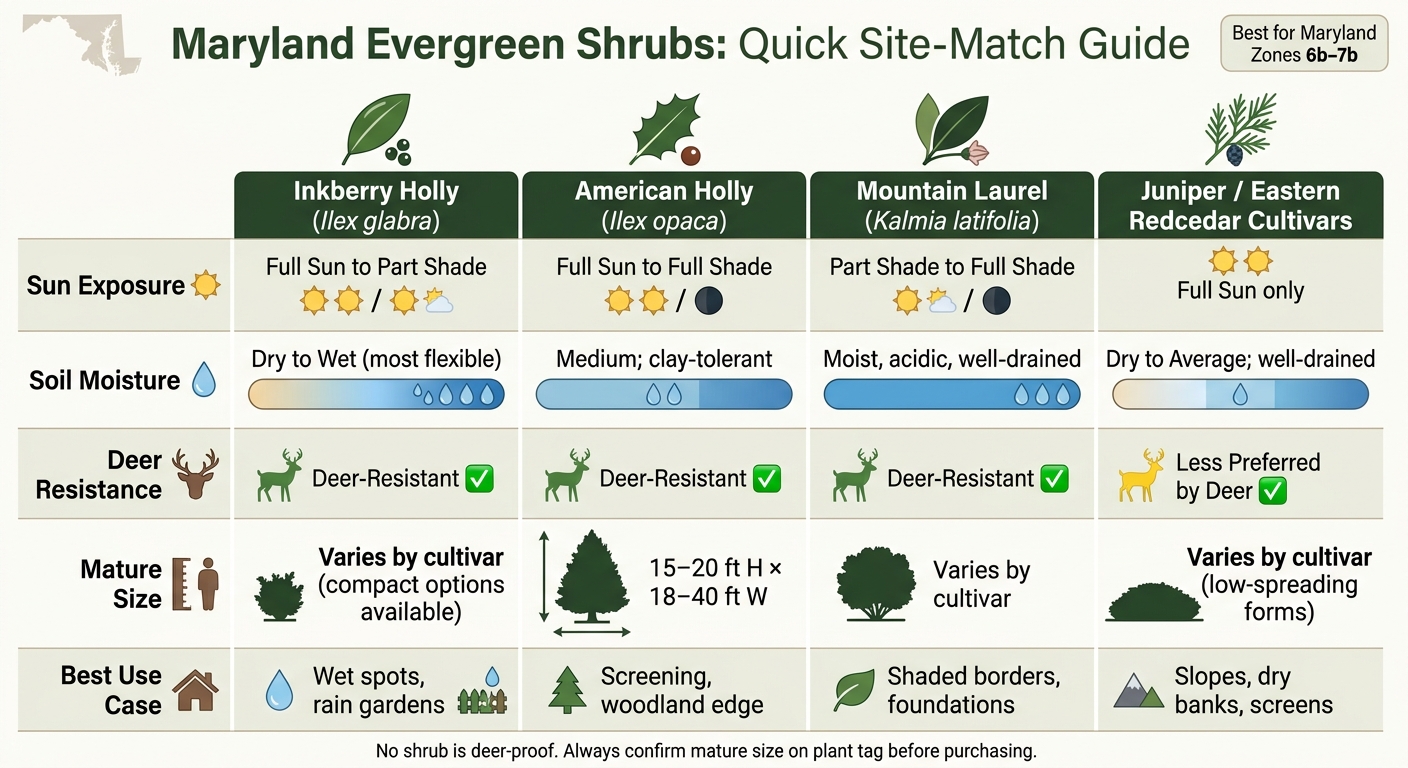
Maryland Evergreen Shrubs: Quick Site-Match Guide
Use the notes from Step 1 to match each bed with shrubs that suit its sun, moisture, deer pressure, and space. The goal isn’t to pick the prettiest shrub. It’s to pick the one that fits the bed.
Choose Shrubs by Sun, Shade, and Moisture
Start with sun exposure. Then check soil moisture.
For full sun, junipers and inkberry holly (Ilex glabra) are solid picks. Inkberry can handle soil that runs from dry to wet, which makes it handy for rain gardens and spots that drain poorly.[5] American holly (Ilex opaca) can take sun or shade and does fine in clay-heavy soil.[4]
For part shade to full shade – like north-facing walls, the east side of the house, or beds under open tree canopies – mountain laurel (Kalmia latifolia) and leucothoe (Leucothoe spp.) are a good match. Both like cool, moist, acidic soil with plenty of organic matter. Mountain laurel also needs good drainage, so skip heavy clay.
Factor In Deer Pressure and Mature Size
If deer move through your yard, make browse resistance a major filter. Inkberry holly, American holly cultivars, and many junipers tend to rank lower on deer browse lists than arborvitae or yews, which often take heavy damage in high-pressure areas.[8][9] No shrub is deer-proof.
Size matters too. A shrub’s mature spread should fit the bed width, with at least 18–24 inches of clearance from the house wall for airflow. For privacy screens, space plants at about 60–75% of mature spread so they fill in without getting cramped.[6][7]
Use a Shrub Comparison Table to Build a Short List
Use the table below to narrow each bed to a short list fast. Check sun first, then moisture, then deer pressure, then size.
| Shrub | Sun Exposure | Soil Moisture | Deer Resistance | Mature Size (H × W) | Best Use |
|---|---|---|---|---|---|
| American holly (Ilex opaca) | Full sun to full shade | Medium; clay-tolerant | Deer-resistant | 15–20 ft × 18–40 ft [4] | Screening, woodland edge, foundation |
| Inkberry holly (Ilex glabra) | Full sun to part shade | Dry to wet | Deer-resistant | Varies by cultivar | Rain gardens, wet spots |
| Mountain laurel (Kalmia latifolia) | Part shade to full shade | Moist, acidic, well-drained | Deer-resistant | Varies by cultivar | Woodland borders, shaded foundations |
| Juniper / eastern redcedar cultivars | Full sun | Dry to average; well-drained | Less preferred by deer | Varies by cultivar | Slopes, dry banks, screens |
Before you buy, confirm mature height and spread on the plant tag.
Then run the same filters again for wet spots, slopes, and narrow side yards.
Step 3: Choose Shrubs for Wet Spots, Slopes, and Narrow Side Yards
Use your shortlist to match shrubs to the problem area, not just the plant tag. That simple shift helps you tie each shrub to an actual site issue: wet soil, unstable slopes, or tight space. This step narrows your list by drainage, slope, and width.
Wet Spots and Poorly Drained Areas
Pick shrubs that can handle periodic wetness, not just “average moisture.” Chronic wet soil starves roots of oxygen and can lead to rot.[1]
Inkberry holly (Ilex glabra) is one of the most practical picks for this kind of spot. It handles clay, periodic wetness, and occasional flooding.[5][13][14] Compact cultivars like ‘Nana’, ‘Densa’, and ‘Shamrock’ fit smaller yards and foundation beds without losing that same moisture tolerance.[10][12]
Sweetbay magnolia (Magnolia virginiana) makes more sense when the soil stays moist or wet for long stretches – like swampy low corners, pond edges, or places where water sits after a storm. It grows well in acidic clay and loam, and it brings fragrant flowers plus evergreen-to-semi-evergreen foliage.[11][15][16][17] If a spot stays soggy long after rain, planting by itself may not fix it. In that case, drainage work, grading, or moving downspouts may need to come first.
If drainage isn’t the main issue and soil is washing away instead, shift to shrubs that work better on slopes.
Slopes and Erosion-Prone Banks
On slopes, go with shrubs that spread low and thick. Spreading junipers are a dependable option for sunny, well-drained banks. They form broad, low mats and handle lean, dry soil once established.[18][19]
Spacing matters more on a slope than it does in a flat bed. Plant a bit closer than you would on level ground so the soil gets covered sooner while the shrubs are still filling in. Use erosion fabric or mulch until the plants knit together, then keep spacing modest so air can still move through.[22] Don’t patch gaps with non-native groundcovers like vinca or pachysandra. Both are flagged as invasive in Maryland.[20][21]
If the main problem isn’t erosion but lack of room, stop thinking about spread and start thinking about width.
Narrow Side Yards and Tight Foundation Spaces
In a side yard that’s only 3–5 ft wide, mature width is the number to focus on first. Width, access, and clearance drive the choice.
Choose columnar or compact shrubs with a mature width that fits the space and still leaves room to get in for maintenance. University of Maryland landscape guidance says to keep small shrubs at least 2 ft from the foundation, medium shrubs at least 3 ft away, and tall shrubs 4–5 ft away. That helps limit moisture buildup against siding and leaves space for airflow.[23][24][25]
Step 4: Plan the Layout and Plant for Long-Term Results
Space Shrubs by Mature Width and Function
Take the short list from Step 3 and map out where each shrub should go. A quick sketch now can save you a lot of trouble later. Mark fixed features, trouble spots, and the mature width of every shrub before you buy anything. Then space plants by their mature width, leaving 6–12 inches between mature canopies so air can move through.
Give each bed a job before you plant. That makes placement much easier.
- Taller, dense shrubs like hollies or arborvitae work well for screening
- Low shrubs fit best under windows and near entryways
- For corners, look for shrubs that mature to about half to two-thirds of first-story height
- Along walkways, keep mature spread at least 18–24 inches back from the hard edge so people can walk comfortably and snow can be cleared
Before you lock in the plan, check the practical stuff: doors, driveways, lights, and sightlines should all stay open.
Prepare the Site, Fix Drainage First, and Plant Correctly
Once the layout is done, get the site ready so water moves away from the roots. Drainage work should happen before planting. That includes regrading, French drains, or dry riverbeds. This step gives the wet-site shrub picks from Step 3 a fair shot. If the soil stays soaked all the time, even the right shrub can struggle. Planting after grading is finished also helps keep new drainage patterns from messing up your layout.
When it’s time to plant, dig holes 2–3 times wider than the root ball, but no deeper.[28][29] In Maryland’s heavy clay, set the top of the root ball 1–2 inches above the surrounding grade so water drains away from the crown instead of sitting around it.[28][30] Backfill with native soil. Potting mix can trap too much water in clay. Water once halfway through backfilling, then again at the end to settle the soil and get rid of air pockets.
Water, Mulch, and Prune With Maryland Seasons in Mind
New shrubs need deep, infrequent watering through the first growing season. Before you water, check moisture 3–4 inches down.[27][31]
Add 2–3 inches of mulch, but keep it 2–3 inches away from the stems.[26][31] Before the ground freezes, water deeply, especially if the shrubs are in exposed areas or sandy soil. That helps cut down on winter burn.[32][33]
For pruning, keep it light. Late winter to early spring is a good window, and some shrubs can also handle a light summer trim after growth hardens. Skip late-season pruning, since it can push soft new growth that gets hit by cold weather. With arborvitae and some junipers, don’t cut back into bare old wood. Those parts usually won’t resprout.
Conclusion: Let Site Conditions Guide Your Evergreen Shrub Choices
Once you’ve checked the site and matched it to the shrub, use these last filters to confirm the pick. For a Maryland yard, the main rule is simple: let the site decide the plant. Start with hardiness, then fine-tune for wind and exposure.
Get sun and drainage right first. If you miss either one, shrubs can thin out or rot. Check deer pressure before you buy, not after. And in narrow side yards, foundation beds, and other tight spots, mature width matters most. A shrub that outgrows its space leads to repeat problems with access, airflow, and plant health.[34][1]
If the site needs drainage or layout work first, handle that before planting. For drainage fixes, grading, planting, and landscape design on hard Maryland sites, Pro Landscapes MD can help.
FAQs
Which evergreen shrub is best for clay soil?
For Maryland’s heavy clay soils, fixing the soil usually works better than betting on a single shrub to solve the problem. Work in organic matter like compost, aged manure, leaf mold, or pine bark fines to help loosen the soil and improve drainage.
If clay keeps causing water to pool, gypsum may help ease compaction. You may also need drainage fixes, such as French drains or regrading, to make the site more suitable for evergreen shrubs.
What should I plant in a wet area?
Choose plants that can handle saturated soil. That helps cut the risk of root rot and keeps plants healthier over time.
For shrubs, Sweet Gale is a smart pick. It forms dense root mats that help hold soil in place in low-lying, wet areas.
In stormwater zones or places with standing water, consider:
It also helps to group plants based on how well they handle periodic flooding or permanent saturation.
How do I choose shrubs for a narrow side yard?
Choose shrubs with a compact or upright growth habit so they don’t crowd structures or walkways. Before you plant, check the mature width to make sure the shrub will fit the space.
It also helps to match the shrub to your side yard’s sunlight, drainage, and soil. Native, drought-tolerant, or compact species usually need less upkeep and are more likely to stay within their intended boundaries.
Chat with Us