









- bhavya gada
- No Comments
If you want a clover lawn in Maryland, I’d start with a tall fescue + microclover mix, seed it from late August to late September, and keep the top ½–1 inch of soil moist for the first 7–14 days. That simple plan matches how lawns grow in most of Maryland’s USDA Zones 6a–7b, where spring and fall are easier on clover than summer heat.
Here’s the short version:
- I’d use 95–97% turf-type tall fescue and 3–5% microclover by weight
- I’d aim for soil pH around 6.0–7.0
- I’d seed microclover at about 1–2 oz per 1,000 sq. ft. in a new mix
- I’d keep seed shallow at 1/8–1/4 inch
- I’d avoid pre-emergents, weed-and-feed products, and broadleaf herbicides
- I’d mow at about 2½–3 inches
- I’d expect more watering with spring seeding than with fall seeding
One big point: a pure clover lawn can thin in summer and leave bare spots in winter, while a fescue-clover mix usually holds cover better in Maryland.
| Option | Best for | Main issue |
|---|---|---|
| Pure clover lawn | Low-traffic areas, more clover look | More summer thinning and winter gaps |
| Tall fescue + microclover | Most Maryland lawns | Needs the right seed ratio and mowing height |
If I were planting in Maryland, I’d focus on four things: seed mix, timing, shallow planting, and steady early watering.
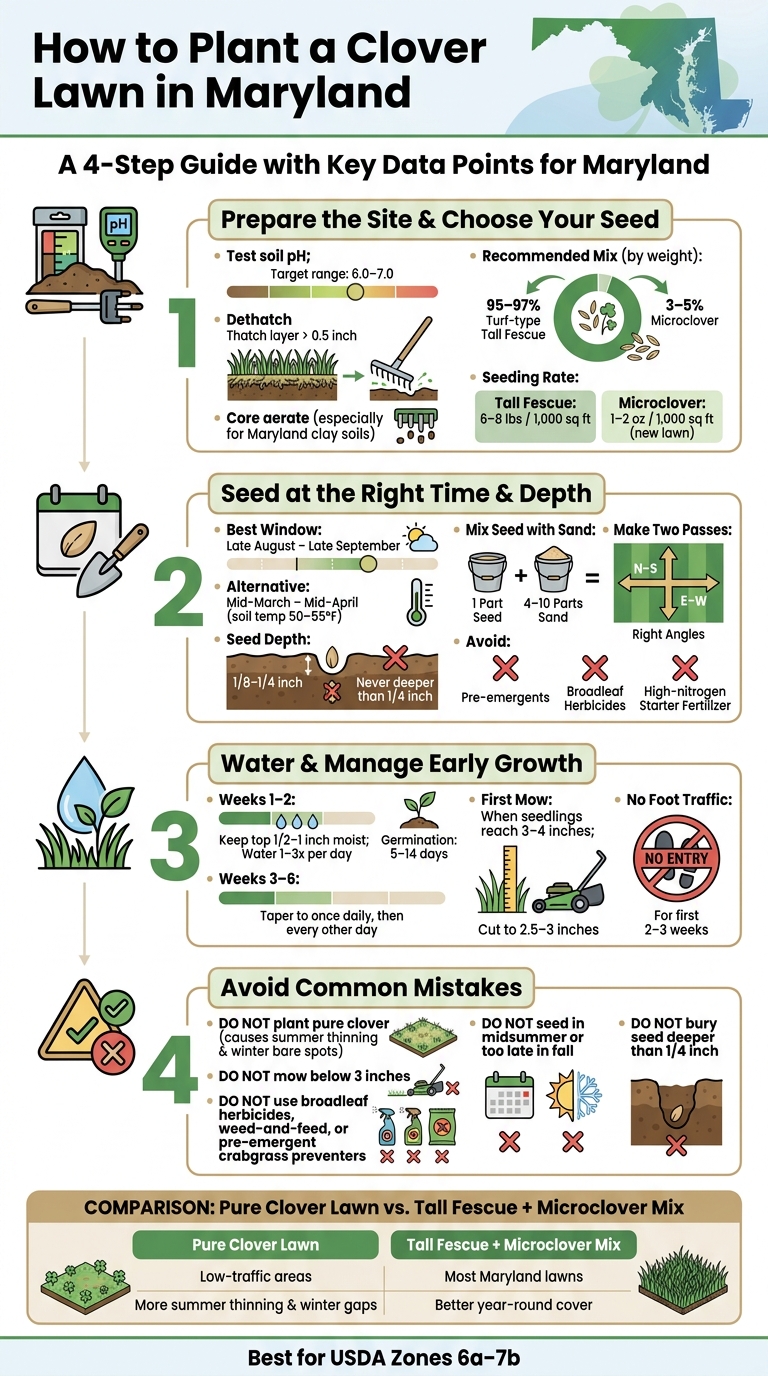
How to Plant a Clover Lawn in Maryland: 4-Step Guide
Step 1: Prepare the Site and Choose the Right Seed
Test Your Soil and Correct pH Before Seeding
Before you buy seed, get a soil test. Clover and its Rhizobium bacteria do best when soil pH is between 6.0 and 7.0, and many sources point to the low 6s as a strong range for growth and nitrogen fixation.[12][15][16]
Once pH drops below 6.0, clover nodules form poorly and growth starts to slow. Around pH 5.0, clover fixes very little nitrogen.[8][9][13][14]
Send a soil sample to an extension lab or another lab that reports both pH and nutrient levels. If the lab calls for lime, apply agricultural lime at least a few weeks before seeding so it has time to start shifting the pH upward.[9][8]
After that, get the surface ready so the seed can make direct contact with the soil.
Prepare Existing Turf or Bare Soil for Good Seed-to-Soil Contact
This part matters more than many people think. Clover seed is tiny, so if it sits on top of thatch or loose debris, germination will be patchy.
For an existing lawn, mow low, dethatch if the thatch layer is thicker than about 0.5 inch, and then core aerate.[3][11] That step helps a lot in Maryland’s compacted clay soils.[3][1] After aeration, broadcast the seed so it drops into the holes and onto loosened soil. Skip aggressive raking that strips out too much turf. The goal here is renovation, not a full restart.[3]
For bare or badly damaged spots, clear away debris, old turf clumps, and weeds first. Then loosen the top 1 to 2 inches of soil with a rake or cultivator.[9][3] Break up clods, level low spots, and lightly firm the soil so it doesn’t shift after rain. A simple check: if your footprint sinks deeper than 1/4 inch, firm the soil before seeding.[9]
With the seedbed set, the next move is choosing the mix and using the right seeding rate.
Choose a Seed Mix That Works in Maryland
For Maryland lawns, use a turf-type tall fescue base with microclover or Dutch white clover. Both are forms of Trifolium repens.[2][5]
University of Maryland Extension recommends keeping microclover at 3% to 5% of the total seed mix by weight, with turf-type tall fescue making up the rest.[6][4] For establishment seeding, that usually works out to about 6 to 8 lbs of tall fescue per 1,000 sq ft.[18][4] That balance helps the lawn stay turf-like instead of letting one species crowd out the other.
The choice between microclover and Dutch white clover mostly comes down to the look you want and how the area will be used:
- Microclover blends into turf more smoothly, with smaller leaves and fewer flowers.[5][11][2][7][6][10]
- Dutch white clover stands out more, looks more natural, and tends to handle hot, dry Maryland summers better without annual reseeding.[5][11][2][7][6][10]
Go with microclover if you want a more even turf look. Pick Dutch white clover for lower-traffic areas or spots where pollinators are welcome.
Once the mix is set, seed it during Maryland’s best planting window.
sbb-itb-843f8be
Step 2: Seed at the Right Time Using the Right Method
Best Time to Seed in Maryland
Once you’ve picked the seed mix, timing matters a lot. In Maryland, the best window for seeding clover is usually late August through late September. That stretch tends to work best because the soil is still warm enough for germination, nights start to cool off, and weed pressure begins to ease.
Spring seeding can also work, usually from mid-March through mid-April, once soil temperatures reach 50–55°F. The catch? Spring seedings usually need more watering and more weed control.
How Much Seed to Use and How Deep to Plant
Clover seed is tiny, so spread it lightly and as evenly as you can. Here are practical seeding rates for Maryland lawns [19][21]:
| Seed Type | Application | Rate per 1,000 sq. ft. |
|---|---|---|
| Microclover | New lawn or renovation blend | 1–2 oz |
| Microclover | Overseeding into existing turf | 0.5–1 oz |
| Dutch white clover | Pure clover lawn | 2–4 oz |
Use the high end of the range for a pure clover lawn. Use the low end when clover is going into a blend or being overseeded into grass.
A simple trick helps a lot here: mix the seed with clean, dry sand at 1 part seed to 4–10 parts sand by volume. That makes it easier to spread the seed more evenly. Then divide the mix into two halves and make two passes at right angles – north to south first, then east to west – to cut down on streaks and bare bands [20].
Broadcast the seed at a depth of 1/8–1/4 inch [29][9][30][17]. After that, lightly rake the surface with the back of a leaf rake or use a lawn roller to press the seed into the soil. Do not bury it deeper than 1/4 inch.
What to Avoid on Planting Day
A few planting-day mistakes can trip this up fast.
- Avoid heavy thatch and pre-emergent herbicides. Both can keep clover seed from reaching the soil or sprouting once it gets there [22][24][28].
- Skip starter fertilizer with high nitrogen. It tends to push grass and weeds harder than young clover [23][25][26][27].
Try to seed before light rain, not heavy rain and not on a windy day. Otherwise, seed can wash away or blow off target.
And if the site itself is the issue, seeding won’t fix it by itself. Poor drainage, low spots, slopes, or fresh grading problems need to be handled first. In those cases, Pro Landscapes MD can help with grading, leveling, drainage, and lawn renovation across central Maryland.
Step 3: Water Correctly and Manage Early Growth
Watering Schedule from Germination Through Establishment
Once the seed is in the ground, moisture becomes the make-or-break factor. If the soil surface dries out too soon, germination can stall. If it stays soaked, seed can shift, clump, or rot.
For the first 7–14 days, keep the top ½–1 inch of soil evenly moist, but not puddled. In sunny, breezy, or sandy spots, you may need light watering 1–3 times per day. In cooler or cloudy weather, once a day can be enough, as long as the surface never dries out. A fine-spray sprinkler or hose nozzle works best so you don’t blast the seed out of place.
Once seedlings show up – usually within 5–14 days – start easing back. At that point, use the schedule below.
When to Mow and When to Allow Foot Traffic
Keep people and pets off the lawn for the first 2–3 weeks. During weeks 3–6, stick to light crossings only, and only if the soil feels firm.
Start mowing when seedlings reach 3–4 inches tall. Cut them down to 2½–3 inches.
What to Expect in the First Year
Some patchiness early on is normal. Don’t panic if it looks a little uneven at first. Clover fills in over time as it spreads through above-ground stems called stolons.
| Stage | Watering | Mowing | Traffic |
|---|---|---|---|
| Weeks 1–2 | Keep top ½–1 inch moist; light, gentle watering 1–3 times per day depending on weather | No mowing | No traffic; avoid pets and play |
| Weeks 3–6 | Taper to once daily, then every other day; moisten top 2–3 inches | First mow at 3–4 inches; set to 2½–3 inches; no more than once per week | Light, occasional foot traffic only |
| Months 2–4 | Deep, infrequent watering; about 1 inch total per week including rain | Regular mowing at 2½–3 inches as needed | Normal household traffic mostly fine; avoid heavy use on wet soil |
| Months 4–12 | Water only during prolonged dry spells | Maintain 2½–3 inches | Full use for most households, including pets and play |
If you keep seeing washout, standing water, or bare spots, the issue may be drainage or grading. In that case, Pro Landscapes MD can handle the site work in central Maryland.
Next, focus on the planting mistakes that most often leave Maryland clover lawns thin or patchy.
Step 4: Avoid Common Clover Lawn Planting Mistakes in Maryland
Mistakes That Cause Patchy Growth or Dieback
Even with good seed and steady watering, a few simple mistakes can ruin establishment. In Maryland, most clover lawn failures follow the same pattern.
The biggest one is planting pure clover instead of a fescue–microclover blend. Pure clover lawns tend to thin out in summer and leave bare spots in winter. In Maryland, lawns usually perform better with a fescue–microclover mix. Aim for 95–97% turf-type tall fescue and 3–5% microclover by weight, or about 0.2–0.3 lb of microclover per 1,000 sq ft with a 6 lb fescue rate.[6][1][4]
Timing and seed depth also trip people up all the time. Seeding in midsummer puts young plants under heat stress and more disease pressure. Seeding too late in fall creates a different problem: plants may not have enough time to root before winter hits. And with microclover, depth matters more than many people think. Keep seed at about ⅛ inch. Planting deeper than that can cut emergence hard.[3][31]
Mowing too short is another common issue. Cutting below about 3 inches weakens both fescue and microclover. It also helps to stay away from products that work against clover from the start, including:
- Broadleaf herbicides
- Weed-and-feed products
- Pre-emergent crabgrass preventers
These can kill clover or stop it from germinating at all.[32][33][31]
When to Bring in Professional Site Help
Sometimes the problem isn’t the seed or the watering. It’s the site itself.
Steep slopes, standing water, heavy compaction, and uneven grading can all make even establishment tough. If you see soil washing out after heavy rain, areas that stay soggy for days, or spots where repeated core aeration still hasn’t improved rooting, you’re likely dealing with a site problem, not a planting problem.
In those cases, Pro Landscapes MD can handle grading, leveling, drainage, and lawn renovation across central Maryland. Fixing the site first gives the lawn a much better shot at filling in evenly.
Conclusion: The Straightforward Path to a Healthier Maryland Clover Lawn
Once the site is ready, the path is pretty simple: use a fescue–microclover blend, seed in late summer or early fall, keep the seedbed moist, mow at about 3 inches, and avoid herbicides and pre-emergents. Those five basics give your Maryland clover lawn the best chance to fill in evenly.
How to Plant Micro Clover in an Existing Lawn
FAQs
Will clover take over my lawn?
Usually not – if it’s handled the right way.
The key is choosing the right clover variety. A good fit can help your lawn look better and use fewer resources without taking over the yard.
Pro Landscapes MD can help you pick the right species and follow proper care practices, so clover works with your current landscape instead of overpowering it.
Can I add clover to an existing Maryland lawn?
Yes – you can overseed clover into an existing lawn in Maryland.
Start by mowing the grass shorter than usual so the clover seed can reach the soil instead of getting hung up in thick turf. If you want better seed-to-soil contact, aerate the lawn or lightly rake the area before seeding.
If you need a hand getting the lawn in shape, Pro Landscapes MD offers lawn care and planting services for conditions in central Maryland.
What if my new clover lawn looks patchy?
If your new clover lawn looks patchy, start by checking the basics. Poor drainage and not enough sunlight can lead to uneven growth, especially in Maryland’s clay-heavy soils.
For thin spots, loosen the top layer of soil and lightly rake in new clover seed. If the patchiness keeps showing up, Pro Landscapes MD can check for soil or moisture problems and suggest a custom fix.
Chat with Us