









- bhavya gada
- No Comments
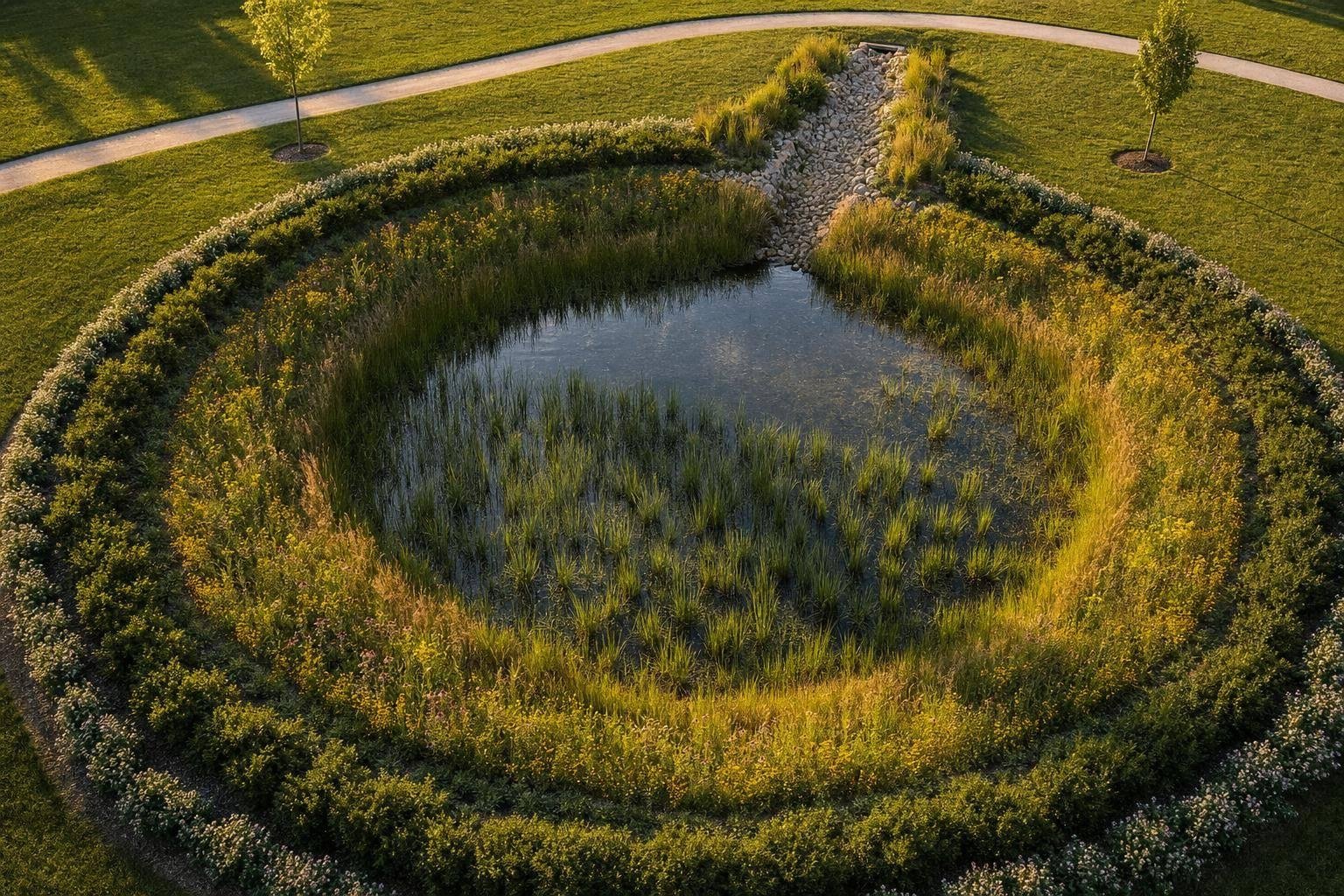
A retention basin should not be planted like one flat area. I’d split it into 4 zones because each part handles water in a different way: the bottom, side slopes, rim/buffer, and overflow path/outlet.
Here’s the short version:
- The bottom is the wettest spot and may hold 6–12 inches of water after storms, so I’d use flood-tolerant natives like rushes, sedges, and iris.
- The side slopes swing from wet to dry, so I’d use deep-rooted grasses and forbs that help hold soil and slow runoff.
- The rim and buffer are mostly dry and often extend 25 feet or more from the high-water line, so I’d focus on cover, root hold, and spacing trees away from structures.
- The overflow path and outlet take the hardest hit during large storms, so I’d pair low-growing grasses with riprap, mats, or blankets to limit washout.
A few numbers matter right away:
- Maryland guidance calls for 85% vegetative cover across the basin surface.
- Side slopes often work best around 3:1 to 4:1.
- Overflow areas should be checked after storms of 1 inch or more in 24 hours during year one.
- Meadow buffers are often cut once a year to 6–12 inches.
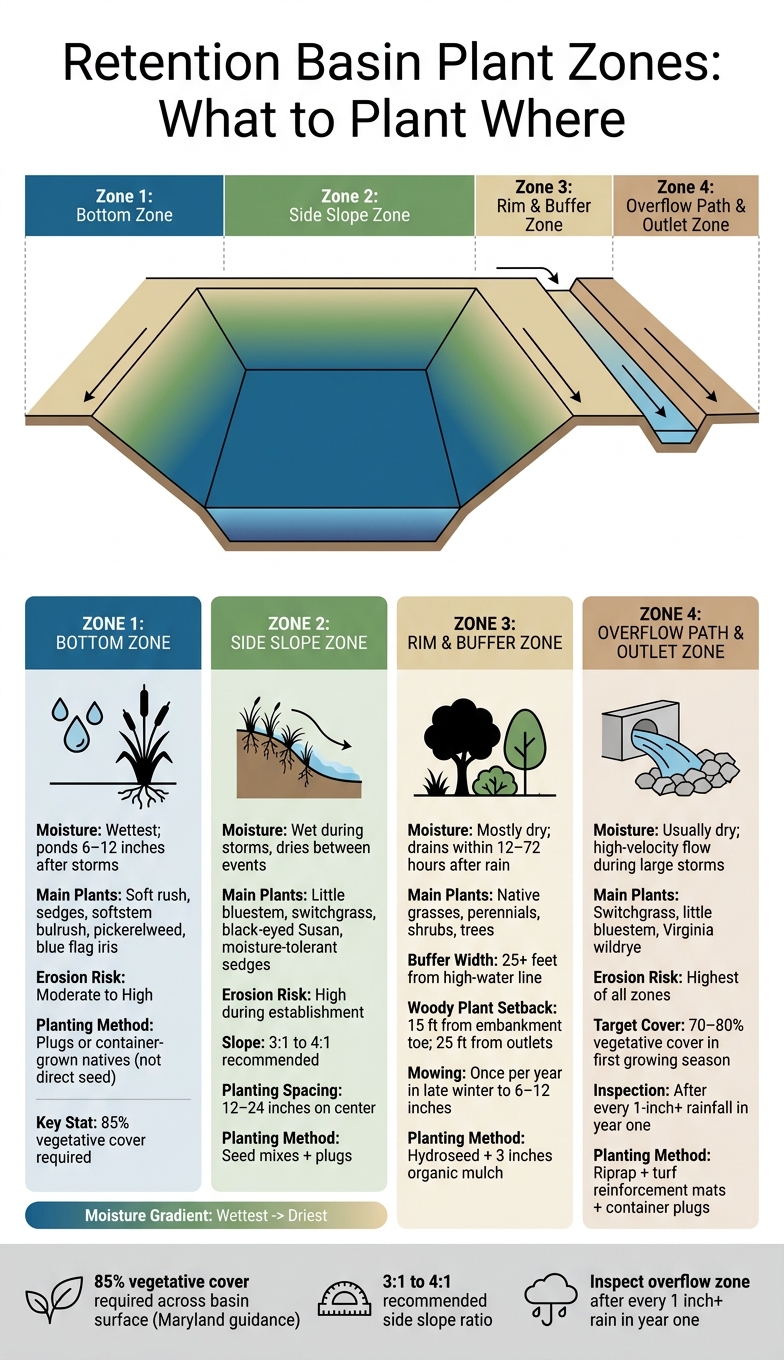
Retention Basin Plant Zones: Moisture, Plants & Erosion Risk by Zone
Beautiful Ponds–Using Native Plants for Color and Function in Stormwater Basins | Webinar
sbb-itb-843f8be
Quick Comparison
| Zone | Usual Moisture | Main Plant Type | Main Risk | Main Planting Focus |
|---|---|---|---|---|
| Bottom | Wettest; can pond | Rushes, sedges, wet-tolerant perennials | Scour, bare soil, sediment buildup | Plugs or container plants |
| Side slopes | Wet, then dry | Native grasses and forbs | Rills and slope erosion | Seed mixes plus plugs |
| Rim/buffer | Mostly dry | Grasses, perennials, shrubs, trees | Sheet-flow erosion, root conflicts | Dense cover and plant spacing |
| Overflow/outlet | Usually dry, high flow in storms | Low-growing grasses, limited shrubs in open areas | High washout risk | Riprap + reinforced planting |
The big takeaway: I’d match plants to water level, slope, and flow force from the start. That cuts plant loss, bare spots, and erosion.
1. Bottom Zone
This is the basin’s collection point, where plants need to deal with standing water and sudden inflow.
Moisture Regime
The bottom zone is the wettest part of the basin. Runoff lands here first, and water can pond before it drains or soaks into the soil. In many designs, this area holds 6–12 inches of ponding.
Between storms, though, the bottom can dry out a lot. That swing from wet to dry is what makes this zone tricky. Plants need to handle both saturated soil and dry spells without falling apart.
Plant Requirements
Because of that wet-dry cycle, plant choice matters a lot. Use native, water-tolerant species with deep or fibrous roots that can sit in saturated soil without root rot. Good picks for Maryland and similar mid-Atlantic sites include soft rush (Juncus effusus), sedges (Carex spp.), softstem bulrush, pickerelweed (Pontederia cordata), and blue flag iris.
These plants do a few jobs at once:
- They help hold the soil in place
- They slow moving water
- They trap sediment
Ornamental plants that aren’t built for flooding usually struggle here. In this zone, flood tolerance isn’t a bonus. It’s the starting point.
Those same roots also help the basin resist damage during inflow and drawdown.
Erosion Risk
Erosion risk is moderate to high, especially near inflow points and before plants get established. The biggest trouble spots are usually where runoff enters the basin and where bare soil is left exposed after construction.
A layer of river rock or a splash pad at the inlet helps cut down scour where water comes in. Maryland guidance calls for at least 85% vegetative cover to stabilize soils and support treatment [1]. Once plants form a dense root mat, the soil holds together much better. Early stabilization still matters, though, because that’s when the area is most exposed.
Planting Method
Seed by itself rarely works well in the bottom zone. Wet, unstable soil can wash it away before it has a chance to germinate. Plug planting and container-grown natives usually do much better because they start with established roots.
For larger areas, hydroseeding paired with erosion-control blankets or coir mats can help protect exposed soil during establishment. Avoid mowing in this zone. Saturated ground ruts easily, and equipment can tear up young plants fast.
From this wet, storage-heavy base, the next challenge is the side slope, where water drains faster but erosion pressure goes up.
2. Side Slope Zone
The side slope connects the wet basin bottom to the drier rim, so this area needs plants that can deal with both runoff and dry spells. It also affects how fast water moves from the rim down to the basin floor. That means the planting here has two jobs at once: hold the soil in place and slow water as it moves across the slope.
Moisture Regime
Side slopes are wet on and off. They get moist during storms and stay damp for a short time after, then dry out between rain events. The lower part of the slope usually stays wet longer, while the upper part acts more like meadow ground.
That swing from wet to dry is a big deal. It’s why plant choice matters more here than it does on the basin floor.
Plant Requirements
Use native grasses and forbs that can take short wet periods and longer dry stretches. On the upper slope, lean toward dry-site prairie plants such as little bluestem, switchgrass, and black-eyed Susan. Lower on the slope, shift to moisture-tolerant grasses, sedges, and forbs that can handle occasional ponding.
A mix of species helps bare soil fill in fast and breaks up runoff before it starts cutting rills. Keep trees and shrubs off the slope face. Place them at the rim instead, away from pipes and spillways. [17][18]
Erosion Risk
This zone comes with real erosion risk, especially during construction and early plant establishment. Water moving down the slope can cut rills fast when soil is bare or compacted.
Use slopes between 3:1 and 4:1 to slow runoff and cut erosion. [14][11][12] If the slope is steeper than 3:1, you’ll usually need engineered stabilization, such as riprap, geotextile, or retaining structures. Loosen compacted slope soil so roots can get in and runoff slows down. [16][13]
Planting Method
Seeding works well on slopes because it covers large areas and helps close gaps fast. Plug planting also works well, especially for forbs. In both cases, plant in clumps with spacing of about 12–24 inches on center so dense patches form early. [10]
A 4:1 or flatter grade also makes mowing and inspection safer and easier for crews.
Above this zone, the rim dries out faster and needs a different plant mix.
3. Rim and Buffer Zone
The rim and buffer zone is the basin’s dry outer edge. In Maryland, this buffer usually extends at least 25 feet outward from the basin’s high-water line [19][21][22].
Moisture Regime
This zone stays dry most of the time. It may get wet for a short stretch during storms when overland sheet flow moves across the surface, but that water drains off fast. Unlike the basin bottom or lower slope, the rim usually dries within about 12 to 72 hours after rainfall [15][25][20].
Plant Requirements
Since this is the driest part of the basin, the goal is cover and soil stability, not flood tolerance.
Use a mixed native planting palette with:
- grasses
- perennials
- shrubs
- trees
That mix helps form a dense buffer that holds up well over time. Keep woody plants at least 15 feet from the embankment toe and 25 feet from outlets or control structures [21][22][24][26]. That spacing helps protect access routes, flow paths, and structural parts. On access benches, use turf grass or erosion-resistant groundcovers [21][23][24].
Erosion Risk
Erosion risk here is moderate. Dense vegetation with deep roots helps slow sheet flow, improve infiltration, and hold soil in place [6][27][28]. If runoff starts to bunch up instead of spreading evenly, use a level spreader to restore sheet flow [27].
Planting Method
For large areas, hydroseed after scarifying the soil 1/2 inch deep before seeding [7][3]. Plant shrubs and trees in spring or early fall. Mulch new plantings with about 3 inches of organic material [15]. Meadow buffers should be mowed once a year in late winter to a height of 6 to 12 inches [15].
If runoff starts to concentrate, move to the overflow path and outlet zone.
4. Overflow Path and Outlet Zone
The overflow path and outlet zone is the basin’s safety valve. When the basin fills up, this is the route that carries extra water through spillways, swales, and outlets. So this area isn’t built to hold water for long. It’s built to handle the water that gets past storage.
Moisture Regime
Moisture in this zone swings back and forth. Most of the time, it stays dry. But during big storm events, it can turn saturated for a short stretch. The main issue isn’t long-term wet soil. It’s fast-moving water that shows up when storms push past the basin’s storage limit. After the storm, the area usually drains fast.
Plant Requirements
In vegetated spillways and overflow swales, dense grasses are often the best fit. In the Mid-Atlantic region, Panicum virgatum (switchgrass), Schizachyrium scoparium (little bluestem), and Elymus virginicus (Virginia wildrye) have worked well [35][37].
In wider overflow corridors, Itea virginica (Virginia sweetspire) and Cornus sericea (red osier dogwood) can be used, but only where they won’t block flow [38].
Keep woody plants away from outlet fronts and narrow spillways. That’s where problems start. Roots can damage outlet structures, and stems can catch debris and cut down hydraulic capacity [8][33].
Erosion Risk
This is a high-risk erosion zone, especially when storms go past design capacity. Common failure points include scour at pipe outfalls, downcutting along overflow swales, and toe erosion where overflow paths enter receiving channels [29][30].
Emergency spillways must safely pass the 100-year developed peak flow with at least 30% freeboard and riprap protection through the full outlet path [31]. If the overflow path is left bare, it will usually be one of the first places to fail in a large storm.
Planting Method
Get the grading and stabilization done before any planting starts. Install riprap aprons or stilling basins at the immediate outlet first, then scarify the soil before planting [36].
In higher-stress sections, place turf reinforcement mats (TRMs) or erosion control blankets over the prepared soil before seeding. They help hold seed and soil in place during early establishment and can handle higher shear stress than vegetation alone [32][7].
Near the outlet, where washout risk is highest, container-grown plugs are a better choice than direct seeding. Their root systems are already in place, so they stand up better to early storms. Aim for at least 70–80% vegetative cover in the first growing season, and inspect the area after every rainfall of 1 inch or more in 24 hours during year one [34].
That tradeoff becomes clearer when the zones are compared side by side.
Pros and Cons by Zone
Each basin zone comes with its own trade-offs. That matters because the right plant in the wrong spot can turn into extra upkeep, erosion, or drainage issues. Looking at each zone side by side makes it easier to match planting, upkeep needs, and slope support.
| Zone | Key Strengths | Key Limitations | Typical Use |
|---|---|---|---|
| Bottom | Highest stormwater benefit per square foot; improves filtration and habitat value [1][4][5][9][42] | Must tolerate ponding and dry spells; sediment buildup can cause clogging; slow drainage increases mosquito risk [39][45] | Native flood-tolerant sedges, rushes, and wetland-edge perennials in basins receiving runoff from roofs, driveways, and patios |
| Side Slope | Periodically wet but rarely ponded; more accessible for maintenance; supports a wider range of native grasses and perennials; slows incoming flow before it hits the bottom [43][44] | Poorly vegetated slopes erode quickly; mulch and soil wash before roots establish; freeze–thaw cycles can destabilize marginal slopes; invasive species can take hold if left unmaintained [40][5] | Native meadow mixes and deep-rooted grasses for slope stabilization and visual transition from yard to basin |
| Rim and Buffer | Seldom inundated and most flexible for plant selection; supports trees, shrubs, and ornamentals; intercepts sediment before it reaches the basin [1][4] | Dense plants near inflow points can redirect runoff; overgrown buffer makes inspection harder; trees placed too close can cause root intrusion [39][2] | Drought-tolerant native perennials, low shrubs, and ornamental grasses to frame the basin and protect nearby structures |
| Overflow Path and Outlet | Filters sediment before water leaves the site; forms part of a complete stormwater system when coordinated with grading [39][4] | High erosion risk during large storms; woody plants prohibited near spillways; dense vegetation can trap debris; maintenance demands are ongoing [2][41][46] | Low-growing, durable grasses and groundcovers paired with riprap or engineered stabilization; keep woody vegetation clear of outlet structures |
These trade-offs lead to a practical order of work.
- Start with the bottom and overflow path/outlet. Those areas do the heavy lifting for storm performance and safety.
- Next, stabilize the side slopes so soil and mulch stay in place.
- Finish with the rim and buffer, where plant choice is more flexible and mostly supports screening, sediment interception, and basin protection.
Maryland’s stormwater vegetation guidance calls for 85% vegetative ground cover across the basin surface to maintain performance and erosion control [1]. For central Maryland basins, Pro Landscapes MD can match planting and grading to each zone’s function.
Conclusion
A retention basin isn’t one kind of planting space. It’s four. The basin bottom stays wet the longest. The side slopes swing between wet and dry. The overflow path gets hit hardest during storms. And the rim acts more like an upland area.
When all four zones get treated the same, problems tend to show up fast: bare spots, erosion, and plant loss.
The takeaway is pretty simple. Each zone needs its own planting job. Bottom areas need wet-tolerant native plants. Side slopes need plants that help hold soil in place. The rim needs buffer planting. Overflow paths need tough, low-growing cover that can handle storm flow.
Maryland guidance calls for at least 85% vegetative cover within three years, followed by ongoing maintenance [1]. That mark is much easier to hit when the right plants go into the right zone from day one.
A zone-based plan is the fastest way to get stable cover and cut down on maintenance. Pro Landscapes MD can turn that plan into a practical planting and maintenance strategy for central Maryland.
FAQs
How do I know which basin zone I’m planting in?
Watch how water moves and where it pools during or after heavy rain. Places with standing water or soaked soil are usually emergent or permanently wet zones. Areas that stay damp but dry out at times are often wet meadow or seasonally wet zones.
Places that flood only during major storm events are floodplain zones. Spots that almost never flood and dry out fast are upland or dry zones. If you want a simple gut check, dig a few inches into the soil and see how much moisture is still there.
What plants fail most often in retention basins?
Plants usually fail when their water needs don’t match the moisture conditions in the area where they’re planted. In most cases, the problem comes down to this: a plant ends up in a spot where it can’t handle the basin’s wettest or driest periods.
For example, drought-sensitive plants often struggle in the soggy bottom zone. On the flip side, moisture-loving plants tend to fail on dry, fast-draining slopes.
When should I use plugs instead of seed?
Use plugs instead of seed in spots that erode easily or where you want to keep soil disturbance low. They get established faster, are less likely to wash away during heavy rain, and help stabilize the soil sooner.
For groundcover layers, plugs or container-grown plants work well when you want better coverage and fewer runoff channels between larger plants.
Chat with Us