









- bhavya gada
- No Comments
Slopes in Maryland are prone to erosion, especially during heavy rains. The right plants can prevent soil loss by anchoring it with strong root systems. Here are five effective options:
- Fragrant Sumac: Forms dense colonies with shallow, spreading roots. Thrives in dry, sunny areas and is ideal for large embankments and retaining walls.
- Switchgrass: Features deep roots up to 10 feet. Handles dry or moderately wet soils and excels in sunny, steep slopes.
- Virginia Creeper: A fast-growing vine with fibrous roots. Adapts to sun and shade, making it versatile for uneven terrains.
- Arrowwood Viburnum: Dense shrubs with overlapping roots. Best for moderate slopes and areas with some moisture.
- Creeping Juniper: Low-growing evergreen with spreading roots. Perfect for dry, rocky slopes and provides year-round coverage.
Quick Comparison:
| Plant | Root Type | Moisture Needs | Sunlight | Slope Type |
|---|---|---|---|---|
| Fragrant Sumac | Shallow, spreading | Dry to mesic | Sun to part shade | Steep to moderate embankments |
| Switchgrass | Deep fibrous | Dry to moist | Full sun | Steep, erosion-prone slopes |
| Virginia Creeper | Fibrous, spreading | Dry to moist | Sun to shade | Steep, uneven terrains |
| Arrowwood Viburnum | Dense, overlapping | Moist to dry | Sun to part shade | Moderate slopes |
| Creeping Juniper | Shallow, spreading | Dry | Full sun | Dry, rocky embankments |
For best results, combine plants with different root systems to stabilize soil at multiple levels. This strategy ensures effective erosion control tailored to Maryland’s varying landscapes.
Best Plants for Erosion Control | How to Protect Your Landscape with Native Plants 🌿
sbb-itb-843f8be
1. Fragrant Sumac
Fragrant Sumac (Rhus aromatica) is a dependable native shrub for managing erosion on Maryland’s slopes. Its natural tendency to spread through suckering allows it to quickly cover bare ground, creating dense colonies that help stabilize soil effectively.
Root System Type
With shallow roots and a suckering growth pattern, Fragrant Sumac offers exceptional soil stabilization. Its stems root wherever they touch the soil, providing additional anchoring points across the slope. Beth DeLain from Johnson’s Nursery highlights this feature:
"Its suckering habit makes Fragrant Sumac an excellent choice for stabilizing and filling slopes. The plant can root as the stems touch the ground, further stabilizing slopes." [4]
Moisture Preference
Fragrant Sumac thrives in Maryland’s dry, well-drained soils. Once established, it becomes drought-tolerant and performs well even in sandy, rocky, or nutrient-poor soils. However, newly planted shrubs will need regular watering until their roots are fully established.
Sun Exposure
This shrub adapts well to a range of light conditions, from full sun to partial shade. For the most vibrant fall foliage – showcasing brilliant reds, oranges, and purples – plant it in full sun. This combination of beauty and functionality makes Fragrant Sumac an excellent choice for slopes with varying light exposure.
Slope Suitability
Fragrant Sumac’s adaptability makes it a go-to option for stabilizing Maryland’s diverse slopes. It’s particularly effective on large, challenging embankments. The ‘Gro-Low’ cultivar (Rhus aromatica ‘Gro-Low’) is a standout choice for ground cover, growing to a height of 2–3 feet with a spread of 8–10 feet. Emily from the University of Maryland Extension recommends this variety for local slopes:
"If you wanted more of a low growing shrub you could explore Fragrant Sumac (Rhus aromatica, variety ‘Gro-Low’). This will also spread to fill in the slope and hold the soil in place." [3]
When planting the ‘Gro-Low’ variety, space shrubs 3–5 feet apart and cover bare ground with biodegradable erosion cloth to protect the soil until the plants are established. Due to its aggressive spread through suckers, Fragrant Sumac is best suited for naturalized slopes rather than confined garden beds.
2. Switchgrass
Switchgrass (Panicum virgatum) is a native, warm-season perennial that grows back each year, making it a low-maintenance option for long-term slope stabilization. It starts growing in April, earlier than many other warm-season grasses, providing soil protection early in the spring [7].
Root System Type
Switchgrass features a fibrous, rhizomatous root system that can reach depths of up to 10 feet, anchoring soil effectively against erosion caused by wind and water [6]. Its underground rhizomes form a dense network, stabilizing slopes, while its tall blades – reaching up to 9 feet – help minimize the impact of heavy rainfall on the soil [5].
Moisture Preference
This grass grows well in clay, loam, or sandy soils and tolerates a range of moisture conditions, from dry to moderately wet [7]. Once established, it can endure long dry spells, making it ideal for Maryland slopes that experience hot summers and quick drainage. Its ability to thrive in these challenging conditions ensures its effectiveness in stabilizing slopes [5].
Sun Exposure
Switchgrass thrives in full sun. On slopes with partial shade, its tall stalks may lose their structure and bend, reducing their stabilizing effect. It struggles in deep shade, so it’s best suited for open, sunlit areas [5].
Slope Suitability
Switchgrass is particularly effective on steep slopes needing strong stabilization. For Maryland’s mid-Atlantic climate, cultivars like "Northwind", "Shenandoah", and "Heavy Metal" have proven to perform well [7]. However, because its roots take time to fully develop and its seeds often have high dormancy rates, controlling weeds during the first year is crucial to give young plants a chance to establish. Seeds should be sown ½ to ¾ inch deep when soil temperatures are consistently above 60°F [5]. This combination of adaptability and strength makes Switchgrass a reliable option for erosion control in Maryland.
3. Virginia Creeper
Virginia Creeper (Parthenocissus quinquefolia) is a hardy, native vine that thrives across Maryland, from the Appalachian Mountains to the Coastal Plain. Its stems root upon contact with the ground, creating a dense mat that binds soil effectively. This makes it a natural choice for erosion control.
Root System Type
Virginia Creeper boasts a fibrous root system that spreads through runners and suckers, enabling it to quickly cover large areas of sloped terrain [8][10]. As Nature Hills describes:
"Strong, fibrous root systems lock soil in place and prevent washouts during heavy rains." [9]
Its foliage also plays a role by intercepting raindrops, reducing the soil disturbance caused by heavy rainfall [10].
Moisture Preference
Once established, Virginia Creeper is incredibly drought-tolerant and thrives in well-drained soils typical of steep slopes [8][11]. During its first growing season, regular watering helps the roots take hold. Afterward, it requires minimal supplemental water. Its ability to adapt to clay soils adds to its versatility, especially considering Maryland’s varied soil conditions [8].
Sun Exposure
This vine is highly adaptable to different light conditions, thriving in full sun, partial shade, and even full shade [9][11]. In sunny spots, its leaves display striking red and orange hues in the fall, while in shaded areas, the foliage grows larger and softer [8]. These traits make it a practical choice for challenging, uneven terrains.
Slope Suitability
Virginia Creeper is particularly effective on steep slopes with grades over 30%, where traditional mowing is not feasible. TN Nursery highlights its ability to stabilize such areas:
"On sinking and eroding slopes, Virginia creeper ties the soil together and prevents the growth of weeds." [8]
On these steep grades, the plant binds soil, suppresses weeds, and helps retain moisture. To manage its vigorous growth, consider using edging to contain its root runners [8][9].
4. Arrowwood Viburnum
Arrowwood Viburnum (Viburnum dentatum) is a native shrub known for its aggressive growth and ability to stabilize slopes effectively. With its dense root system and adaptability, it ranks among the top five shrubs for soil stabilization in landscaping [9]. This plant thrives in local soil conditions, making it a reliable choice for landscape projects in Maryland involving challenging terrains.
Root System Type
One of the standout features of Arrowwood Viburnum is its suckering habit, which continuously produces new stems to form dense thickets [13]. Its overlapping roots not only anchor soil particles but also enhance moisture retention, which helps reduce both runoff and erosion. Judy Pfister from Ask Extension highlights the benefits of native plants like this one:
"Native plants are best for this type situation as they usually have either very deep roots or extremely fibrous root systems meant to hold soil in place on slopes" [12].
Moisture Preference
This shrub thrives in moist environments, making it a natural fit for areas near ponds, streams, or wetlands [9]. However, its adaptability allows it to grow in a variety of soil types [13], making it versatile for different landscapes.
Sun Exposure
Arrowwood Viburnum does best in full sun to partial shade. While it can tolerate some shade, heavy shade significantly reduces its ability to flower and produce berries [13]. For optimal growth on slopes with tree cover, plant it where it can get a few hours of direct sunlight daily. This flexibility, combined with its strong root system, makes it an excellent choice for steep, erosion-prone areas.
Slope Suitability
Thanks to its dense growth and suckering habit, Arrowwood Viburnum is ideal for stabilizing steep hillsides, especially in areas with heavy rainfall [9]. For maximum effectiveness, plant shrubs 3–5 feet apart in staggered rows. This arrangement slows water flow and creates an interconnected root system for continuous soil stabilization. To further enhance erosion control, pair it with low-growing groundcovers to fill gaps and minimize runoff.
5. Creeping Juniper
Creeping Juniper (Juniperus horizontalis) is a low-growing evergreen conifer that grows about 6–12 inches tall and spreads 6–8 feet wide. It’s one of the most practical groundcovers for stabilizing slopes. Acting as a "living mulch", its dense foliage helps suppress weeds and manage stormwater runoff year-round, even in winter when many plants go dormant.
Root System Type
Creeping Juniper has shallow, spreading roots that thrive in sandy or loose soils. Its growth pattern is particularly helpful on slopes because its branch tips can root when they touch the ground, gradually creating a dense, interconnected mat. With branches capable of extending 10–20 feet, a single plant can eventually cover a significant area [14].
"Massed on slopes will help stabilize soils with its shallow and spreading roots, adding greenery where other plants seem to fail." – Beth DeLain, Johnson’s Nursery [14]
Moisture Preference
This plant thrives in dry, well-drained soil and struggles in wet conditions, which can lead to root rot [16]. It performs well in sandy, loamy, or rocky soils and becomes highly drought-tolerant once established [16]. For new plantings, apply a 3–4 inch layer of rough mulch to retain moisture while the plant establishes itself [16]. Once mature, remove the mulch to encourage natural root spread [15].
Sun Exposure
Creeping Juniper thrives in full sun, requiring at least 6 hours of direct sunlight daily [15]. It doesn’t do well in shaded areas, so clear any overhanging branches or undergrowth that might block sunlight. Additionally, avoid planting it near apples, crabapples, hawthorns, or serviceberries, as it can host Cedar Apple Rust. Its preference for sunny conditions makes it an excellent choice for exposed slopes.
Slope Suitability
This plant is ideal for stabilizing challenging terrain like sandy dunes, clay bluffs, and limestone areas [14]. For effective erosion control, space plants 3–5 feet apart; they typically cover the ground within two years [16]. Unlike invasive groundcovers like English Ivy, Creeping Juniper is non-invasive in Maryland and won’t crowd out native species [15]. To protect bare soil on steep slopes until the juniper establishes, use biodegradable coverings such as untreated burlap [15].
Plant Comparison Table
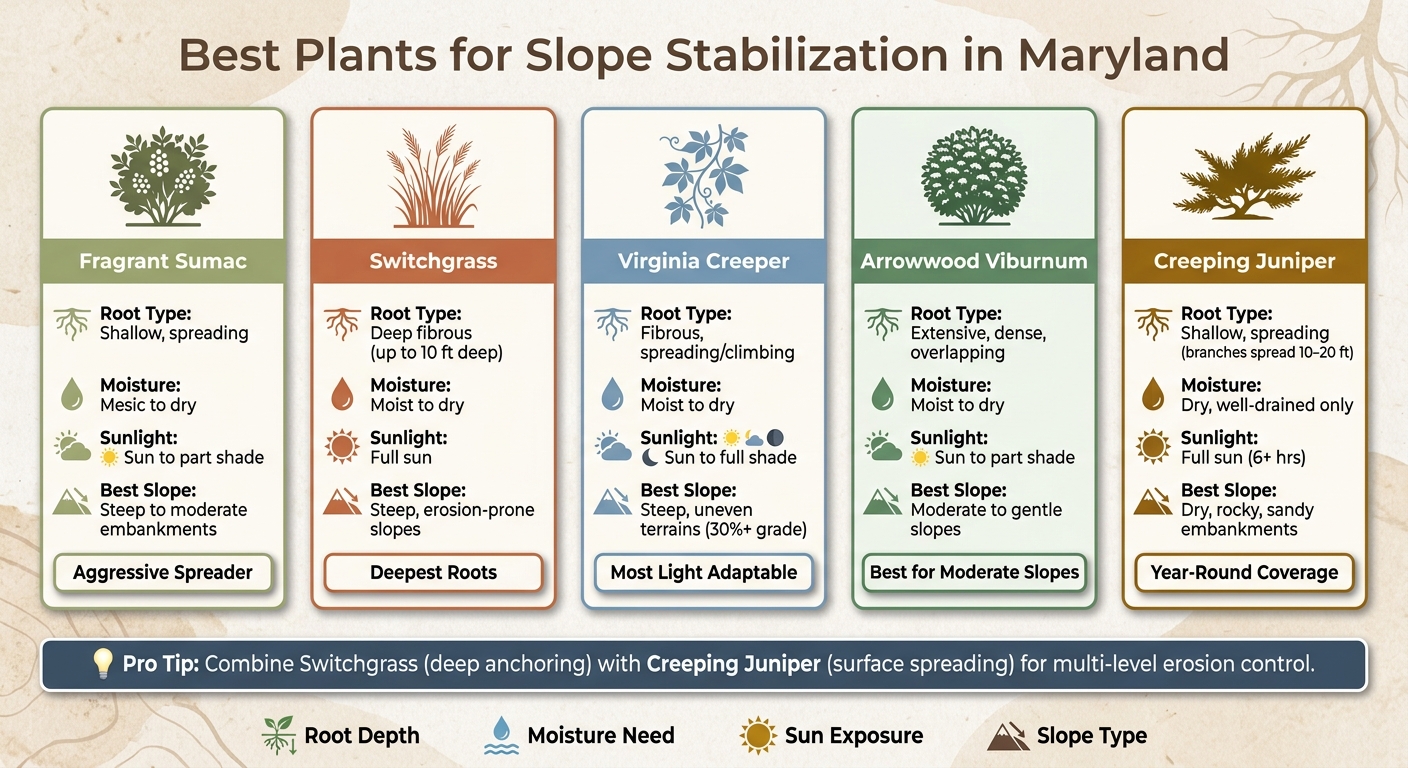
Best Plants for Slope Stabilization in Maryland: Side-by-Side Comparison
This table showcases five plants known for their effectiveness in stabilizing slopes. Each plant has distinct traits, including root system types, moisture needs, sun exposure preferences, and the types of slopes they are best suited for. Choosing the right plant depends on the unique conditions of your site.
| Plant | Root System Type | Moisture Preferences | Sun Exposure | Best For |
|---|---|---|---|---|
| Fragrant Sumac | Spreading roots [2] | Mesic to dry [1] | Sun to part shade | Steep to moderate – aggressive spreader for surface stabilization [1] |
| Switchgrass | Deep fibrous roots [2] | Moist to dry [1] | Full sun | Steep to moderate – deep soil anchoring and long-term erosion control [2] |
| Virginia Creeper | Spreading/climbing roots [2] | Moist to dry | Sun to shade | Steep to moderate – rapid coverage for large banks or rocky inclines [2] |
| Arrowwood Viburnum | Extensive and dense roots [2] | Moist to dry | Sun to part shade | Moderate to gentle – structural reinforcement and mid-slope density [2] |
| Creeping Juniper | Spreading roots [2] | Dry, well-drained [1] | Full sun | Steep to moderate – best for dry, sandy, or rocky embankments [1] |
This side-by-side comparison highlights the distinct advantages each plant offers:
- Switchgrass stands out for its deep fibrous roots, making it ideal for anchoring soil at depth and providing long-term erosion control.
- Fragrant Sumac and Creeping Juniper both have spreading root systems, but their moisture tolerances differ. Creeping Juniper is better for dry, rocky conditions, while Fragrant Sumac can manage a wider range of moisture levels.
- Virginia Creeper excels in light adaptability, thriving in conditions ranging from full sun to full shade. This makes it a versatile option for slopes with varying canopy cover.
- Arrowwood Viburnum is perfect for moderate or gentle slopes, where its dense root system adds structural stability rather than focusing on rapid surface coverage.
"Steep slopes present an opportunity to use native plants that are vulnerable to deer. Deer are browsing and grazing many of our native plant species into oblivion, but they cannot risk a twisted or broken ankle, so they avoid slopes." – Dr. Sara Tangren, former Sr. Agent Associate, University of Maryland Extension [1]
For optimal results, combine plants with complementary traits. For instance, pairing Switchgrass for deep anchoring with a surface spreader like Creeping Juniper tackles both deep soil stabilization and surface runoff control [2]. This integrated approach aligns with the broader strategies discussed earlier, ensuring effective and balanced slope stabilization.
Conclusion
No single plant can do it all. To effectively protect soil, combine deep-rooted grasses with spreading groundcovers. This approach addresses soil stability at multiple levels. When planning, consider factors like slope aspect, soil texture, and moisture levels. Such a design also takes into account seasonal challenges.
Winter protection is especially critical. Evergreen species or plants with basal blades help shield soil during dormancy, a time when erosion risks are at their highest [1].
Maryland’s ecoregions present unique challenges. For instance, a plant thriving on a dry, sunny embankment in Howard County might struggle on a shaded, damp slope in Frederick County. Selecting the right plants is key to avoiding expensive replanting and erosion repairs. For expert advice tailored to Maryland’s varied landscapes, Pro Landscapes MD offers professional assessments and custom solutions. They simplify slope stabilization by combining detailed site evaluations with plant strategies designed specifically for the region.
"A more modern and ecologically sound approach is to use native plants that have some of these attributes [aggressive spreading and quick growth]." – University of Maryland Extension [1]
FAQs
How do I choose the best plant for my slope’s sun and moisture?
When selecting plants for a slope, start by evaluating sun exposure and soil moisture. For slopes that are sunny and dry, consider native options like Butterfly Milkweed or Virginia Wildrye, which do well in well-drained soils. If the area tends to stay moist, grasses and sedges such as Carex species are excellent choices. Focus on native plants with deep or spreading root systems to enhance stability. To ensure the best results for erosion control, consult local experts who can recommend plants suited to your specific soil and environmental conditions.
Should I mix deep-rooted and spreading plants on the same slope?
Combining plants with deep roots and spreading growth habits on a slope works effectively to stabilize the soil. Deep-rooted plants anchor the soil over time, offering lasting stability. Meanwhile, spreading plants cover the surface rapidly, helping to minimize erosion. Together, they form a well-rounded solution for protecting and stabilizing slopes.
How long does it take these plants to control erosion?
The time it takes for plants to effectively control erosion varies based on factors like the species used, site conditions, and planting techniques. Native grasses with deep root systems can begin stabilizing soil within a few months, though complete stabilization generally occurs over 1 to 3 years. Success largely depends on proper planting and consistent maintenance.
Chat with Us