









- bhavya gada
- No Comments
If you want County stormwater funding, the first step is simple: match your project to the right program. In Prince George’s County, Stormwater Stewardship Grants fit larger community projects, while Rain Check Rebates fit approved installations on single properties. Stewardship awards can range from $500 to $300,000, and the total program pool is about $2,160,000. Rain Check works as a post-installation rebate, not an upfront grant.
Here’s the short version:
- Use Stewardship Grants for projects led by nonprofits, schools, public groups, HOAs, businesses, or residents that serve a community.
- Use Rain Check Rebates for approved practices like rain barrels, cisterns, rain gardens, permeable pavement, green roofs, conservation landscaping, urban tree planting, and pavement removal on eligible properties.
- Location matters for both programs: the site must be in Prince George’s County and outside the City of Bowie.
- Rules can change by funding cycle, so I’d check the current RFP, rebate rules, funding caps, and deadlines before applying.
- These programs do not cut your County stormwater fee by default. Funding and fee-credit rules are separate.
- Maintenance is part of the deal. Grant recipients must keep records and submit reports, and rebate-funded practices still need upkeep.
- One big update: the Stormwater Stewardship Grant Program is suspended for new FY26 applications.
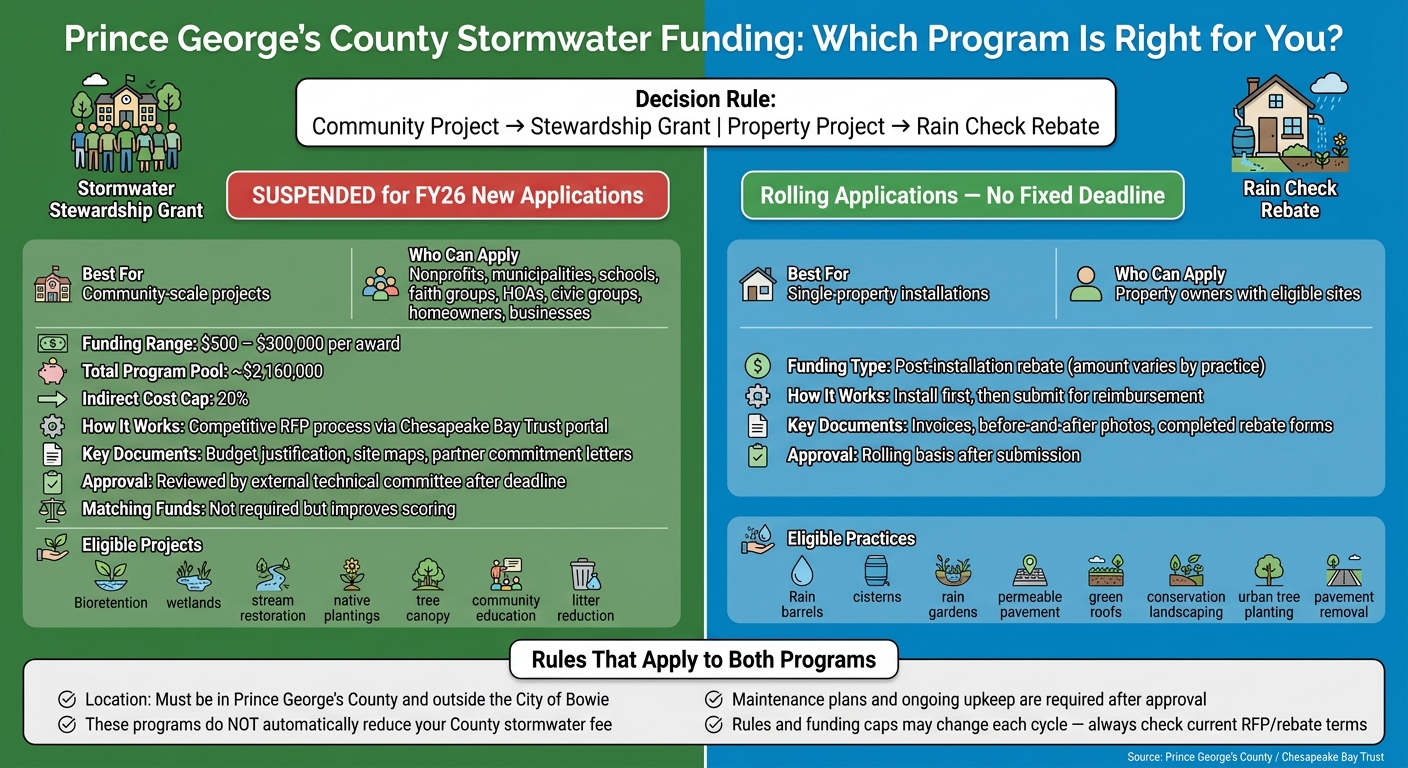
Prince George’s County Stormwater Grants: Stewardship vs. Rain Check Rebate
Quick Comparison
| Program | Best For | Who Can Apply | Funding | How It Works |
|---|---|---|---|---|
| Stormwater Stewardship Grant | Community-scale projects | Nonprofits, municipalities, schools, faith groups, HOAs, civic groups, homeowners, businesses | $500 to $300,000 depending on track | Competitive RFP through the Chesapeake Bay Trust |
| Rain Check Rebate | Single-property installations | Property owners and other eligible applicants tied to an eligible site | Rebate amount depends on approved practice | Install first, then submit forms, invoices, and photos |
If I were deciding fast, I’d use one rule: community project = Stewardship Grant; property project = Rain Check Rebate.
sbb-itb-843f8be
Who Can Apply and Which Properties Qualify
Who Is Eligible for Stormwater Stewardship Grants
Stormwater Stewardship Grants are open to a broad mix of applicants. That includes tax-exempt 501(c) nonprofit organizations, municipalities, public agencies, faith-based organizations, educational institutions, community associations (HOAs), civic groups, homeowners, and businesses [1][2][5].
There are two location rules that matter right away: the project must be in Prince George’s County, and it must be outside the City of Bowie [2][4].
If your organization is based outside Prince George’s County, you can still apply. But there’s a catch. You need to partner with a County-based entity and include a signed commitment letter from that partner with your application [5].
Funded projects also need to do more than just check an address box. Each one must provide local water-quality benefits and involve Prince George’s County residents in restoring and protecting local rivers and streams [1]. Projects that show strong community partnerships, matching funds, or in-kind support may score better during review [1].
Rain Check Rebates work a bit differently. They focus less on the type of applicant and more on the property itself.
Who Is Eligible for Rain Check Rebates
Rain Check Rebates are property-based incentives for eligible private properties, not grant awards for organizations in the same way as Stewardship Grants [3]. To qualify, the property must be in Prince George’s County and outside the City of Bowie [2][4].
You also need to meet the installation rules tied to the specific approved practice you’re applying for [3]. So even if the property is in the right place, the project still has to match the program’s practice-level requirements.
Which Projects and Practices Can Receive Funding
Once you know a project meets the basic rules, the next step is figuring out what each program will actually pay for.
Projects Commonly Funded Through Stewardship Grants
The Stormwater Stewardship Grant Program supports community-scale restoration projects. It funds work across five areas: water quality implementation, tree canopy, community awareness and engagement, litter reduction and beautification, and additional project support [1][2].
Common examples include bioretention, wetlands, stream restoration, and native plantings. The program can also fund specimen tree preservation and community education parts tied to the project [1][3][5].
That difference in scale is the big split between the two programs.
Practices Commonly Eligible for Rain Check Rebates
Rain Check Rebates work differently. These are rebates for individual properties, and the program pays for approved stormwater practices on eligible sites [3].
Eligible practices include rain barrels, cisterns, rain gardens, permeable pavement, green roofs, conservation landscaping, urban tree planting, and pavement removal [3].
Put simply, stewardship grants support larger community projects, while Rain Check Rebates cover approved practices on individual properties.
How Pro Landscapes MD May Support Approved Installations

Pro Landscapes MD may help with approved installations such as rain gardens, permeable pavers, grading, and drainage improvements.
After you match the project to the right program, the next step is the application process.
How the Application Process Works
Once you know which program fits your project, the next step is the application. The two programs work in very different ways, so it helps to know the path for each one before you start pulling documents together.
Applying for a Stormwater Stewardship Grant
Stormwater Stewardship Grants use a competitive RFP process run by the Chesapeake Bay Trust. You submit your application through the CBT portal, and an external technical committee reviews it [5].
Start with the current RFP. It lays out the active funding tracks and tells you what the program is looking for right now. Funding usually ranges from $500 to $300,000, depending on the track, and the total program funding pool is about $2,160,000 [5][2].
After you define your project, you’ll need to put together the core materials: a detailed budget justification, site maps, and signed letters of commitment from any partners. Indirect costs are capped at 20%. Matching funds aren’t required, but proposals that include cash or in-kind matches tend to get a better look during review [5][1]. Also, check the current RFP deadline before you apply.
Rain Check works the other way around: you install first, then ask for reimbursement.
Applying for a Rain Check Rebate
Rain Check Rebate applications are accepted on a rolling basis, so there’s no one deadline circled on the calendar. That said, you need to follow the program rules closely. If you install practices that aren’t approved or don’t meet program standards, your reimbursement may be denied.
After installation, submit your invoices, before-and-after photos, and the required rebate forms through the Rain Check Rebate online portal [3].
The table below shows the main procedural differences.
| Feature | Stormwater Stewardship Grant | Rain Check Rebate |
|---|---|---|
| Application Method | CBT portal; competitive RFP process | Rebate portal; post-installation submission |
| Key Documents | Budget justification, site maps, letters of commitment | Invoices, before-and-after photos, completed rebate forms |
| Approval Timing | Reviewed by technical committee after deadline | Reviewed on a rolling basis after submission |
| Funding Type | Upfront competitive grant | Post-installation rebate |
Fees, Maintenance, and Next Steps
After approval or reimbursement, two issues still matter: fees and maintenance.
How These Programs Relate to the County Stormwater Fee
These programs are financed through the Local Watershed Protection and Restoration Fund. They help pay for approved stormwater projects, but they do not automatically lower County stormwater fees or take the place of fee-credit programs.
Here’s the plain-English version: treat these programs as funding tools, not as fee-credit substitutes. A rain barrel rebate and a competitive grant for bioretention work are separate programs with separate rules. Neither one automatically lowers or wipes out what you owe under the County’s stormwater fee system. If you’re focused on fee-credit programs, those follow a different set of requirements altogether [1][3].
Maintenance Responsibilities After Approval
Approval is just the starting line. Long-term results depend on upkeep, and approval itself depends on having a maintenance plan that makes sense.
After installation, grant recipients must:
- keep detailed financial records
- provide periodic progress reports
- submit a final report with outcome metrics showing that the practice is working as intended [5]
Rain Check projects also need routine maintenance to keep doing their job. Pro Landscapes MD can help with drainage repair, grading, yard leveling, and stormwater maintenance after installation.
Conclusion: Key Points to Remember
Before you apply, use this short checklist:
- Match the program to your project. Homeowners and businesses installing certain practices should look at Rain Check. Nonprofits, municipalities, and schools running larger restoration or education projects should aim for the Stewardship Grant [3].
- Check current program status. The Stormwater Stewardship Grant Program is suspended for new FY26 applications [5].
- Build in a maintenance plan from the start. Sustainability is a scoring factor, not something to tack on later [1][5].
- Reach out early. For Rain Check questions, contact Delaney Samons at 410-974-2941 x131. For Stewardship Grant questions, contact Whitney Vong at 410-974-2941 x122 [3].
FAQs
Which program fits my project?
The Prince George’s County Stormwater Stewardship Grant Program funds hands-on restoration work and community engagement projects across the county, except for the City of Bowie.
To apply, line up your project with one of these five tracks:
- Track 1: Water Quality Implementation – $50,000 to $200,000
- Track 2: Tree Canopy – $50,000 to $300,000
- Track 3: Community Awareness and Engagement – $10,000 to $60,000
- Track 4: Litter Reduction and Beautification – $10,000 to $50,000
- Track 5: Additional Project Support – $500 to $5,000
Can I apply if my property is in Bowie?
No. Properties within the City of Bowie are not eligible for the Prince George’s County Stormwater Stewardship Grant Program because Bowie runs its own stormwater program separate from the County.
Do these programs reduce my stormwater fee?
No. The Stormwater Stewardship Grant Program does not directly reduce your stormwater fee.
Instead, it funds organizations that carry out restoration projects to improve local water quality and community spaces.
If you’re looking for financial help for stormwater work on private property, check the separate Prince George’s County Rain Check Rebate Program.
Chat with Us