









- bhavya gada
- No Comments
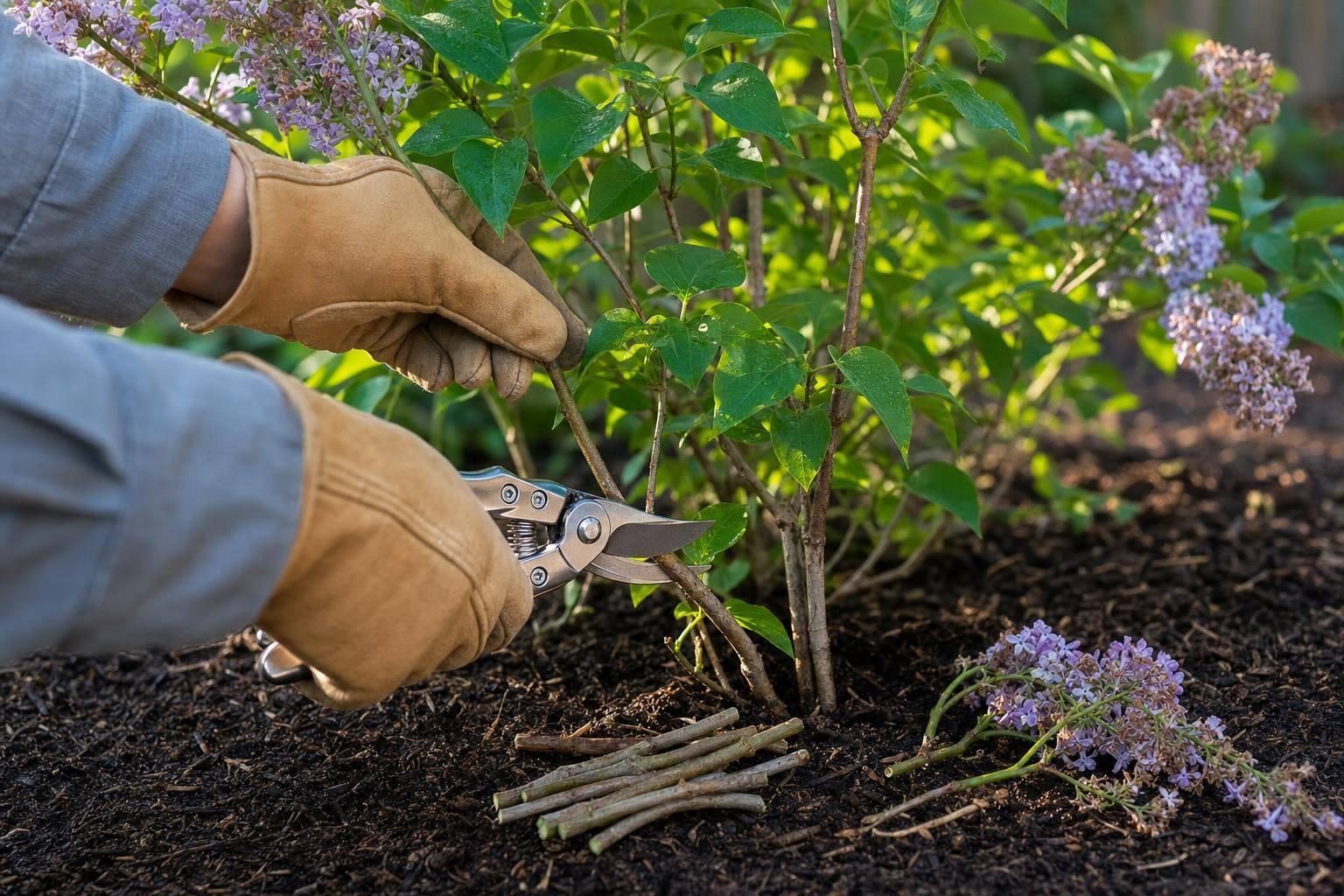
If you prune spring-blooming shrubs at the wrong time, you can cut off next year’s flowers. I’d keep one rule in mind: prune right after the plant finishes blooming, then limit cuts to what the shrub needs.
Here’s the short version:
- Spring bloomers flower on old wood, so buds for next year form on stems from this year.
- Late-winter or fall pruning can remove flower buds before they open.
- I’d start with dead, damaged, or diseased wood first.
- Then I’d use thinning cuts to remove crowded or old stems at the base.
- I’d use heading cuts only when size control is needed.
- For overgrown shrubs, I’d remove about 1/3 of the oldest stems per year for 3 years.
- I’d skip hedge shearing on plants like forsythia, lilac, azalea, and rhododendron.
- After pruning, I’d water during dry spells and avoid cutting off more than 33% of live growth in one season.
Common Maryland examples include forsythia, lilac, azalea, rhododendron, camellia, and some spring clematis. In plain terms: if it blooms in spring, I’d assume it needs pruning after bloom, not before, unless I know the plant’s habit for sure.
This comes down to timing, clean cuts, and restraint. If I prune too early, shear everything flat, or remove too much at once, bloom count drops fast.
Timing is Everything: Pruning Spring-Blooming Shrubs
sbb-itb-843f8be
Step 1: Gather the Right Tools and Prepare to Prune Safely
Use sharp, clean tools so each cut heals fast and doesn’t open the door to disease. Clean cuts matter even more on spring bloomers because rough cuts can injure the wood that carries next year’s buds.
Match the Tool to the Branch Size
Pick your tool based on branch thickness. Bypass hand pruners work for stems up to about 1 inch thick and make clean cuts on live wood without crushing the stem [4]. Bypass loppers are made for branches up to 2 inches thick, giving you more leverage when growth gets heavier [4]. For wood over 2 inches thick or stems packed into a tight spot, use a pruning saw [4].
Skip hedge shears. They push plants into thick outer growth and can cut down bloom production [1].
| Tool | Branch Size | Best Use |
|---|---|---|
| Bypass Hand Pruners | Under 1 inch | Small stems, selective shaping |
| Bypass Loppers | Up to 2 inches | Medium branches needing leverage |
| Pruning Saw | Over 2 inches | Large wood or tight spaces |
Protect Yourself and Work From Stable Ground
Wear heavy-duty gloves and safety glasses [4]. Set a stable stepladder on level ground, and don’t lean too far to reach a branch [4].
Clean and Disinfect Blades Between Plants
Dirty blades can spread disease from one shrub to the next [4][7]. Before you move to another plant, clear off sap and debris. Then disinfect the blades with 70% to 99% isopropyl alcohol – spray or dip, then wipe them clean [4].
A 10% bleach solution works too. If you use bleach, rinse and dry the blades well, then add a light coat of lubricant to help stop rust.
Once your tools are set, the next move is choosing the cut that fits the plant’s condition.
Step 2: Choose the Right Pruning Method for the Plant’s Condition
Not every shrub needs the same kind of cut. Start by removing dead, damaged, or diseased wood. After that, choose the least aggressive method that fixes the issue. Since these shrubs bloom on old wood, every cut can affect next year’s buds. The order matters: clean up damage first, thin crowded growth next, and shorten branches only if the plant still needs size control.
Thinning Cuts: Open the Plant and Improve Airflow
Thinning removes a stem at its point of origin or down at ground level [4][2]. That opens up the shrub, improves airflow, and helps push new stems to grow [1].
For most mature spring-blooming shrubs, thinning is the best default move. It keeps the plant’s natural shape instead of forcing it into a tight outline. It also helps the shrub put energy into the growth that does the most work. When deciding what to remove, go after stems that cross or rub, grow hard toward the center, or crowd the middle. Keep stems with wide, strong branch angles [4].
If the shrub still feels too large after thinning, use heading cuts on only a small number of branches.
Heading Cuts: Reduce Size and Shape Growth
A heading cut shortens a branch tip back to just above a healthy bud or side branch [2][4]. It works well when you need to shorten one branch or fill in a thin spot.
Use heading cuts sparingly. They’re for branches that actually need size control, not for general shaping. And skip shearing the whole shrub with hedge trimmers. That tends to create a dense outer layer of leaves while the inside turns bare and less productive [1].
Rejuvenation Pruning: Restore Overgrown Shrubs Over Time
If a shrub has gotten too big, blooms poorly, or is packed with thick, woody stems and very little new growth, rejuvenation pruning may be the right fix. Remove the oldest, thickest stems at ground level, but only part of them at a time.
Spread the job across three years, taking out about one-third of the oldest stems each season. That gives the plant time to recover while it replaces tired wood with strong new growth. Cutting more than one-third at once can stress the plant [4].
Use this method only when regular thinning no longer brings the shrub back into shape.
Next, apply these methods to common Maryland spring bloomers.
Step 3: Prune Common Spring-Blooming Plants in Maryland
Use the methods above on some of Maryland’s most common spring bloomers, or view our landscaping services for professional assistance.
Forsythia and Lilac: Remove Old Stems Right After Bloom
Once flowering ends, remove up to one-third of the oldest stems at the base. With lilac, cut spent flower clusters back to the first set of leaves. With forsythia, skip shearing or topping. Instead, shorten long stems back to a side branch so the shrub keeps its natural arching shape [10][2].
Broadleaf shrubs call for a lighter touch and more precise cuts.
Azalea and Rhododendron: Use Selective Cuts, Not Heavy Shearing
Use hand pruners or loppers, not hedge shears. Shearing forms a dense outer layer that blocks light from the inside of the plant and can leave the center bare and more open to pests and disease [3][1]. Thin crowded stems, and cut tall shoots back to a side branch or an outward-facing bud [9][2].
Rhododendrons tend to grow more slowly than many deciduous shrubs, so light thinning usually works better than hard rejuvenation [2].
Vines and camellias need an even gentler approach.
Clematis and Camellia: Match the Cut to the Blooming Habit
Spring clematis and camellia both bloom on old wood, which means you should prune them right after flowering, not before [6][5][7]. For spring clematis, thin weak or tangled stems and do only light shaping after the blooms fade. For camellia, go even lighter. Focus on deadheading spent flowers [2][7] and removing dead wood when needed [4]. Save rejuvenation pruning for plants that are badly overgrown, and spread that work over several years.
Avoid Common Mistakes and Finish With Proper Aftercare
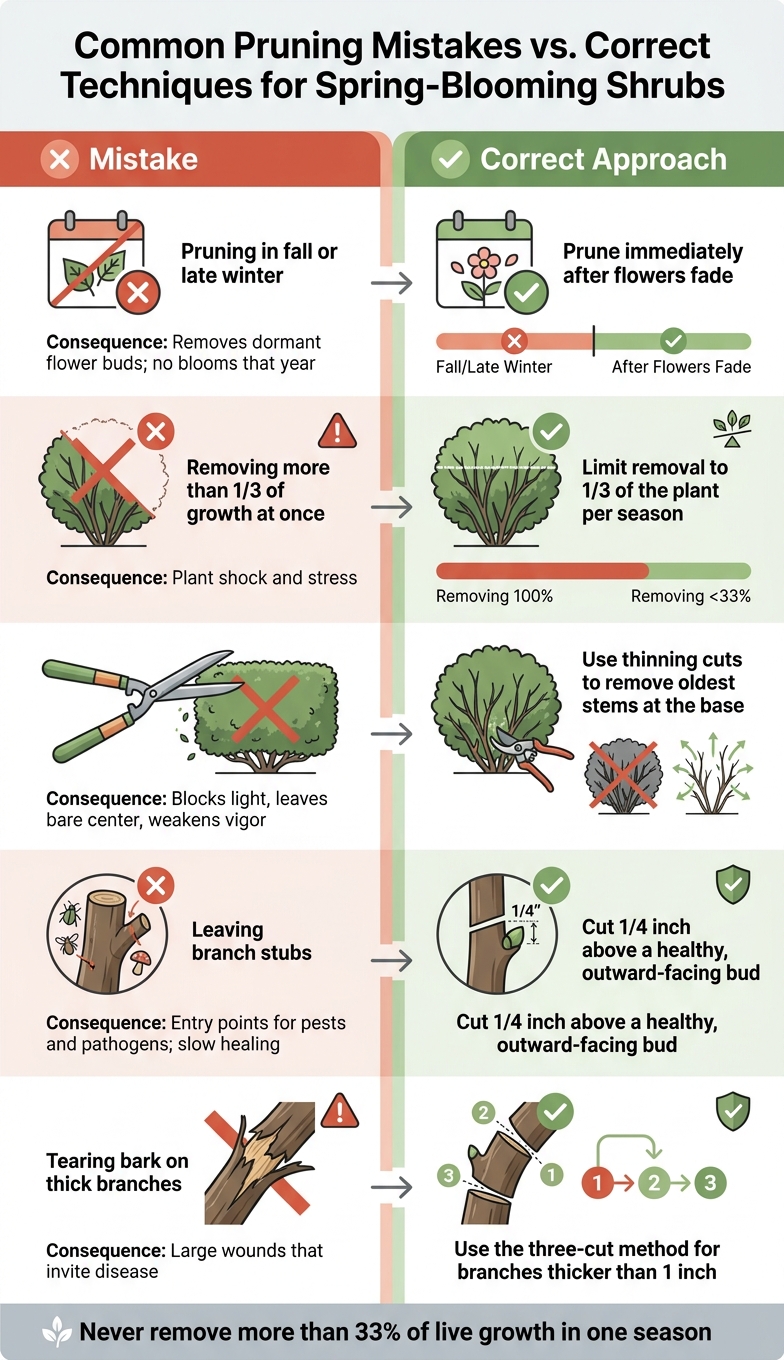
Common Pruning Mistakes vs. Correct Techniques for Spring Bloomers
Mistakes That Reduce Blooms or Weaken Shrubs
A few pruning mistakes can wipe out next spring’s flowers fast. The big one: pruning spring bloomers before they finish flowering. If you cut too early, you’re cutting off the buds the plant already made for this year.
Another easy way to set a shrub back is cutting too much at once. Try not to remove more than one-third of a shrub’s live growth in a single season. Bigger cuts can shock the plant and cut down bloom production.
| Pruning Mistake | Consequence | Correct Alternative |
|---|---|---|
| Pruning in fall or late winter | Removes dormant flower buds; no blooms that year [1][6] | Prune immediately after flowers fade [2] |
| Removing more than 1/3 of growth | Plant shock and stress [4][8] | Limit removal to 1/3 of the plant per season [4] |
| Shearing | Blocks light, leaves a bare center, weakens vigor [1][3] | Use thinning cuts to remove the oldest stems at the base [1][3] |
| Leaving branch stubs | Entry points for pests and pathogens; slow healing [4] | Cut 1/4 inch above a healthy, outward-facing bud [11] |
| Tearing bark | Large wounds that are slow to heal and invite disease [4] | Use the three-cut method for any branch thicker than 1 inch [4] |
Shearing is another common problem. It may look neat for a minute, but it blocks light, leaves the center bare, and weakens the shrub over time [1][3]. Thinning cuts work better because they remove old stems at the base and let light and air move through the plant [1][3].
Small details matter too. If you leave branch stubs, you create spots where pests and pathogens can get in, and the plant heals more slowly [4]. Cut 1/4 inch above a healthy, outward-facing bud instead [11]. And for branches thicker than 1 inch, use the three-cut method so you don’t tear the bark [4].
Aftercare: Deadhead, Water During Dry Spells, and Watch for Stress
Once you’re done pruning, a little aftercare goes a long way. Deadheading and structural pruning are not the same job. Deadheading removes spent flowers, while structural pruning shapes the shrub.
Deadhead old flower clusters on plants like lilacs and rhododendrons to keep the shrub from putting energy into seed production [4][2]. Save structural pruning for the post-bloom window, then deadhead as needed through the season.
After pruning, water deeply during dry spells so the shrub can recover well [10][12]. Also, skip wound sealers on fresh cuts. Shrubs close those cuts on their own, and sealers can trap moisture and slow healing [11].
Conclusion: Prune After Bloom, Cut Selectively, and Keep the Natural Shape
The basic approach is simple: prune after bloom, cut with care, and keep the shrub’s natural shape. Use thinning cuts more often than shearing, keep removals under one-third of the plant’s mass, and spread major rejuvenation pruning across three years if the shrub is overgrown [11].
That’s what helps a spring-blooming shrub stay healthy and flower well year after year: clean cuts, the right timing, and simple aftercare.
FAQs
How do I know if my shrub blooms on old wood?
The best clue is when it blooms. Shrubs that flower in early spring usually bloom on old wood. That means the buds formed on stems that grew the year before.
Common examples include azaleas, rhododendrons, lilacs, forsythia, and some hydrangeas, such as bigleaf and oakleaf. If you’re not sure which type you have, a mobile plant ID app can help you check the variety and figure out its pruning needs.
What should I do if I missed the post-bloom pruning window?
If you miss the post-bloom pruning window, it’s usually best to wait until next year.
Here’s why: many spring-blooming plants set next season’s flower buds on old wood. So if you prune too late, you may cut off the buds before they have a chance to bloom.
That said, you can still remove dead, damaged, or diseased branches at any time if the plant needs care.
Can an overgrown spring bloomer recover without losing its flowers?
Yes, but timing matters.
If you prune before it flowers, you’ll cut off buds that formed on last year’s growth. And that means it won’t bloom that season.
If you want to keep the plant healthy without losing blooms, prune it right after the flowers fade. That gives it time to grow through the summer and set buds for next spring.
Chat with Us