









- bhavya gada
- No Comments
Yes – most Maryland homeowners can use a rain barrel. But the part that trips people up is this: state law is only part of the picture. Your county, city, or HOA may set extra rules on overflow, placement, rebates, and inspections.
If I wanted the short version, here’s what I’d want to know right away:
- Rain barrels are generally allowed in Maryland for outdoor, non-drinking water use.
- A basic above-ground barrel usually does not need a permit.
- Local rules matter most for drainage, overflow, downspout changes, and rebate details.
- Montgomery County offers $1 per gallon in RainScapes rebates, up to $250, but the project must meet size rules.
- One standard barrel only holds about 50 to 60 gallons, so it helps with small roof runoff but won’t fix major drainage or basement water problems.
- Setup matters: keep the barrel on a level base, use a screened lid, and send overflow at least 4 feet from the foundation onto a surface that can absorb water.
A few numbers put this in perspective. A full 60-gallon rain barrel can weigh 500+ pounds. And in some rebate programs, one barrel is not enough by itself because the total storage may need to reach 100 or 200 gallons.
Here’s the plain-English takeaway: Maryland allows rain barrels, but local program rules decide how much money you may get and how the system should be installed. I’d treat a rain barrel as a small runoff tool – not a full drainage fix.
This article gives a simple rundown of the law, county rebates, setup rules, and when you may need more than a barrel.
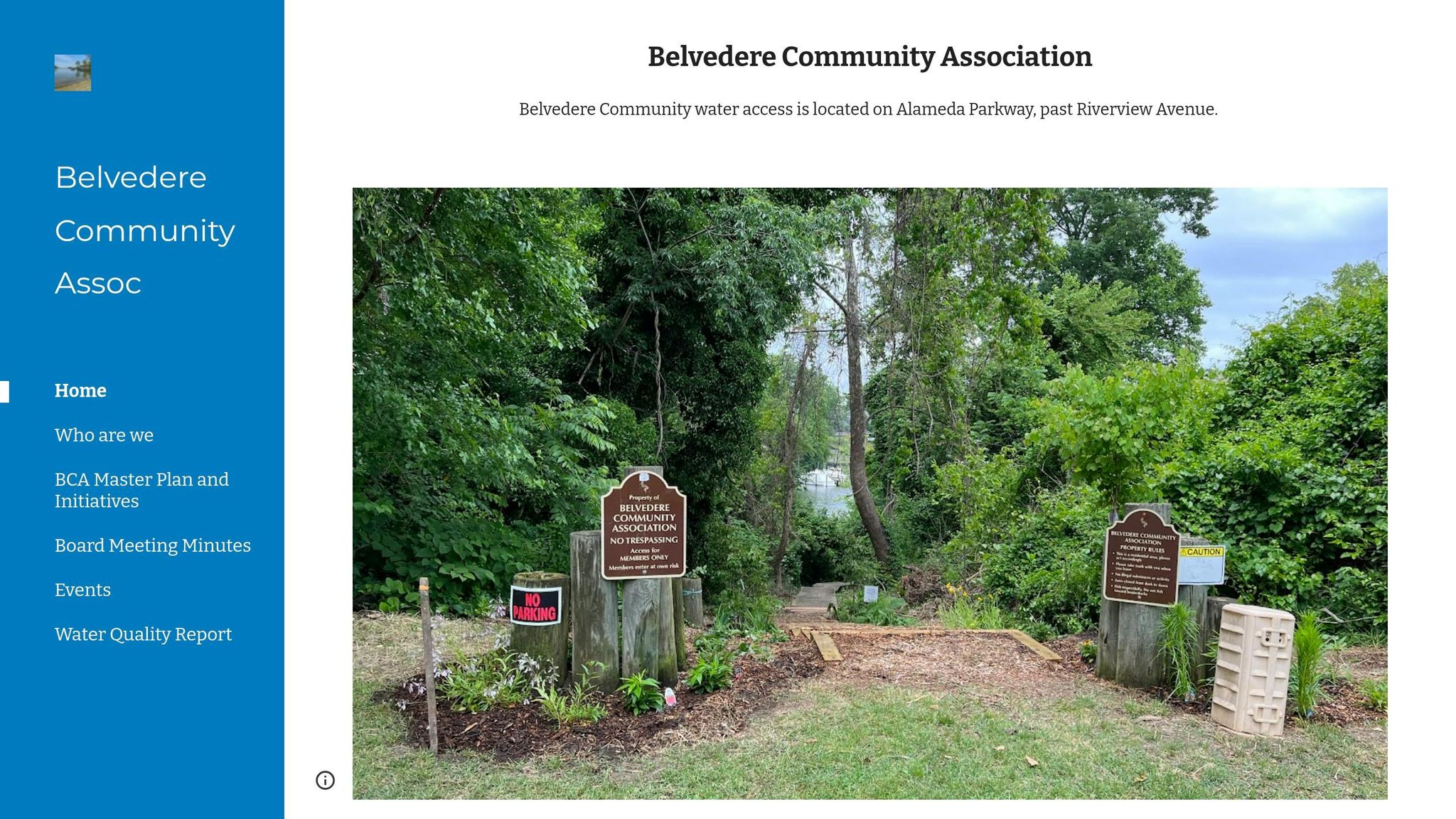
Rain Barrel Installation Demo – Belvedere Community Association
sbb-itb-843f8be
Maryland rules on rain barrels
Maryland does not have a statewide ban on residential rain barrels. You can use collected rainwater for outdoor, non-potable jobs like watering plants or rinsing garden tools.[1]
The University of Maryland Extension also points out that HOA, landlord, and local rules still apply.[1]
State guidance and local rules
Local codes may set rules for overflow, drainage direction, setbacks, and downspout changes.[3] The main goal is simple: keep overflow on your property and away from neighboring lots. In practice, that means the overflow should stay on-site and follow the existing drainage path.[3]
HOA rules can also affect where you place a rain barrel and how it looks. For example, Montgomery County’s RainScapes rebate program requires an HOA approval letter as part of the application.[3]
Whether a permit is usually required
A simple above-ground rain barrel usually does not need a permit in Maryland.[1] But larger cisterns or underground systems may lead to local review.[1][3]
Once you’ve checked local rules, it’s worth seeing whether your county offers rebates or fee credits.
Maryland stormwater rebates and fee credits
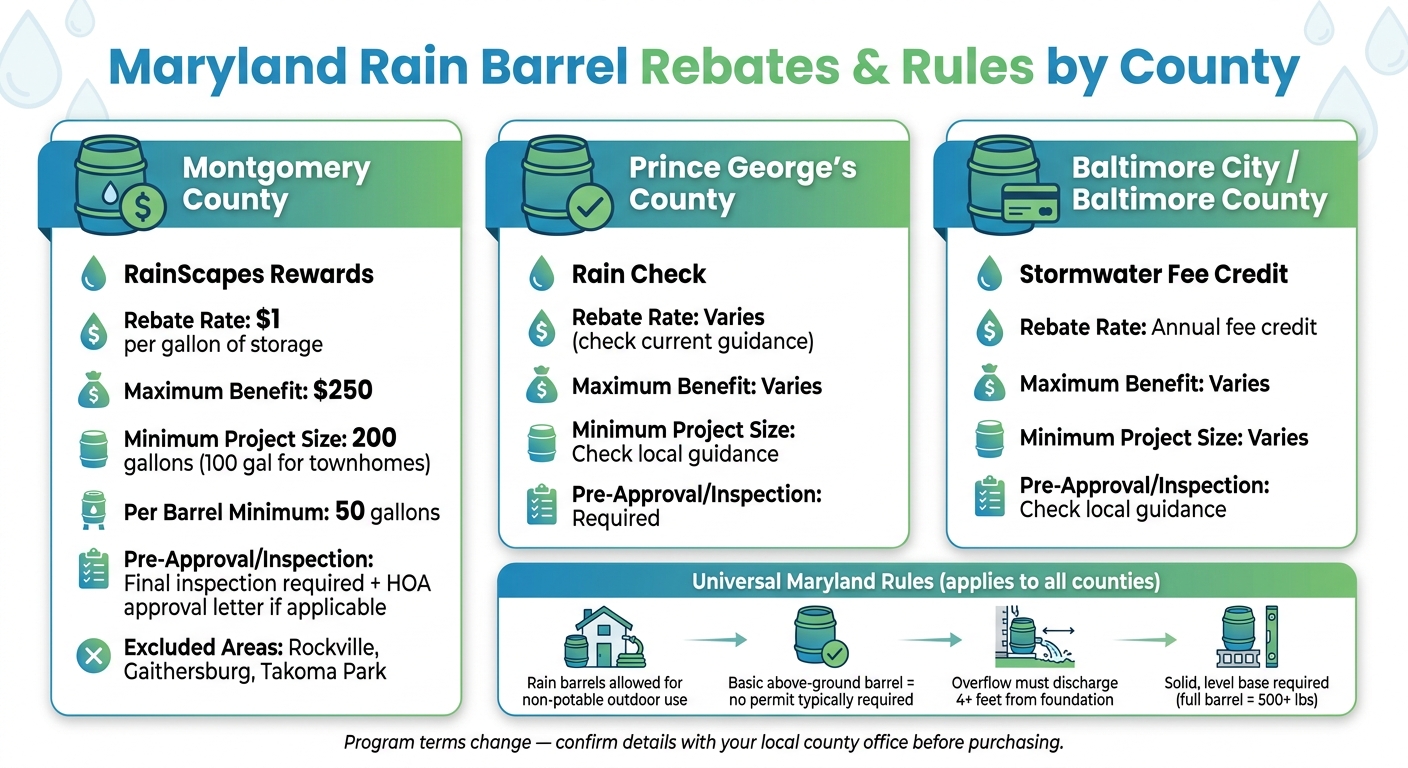
Maryland Rain Barrel Rebates & Rules by County
Local programs can help cut the cost of a rain barrel through rebates or yearly stormwater fee credits. In Maryland, that usually comes down to county rules, not state law, so the county where you live matters most if you’re trying to save money.
Prince George’s County and Montgomery County programs
Montgomery County’s RainScapes Rewards program pays $1 per gallon of storage capacity, up to $250 for residential properties.[3] There are a few size rules attached. Your full project must store at least 200 gallons, or 100 gallons for townhomes, and each barrel must hold at least 50 gallons.[3] The program is only open to properties outside Rockville, Gaithersburg, and Takoma Park.[3]
"RainScapes projects are designed to reduce stormwater runoff and enhance the local environment." – Montgomery County Department of Environmental Protection
Montgomery County also limits rebates to voluntary, new projects. They don’t apply to stormwater work that was already required. To apply, you’ll need a site plan, itemized receipts, a signed Property Owner Agreement, any HOA approval that’s required, and a final inspection. Sales tax is deducted from the rebate.[3]
Prince George’s County’s Rain Check program has offered rebates for rain barrels that meet county rules. Since program terms can change, it’s smart to check the current eligibility rules and rebate amount with the county before you buy.
Baltimore-area credits and other local programs
In the Baltimore area, the setup is a bit different. Baltimore City and Baltimore County may offer fee credits for rain barrels that meet local standards, but the details depend on the jurisdiction. Howard County also includes rain barrels in its watershed fee program.[2]
Maryland incentive details by jurisdiction
Rules can change a lot from one county to the next. This table gives you a quick side-by-side look, but you’ll still want to confirm the latest details with your local county office.
| Jurisdiction | Program Name | Min. Project Size | Rebate/Credit Structure | Max Benefit | Pre-approval/Inspection |
|---|---|---|---|---|---|
| Montgomery County | RainScapes Rewards | 200 gal (100 for townhomes) | $1 per gallon rebate | $250 | Final inspection required |
| Prince George’s County | Rain Check | Check local guidance | Rebate | Varies | Required |
| Baltimore City/County | Stormwater Fee Credit | Varies | Annual fee credit | Varies | Check local guidance |
Installation standards that help avoid drainage problems
Once rebates and local approvals are in place, the next part is what makes or breaks the system: installation. If a rain barrel is set up the wrong way, water can collect near your foundation, mosquitoes can move in, and overflow can turn into a mess.
Basic setup requirements
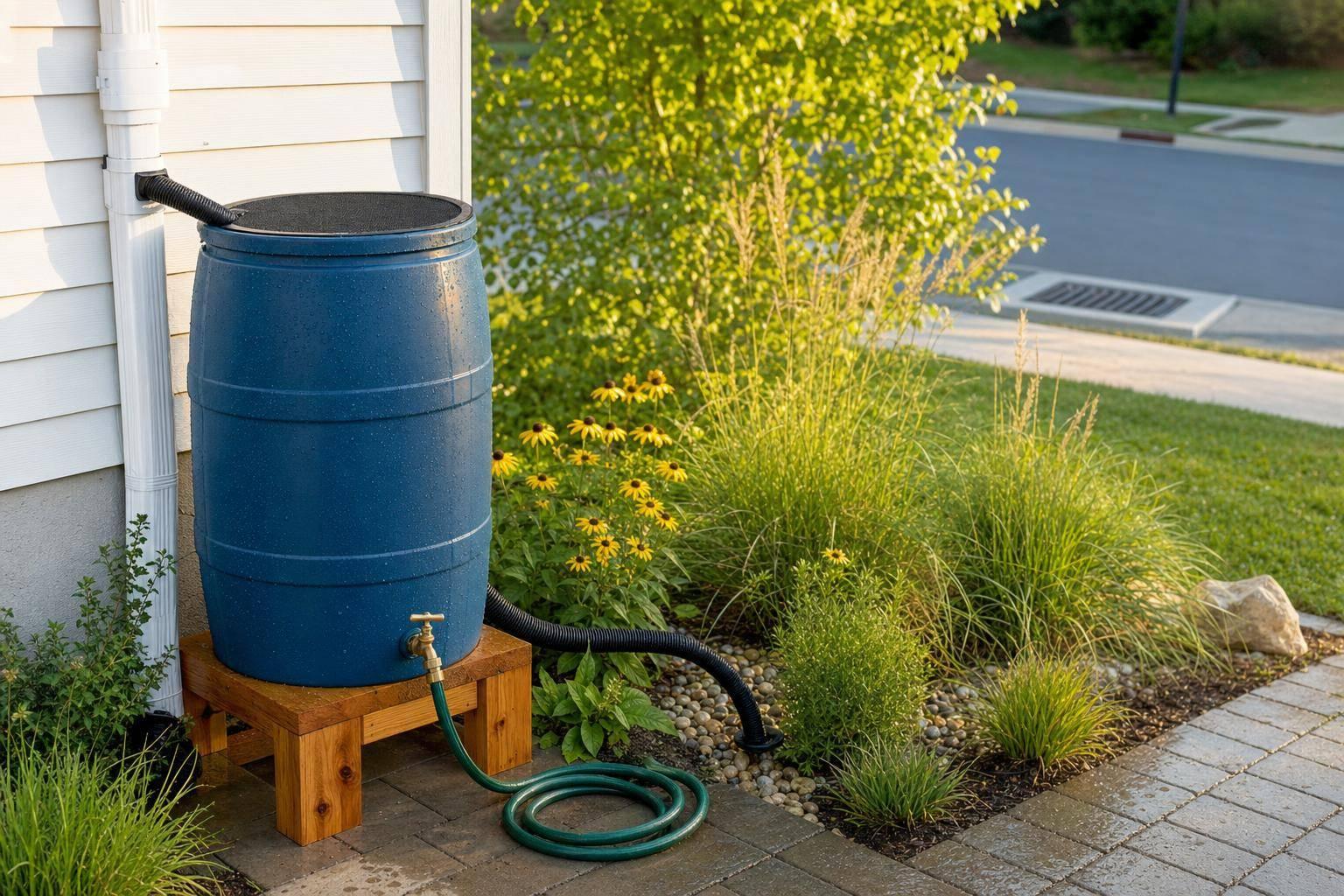
Start with the base. This part matters more than people think. A full 60-gallon barrel can weigh more than 500 pounds, so it needs a solid, level support base that can safely hold it when full. [3]
You’ll also want a screened inlet and a secure lid to keep out debris and cut down on mosquito breeding. [3] And the barrel itself should be a rigid, food-grade plastic barrel. [3]
How to manage overflow correctly
Overflow is where many setups slip up. Your overflow outlet needs to discharge at least 4 feet away from your foundation, and it should drain onto a permeable surface like grass or a garden bed. [3] It also needs to stay out of window wells. [3]
There are two common ways to handle extra water:
- An inline diverter can send excess water back into the downspout once the barrel is full. [3]
- If you use an overflow pipe instead, aim it at a splash block to help limit soil erosion near the outlet. [3]
Between storms, empty the barrel so it’s ready for the next rainfall instead of spilling over without control. [1]
Required vs. recommended features
The table below shows what’s usually required under Maryland and local program guidance versus what’s simply smart to include.
| Feature | Required | Recommended |
|---|---|---|
| Screened openings and secure lid | Yes – helps prevent mosquitoes, debris, and child access [3] | – |
| Overflow routing | At least 4 feet from the foundation and onto a permeable surface [3] | Add splash blocks to reduce erosion [3] |
| Solid, level base | Yes – must support the full weight of the barrel when full [3] | Elevated base for better gravity-fed pressure [3] |
| Inlet cleaning | Regular cleaning of inlets and screens [3] | Empty completely before winter freezes [3] |
| Diverter system | Optional [3] | Highly recommended for automatic overflow control [3] |
A rain barrel can help with small amounts of roof runoff. But if you’re dealing with bigger drainage and stormwater issues, storage alone usually won’t fix it.
How rain barrels fit into a larger stormwater plan
What rain barrels can and cannot do
A properly installed rain barrel helps, but it’s only one part of runoff control. It collects rooftop runoff before that water hits the ground, which can cut down on small-scale erosion near downspouts.[1] On its own, one barrel has a limited effect. But across a neighborhood, lots of barrels can chip away at runoff.
That limit becomes a big deal when a property already has drainage trouble. A standard 50- to 60-gallon barrel can help at the downspout, but it won’t stop basement flooding, fix poor grading, or handle runoff from large paved areas or compacted soil.[1]
When a property needs more than a barrel
If you’re dealing with standing water, basement seepage, or repeat overflow, a barrel isn’t going to solve the root problem. In cases like that, the fix usually calls for site-wide drainage work, not just a storage container.
For drainage issues that go beyond what a barrel can do, Pro Landscapes MD can tie grading, French drains, dry riverbeds, and stormwater management into one plan.
Key Maryland takeaways for homeowners
In Maryland, rain barrels are generally allowed for non-potable outdoor use, and there are no state-level limits on harvesting rainwater.[1] That said, local rules, HOA requirements, and program guidelines can still vary, so it’s smart to check before installing one. In Montgomery County, the RainScapes rebate offers $1 per gallon of storage, up to $250.[3]
The setup details matter too. A solid, level base, proper overflow routing, and a screened lid can make the system work the way it’s supposed to.[3]
FAQs
Can I use rain barrel water on vegetables?
Yes. You can use rain barrel water to water vegetable gardens.
However, it is not potable and may contain bacteria or pollutants from roof debris. So wash all fruits and vegetables thoroughly with clean tap water before eating or cooking.
Also, keep the system properly screened to help maintain water quality for outdoor use.
What if my HOA does not allow rain barrels?
If your homeowners association (HOA) bans rain barrels, talk with HOA board members or local elected officials about their concerns. Those conversations can help guide new water-saving rules in your community.
Before you install anything, check all HOA rules that apply. You still need to follow your community’s guidelines.
When is a rain barrel not enough?
A rain barrel isn’t always enough. If your roof sends down more runoff than the barrel can store, it can fill up fast during a heavy storm.
Most standard rain barrels hold 50 to 60 gallons. That sounds like a lot at first, but in moderate to intense rain, they can be full within minutes.
If you need more water stored for dry spells, or you’re dealing with larger amounts of runoff, a cistern may be a better fit. Pro Landscapes MD can also help handle extra water with drainage solutions.
Chat with Us