









- bhavya gada
- No Comments
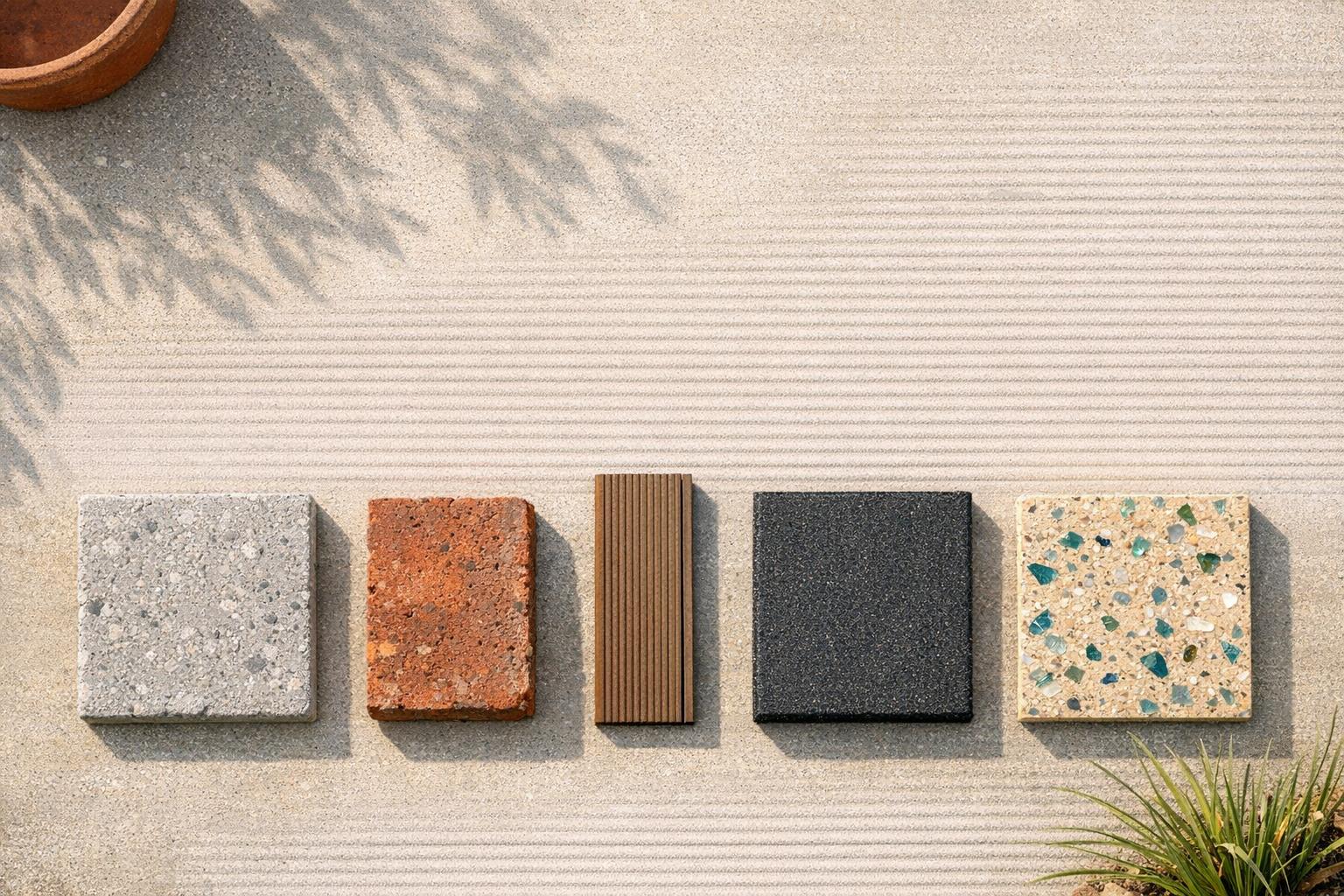
Looking to build a patio that’s durable, cost-effective, and reduces waste? Recycled materials offer a smart solution, combining functionality with eco-conscious benefits. From reclaimed wood to recycled plastic lumber, these materials not only help reduce landfill waste but also provide long-lasting outdoor surfaces. Here’s a quick overview of five top options:
- Reclaimed Wood: Dense, old-growth wood sourced from vintage buildings; requires maintenance but adds charm and history.
- Recycled Concrete (Urbanite): Salvaged concrete chunks that mimic flagstone; durable and budget-friendly.
- Salvaged Bricks: Weathered bricks with unique textures; durable but require precise installation.
- Recycled Rubber Pavers: Made from old tires; flexible, slip-resistant, and low-maintenance.
- Recycled Plastic Lumber: Weather-resistant and rot-proof; higher upfront cost but minimal upkeep.
Each material has its own strengths, installation requirements, and price points. Whether you prioritize aesthetics, durability, or affordability, these options can help you create a patio that lasts while making a positive impact. Keep reading to explore the details and find the best fit for your needs.
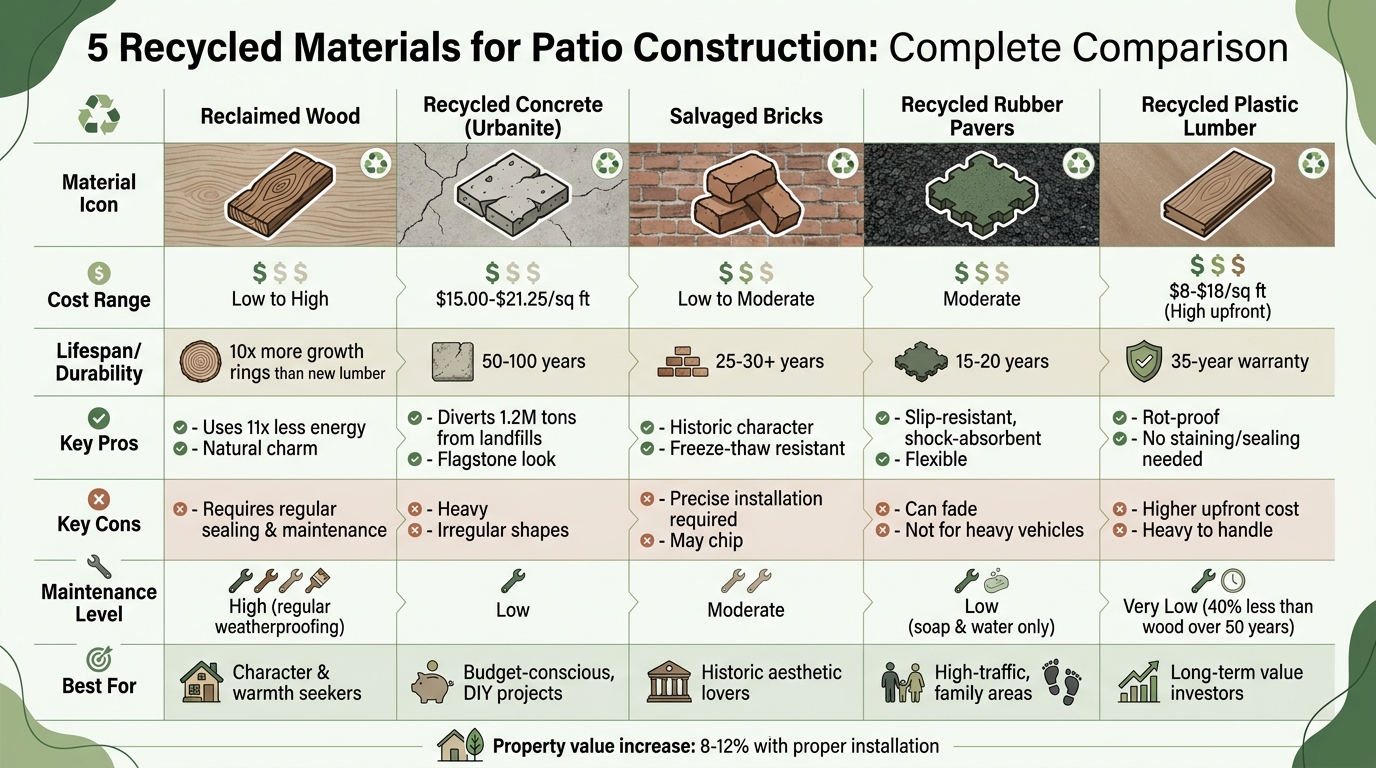
Recycled Patio Materials Comparison: Cost, Durability and Maintenance Guide
How to Build a Patio with Recycled Concrete | Urbanite Patio DIY
sbb-itb-843f8be
1. Reclaimed Wood
Reclaimed wood brings a timeless charm to patios. Sourced from barns, bridges, and vintage buildings – some over a century old – this material boasts a density that far surpasses new lumber. In fact, old-growth reclaimed wood can have nearly 10 times more growth rings per inch than its newer counterparts, making it naturally more resistant to rot and decay [3].
From an environmental standpoint, reclaimed wood is a win. It uses up to 11 times less energy and significantly lowers its Global Warming Potential compared to virgin lumber [4]. As Urban Evolutions puts it:
"Reclaimed wood is widely recognized as the most climate-friendly wood source." [3]
But installation takes some effort. Each piece needs to be carefully prepped – start by checking for hidden nails or screws, inspect for rot (steer clear of heavily damaged pieces), and then clean, sand, and apply several thin layers of finish, sanding between coats [5].
Maintenance is key to keeping reclaimed wood patios in top shape. Regular weatherproofing helps protect against moisture and UV damage [6]. For durability, go for species like teak, redwood, or western red cedar. Also, let the wood acclimate to your local climate before installation to reduce issues with expansion or contraction [7].
To ensure quality, source your reclaimed wood from FSC-certified suppliers. While the salvage process can make it pricier upfront, reclaimed wood offers warmth and character that new lumber often can’t match – and at a lower environmental cost [2][7].
Next, we’ll explore recycled concrete – a material that pairs durability with eco-friendly benefits, much like reclaimed wood.
2. Recycled Concrete (Urbanite)
Recycled concrete, often referred to as urbanite, is salvaged from demolished driveways, sidewalks, and building foundations. Instead of filling up landfills, these concrete chunks find a new purpose as patio pavers. For perspective, Washington State alone recycled nearly 1.2 million tons of concrete rubble in 2017 – roughly the weight of three Empire State Buildings [8]. Following reclaimed wood, urbanite stands out as a sturdy and budget-friendly option.
Urbanite comes with environmental perks. By reusing concrete, the demand for new cement production drops, which helps reduce emissions [8][2]. Plus, it keeps bulky debris out of landfills while offering the durability of traditional concrete – structures made from it often last 50 to 100 years [8].
Installing urbanite is fairly straightforward. Start by clearing the area of grass, lay down a compacted gravel base, and fit the concrete pieces together snugly. Larger chunks can be resized with a sledgehammer. To finish, sweep a dry mortar mix into the gaps and mist with water. If you can source the concrete for free, the entire project might only cost $10–$20 for mortar [9]. As gardener Jami Boys puts it:
"There’s a whole movement in the gardening community to reuse broken concrete and they’ve even made a fancy-sounding word for it: Urbanite." [9]
One consideration with fresh crushed concrete is its high pH level. Rainwater runoff from it can impact nearby plants or water sources until the material naturally neutralizes by absorbing carbon dioxide. For safety, keep stockpiles away from wells or sensitive areas and ensure your source tests for contaminants like lead or asbestos [8].
Urbanite offers a flagstone-like look at a fraction of the cost of a professionally poured concrete slab [9][10]. It’s tough, affordable, and adds a unique sense of character and history to your patio that new materials just can’t replicate [2].
3. Salvaged Bricks
Salvaged bricks from old factories, historic sites, and demolished buildings bring a mix of durability and eco-friendly appeal to modern patios. These bricks have stood the test of time – often lasting decades or more than a century – proving their resilience. For instance, historic clay street bricks were fired at extremely high temperatures to endure heavy traffic and horse-drawn carts. This process made them exceptionally resistant to freeze-thaw cycles and tough weather conditions [11]. However, their durability also means they require precise installation techniques.
Reusing these bricks not only reduces waste but also eliminates the need for energy-intensive firing processes. Plus, they offer a character and weathered texture – like charred edges and worn faces – that new bricks simply can’t replicate [11].
While their aesthetic and environmental benefits are clear, installation requires extra care. Due to slight variations in size and height, careful dry fitting and sorting are necessary [11]. Their hardness also means you’ll need a wet saw equipped with a porcelain tile diamond blade for clean cuts [11]. As Alkis Valentin, Founder of Chief Bricks, explains:
"Historic clay street bricks were fired to extreme hardness, so when properly installed they offer decades of durability in both harsh winters and hot summers." [11]
The foundation is just as important as the bricks themselves. You’ll need to excavate 6 to 10 inches below the final patio level and lay down 4 to 6 inches of compacted crushed stone or recycled concrete as a sturdy base [11]. Patterns like herringbone or basket weave can help mask slight size differences [11][12], and strong edge restraints – such as steel, aluminum, or granite curbing – are essential to keep the patio stable over time [13].
Reclaimed flat bricks typically cost around $2.25 each [11]. For a professionally installed 400-square-foot patio using high-quality salvaged bricks, you can expect to pay between $11,000 and $14,000 or more [13]. When installed correctly on a compacted base, these historic bricks can last 25 to 30 years or longer, offering both sustainability and lasting value [13].
Helen Garner from Reclaimed Brick Company sums it up beautifully:
"The slight differences in size and shape of your bricks will come together to create a charming rustic patio that will look stunning." [12]
4. Recycled Rubber Pavers
Recycled rubber pavers are a smart and environmentally friendly choice for modern patios, turning old vehicle tires into durable outdoor surfaces. With nearly 300 million tires discarded annually [16], these pavers tackle a significant waste issue while providing practical and safe patio solutions. Made entirely from recycled tire rubber, they help reduce landfill waste and require much less energy to produce compared to traditional concrete [14][16].
One of their standout features is their flexibility and durability. Rubber pavers naturally expand and contract with temperature changes, making them resistant to damage from freeze–thaw cycles [14]. They typically last between 15 and 20 years, and as Julia Nass points out:
Reflecting their origin, rubber pavers are equally tough and weatherproof [16].
These pavers also offer excellent shock absorption and slip resistance, even when wet, which makes them a great choice for families with kids or elderly members [14][15].
Easy Installation
Installing rubber pavers is straightforward. They are lightweight and designed with interlocking edges, allowing you to place them over surfaces like concrete, asphalt, or compacted gravel without needing specialized tools [14]. For hard surfaces, polyurethane adhesives work well for securing straight-edged tiles, while staples are effective for wood decks [16]. Just make sure the base is level to prevent shifting over time [14][15].
Limitations and Maintenance
Rubber pavers are best suited for pedestrian areas like patios and walkways. They are not ideal for driveways or areas exposed to heavy vehicle loads, as this can lead to warping or permanent indentations [14]. For winter upkeep, use plastic shovels or brooms to clear snow to avoid damaging the surface. Also, steer clear of petroleum-based products like gasoline or motor oil, as these can degrade the material [14].
Cost and Aesthetic Options
Although the initial cost per square foot is higher than that of basic concrete or gravel, rubber pavers can save money in the long run. They don’t require sealants, weed control, or frequent replacements due to cracking [14][16]. Plus, modern designs have moved beyond the standard "tire-black" look, offering a variety of colors and textures that mimic materials like brick, cobblestone, or slate [14][15]. They are also a great option for those pursuing LEED certifications for green building projects [14].
5. Recycled Plastic Lumber
Recycled plastic lumber is another durable, low-maintenance option for patios, standing alongside recycled rubber pavers as a sustainable alternative.
This material is created by transforming discarded plastics, primarily High-Density Polyethylene (HDPE), into a sturdy, weather-resistant product. Unlike traditional wood, it doesn’t rot, splinter, or crack, and it holds up against sun, rain, snow, and fluctuating temperatures. Plus, it skips the hassle of regular staining and sealing – just a quick wash with soap and water keeps it looking great.
Environmental and Cost Benefits
The environmental impact of recycled plastic lumber is hard to ignore. According to By the Yard:
Just one ton of recycled plastic saves 30 cubic yards of landfill space and more than 16 barrels of oil [17].
Given that only 9% of plastic waste is recycled annually [18], using this material can make a meaningful difference. While its price ranges from $8 to $18 per square foot – higher than the $2 to $8 for pressure-treated wood [20] – the reduced maintenance costs balance out the initial expense. For example, maintaining a wood deck over 50 years can cost nearly $4,000 more than its recycled counterpart [20]. Trex Company, Inc. puts it this way:
While the upfront cost of wood may seem lower, over 50 years… on average, a wood deck costs 40% more in maintenance due to frequent repairs, sanding and staining [19].
Manufacturers like By the Yard often offer warranties lasting up to 35 years, adding further value [17].
Installation Essentials
When installing recycled plastic lumber, it’s important to account for thermal expansion. Leave a 20mm gap between subframes and fixed walls, and a 6mm gap at butt joints to accommodate movement and ensure proper drainage [21]. Use recycled plastic joists spaced no more than 12 inches apart (center-to-center) for adequate support, and make sure your base has a 2% slope for drainage [21]. Pre-drill oversized pilot holes (about 1/8 inch larger) before fastening with stainless steel screws to allow for material movement [21][22]. Avoid rip-cutting boards lengthwise, as this can weaken their structure [21].
Practical Considerations
Keep in mind that recycled plastic lumber is much heavier than traditional wood, so you’ll need two people to handle it safely [21]. It may also show slight color variations between boards at first, though these usually even out after a few months of UV exposure [21]. To ensure the best results, store the boards flat and undercover before installation. Additionally, maintain proper ventilation beneath the patio by leaving at least a 1.2-inch airflow gap to prevent moisture buildup [21].
This option completes the lineup of eco-friendly materials for sustainable patio construction, combining durability with environmental responsibility.
Material Comparison Table
Here’s a handy table summarizing the pros, cons, and installation details of various recycled materials for patios. This breakdown can help you weigh your options based on budget, climate, and maintenance needs.
| Material | Pros | Cons | Cost Per Sq. Ft. (Installed) | Installation Notes |
|---|---|---|---|---|
| Reclaimed Wood | Beautiful, affordable, helps reduce deforestation [2] | Needs regular sealing and maintenance to avoid rot [2] | Low (sometimes free) to High (especially old-growth wood) [24] | Requires outdoor treatment and careful selection for quality [2][24] |
| Recycled Concrete (Urbanite) | Durable, strong, and eco-friendly with a low carbon footprint [2] | Heavy to move; irregular shapes can complicate fitting [2] | $15.00–$21.25 [13] | Needs a compact base to prevent shifting; can be used as slabs or crushed gravel [13][24] |
| Salvaged Bricks | Offers unique character and historical charm [2] | May chip, crack, or shift over time [23] | Low to Moderate | Requires manual sorting and cleaning; great for borders and pathways [24] |
| Recycled Rubber Pavers | Slip-resistant, shock-absorbent, crack-free, and eco-friendly [23] | Can fade in sunlight; less natural-looking [23] | Moderate | Light and easy to install, remove, or reposition; suppresses weeds effectively [23][24] |
| Recycled Plastic Lumber | Resistant to rot, insects, and requires little maintenance [2] | Higher upfront cost compared to natural wood [2] | High upfront cost (varies) | Handles freezing weather well; needs thermal expansion gaps and pre-drilled holes [2][21] |
The table highlights the unique strengths of each material. For example, rubber pavers, made from repurposed car tires [23], are perfect for high-traffic areas due to their durability and ease of maintenance. On the other hand, reclaimed wood adds a natural, warm aesthetic but comes with higher maintenance demands [2].
As Paramount Stone points out:
"These materials may cost more upfront, but the savings show over years of use" [2].
Additionally, a properly installed patio – especially with a solid, compacted base – can increase property value by 8% to 12% [13]. Choosing eco-conscious materials and ensuring proper installation not only elevates your outdoor space but also contributes to long-term value [13].
Conclusion
Opting for recycled materials for your patio comes with three major perks: helping the planet, saving money in the long run, and creating a patio with a one-of-a-kind look. By reusing materials like salvaged bricks or recycled concrete, you reduce landfill waste and cut down on the demand for new cement production, which is a significant contributor to carbon emissions [2].
The financial benefits are clear, too. Recycled options, such as plastic lumber, require minimal upkeep since they resist issues like rot, fading, and insect damage. As Paramount Stone explains:
These materials may cost more upfront, but the savings show over years of use [2].
On top of that, a thoughtfully designed patio can increase your property value by 8% to 12% [13].
Recycled materials also bring unmatched design possibilities. Salvaged bricks can add a sense of history and charm, while recycled rubber pavers provide a modern, slip-resistant surface. You can combine these materials to create a patio that reflects your personal style. This versatility, paired with the benefits mentioned earlier, highlights the importance of professional installation to achieve the best results.
Professional installation ensures that your eco-friendly patio not only looks great but also performs well. Experts handle critical details like drainage, base preparation, and material selection tailored to Maryland’s climate. Pro Landscapes MD specializes in designing and installing sustainable patios with recycled materials throughout central Maryland, including areas like Howard County, Baltimore County, and Washington, DC.
Whether you’re drawn to the rustic appeal of reclaimed wood or the durability of recycled concrete, these materials prove that eco-conscious choices can be both practical and beautiful. With skilled professionals, you’ll have a patio that stands up to the elements and lasts for years to come [1].
FAQs
Which recycled patio material is best for my climate?
Reclaimed brick and recycled concrete offer fantastic choices for patios in various climates. These materials are known for their durability and their eco-friendly nature, as they help cut down on the production of new materials. Their strength and adaptability make them ideal for handling different weather conditions, providing a reliable and long-lasting patio surface.
Do recycled patio materials require special drainage or a thicker base?
Proper drainage and a stable base are essential for any patio, whether using recycled materials or not. While there’s no specific information about whether recycled patio materials require unique drainage or a thicker base, ensuring these elements are in place helps maintain the patio’s durability and prevents water-related problems.
How do I find safe, clean reclaimed materials for a patio?
To source safe and clean reclaimed materials for your patio, stick with trustworthy suppliers who are transparent about where their materials come from and how they’ve been treated. Check that the materials are free from mold, mildew, or water damage to avoid future issues. The EPA offers helpful guidance on sustainable construction materials, which can point you toward reliable options. Make sure any reclaimed materials have been thoroughly cleaned and inspected to ensure they’re safe and ready for your project.
Chat with Us